10 results for "Psychology"

Learn to write badly: how to succeed in the social sciences

Billig, Michael
"Modern academia is increasingly competitive yet the writing style of social scientists is routinely poor and continues to deteriorate. Are social science postgraduates being taught to write poorly? What conditions adversely affect the way they write? And which linguistic features contribute towards this bad writing? Michael Billig's witty and entertaining book analyses these questions in a quest to pinpoint exactly what is going wrong with the way social scientists write. Using examples from diverse fields such as linguistics, sociology and experimental social psychology, Billig shows how technical terminology is regularly less precise than simpler language. He demonstrates that there are linguistic problems with the noun-based terminology that social scientists habitually use--'reification' or 'nominalization' rather than the corresponding verbs 'reify' or 'nominalize'. According to Billig, social scientists not only use their terminology to exaggerate and to conceal, but also to promote themselves and their work."--Page 4 of cover.
Cambridge University Press 2013 234 pages

Learn to write badly: how to succeed in the social sciences

Billig, Michael
"Modern academia is increasingly competitive yet the writing style of social scientists is routinely poor and continues to deteriorate. Are social science postgraduates being taught to write poorly? What conditions adversely affect the way they write? And which linguistic features contribute towards this bad writing? Michael Billig's witty and entertaining book analyses these questions in a quest to pinpoint exactly what is going wrong with the way social scientists write. Using examples from diverse fields such as linguistics, sociology and experimental social psychology, Billig shows how technical terminology is regularly less precise than simpler language. He demonstrates that there are linguistic problems with the noun-based terminology that social scientists habitually use--'reification' or 'nominalization' rather than the corresponding verbs 'reify' or 'nominalize'. According to Billig, social scientists not only use their terminology to exaggerate and to conceal, but also to promote themselves and their work."--Page 4 of cover.
Cambridge University Press 2013-06-20 234 pages

Banal nationalism

Billig, Michael
Michael Billig presents a major challenge to orthodox conceptions of nationalism in this elegantly written book. While traditional theorizing has tended to the focus on extreme expressions of nationalism, the author turns his attention to the everyday, less visible forms which are neither exotic or remote, he describes as `banal nationalism'. The author asks why people do not forget their national identity. He suggests that in daily life nationalism is constantly flagged in the media through routine symbols and habits of language. Banal Nationalism is critical of orthodox theories in sociology, politics and social psychology for ignoring this core feature of national identity. Michael Billig argues forcefully that wi
Sage 1995-09-25 200 pages

Arguing and thinking: a rhetorical approach to social psychology

Billig, Michael
Arguing and Thinking is an entertaining and scholarly exposition of ideas of rhetoric - from Classical times to the nineteenth century - viewed as social psychological theories. It is self-confessedly unorthodox. Social psychologists may probe experimentally the foundations of 'attitude-change' or 'persuasive communication', but in so doing, Michael Billig claims in his Introduction, 'they are continuing to think about the same sort of issues as those which filled the contents of Aristotle's Rhetoric, or Cicero's Orator, or Quintilian's Institutes of Oratory'. He is especially concerned to point out the relations between thinking and arguing, and suggests that the ability to contradict is one of the most important mental faculties. The argumentative aspects of attitudes, commonsense, roles and cognitive processes are discussed as the author himself takes issue with some familiar psychological theories.
Cambridge University Press 1991 290 pages

Freudian repression: conversation creating the unconscious

Billig, Michael
In Freudian Repression, Michael Billig presents an original reformulation of Freud's concept of repression, showing that in his theory of the unconscious he fails to examine how people actually repress shameful thoughts. Drawing on recent insights from discursive psychology, Billig suggests that in learning to speak we also learn what not to say: language is thus both expressive and repressive. He applies this perspective to some of Freud's classic case histories such as 'Dora' and the 'Rat Man' and the great psychologist's own life to show the importance of small words in speech. By focusing on previously overlooked exchanges, even Freud himself can be seen to be repressing. Freudian Repression also offers insights into the debate about recovered memories and the ideological background to psychoanalysis which will guarantee its interdisciplinary appeal to psychologists, language theorists, discourse analysts, students of psychoanalysis, literary studies and sociologists.
Cambridge University Press 1999-11-04 290 pages

The hidden roots of critical psychology: understanding the impact of Locke, Shaftesbury, and Reid

Billig, Michael
Today new forms of critical psychology are challenging the cognitive revolution that has dominated psychology for the past three decades. This book explores the historical roots of these new psychologies. It demonstrates that their ideas are not quite as new as is often supposed. --From publisher's description.
SAGE Publications 2008-02-26 219 pages

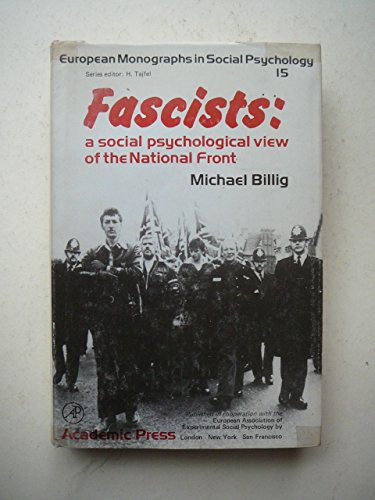
Fascists: a social psychological view of the National Front

Billig, Michael
The growth of the National Front into a political party has shown that fascism is alive and kicking in Britain, and no longer confined to a tiny lunatic fringe.This book examines in detail the official propaganda of the National Front and this, together with an analysis of its basic ideology and interviews with ordinary members, demonstrates a clear historical continuity with Nazism and the survival of the anti-Semitic belief in a world Jewish conspiracy.The idea of a Nazi revival here in Britain is of frightening importance and this book should be read by all those with an interest in the threat posed by contemporary fascism.
Academic Press in co-operation with European Association of Experimental Social Psychology 1978 393 pages

More examples, less theory: historical studies of writing psychology

Billig, Michael
In his new book, Michael Billig uses psychology's past to argue that nowadays, when we write about the mind, we should use more examples and less theory. He provides a series of historical studies, analysing how key psychological writers used examples. Billig offers new insights about famous analysts of the mind, such as Locke, James, Freud, Tajfel and Lewin. He also champions unfairly forgotten figures, like the Earl of Shaftesbury and the eccentric Abraham Tucker. There is a cautionary chapter on Lacan, warning what can happen when examples are ignored. Marie Jahoda is praised as the ultimate example: a psychologist from the twentieth century with a social and rhetorical imagination fit for the twenty-first. More Examples, Less Theory is an easy-to-read book that will inform and entertain academics and their students. It will particularly appeal to those who enjoy the details of examples rather than the simplifications of big theory
Cambridge University Press 2019-10-03 285 pages