2051 results for "Psychology"

The coddling of the American mind

Haidt, Jonathan,Lukianoff, Greg
"Something has been going wrong on many college campuses in the last few years. Speakers are shouted down. Students and professors say they are walking on eggshells and are afraid to speak honestly. Rates of anxiety, depression, and suicide are rising--on campus as well as nationally. How did this happen? First Amendment expert Greg Lukianoff and social psychologist Jonathan Haidt show how the new problems on campus have their origins in three terrible ideas that have become increasingly woven into American childhood and education: What doesn't kill you makes you weaker; Always trust your feelings; and Life is a battle between good people and evil people. These three Great Untruths contradict basic psychological principles about well-being and ancient wisdom from many cultures. Embracing these untruths -- and the resulting culture of safetyism -- interferes with young people's social, emotional, and intellectual development. It makes it harder for them to become autonomous adults who are able to navigate the bumpy road of life. Lukianoff and Haidt investigate the many social trends that have intersected to promote the spread of these untruths. They explore changes in childhood such as the rise of fearful parenting, the decline of unsupervised, child-directed play, and the new world of social media that has engulfed teenagers in the last decade. They examine changes on campus, including the corporatization of universities and the emergence of new ideas about identity and justice.
Allen Lane 2018 338 pages

Thinking, fast and slow

Kahneman, Daniel
"Daniel Kahneman, recipient of the Nobel Prize in Economic Sciences for his seminal work in psychology that challenged the rational model of judgment and decision making, is one of our most important thinkers. His ideas have had a profound and widely regarded impact on many fields - including economics, medicine, and politics - but until now, he has never brought together his many years of research and thinking in one book. ... [He] explains the two systems that drive the way we think. System 1 is fast, intuitive, and emotional; System 2 is slower, more deliberative, and more logical. Kahneman exposes the extraordinary capabilities - and also the faults and biases - of fast thinking, and reveals the pervasive influence of intuitive impressions on our thoughts and behavior. ... reveals where we can and cannot trust our intuitions and how we can tap into the benefits of slow thinking. He offers practical and enlightening insights into how choices are made in both our business and our personal lives - and how we can use different techniques to guard against the mental glitches that often get us into trouble"--From jacket.
Farrar, Straus and Giroux 2011 499 pages

The hard thing about hard things: building a business when there are no easy answers

Horowitz, Ben
In this book, Ben Horowitz, cofounder of Andreessen Horowitz, draws on his own story of founding, running, selling, buying, managing, and investing in technology companies to offer essential advice and practical wisdom for navigating the toughest problems business schools don't cover. His blog has garnered a devoted following of millions of readers who have come to rely on him to help them run their businesses. A lifelong rap fan, Horowitz amplifies business lessons with lyrics from his favorite songs and tells it straight about everything from firing friends to poaching competitors, from cultivating and sustaining a CEO mentality to knowing the right time to cash in. His advice is grounded in anecdotes from his own rise -- from cofounding the early cloud service provider Loudcloud to building the successful Andreessen Horowitz venture capital firm, both with fellow tech superstar Marc Andreessen (inventor of Mosaic, the Internet's first popular Web browser). This is no polished victory lap; he analyzes issues with no easy answers through his trials, including demoting (or firing) a loyal friend; whether you should incorporate titles and promotions, and how to handle them; if it's OK to hire people from your friend's company; how to manage your own psychology while the whole company is relying on you; what to do when smart people are bad employees; why Andreessen Horowitz prefers founder CEOs, and how to become one; and whether you should sell your company and how to do it.
Harper Business, an imprint of HarperCollins Publishers 2014-03-04 289 pages

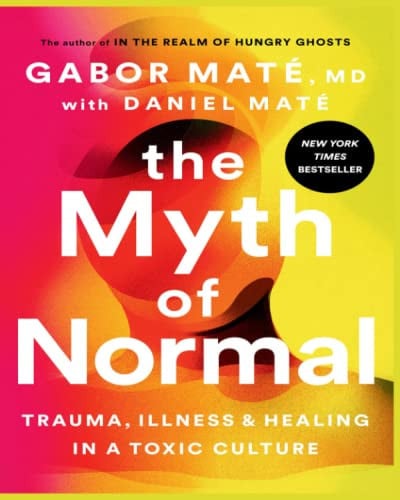
The Myth of Normal: Trauma, Illness, and Healing in a Toxic Culture Written by Gabor Maté with Daniel Maté

Gabor Maté
In this revolutionary book, renowned physician Gabor Mate eloquently dissects how in Western countries that pride themselves on their healthcare systems, chronic illness and general ill health are on the rise. Nearly 70 percent of Americans are on at least one prescription drug; more than half take two. In Canada, every fifth person has high blood pressure. In Europe, hypertension is diagnosed in more than 30 percent of the population. And everywhere, adolescent mental illness is on the rise. So what is really "normal" when it comes to health?
independently published 2022 515 pages

Games People Play

Eric Berne
Dr. Eric Berne, as the originator of transactional analysis, has attained recognition for developing one of the most innovative approaches to modern psychotherapy. Discover how many of these "secret games" you play everyday of your life: Iwfy (If it weren't for you); Sweetheart; Threadbare; Harried; Alcoholic, and many more. A groundbreaking book that bores deep into the heart of all our relationships, GAMES PEOPLE PLAY is a classic that should be read again and again.
Knopf Doubleday Publishing Group 1969-05 192 pages

Learned optimism: how to change your mind and your life

Seligman, Martin E. P.
Known as the father of the new science of positive psychology, Martin E.P. Seligman draws on more than twenty years of clinical research to demonstrate how optimism enhances the quality of life, and how anyone can learn to practice it. Offering many simple techniques, Dr. Seligman explains how to break an I-give-up habit, develop a more constructive explanatory style for interpreting your behavior, and experience the benefits of a more positive interior dialogue. These skills can help break up depression, boost your immune system, better develop your potential, and make you happier. With generous additional advice on how to encourage optimistic behavior at school, at work and in children, Learned Optimism is both profound and practical--and valuable for every phase of life. --Publisher.
Vintage Books 2006-01-03 319 pages

Enlightenment now: the case for reason, science, humanism, and progress

Pinker, Steven
Is the world really falling apart? Is the ideal of progress obsolete? Cognitive scientist Steven Pinker urges us to step back from the gory headlines and prophecies of doom, which play to our psychological biases. Instead, follow the data. In seventy-five graphs, Pinker shows that life, health, prosperity, safety, peace, knowledge, and happiness are on the rise, not just in the West, but worldwide. This progress is not the result of some cosmic force. It is a gift of the Enlightenment: the conviction that reason and science can enhance human flourishing. Far from being a naïve hope, the Enlightenment, we now know, has worked. But more than ever, it needs a vigorous defense. The Enlightenment project swims against currents of human nature -- tribalism, authoritarianism, demonization, magical thinking -- which demagogues are all too willing to exploit. Many commentators, committed to political, religious, or romantic ideologies, fight a rearguard action against it. The result is a corrosive fatalism and a willingness to wreck the precious institutions of liberal democracy and global cooperation. Pinker makes the case for reason, science, and humanism: the ideals we need to confront our problems and continue our progress.
Viking, an imprint of Penguin Random House LLC 2018-02-13 556 pages

Men explain things to me

Solnit, Rebecca
"In her comic, scathing essay "Men Explain Things to Me," Rebecca Solnit took on what often goes wrong in conversations between men and women. She wrote about men who wrongly assume they know things and wrongly assume women don't, about why this arises, and how this aspect of the gender wars works, airing some of her own hilariously awful encounters. She ends on a serious note-- because the ultimate problem is the silencing of women who have something to say, including those saying things like, "He's trying to kill me!" This book features that now-classic essay with six perfect complements, including an examination of the great feminist writer Virginia Woolf 's embrace of mystery, of not knowing, of doubt and ambiguity, a highly original inquiry into marriage equality, and a terrifying survey of the scope of contemporary violence against women"--
Haymarket Books 2014 130 pages

Managing oneself

Drucker, Peter F.
With ambition, drive, and talent, you can rise to the top of your chosen profession regardless of where you started out. But companies today aren't managing your career-- you must be your own chief executive officer. It's up to you to carve out your place in the world and know when to change course. In this short work Drucker gives you the keys to unlock your full potential so that you can achieve true and lasting excellence.
Harvard Business Press 2008 60 pages

A Theory of Human Motivation (Hardcover Library Edition)

Abraham H. Maslow
First published in 1943, 'A Theory of Human Motivation' is an article by Abraham H. Maslow, an American psychologist, in which he first introduced his hierarchy of needs, a theory of psychological health predicated on fulfilling inherent human needs in preference, pinnacling in self-actualization. Maslow thereafter expanded the idea to include his observations of humans' inherent curiosity. His theories parallel many other theories of human developmental psychology, some of which concentrate on describing the stages of growth in humans. Maslow explained various needs and used the terms Physiological, Safety, Belongingness, Love, Esteem, Self-Actualization, and Self-Transcendence to define the pattern that human motivations generally move through. Maslow studied what he called ideal people such as Albert Einstein, Jane Addams, Eleanor Roosevelt, and Frederick Douglass rather than mentally sick or unstable people. Top 10 Hardcover Library Books: A Wrinkle in Time (9789389440188) How to Stop Worrying and Start Living (9789387669161) Their Eyes Were Watching God (9789389440577) The Magic of Believing (9789388118217) Zen in the Art of Archery (9789354990298) A Cloud by Day, a Fire by Night (9789391181611) Siddhartha by Hermann hesse (9789387669116) The Richest Man in Babylon (9789354990717) The Book of Five Rings (9789389440553) The Knowledge of the Holy (9789389157239) Note: Search by ISBN
General Press 2021-06-10 82 pages

The madwoman in the attic: the woman writer and the nineteenth-century literary imagination

Gilbert, Sandra M.,Gubar, Susan
A pathbreaking book of literary criticism is now reissued with a new introduction by Lisa Appignanesi that speaks to how The Madwoman in the Attic set the groundwork for subsequent generations of scholars writing about women writers, and why the book still feels fresh some four decades later.
Yale University Press 2020-03-17 719 pages

Boys & Sex Young Men on Hookups, Love, Porn, Consent, and Navigating the New Masculinity

Peggy Orenstein
NEW YORK TIMES BESTSELLER Now in paperback--Peggy Orenstein, author of the groundbreaking New York Times bestseller Girls & Sex, turns her focus to the sexual lives of young men. "Eye-opening.... Every few pages, the boy world cracks open a little bit.... Even in the most anxiety-provoking moments of Boys & Sex, it's clear that Orenstein believes in the goodness of boys and the men they can become, and she believes in us, as parents, to raise them" (New York Times Book Review). Peggy Orenstein's Girls & Sex broke ground, shattered taboos, and launched conversations about young women's right to pleasure and agency in sexual encounters. It also had an unexpected effect on its author: Orenstein realized that talking about girls is only half the conversation. Boys are subject to the same cultural forces as girls--steeped in the same distorted media images and binary stereotypes of female sexiness and toxic masculinity--which equally affect how they navigate sexual and emotional relationships. In Boys & Sex, Peggy Orenstein dives back into the lives of young people to once again give voice to the unspoken, revealing how young men understand and negotiate the new rules of physical and emotional intimacy. Drawing on comprehensive interviews with young men, psychologists, academics, and experts in the field, Boys & Sex dissects so-called locker room talk; how the word "hilarious" robs boys of empathy; pornography as the new sex education; boys' understanding of hookup culture and consent; and their experience as both victims and perpetrators of sexual violence. By surfacing young men's experience in all its complexity, Orenstein is able to unravel the hidden truths, hard lessons, and important realities of young male sexuality in today's world. The result is a provocative and paradigm-shifting work that offers a much-needed vision of how boys can truly move forward as better men.
HarperCollins Publishers 2021-02-09 304 pages

The age of magical overthinking: notes on modern irrationality

Montell, Amanda
"'Magical thinking' can be broadly defined as the belief that one's internal thoughts can affect unrelated events in the external world: Think of the conviction that one can manifest their way out of poverty, stave off cancer with positive vibes, thwart the apocalypse by learning to can their own peaches, or transform an unhealthy relationship to a glorious one with loyalty alone. In all its forms, magical thinking works in service of restoring agency amid chaos, but in The Age of Magical Overthinking, Montell argues that in the modern information age, our brain's coping mechanisms have been overloaded, and our irrationality turned up to an eleven. Montell delves into a cornucopia of the cognitive biases that run rampant in our brains, from how the 'Halo effect' cultivates worship (and hatred) of larger than life celebrities, to how the 'Sunk cost fallacy' can keep us in detrimental relationships long after we've realized they're not serving us. As she illuminates these concepts with her signature brilliance and wit, Montell's prevailing message is one of hope, empathy, and ultimately forgiveness for our anxiety-addled human selves. If you have all but lost faith in our ability to reason, Montell aims to make some sense of the senseless. To crack open a window in our minds, and let a warm breeze in. To help quiet the cacophony for a while, or even hear a melody in it"--
One Signal Publishers/Atria 2024-04-09 257 pages

The mindful way through depression: freeing yourself from chronic unhappiness

Williams, J. Mark G,Teasdale, John D.,Segal, Zindel V.,Kabat-Zinn, Jon
"Description: The revolutionary book that has helped hundreds of thousands of readers find relief from chronic unhappiness is now in a revised and updated second edition. This authoritative, easy-touse self-help program is grounded in mindfulness-based cognitive therapy (MBCT), a clinically proven approach. The expert authors explain why our usual attempts to "fix" sadness or "talk ourselves out of it" can actually worsen recurrent depression instead of relieving it. Through vivid stories and downloadable audio meditations encouragingly narrated by Jon Kabat-Zinn, the book shows how to break the mental habits that lead to despair--and recover a sense of joy, aliveness, and possibility. Revised throughout to be even more reader friendly, the second edition features fresh insights on coping with the challenges of our ever-changing world; the latest scientific data; and four additional audio tracks. -- Keywords: mindfulness, meditations, audio tracks, body scan, downloads, files, mindfulness-based cognitive therapy, MBCT, self-help guide, psychology, mood disorders, personal development, exercises, practices, recovering from, preventing, sadness, despair, overcoming"--
The Guilford Press 2025 262 pages