144 results for "Astronomy"

Extraterrestrial The First Sign of Intelligent Life Beyond Earth

Avi Loeb
New York Times Bestseller | Wall Street Journal Bestseller | Publishers Weekly Bestseller | Publishers Marketplace 2020 Buzz Book | Amazon Best Book of the Year | Longlisted for the 2022 PEN/E.O. Wilson Literary Science Writing Award Harvard's top astronomer lays out his controversial theory that our solar system was recently visited by advanced alien technology from a distant star. "Provocative and thrilling ... Loeb asks us to think big and to expect the unexpected."--Alan Lightman, New York Times bestselling author of Einstein's Dreams and Searching for Stars on an Island in Maine In late 2017, scientists at a Hawaiian observatory glimpsed an object soaring through our inner solar system, moving so quickly that it could only have come from another star. Avi Loeb, Harvard's top astronomer, showed it was not an asteroid; it was moving too fast along a strange orbit, and left no trail of gas or debris in its wake. There was only one conceivable explanation: the object was a piece of advanced technology created by a distant alien civilization. In Extraterrestrial, Loeb takes readers inside the thrilling story of the first interstellar visitor to be spotted in our solar system. He outlines his controversial theory and its profound implications: for science, for religion, and for the future of our species and our planet. A mind-bending journey through the furthest reaches of science, space-time, and the human imagination, Extraterrestrial challenges readers to aim for the stars--and to think critically about what's out there, no matter how strange it seems.
HarperCollins Publishers 2022-02-22 240 pages

The Demon-haunted World Science as a Candle in the Dark

Carl Sagan
Are we on the brink of a new Dark Age of irrationality and superstition? In this book, the writer shows how scientific thinking is necessary to safeguard our democratic institutions and our technical civilization. This book is more personal and richer in moving and revealing human stories than anything the author has previously written. With illustrations from his own childhood experience as well as engrossing tales of discovery, he shows how the method of scientific thought can cut through prejudice and hysteria to uncover the often surprising truth. He convincingly debunks "alien abduction," "channelers," faith-healer fraud, the "face" on Mars, and much else. Along the way, he refutes the arguments that science destroys spirituality or is just another arbitrary belief system, asks why scientific study is often stigmatized, discusses the dangers of the misuse of science, and provides a "baloney detection kit" for thinking through political, social, religious, and other issues. -- Jacket
Ballantine Books 1997 457 pages

Interstellar The Search for Extraterrestrial Life and Our Future in the Stars

Avi Loeb
"The world's leading alien hunter" -- New York Times Magazine From acclaimed Harvard astrophysicist and bestselling author of Extraterrestrial comes a mind-expanding new book explaining why becoming an interstellar species is imperative for humanity's survival and detailing a game plan for how we can settle among the stars. In the New York Times bestseller Extraterrestrial, Avi Loeb, the longest serving Chair of Harvard's Astronomy Department, presented a theory that shook the scientific community: our solar system, Loeb claimed, had likely been visited by a piece of advanced alien technology from a distant star. This provocative and persuasive argument opened millions of minds internationally to the vast possibilities of our universe and the existence of intelligent life beyond Earth. But a crucial question remained: now that we are aware of the existence of extraterrestrial life, what do we do next? How do we prepare ourselves for interaction with interstellar extraterrestrial civilization? How can our species become interstellar? Now Loeb tackles these questions in a revelatory, powerful call to arms that reimagines the idea of contact with extraterrestrial civilizations. Dismantling our science-fiction fueled visions of a human and alien life encounter, Interstellar provides a realistic and practical blueprint for how such an interaction might actually occur, resetting our cultural understanding and expectation of what it means to identify an extraterrestrial object. From awe-inspiring searches for extraterrestrial technology, to the heated debate of the existence of Unidentified Aerial Phenomena, Loeb provides a thrilling, front-row view of the monumental progress in science and technology currently preparing us for contact. He also lays out the profound implications of becoming--or not becoming--interstellar; in an urgent, eloquent appeal for more proactive engagement with the world beyond ours, he powerfully contends why we must seek out other life forms, and in the process, choose who and what we are within the universe. Combining cutting edge science, physics, and philosophy, Interstellar revolutionizes the approach to our search for extraterrestrial life and our preparation for its discovery. In this eye-opening, necessary look at our future, Avi Loeb artfully and expertly raises some of the most important questions facing us as humans, and proves, once again, that scientific curiosity is the key to our survival.
HarperCollins Publishers 2024-08-20 256 pages

Black hole survival guide

Levin, Janna
"From the acclaimed author of Black Hole Blues and Other Songs from Outer Space--an authoritative, wholly accessible, fascinating guide to the most challenging phenomena of contemporary science, which is now the anchor of our understanding of the cosmos. Throughout her career, astrophysicist Janna Levin has focused, alongside her research, on making the science she studies not just accessible, but, perhaps more important, intriguing to the nonscientist. And that is what she has done again here, helping us to understand the black hole: perhaps the most opaque theoretical construct ever imagined by physicists. She explains how their existence came to be proven decades after they were first predicted in Einstein's 1915 general theory of relativity. And she explores the ways in which what we know about them has changed our most basic understanding of the galaxy, the universe, the whole expanse of reality that we inhabit. Lively, engaging and utterly unique, Black Hole Survival Guide is not just informative. It is as well, a wonderful read from first to last"--
Alfred A. Knopf 2020 143 pages

Black hole blues: and other songs from outer space

Levin, Janna
"In 1916, Einstein became the first to predict the existence of gravitational waves: sounds without a material medium generated by the unfathomably energy-producing collision of black holes. Now, Janna Levin, herself an astrophysicist, recounts the story of the search, over the last fifty years, for these elusive waves--a quest that has culminated in the creation of the most expensive project ever funded by the National Science Foundation ($1 billion-plus). She makes clear the how the waves are created in the cosmic collision of black holes, and why the waves can never be detected by telescope. And, most revealingly, she delves into the lives and fates of the four scientists currently engaged in--and obsessed with--discerning this soundtrack of the universe's history. Levin's account of the surprises, disappointments, achievements, and risks of this unfolding story provides us with a uniquely compelling and intimate portrait of the people and processes of modern science"--
Alfred A. Knopf 2016 241 pages

Comet

Carl Sagan,Ann Druyan
WHAT ARE THESE GRACEFUL VISITORS TO OUR SKIES? WE NOW KNOW THAT THEY BRING BOTH LIFE AND DEATH AND TEACH US ABOUT OUR ORIGINS. Comet begins with a breathtaking journey through space astride a comet. Pulitzer Prize-winning astronomer Carl Sagan, author of Cosmos and Contact, and writer Ann Druyan explore the origin, nature, and future of comets, and the exotic myths and portents attached to them. The authors show how comets have spurred some of the great discoveries in the history of science and raise intriguing questions about these brilliant visitors from the interstellar dark. Were the fates of the dinosaurs and the origins of humans tied to the wanderings of a comet? Are comets the building blocks from which worlds are formed? Lavishly illustrated with photographs and specially commissioned full-color paintings, Comet is an enthralling adventure, indispensable for anyone who has ever gazed up at the heavens and wondered why. "SIMPLY THE BEST." *The Times of London "FASCINATING, EVOCATIVE, INSPIRING." *The Washington Post "COMET HUMANIZES SCIENCE. A BEAUTIFUL, INTERESTING BOOK." *United Press International "MASTERFUL . . . SCIENCE, POETRY, AND IMAGINATION." *The Atlanta Journal & Constitution
Pocket Books 1986 396 pages

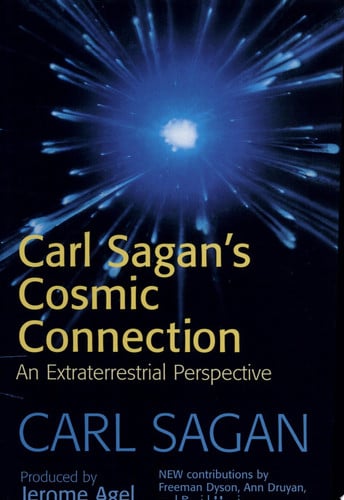
Carl Sagan's cosmic connection: an extraterrestrial perspective

Sagan, Carl
In 1973, Carl Sagan published The Cosmic Connection, a daring view of the universe, which rapidly became a classic work of popular science and inspired a generation of scientists and enthusiasts. This seminal work is reproduced here for a whole new generation to enjoy. In Sagan's typically lucid and lyrical style, he discusses many topics from astrophysics and solar system science, to colonization, terraforming and the search for extraterrestrials. Sagan conveys his own excitement and wonder, and relates the revelations of astronomy to the most profound human problems and concerns: issues that are just as valid today as they were thirty years ago. New to this edition are Freeman Dyson's comments on Sagan's vision and the importance of the work, Ann Druyan's assessment of Sagan's cultural significance as a champion of science, and David Morrison's discussion of the advances made since 1973 and what became of Sagan's predictions. Who knows what wonders this third millennium will reveal, but one thing is certain: Carl Sagan played a unique role in preparing us for them.
Cambridge University Press 2000-08-31 302 pages

Cosmos Possible Worlds

Druyan, Ann
This all-new and long-awaited sequel to Carl Sagan and Ann Druyan's international bestseller Cosmos takes readers to worlds only now emerging with the advent of new technologies. With lucid prose that recalls the best-selling and beloved Cosmos, Ann Druyan takes readers on an extraordinary journey through the vast and unexplored realms of Earth and space, past and future, fact and imagination. Written and published in coordination with the sensational international television debut of a second season of National Geographic's Cosmos, Cosmos: Possible Worlds travels through more than 14 billion years of cosmic evolution and into an astonishing future where probes travel by light beams to distant stars, helping us solve enduring mysteries of our origins and dream of an unimaginable time ahead. Along the way, we meet the colorful characters who push beyond the boundaries of knowledge—both the little-known but monumental visionaries of the past and the scientists whose work is shaping our future. Color photographs, art, and diagrams based on graphics created for the television series—plus a foreword by Neil deGrasse Tyson, best-selling author, wildly popular science commentator, and host of Cosmos on the National Geographic Channel—complete this highly anticipated package.
National Geographic 2020-02-25 384 pages

Earth: evolution of a habitable world

Lunine, Jonathan Irving
Fully updated throughout, including revised illustrations and new images from NASA missions, this new edition provides an overview of Earth's history from a planetary science perspective for Earth science undergraduates. Earth's evolution is described in the context of what we know about other planets and the cosmos at large, from the origin of the cosmos to the processes that shape planetary environments and from the origins of life to the inner workings of cells. Astronomy, earth science, planetary science and astrobiology are integrated to give students the whole picture of how the Earth has come to its present state and an understanding of the relationship between key ideas in different fields. The book presents concepts in nontechnical language and mathematical treatments are avoided where possible. New end-of-chapter summaries and questions allow students to check their understanding and critical thinking is emphasized to encourage students to explore ideas scientifically for themselves.
Cambridge University Press 2013-04-08 318 pages

Find the Constellations

Hans Augusto Rey
Containing star charts, a guide to the constellations, and details about seasons and the movement of the objects we see in the sky, this classic book makes H. A. Rey's passion for astronomy evident on every page. New updates concentrate on the planetary and solar system information in the latter part of the book. Facts and figures for each planet have been revised, and new scientific information has been added, such as Pluto's reclassification as a dwarf planet. There's also a new online resource that allows readers to track the positions of the planets in the night sky till the year 2100.
Houghton Mifflin Harcourt 2016 72 pages

The Case for Mars The Plan to Settle the Red Planet and Why We Must

Robert Zubrin
The Case for Mars makes living in space seem more possible than ever in this updated 25th anniversary edition, featuring the latest information on the planet's exploration and the drive to send humans there. Since the beginning of human history, Mars has been an alluring dream—the stuff of legends, gods, and mystery. The planet most like ours, it had long been thought impossible to reach, let alone explore and inhabit. But that is changing fast. In February 2021, the American rover Perseverance will touch down on Mars. Equipped with a powerful suite of scientific instruments—including some that will attempt to make oxygen from the Martian atmosphere—the rover also carries a helicopter that will take spectacular panoramic movies from the air. Most exciting of all, a spectrometer onboard may find evidence of fossils left behind by microbes millions of years ago, when the planet was warm and wet, proving at last that life on Earth is not unique, but a general phenomenon in the universe. Meanwhile, in Boca Chica, Texas, Elon Musk’s SpaceX has created a shipyard that is building and testing the vessels that will take humans to Mars before this decade is out. Leading space exploration expert Robert Zubrin crafted the daring blueprint for humanity’s reach to the Red Planet twenty-five years ago, when he first published The Case for Mars . Now, in this updated edition, he looks to the future once more to describe how—in an era when the American space program and private companies like SpaceX are racing to send astronauts to Mars—our first colonies there are imminent. In the grand tradition of successful explorers, Zubrin calls for a travel-light and live-off-the-land approach to Martian settlement. He explains how scientists can use present-day technology to send humans to Mars, produce fuel and oxygen on the planet’s surface with its own natural resources, build bases and communities, and one day, terraform—or alter the atmosphere of the planet in order to pave the way for sustainable life. As a landmark new mission opens the decisive campaign to take humans to the Red Planet, Zubrin lays out a comprehensive plan to build life on a new world.
Simon and Schuster 2021-02-02 448 pages

Extraterrestrial Civilizations

Isaac Asimov
Isaac Asimov concludes that we are not alone! Using the most up-to-date astronomical research as the backdrop for speculation, Asimov confronts the possibilities of other-worldly life head-on in Extraterrestrial Civilizations . In what will surely become one of the most provocative books ever written on the possibilities of life elsewhere in the universe, the incomparable Isaac Asimov provides chilling, hopeful, and exciting new insights. Here is astounding speculation about where the next giant step for mankind will take us. . . . Praise for Extraterrestrial Civilizations "[Isaac] Asimov holds our attention as he builds a meticulous case. We are not alone. It's just a matter of time until we know for sure." -- Miami Herald "Intriguing" -- Publishers Weekly
Fawcett Columbine 1980 282 pages