833 results for "Environment"

The Omnivore's Dilemma

Michael Pollan
"The New York Times" bestseller that s changing America s diet is now perfect for younger readers What s for dinner? seemed like a simple question until journalist and supermarket detective Michael Pollan delved behind the scenes. From fast food and big organic to small farms and old-fashioned hunting and gathering, this young readers adaptation of Pollan s famous food-chain exploration encourages kids to consider the personal and global health implications of their food choices. In a smart, compelling format with updated facts, plenty of photos, graphs, and visuals, as well as a new afterword and backmatter, "The Omnivore s Dilemma" serves up a bold message to the generation that needs it most: It s time to take charge of our national eating habits and it starts with you."
Perfection Learning 2009-10-15 298 pages

Collapse: how societies choose to fail or succeed

Diamond, Jared M.
A study of the downfall of some of history's greatest civilizations, written by the Pulitzer Prize-winning author of Guns, Germs, and Steel, includes coverage of such cultures as the Anasazi, the Maya, and the Viking colony on Greenland, tracing patterns of environmental damage, climate change, poor political choices, and other factors that were pivotal to their demise. 250,000 first printing.
Penguin Books 2006 575 pages

The blank slate

Pinker, Steven
'A passionate defence of the enduring power of human nature ... both life-affirming and deeply satisfying' Daily Telegraph Recently many people have assumed that we are blank slates shaped by our environment. But this denies the heart of our being: human nature. Violence is not just a product of society; male and female minds are different; the genes we give our children shape them more than our parenting practices. To acknowledge our innate abilities, Pinker shows, is not to condone inequality, but to understand the very foundations of humanity. 'Brilliant ... enjoyable, informative, clear, humane' New Scientist 'If you think the nature-nurture debate has been resolved, you are wrong ... this book is required reading' Literary Review 'An original and vital contribution to science and also a rattling good read' Matt Ridley, Sunday Telegraph 'Startling ... This is a breath of air for a topic that has been politicized for too long' Economist
Penguin Books 2003-06-05 509 pages

Behave: the biology of humans at our best and worst

Sapolsky, Robert M.
Why do we do the things we do? Over a decade in the making, this game-changing book is Robert Sapolsky's genre-shattering attempt to answer that question as fully as perhaps only he could, looking at it from every angle. Sapolsky's storytelling concept is delightful but it also has a powerful intrinsic logic: he starts by looking at the factors that bear on a person's reaction in the precise moment a behavior occurs, and then hops back in time from there, in stages, ultimately ending up at the deep history of our species and its evolutionary legacy. And so the first category of explanation is the neurobiological one. A behavior occurs--whether an example of humans at our best, worst, or somewhere in between. What went on in a person's brain a second before the behavior happened? Then Sapolsky pulls out to a slightly larger field of vision, a little earlier in time: What sight, sound, or smell caused the nervous system to produce that behavior? And then, what hormones acted hours to days earlier to change how responsive that individual is to the stimuli that triggered the nervous system? By now he has increased our field of vision so that we are thinking about neurobiology and the sensory world of our environment and endocrinology in trying to explain what happened. Sapolsky keeps going: How was that behavior influenced by structural changes in the nervous system over the preceding months, by that person's adolescence, childhood, fetal life, and then back to his or her genetic makeup? Finally, he expands the view to encompass factors larger than one individual. How did culture shape that individual's group, what ecological factors millennia old formed that culture? And on and on, back to evolutionary factors millions of years old. The result is one of the most dazzling tours d'horizon of the science of human behavior ever attempted, a majestic synthesisthat harvests cutting-edge research across a range of disciplines to provide a subtle and nuanced perspective on why we ultimately do the things we do...for good and for ill. Sapolsky builds on this understanding to wrestle with some of our deepest and thorniest questions relating to tribalism and xenophobia, hierarchy and competition, morality and free will, and war and peace. Wise, humane, often very funny, Behave is a towering achievement, powerfully humanizing, and downright heroic in its own right"
Bodley Head 2017 790 pages

In Defense of Food: An Eater's Manifesto

Pollan, Michael
In his hugely influential treatise The Omnivore's Dilemma, Pollan traced a direct line between the industrialization of our food supply and the degradation of the environment. His new book takes up where the previous work left off. Examining the question of what to eat from the perspective of health, this powerfully argued, thoroughly researched and elegant manifesto cuts straight to the chase with a maxim that is deceptively simple: 'Eat food, not too much, mostly plants.' But as Pollan explains, 'food' in a country that is driven by 'a thirty-two billion-dollar marketing machine' is both a loaded term and, in its purest sense, a holy grail. The first section of his three-part essay refutes the authority of the diet bullies, pointing up the confluence of interests among manufacturers of processed foods, marketers and nutritional scientists — a cabal whose nutritional advice has given rise to 'a notably unhealthy preoccupation with nutrition and diet and the idea of eating healthily.' The second portion vivisects the Western diet, questioning, among other sacred cows, the idea that dietary fat leads to chronic illness. A writer of great subtlety, Pollan doesn't preach to the choir; in fact, rarely does he preach at all, preferring to lets the facts speak for themselves." Publishers Weekly (Starred Review) (Copyright Reed Business Information, Inc.)
Penguin Books 2009-04-28 256 pages

Anthem

Ayn Rand
"My happiness is not the means to any end. It is the end. It is its own goal. It is its own purpose." ― Ayn Rand, Anthem Anthem has long been hailed as one of Ayn Rand's classic novels, and a clear predecessor to her later masterpieces, The Fountainhead and Atlas Shrugged. In Anthem, Rand examines a frightening future in which individuals have no name, no independence, and no values. Equality 7-2521 lives in the dark ages of the future where all decisions are made by committee, all people live in collectives, and all traces of individualism have been wiped out. Despite such a restrictive environment, the spark of individual thought and freedom still burns in him--a passion which he has been taught to call sinful. In a purely egalitarian world, Equality 7-2521 dares to stand apart from the herd--to think and choose for himself, to discover electricity, and to love the woman of his choice. Now he has been marked for death for committing the ultimate sin. In a world where the great "we" reign supreme, he has rediscovered the lost and holy word--"I." A True Classic that Belongs on Every Bookshelf!
Createspace Independent Publishing Platform 2014-11-28 56 pages

The sixth extinction: an unnatural history

Kolbert, Elizabeth
Over the last half billion years, there have been five major mass extinctions, when the diversity of life on Earth suddenly and dramatically contracted. Scientists are currently monitoring the sixth extinction, predicted to be the most devastating since the asteroid impact that wiped out the dinosaurs. This time around the cataclysm is us. In this book the author tells us why and how human beings have altered life on the planet in a way no species has before. She provides a moving account of the disappearances of various species occurring all around us and traces the evolution of extinction as concept, from its first articulation by Georges Cuvier in revolutionary Paris up to Lyell and Darwin, and through the present day. The sixth extinction is likely to be mankind's most lasting legacy, compelling us to rethink the fundamental question of what it means to be human. -- Publisher description.
Henry Holt 2014 319 pages

Hit Makers: the science of popularity in an age of distraction

Thompson, Derek
Nothing "goes viral.” If you think a popular movie, song, or app came out of nowhere to become a word-of-mouth success in today's crowded media environment, you're missing the real story. Each blockbuster has a secret history—of power, influence, dark broadcasters, and passionate cults that turn some new products into cultural phenomena. Even the most brilliant ideas wither in obscurity if they fail to connect with the right network, and the consumers that matter most aren't the early adopters, but rather their friends, followers, and imitators -- the audience of your audience. In his groundbreaking investigation, Atlantic senior editor Derek Thompson uncovers the hidden psychology of why we like what we like and reveals the economics of cultural markets that invisibly shape our lives. Shattering the sentimental myths of hit-making that dominate pop culture and business, Thompson shows quality is insufficient for success, nobody has "good taste," and some of the most popular products in history were one bad break away from utter failure. It may be a new world, but there are some enduring truths to what audiences and consumers want. People love a familiar surprise: a product that is bold, yet sneakily recognizable. Every business, every artist, every person looking to promote themselves and their work wants to know what makes some works so successful while others disappear. Hit Makers is a magical mystery tour through the last century of pop culture blockbusters and the most valuable currency of the twenty-first century—people's attention. From the dawn of impressionist art to the future of Facebook, from small Etsy designers to the origin of Star Wars, Derek Thompson leaves no pet rock unturned to tell the fascinating story of how culture happens and why things become popular.
Penguin Books 2018-02-06 344 pages

Stolen youth: how radicals are erasing innocence and indoctrinating a generation

Markowicz, Karol,Mandel, Bethany
The kids are not alright. The Left is waging an all-out battle on the American family, particularly the youngest members. If they can make our children miserable, lead them to question every building block of society, and rebuild their entire concept of reality, then the Left and their woke indoctrinators will consider that a victory. But we can't let them win. As concerned parents and American citizens, we have to understand what's truly going on before we can do something about it. Stolen Youth provides an urgent deep dive into issues surrounding the current woke indoctrination happening in politics, education, medicine, mental health, entertainment, and culture. These issues may seem subtle, insidious, and hard to make sense of, but armed with the information provided in this book, we now have a framework from which to fight. While we may simply be trying to parent our children well and create a healthy and happy home environment, this is no longer enough. We must now go on the offense to protect our kids, and this book sheds a bright light on the reason why. We can no longer afford to stay ignorant. Our children's lives and the survival of our families are at stake. "A win is a family who is free." Stolen Youth outlines how to fight for our children's freedom--and win.
DW Books 2023 295 pages

Trillion dollar coach: the leadershio handbook of Silicon Valley's Bill Campbell

Schmidt, Eric,Rosenberg, Jonathan,Eagle, Alan
Bill Campbell played an instrumental role in the growth of several prominent companies, such as Google, Apple, and Intuit, fostering deep relationships with Silicon Valley visionaries, including Steve Jobs, Larry Page, and Eric Schmidt. In addition, this business genius mentored dozens of other important leaders on both coasts, from entrepreneurs to venture capitalists to educators to football players, leaving behind a legacy of growing companies, successful people, respect, friendship, and love after his death in 2016.Leaders at Google for over a decade, Eric Schmidt, Jonathan Rosenberg, and Alan Eagle experienced firsthand how the man fondly known as Coach Bill built trusting relationships, fostered personal growth-even in those at the pinnacle of their careers-inspired courage, and identified and resolved simmering tensions that inevitably arise in fast-moving environments. To honor their mentor and inspire and teach future generations, they have codified his wisdom in this essential guide.Based on interviews with over eighty people who knew and loved Bill Campbell, TRILLION DOLLAR COACH explains the Coach's principles and illustrates them with stories from the many great people and companies with which he worked. The result is a blueprint for forward-thinking business leaders and managers that will help them create higher performing and faster moving cultures, teams, and companies.
John Murray 2019-04-16 218 pages

Eight Weeks to Optimum Health A Proven Program for Taking Full Advantage of Your Body's Natural Healing Power

Andrew Weil
The Eight-Week Program sets up a foundation for healthy living that is preventative in the broadest sense. Not only does Dr. Weil provide information with which you can keep your body's inherent healing system in peak working order as you encounter the challenges of day-to-day life; he also shows you how to construct a lifestyle that will protect you from premature illness and disability, and teaches practices and skills that will enable you to prepare for any eventual health crisis you may face. With clearly explained and authoritatively informed recommendations, Dr. Weil guides you in fine-tuning your current eating habits - to eat less fat and animal protein, more whole grains and other complex carbohydrates, and more fruits and vegetables - so that your diet becomes more nutritious and increasingly beneficial to general health (he also includes simple, flavorful recipes to help you make the dietary changes quickly and easily). He shows how walking and stretching will satisfy all your exercise requirements throughout your life, and provides a gradual plan by which you can make brisk forty-five-minute walks and some simple stretches part of your weekly regimen. Dr. Weil recommends the addition of four antioxidant supplements - vitamins C and E, selenium, and mixed carotenes - to further protect your healing system. He provides instruction in five basic breathing exercises that can impart both greater relaxation and energy. He discusses the benefits and techniques of visualization. He explains ways to overcome sleeping problems; to test and filter your water supply; to eliminate toxins from your diet; and to avoid environmental hazards such as the sun's ultraviolet rays. He suggestsways to make art, music, and the natural world more important parts of your life. For those who wish to experiment further, he outlines several projects and activities such as cleansing fasts. There are a dozen additional programs that concentrate on the specific needs of pregnant
Ballantine 1998 288 pages

Under a white sky: The nature of the future

Kolbert, Elizabeth
'Important, necessary, urgent and phenomenally interesting' HELEN MACDONALD, New York Times ONE OF THE SUNDAY TIMES 'BOOKS OF 2021' The author of the international bestseller The Sixth Extinction returns to humanity's transformative impact on the environment, now asking- after doing so much damage, can we change nature, this time to save it? Elizabeth Kolbert has become one of the most important writers on the environment. Now she investigates the immense challenges humanity faces as we scramble to reverse, in a matter of decades, the effects we've had on the atmosphere, the oceans, the world's forests and rivers - on the very topography of the globe. In Under a White Sky , she takes a hard look at the new world we are creating. Along the way, she meets biologists who are trying to preserve the world's rarest fish, which lives in a single tiny pool in the middle of the Mojave desert; engineers who are turning carbon emissions to stone in Iceland; Australian researchers who are trying to develop a 'super coral' that can survive on a hotter globe; and physicists who are contemplating shooting tiny diamonds into the stratosphere to cool the earth, changing the sky from blue to white. One way to look at human civilisation, says Kolbert, is as a ten-thousand-year exercise in defying nature. In The Sixth Extinction , she explored the ways in which our capacity for destruction has reshaped the natural world. Now she examines how the very sorts of interventions that have imperilled our planet are increasingly seen as the only hope for its salvation. By turns inspiring, terrifying and darkly comic, Under a White Sky is an utterly original examination of the challenges we face.
The Bodley Head an imprint of Vintage 2021-03 234 pages

Our revolution: a future to believe in

Sanders, Bernie
"When Bernie Sanders began his race for the presidency, it was considered by the political establishment and the media to be a "fringe" campaign, something not to be taken seriously. After all, he was just an independent senator from a small state with little name recognition. His campaign had no money, no political organization, and it was taking on the entire Democratic Party establishment. By the time Sanders's campaign came to a close, however, it was clear that the pundits had gotten it wrong. Bernie had run one of the most consequential campaigns in the modern history of the country. He had received more than 13 million votes in primaries and caucuses throughout the country, won twenty-two states, and more than 1.4 million people had attended his public meetings. Most important, he showed that the American people were prepared to take on the greed and irresponsibility of corporate America and the 1 percent. In Our Revolution, Sanders shares his personal experiences from the campaign trail, recounting the details of his historic primary fight and the people who made it possible. And for the millions looking to continue the political revolution, he outlines a progressive economic, environmental, racial, and social justice agenda that will create jobs, raise wages, protect the environment, and provide health care for all--and ultimately transform our country and our world for the better. For him, the political revolution has just started. The campaign may be over, but the struggle goes on"--Provided by publisher.
Thomas Dunne Books 2017-08-29 450 pages

Animal liberation

Singer, Peter
Since its original publication in 1975, this groundbreaking work has awakened millions of concerned men and women to the shocking abuse of animals everywhere -- inspiring a worldwide movement to eliminate much of the cruel and unnecessary laboratory animal experimentation of years past.In this newly revised and expanded edition, author Peter Singer exposes the chilling realities of today's "factory forms" and product-testing procedures -- offering sound, humane solutions to what has become a profound environmental and social as well as moral issue. An important and persuasive appeal to conscience, fairness, decency and justice, Animal Liberation is essential reading for the supporter and the skeptic alike.
Ecco 2002 324 pages

This changes everything: capitalism vs. the climate

Klein, Naomi
Naomi Klein, author of the number 1 international bestsellers, The Shock Doctrine and No Logo, returns with This Changes Everything, a must-read on how the climate crisis needs to spur transformational political change. Forget everything you think you know about global warming. It's not about carbon - it's about capitalism. The good news is that we can seize this existential crisis to transform our failed economic system and build something radically better. In her most provocative book yet, Naomi Klein, author of the global bestsellers The Shock Doctrine and No Logo, tackles the most profound threat humanity has ever faced: the war our economic model is waging against life on earth. Klein exposes the myths that are clouding the climate debate. You have been told the market will save us, when in fact the addiction to profit and growth is digging us in deeper every day. You have been told it's impossible to get off fossil fuels when in fact we know exactly how to do it - it just requires breaking every rule in the "free-market" playbook: reining in corporate power, rebuilding local economies and reclaiming our democracies. You have also been told that humanity is too greedy and selfish to rise to this challenge. In fact, all around the world, the fight back for the next economy is already succeeding in ways both surprising and inspiring. Climate change, Klein argues, is a civilizational wake-up call, a powerful message delivered in the language of fires, floods, storms, and droughts. Confronting it is no longer about changing the light bulbs. It's about changing the world - before the world changes so drastically that no one is safe. Either we leap - or we sink. Once a decade, Naomi Klein writes a book that redefines its era. No Logo did so for globalization. The Shock Doctrine changed the way we think about austerity. This Changes Everything is about to upend the debate about the stormy era already upon us.
Penguin Books 2015-08-04 566 pages

Network propaganda: manipulation, disinformation, and radicalization in American politics

Benkler, Yochai,Faris, Rob,Roberts, Hal
Is social media destroying democracy? Are Russian propaganda or "Fake news" entrepreneurs on Facebook undermining our sense of a shared reality? A conventional wisdom has emerged since the election of Donald Trump in 2016 that new technologies and their manipulation by foreign actors played a decisive role in his victory and are responsible for the sense of a "post-truth" moment in which disinformation and propaganda thrives. Network Propaganda challenges that received wisdom through the most comprehensive study yet published on media coverage of American presidential politics from the start of the election cycle in April 2015 to the one year anniversary of the Trump presidency. Analyzing millions of news stories together with Twitter and Facebook shares, broadcast television and YouTube, the book provides a comprehensive overview of the architecture of contemporary American political communications. Through data analysis and detailed qualitative case studies of coverage of immigration, Clinton scandals, and the Trump Russia investigation, the book finds that the right-wing media ecosystem operates fundamentally differently than the rest of the media environment. The authors argue that longstanding institutional, political, and cultural patterns in American politics interacted with technological change since the 1970s to create a propaganda feedback loop in American conservative media. This dynamic has marginalized centre-right media and politicians, radicalized the right wing ecosystem, and rendered it susceptible to propaganda efforts, foreign and domestic. For readers outside the United States, the book offers a new perspective and methods for diagnosing the sources of, and potential solutions for, the perceived global crisis of democratic politics
Oxford University Press 2018 462 pages

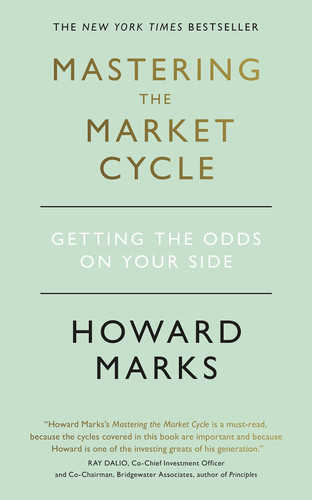
Mastering the market cycle: getting the odds on your side

Marks, Howard
A NEW YORK TIMES , WALL STREET JOURNAL , AND USA TODAY BESTSELLER The legendary investor shows how to identify and master the cycles that govern the financial markets. "A MUST-READ" Ray Dalio, bestselling author of Principles and Co-Chief Investment Officer and Co-Chairman, Bridgewater Associates "WHEN I SEE MEMOS FROM HOWARD MARKS IN MY MAIL, THEY'RE THE FIRST THING I OPEN AND READ" Warren Buffett " HOWARD IS A LEGENDARY INVESTOR" Tony Robbins We all know markets rise and fall, but when should you pull out, and when should you stay in? The answer is never black or white, but is best reached through a keen understanding of the reasons behind the rhythm of cycles. Confidence about where we are in a cycle comes when you learn the patterns of ups and downs that influence not just economics, markets, and companies, but also human psychology and the investing behaviors that result. If you study past cycles, understand their origins and remain alert for the next one, you will become keenly attuned to the investment environment as it changes. You'll be aware and prepared while others get blindsided by unexpected events or fall victim to emotions like fear and greed. By following Marks's insights - drawn in part from his iconic memos over the years to Oaktree's clients - you can master these recurring patterns to have the opportunity to improve your investing results. SEE WHAT REVIEWERS ARE SAYING ABOUT MASTERING THE MARKET CYCLE : ⭐⭐⭐⭐⭐ "This book lays the timeless fundamentals for investment success" ⭐⭐⭐⭐⭐ "A must-read" ⭐⭐⭐⭐⭐ " Excellent book on cycles and psychology"
Nicholas Brealey Publishing 2020-01-23 323 pages

Field notes from a catastrophe

Kolbert, Elizabeth
In writing that is both clear and unbiased, Kolbert - an acclaimed New Yorker journalist - approaches global warming from every angle. She travels to the Arctic, the North of England, Holland and Puerto Rico, interviews researchers and environmentalists, explains the science and the studies, draws frightening parallels to lost ancient civilizations, unpacks the politics, and presents the personal tales of those who are being affected most- the people who make their homes near the poles and, in an eerie foreshadowing, are watching their worlds disappear. Scientists have been warning the world since the late 1970s that the build-up of carbon dioxide in our atmosphere threatens to melt the polar ice sheets and irreversibly change our climate. With little done since then to alter this dangerous course, now is the moment for all the countries in the world, but perhaps especially the USA, to face up to the realities of global warming and to secure our future. By the end of the century, the world will probably be hotter than it's been in the last two million years, and the sweeping consequences of this change will determine the future of life on earth for generations to come. Field Notes from a Catastrophe brings the environment into the consciousness of the reader and asks what, if anything, can be done, and how we can change our planet.
Bloomsbury 2006 210 pages