11 results for "History"

The Western canon: the books and school of the ages

Bloom, Harold
Includes criticism and interpretation of William Shakespeare, Dante, Cervantes, Montaigne, Moliere, John Milton, Samuel Johnson, Goethe, William Wordsworth, Jane Austen and Persuasion, Walt Whitman, Emily Dickinson, Charles Dickens and Bleak House, George Eliot and Middlemarch, Tolstoy, Ibsen, Freud, Proust, James Joyce and Ulysses, Virginia Woolf and Orlando, Franz Kafka, Jorge Luis Borges, Pablo Neruda, and Fernando Pessoa.
Mariner Books 2025-09-02 592 pages

Take arms against a sea of troubles: the power of the reader's mind over a universe of death

Bloom, Harold
"The great poems, plays, novels, stories teach us how to go on living. . . . Your own mistakes, accidents, failures at otherness beat you down. Rise up at dawn and read something that matters as soon as you can." So Harold Bloom, the most famous literary critic of his generation, exhorts readers of his last book: one that praises the sustaining power of poetry. "Passionate. . . . Perhaps Bloom's most personal work, this is a fitting last testament to one of America's leading twentieth-century literary minds." -- Publishers Weekly "An extraordinary testimony to a long life spent in the company of poetry and an affecting last declaration of [Bloom's] passionate and deeply unfashionable faith in the capacity of the imagination to make the world feel habitable"--Seamus Perry, Literary Review "Reading, this stirring collection testifies, 'helps in staying alive.'"-- Kirkus Reviews , starred review This dazzling celebration of the power of poetry to sublimate death--completed weeks before Harold Bloom died--shows how literature renews life amid what Milton called "a universe of death." Bloom reads as a way of taking arms against the sea of life's troubles, taking readers on a grand tour of the poetic voices that have haunted him through a lifetime of reading. "High literature," he writes, "is a saving lie against time, loss of individuality, premature death." In passages of breathtaking intimacy, we see him awake late at night, reciting lines from Dante, Shakespeare, Milton, Montaigne, Blake, Wordsworth, Hart Crane, Jay Wright, and many others. He feels himself "edged by nothingness," uncomprehending, but still sustained by reading. Generous and clear‑eyed, this is among Harold Bloom's most ambitious and most moving books.
Yale University Press 2021-10-12 672 pages

Agon: towards a theory of revisionism

Bloom, Harold
"In the culmination of a series that began with "The Anxiety of Influence" and "A Map of Misreading," Harold Bloom expands upon his controversial theory of revisionism, which he views as a contest of opposing artistic and moral drives. From this theoretical perspective, Bloom re-examines Freud, religious sources of literature, literary modes such as fantasy, and the sequence of American writers that includes Emerson, Whitman, Wallace Stevens, Hart Crane, and John Ashbery. A 1982 National Book Critics Circle nominee."--Back cover
Oxford University Press 1982 336 pages

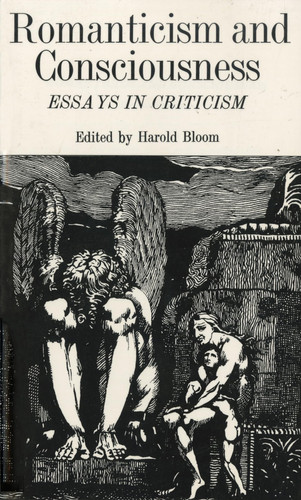
Romanticism and consciousness: essays in criticism

Bloom, Harold
'Romanticism and Consciousness' is a comprehensive collection of essays on Romanticism-its intellectual and political backgrounds, its place in literary history, its continued relevance to the present age, its relation to psychoanalysis and other modern trends of thought-and on the major English Romantic poets. The topics covered include the relations between nature and consciousness, nature and revolution, and nature and literary form; the principal poets studied are Blake, Wordsworth, Coleridge, Byron, Shelley, and Keats.
Norton 1970 405 pages

Poetry and repression: revisionism from Blake to Stevens

Bloom, Harold
This reinterpretation of the full sweep of English and American romantic poetry offers close readings of poems of Blake, Wordsworth, Shelley, Keats, Tennyson, Browning, Whitman, Yeats, and Stevens. It also reviews the crucial ideas of Emerson, Nietzsche, and in particular Freud, whose psychoanalytic theory of repression and defense Bloom undertakes to revise for purposes of literary criticism. "Bloom offers a fully defined alternative to the principal modes of contemporary criticism, from Freudian literary criticism (which he insists is neither Freudian nor literary criticism) to the New Criticism and structuralist and archetypal approaches. It is an original, vigorous, and passionate study which is both compelling and provocative."-The British Studies Monitor "Show me but one paragraph of Bloom's approaches to texts, and I'm hooked. . . . I find sheer delight in his ingenious ways."-Kenneth Burke "Bloom has made a remarkable contribution to poetic theory."-Phoebe Pettingell, The New Leader
Yale University Press 1976 293 pages