
4 results for "Psychology"

Just babies: the origins of good and evil

Bloom, Paul
"A leading cognitive scientist argues that a deep sense of good and evil is bred in the bone. From Sigmund Freud to Lawrence Kohlberg, psychologists have long believed that we begin life as amoral animals. After all, isn't it the parents' role to turn babies into civilized beings who can experience empathy and shame, and override selfish impulses? In Just Babies, Paul Bloom argues that humans are in fact hardwired with a sense of morality. Drawing upon years of original research at his Yale lab, he shows that babies and toddlers can judge the goodness and badness of others' actions; that they act to soothe those in distress; and that they feel guilt, shame, pride, and righteous anger. Yet this innate morality is tragically limited. Our natural strong moral feelings toward those in our own group--same family, same race--are offset by ingrained dislike, even hatred, of those in different groups. Put more simply, we are natural-born bigots. Vivid and intellectually probing, Just Babies argues that through intelligence and creativity we can transcend the primitive sense of morality we are born with. This erudite yet accessible book will captivate readers of Steven Pinker, Philip Zimbardo, and Robert Wright"--
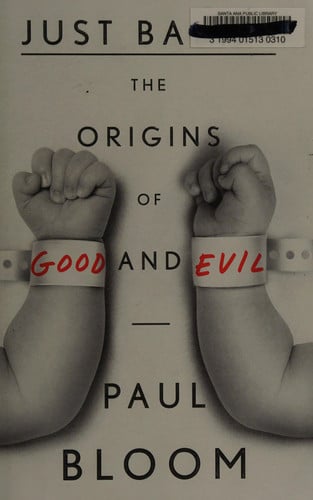
Crown Publishers 2013 273 pages

Psych: the story of the human mind

Bloom, Paul
How does the brain-a three-pound wrinkly mass-give rise to intelligence and conscious experience? Was Freud right that we are all plagued by forbidden sexual desires? What is the function of emotions such as disgust, gratitude, and shame? Renowned psychologist Paul Bloom answers these questions and many more in Psych, his riveting new book about the science of the mind. Psych is an expert and passionate guide to the most intimate aspects of our nature, serving up the equivalent of a serious university course while being funny, engaging, and full of memorable anecdotes. But Psych is much more than a comprehensive overview of the field of psychology. Bloom argues that a number of widely accepted theories in the field are probably wrong, and he reveals what psychology can tell us about the most pressing moral and political issues of our time-including belief in conspiracy theories, the role of genes in explaining human differences, and the discussion around implicit racial bias. Bloom also shows how psychology can give us practical insights into important issues-from the treatment of mental illnesses such as depression and anxiety to the best way to lead happy and fulfilling lives. Psych is a riveting guide to the most important topic there is: it is the story of us.
Ecco, an imprint of HarperCollins Publishers 2023 454 pages

Descartes' baby: how the science of child development explains what makes us human

Bloom, Paul
"If you really want to understand human nature, you must observe people as they are before they are corrupted by language and culture, by MTV and Hebrew school. You must look at babies." So contends psychologist Paul Bloom-whom Steven Pinker calls "the wunderkind of cognitive science"-in this fascinating account of how we learn to make sense of reality. All humans see the world in two fundamentally different ways: Even babies have a rich understanding of both the physical and social worlds. They expect objects to obey principles of physics, and they're startled when things disappear or defy gravity. Yet they can also read emotions and respond with anger, sympathy, and joy.In Descartes' Baby, Bloom draws on a wealth of scientific discoveries to show how these two ways of knowing give rise to such uniquely human traits as humor, disgust, religion, art, and morality. The myriad ways that our dualist perspectives, born in infancy, undergo development throughout our lives and profoundly influence our thoughts, feelings, and actions is the subject of this richly rewarding book.
Basic Books 2004-04-13 271 pages

How children learn the meanings of words

Bloom, Paul
How do children learn that the word "dog" refers not to all four-legged animals, and not just to Ralph, but to all members of a particular species? How do they learn the meanings of verbs like "think," adjectives like "good," and words for abstract entities such as "mortgage" and "story"? The acquisition of word meaning is one of the fundamental issues in the study of mind. According to Paul Bloom, children learn words through sophisticated cognitive abilities that exist for other purposes. These include the ability to infer others' intentions, the ability to acquire concepts, an appreciation of syntactic structure, and certain general learning and memory abilities. Although other researchers have associated word learning with some of these capacities, Bloom is the first to show how a complete explanation requires all of them. The acquisition of even simple nouns requires rich conceptual, social, and linguistic capacities interacting in complex ways. This book requires no background in psychology or linguistics and is written in a clear, engaging style. Topics include the effects of language on spatial reasoning, the origin of essentialist beliefs, and the young child's understanding of representational art. The book should appeal to general readers interested in language and cognition as well as to researchers in the field.
MIT 2002-01-25 315 pages