
2 results for "Science"

Step by Step Evolution and Operation of the Cornell Students' Civil-Rights Project in Tennessee, Summer, 1964

Douglas Dowd
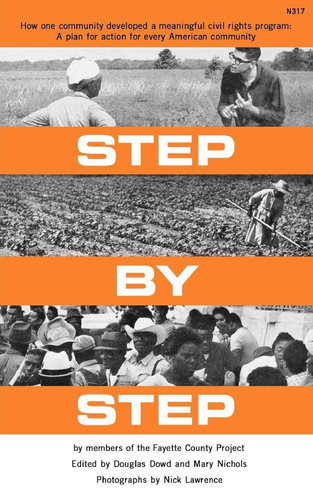
The book arose out of the authors' experiences in a project which was itself unique: The Cornell-Tompkins Committee for Free and Fair Elections in Fayette County, Tennessee. The project entailed six to eight weeks of living in Fayette County by forty-five volunteers, mostly students from Cornell University, in the summer of 1964. The project was financed entirely, to an amount exceeding fifteen thousand dollars, by the contributions of students, faculty, and townspeople in and around Cornell University, and by contributions from more distant places solicited by those involved at Cornell.Of the many things learned from the Cornell project, one of the most important was how responsive a community can become when confronted with a concrete civil rights program, one with which it can identify, one small enough to be feasible and intelligible, but still compelling in terms of the needs involved.The authors believe that many thousands of Americans can find no good answer to the questions "What can I do." not because they are unwilling to do much, nor because there is little to be done, but because they lack the knowledge of what is needed where, and how and with whom one can go about responding to such needs. The book therefore undertakes, step by step, to describe and explain the development of the project at Cornell and its workings during the summer in Tennessee, and reasons that similar steps can be taken by others, with appropriate variations. It concludes with a detailed appendix listing civil rights projects and organizations desperately in need of help, whether in terms of money or volunteers or both.
W. W. Norton, Incorporated 1965-04 132 pages

Thorstein Veblen

Douglas dowd
Thorstein Veblen shook the complacency of America in the early twentieth century with his incisive criticisms of our social and economic systems. Discarding the classical view of "eternal" economic laws that conveniently justified the nineteenth-century predatory practices of "big business" in terms of rational self-interest, Veblen cast a fresh, merciless eye on America's money-making passion. In glittering prose, Veblen exposed our social system as one designed to block man's natural "instinct of workmanship." He demonstrated that our leisure-class culture fostered the myth that work was inherently irksome to man. Veblen was also fascinated by the machine and the new science of technology. He saw businessmen basically at war with engineers and scientists because making exorbitant profits did not necessarily jibe with making better goods.In his study of this intriguing personality, Thorstein Veblen, Douglas Dowd reveals that Veblen was unsuccessful in his university career and his two marriages, and in his private life was strange, bitter, and detached. But in his books, Veblen shone as one of America's most penetrating thinkers whose theories proved a potent force in the modernization of economics as a science. Dowd's sympathetic approach to Veblen's nature and problems places this giant in the field against a contemporary background in powerful and lively fashion. In his new introduction, Michael Keaney breathes new life into this unjustly neglected primer on Veblen. A new generation of students will undoubtedly benefit from this comprehensive guide to the thought of someone whose intellectual endeavor was non-doctrinaire and constantly -changing.
Simon & Schuster 1901-01-01