6 results for "Physics"

"Surely you're joking, Mr. Feynman!”: adventures of a curious character

Feynman, Richard P.
Winner of the Nobel Prize for Physics in 1965, Richard Feynman was one of the world's greatest theoretical physicists, but he was also a man who fell, often jumped, into adventure. An artist, safecracker, practical joker and storyteller, Feynman's life was a series of combustible combinations made possible by his unique mixture of high intelligence, unquenchable curiosity and eternal skepticism. Over a period of years, Feynman's conversations with his friend Ralph Leighton were first taped and then set down as they appear here, little changed from their spoken form, giving a wise, funny, passionate and totally honest self-portrait of one of the greatest men of our age.
Norton 1985 350 pages

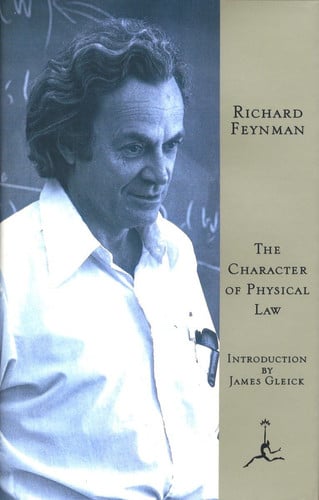
The character of physical law

Feynman, Richard P.
Like any set of oral reflections, The Character of Physical Law has special value as a demonstration of the mind in action. The reader is particularly lucky in Richard Feynman - one of the most eminent and imaginative modern physicists. In these Messenger Lectures, originally delivered at Cornell University and recorded for television by the BBC, Richard Feynman offers an overview of selected physical laws and gathers their common features into one broad principle of invariance. He maintains at the outset that the importance of a physical law is not ''how clever we are to have found it out - but . . . how clever nature is to pay attention to it'' and steers his discussions toward a final exposition of the elegance and simplicity of all scientific laws. Rather than an essay on the most significant achievements in modern science, The Character of Physical Law is a statement of what is most remarkable in nature. Feynman's enlightened approach, his wit, and his enthusiasm make this a memorable exposition of the scientist's craft. The law of gravitation is the author's principal example. Relating the details of its discovery and stressing its mathematical character, he uses it to demonstrate the essential interaction of mathematics and physics. He views mathematics as the key to any system of scientific laws, suggesting that if it were possible to fill out the structure of scientific theory completely, the result would be an integrated set of mathematical axioms. The principles of conservation, symmetry, and time irreversibility are then considered in relation to developments in classical and modern physics, and in his final lecture, Feynman develops his own analysis of the process and future of scientific discovery.
Modern Library 1994-11-08 167 pages

Feynman lectures on computation

Feynman, Richard P.
From 1983 to 1986, the legendary physicist and teacher Richard Feynman gave a course at Caltech called “Potentialities and Limitations of Computing Machines.”Although the lectures are over ten years old, most of the material is timeless and presents a “Feynmanesque” overview of many standard and some not-so-standard topics in computer science. These include computability, Turing machines (or as Feynman said, “Mr. Turing's machines”), information theory, Shannon's Theorem, reversible computation, the thermodynamics of computation, the quantum limits to computation, and the physics of VLSI devices. Taken together, these lectures represent a unique exploration of the fundamental limitations of digital computers.Feynman's philosophy of learning and discovery comes through strongly in these lectures. He constantly points out the benefits of playing around with concepts and working out solutions to problems on your own-before looking at the back of the book for the answers. As Feynman says in the lectures: “If you keep proving stuff that others have done, getting confidence, increasing complexities of your solutions-for the fun of it-then one day you'll turn around and discovers that nobody actually did that one! And that's the way to become a computer scientist.”
Addison-Wesley 1996-09-08 303 pages

"What do you care what other people think?”

Feynman, Richard P.
"Here is the story of how two people most influenced Feynman's early years-his father, who taught him to think, and his first wife Arlene who taught him to love, even as she lay dying in an Albuquerque hospital while Feynman worked nearby, on the atomic bomb at Los Alamos. And here are lighter moments, some told through letters, as Feynman reports from Geneva, Trinidad, Greece, and Japan on the effects this curious character has had on the locals. The second half of the book...is Feynman's behind-the-scenes account of the investigation that followed the space shuttle Challenger's explosion in January 1986"--Jacket.
Norton 1988 255 pages