4 results for "Environment"

The sixth extinction: journey among the lost and left behind

Glavin, Terry
The Sixth Extinction is a haunting account of the age in which we live. Ecologists are calling it the Sixth Great Extinction, and the world isn't losing just its ecological legacy; also vanishing is a vast human legacy of languages and our ways of living, seeing, and knowing. Terry Glavin confirms that we are in the midst of a nearly unprecedented, catastrophic vanishing of animals, plants, and human cultures. He argues that the language of environmentalism is inadequate in describing the unraveling of the vast system in which all these extinctions are actually related. And he writes that we're no longer gaining knowledge with every generation. We're losing it. In the face of what he describes as a dark and gathering sameness upon the Earth, Glavin embarks on a global journey to meet the very things we're losing (a distinct species every ten minutes, a unique vegetable variety every six hours, an entire language every two weeks) and on the way encounters some of the world's wonderful, rare things: a human-sized salmon in Russia; a mysterious Sino-Tibetan song-language; a Malayan tiger, the last of its kind; and a strange tomato that tastes just like black cherry ice cream. And he finds hope in the most unlikely places---a macaw roost in Costa Rica; a small village in Ireland; a relic community of Norse whalers in the North Atlantic; the vault beneath the Royal Botanical Garden at Kew; and the throne room of the Angh of Longwa in the eastern Himalayas. A fresh narrative take on the usual doom and gloom environmentalism, The Sixth Extinction draws upon zoology, biology, ecology, anthropology, and mythology to share the joys hidden within the long human struggle to conserve the world's living things. Here, we find hope in what's left: the absolute and stunning beauty in the Earth's last cultures and creatures.
Thomas Dunne Books/St. Martin's Press 2007-04-03 318 pages

Waiting for the macaws: and other stories from the age of extinctions

Glavin, Terry
“ Waiting for the Macaws is a haunting reminder of the scale and breadth of what can only be described as a catastrophe of the human spirit and imagination.”—Wade Davis, author of Light at the Edge of the World and Explorer-in-Residence, National Geographic Society Waiting for the Macaws is a haunting and beautifully written account of the age in which we live. Journeying around the world, Terry Glavin argues that all extinctions are related and that the language of environmentalism is inadequate to describing this great unravelling. But Glavin discovers that there is hope, finding it in the most unlikely places—a macaw roost in Costa Rica, a Small village in Ireland, a community of Norse whalers on the Lofoten Islands in the North Atlantic, the vault beneath the Royal botanical Garden at Kew, and the throne room of the Angh of Longwa in the Patkai Range of the eastern Himalayas.
Penguin Canada 2007-01-30 318 pages

Dead reckoning: confronting the crisis in Pacific fisheries

Glavin, Terry
Abundant fish along North America's West Coast Coast have nurtured rich and diverse cultures for centuries. But today millions of sockeye salmon routinely seem to disappear from the Fraser River, chinook salmon populations are collapsing, the abalone fishery is one of several that has been shut down and oolichan populations are in dramatic decline. At the same time, biodiversity is being lost as the remaining stocks are concentrated into fewer populations. Will the Pacific fishery go the way of the Atlantic fishery? How can it be better managed? And what can be done to ensure its long-term sustainability? In Dead Reckoning, award-winning journalist Terry Glavin attempts to answer these troublesome questions. He begins at Byrne Creek, a local stream that shaped his boyhood world, then takes us up the Fraser River, where Coyote once assigned fishing rights and techniques, and out onto the high seas. It is later than we think - but not too late, says Glavin. In precise, highly visual and moving prose, he presents concrete alternatives for fishing communities on the West Coast and around the globe, and introduces us to some of the fishers, biologists and average citizens who are working to conserve and restore the world's great fisheries today.
David Suzuki Foundation 1996 181 pages

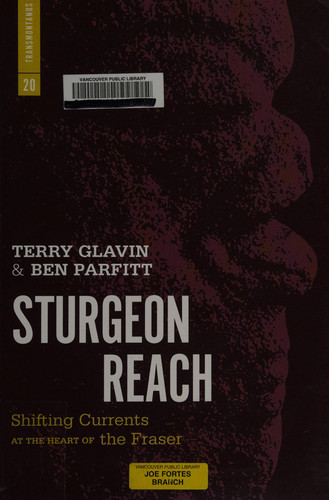
Sturgeon Reach: shifting currents at the heart of the Fraser

Glavin, Terry
Sturgeon Reach is the name some have given to a stretch of the Fraser River between Hope and Pitt Meadows, where its flow slows, and it deposits the gravel it's been carrying from the province's interior. Its story is one of rocks and stones, from its geological origins, from the mythic beginnings of human settlement, and from the arrival of Simon Fraser through to the onslaught of dykes and roads and bridges and foundations that today threaten the river's essential nature. Sturgeon Reach hosts an incredible array of life, from giant black cottonwoods to a creature that dates from the age of dinosaurs –– the remarkable white sturgeon. This stretch of river is the spawning ground for major salmon runs. And for millennia, it has also been the home of the Sto:lo Indians. How can we now live well along a river that has a ceaseless desire to overflow its banks and set its own course? How can we allow the life that the river's character fosters to persist in the face of overwhelming development? In the 20th book in the Transmontanus series, Terry Glavin and Ben Parfitt explore Sturgeon Reach — its geography, its history, its critical role in the coastal ecosystem, and the compelling story it tells about competing human needs.
New Star Books 2012-11-15 69 pages