12 results for "History"

The Caves of Steel

Isaac Asimov
A millennium into the future, two advancements have altered the course of human history: the colonization of the galaxy and the creation of the positronic brain. Isaac Asimov's Robot novels chronicle the unlikely partnership between a New York City detective and a humanoid robot who must learn to work together. Like most people left behind on an over-populated Earth, New York City police detective Elijah Baley had little love for either the arrogant Spacers or their robotic companions. But when a prominent Spacer is murdered under mysterious circumstances, Baley is ordered to the Outer Worlds to help track down the killer. The relationship between Baley and his Spacer superiors, who mistrusted all Earthmen, was strained from the start. Then he learned that they had assigned him a partner: R. Daneel Olivaw. Worst of all was that the "R" stood for robot---and his positronic partner was made in the image and likeness of the murder victim!
Ballantine 1986-10-12 268 pages

Asimov's Guide to Shakespeare

Isaac Asimov
Shakespeare's genius is marked by his rare ability to appeal to theatergoers of all types and all levels of education. But for most modern folks, the Greek and Roman mythology and history, let alone the history of England and the geography of sixteenth-century Europe that his works are laden with, are hardly within our grasp. Isaac Asimov comes to making obscure issues clear to the layperson, selects key passages from 38 of the great bard's plays plus two of his narrative poems and, with the help of beautifully rendered maps an figures, illuminates us about their historical and mythological background.
Doubleday

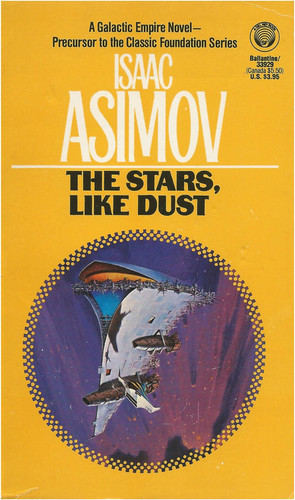
The Stars, Like Dust

Isaac Asimov
The first book in the Galactic Empire series, the spectacular precursor to the classic Foundation series, by one of history's most influential writers of science fiction, Isaac Asimov His name was Biron Farrill and he was a student at the University of Earth. A native of one of the helpless Nebular Kingdoms, he saw his home world conquered and controlled by the planet Tyrann--a ruthless, barbaric Empire that was building a dynasty of cruelty and domination among the stars. Farrill's own father had been executed for trying to resist the Tyrann dictatorship and now someone was trying to kill Biron. But why? His only hope for survival lay in fleeing Earth and joining the rebellion that was rumored to be forming somewhere in the Kingdoms. But once he cast his lot with the freedom fighters, he would find himself guarding against treachery on every side and facing the most difficult choice of all: to betray either the woman he loved or the revolution that was the last hope for the future.
Ballantine books 1986 231 pages

Banquets of the Black Widowers

Isaac Asimov
This book is the fourth of six that describe mysteries solved by the Black Widowers, based on a literary dining club he belonged to known as the Trap Door Spiders. It collects twelve stories by Asimov, together with a general introduction and an afterword following each story by the author. Nine of the stories were previously published; "The Driver," "The Wrong House" and "The Intrusion" are new to this collection. Each story involves the club members' knowledge of trivia. Nearly every story here is about decoding a riddle, each of which provides a clue based on dying or last words, misunderstood words, forgotten words, or withheld words. A few are based on facts that are, perhaps, not generally known to the public Asimov was a frequent writer of popular science and his inclination to explain anything and everything for the general public carried over into other fields, such as history and sociology but all the mysteries play fair with the reader, who is given either enough information to figure out the solution or a satisfying conclusion that is based on previously given facts and personality qualities.
Random House Publishing Group 1986 223 pages

Asimov on Numbers

Isaac Asimov
Why computers and people can't use the same number system - and more! With the clear, engaging style for which The New York Times has praised him for "Explaining complex material better than any other living person," Isaac Asimov - author of over 180 books ranging from science and science fiction to history, religion, literature, and geography - startles and fascinates as only he can. Here is Asimov's utterly engrossing exploration of the miraculous universe of numbers - from man's first act of counting to the highest mathematics, from the smallest living creature to the dazzling reaches of farthest space.
Pocket Books 1978 286 pages