7 results for "History"

Fire alarm: reading Walter Benjamin's 'On the concept of history'

Löwy, Michael
This illuminating study of Benjamin’s final essay helps unlock the mystery of this great philosopher Revolutionary critic of the philosophy of progress, nostalgic of the past yet dreaming of the future, romantic partisan of materialism—Walter Benjamin is in every sense of the word an “unclassifiable” philosopher. His essay “On the Concept of History” was written in a state of urgency, as he attempted to escape the Gestapo in 1940, before finally committing suicide. In this scrupulous, clear and fascinating examination of this essay, Michael Löwy argues that it remains one of the most important philosophical and political writings of the twentieth century. Looking in detail at Benjamin’s celebrated but often mysterious text, and restoring the philosophical, theological and political context, Löwy highlights the complex relationship between redemption and revolution in Benjamin’s philosophy of history.
Verso 2016-10-04 148 pages

The war of gods: religion and politics in Latin America

Löwy, Michael
The War of Gods traces the intimate relationship between religion, politics and social issues in Latin America over the last three decades, as liberation theology has reinterpreted the vocation of the Catholic Church and as Protestantism has made inroads on traditional Catholic strongholds. In the 1960s liberation theology addressed itself to the problems of a continent racked by poverty and oppression. Comprising a network of localized communities and pastoral organizations, it soon became something much more than a doctrinal current. Liberationist Christianity defined itself in a multitude of social struggles, particularly in Brazil and Central America. Many of the most momentous events in the continent’s recent history—the Nicaraguan revolution, the development of the PT (Workers’ Party) in Brazil, the tortuous ascent of President Aristide in Haiti and the uprising in Chiapas—have borne witness to the influence of a distinctive liberationist Christianity. Michael Löwy proposes here a new interpretation—inspired by the sociology of culture—both of liberation theology and of the rival religious projects in Latin America.
Verso 1996-07-17 163 pages

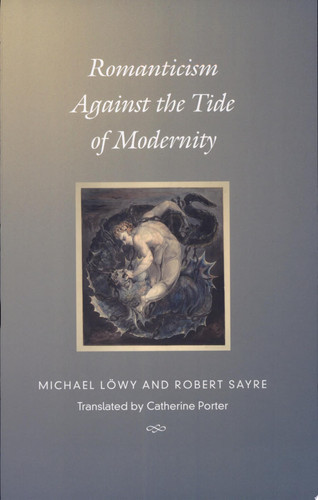
Romanticism against the tide of modernity

Löwy, Michael
Romanticism is a worldview that finds expression over a whole range of cultural fields—not only in literature and art but in philosophy, theology, political theory, and social movements. In Romanticism Against the Tide of Modernity Michael Löwy and Robert Sayre formulate a theory that defines romanticism as a cultural protest against modern bourgeois industrial civilization and work to reveal the unity that underlies the extraordinary diversity of romanticism from the eighteenth to the twenty-first century. After critiquing previous conceptions of romanticism and discussing its first European manifestations, Löwy and Sayre propose a typology of the sociopolitical positions held by romantic writers-from “restitutionist” to various revolutionary/utopian forms. In subsequent chapters, they give extended treatment to writers as diverse as Coleridge and Ruskin, Charles Peguy, Ernst Bloch and Christa Wolf. Among other topics, they discuss the complex relationship between Marxism and romanticism before closing with a reflection on more contemporary manifestations of romanticism (for example, surrealism, the events of May 1968, and the ecological movement) as well as its future. Students and scholars of literature, humanities, social sciences, and cultural studies will be interested in this elegant and thoroughly original book.
Duke University Press 2001 317 pages

Romantic anti-capitalism and nature: the enchanted garden

Sayre, Robert,Löwy, Michael
Romantic Anti-capitalism and Nature examines the deep connections between the romantic rebellion against modernity and ecological concern with modern threats to nature. The chapters deal with expressions of romantic culture from a wide variety of different areas: travel writing, painting, utopian vision, cultural studies, political philosophy, and activist socio-political writing. The authors discuss a highly diverse group of figures - William Bartram, Thomas Cole, William Morris, Walter Benjamin, Raymond Williams, and Naomi Klein - from the late eighteenth to the early twenty-first century. They are rooted individually in English, American, and German cultures, but share a common perspective: the romantic protest against modern bourgeois civilisation and its destruction of the natural environment. Although a rich ecocritical literature has developed since the 1990s, particularly in the United States and Britain, that addresses many aspects of ecology and its intersection with romanticism, they almost exclusively focus on literature, and define romanticism as a limited literary period of the late eighteenth and early nineteenth centuries. This study is one of the first to suggest a much broader view of the romantic relation to ecological discourse and representation, covering a range of cultural creations and viewing romanticism as a cultural critique, or protest against capitalist-industrialist modernity in the name of past, pre-modern, or pre-capitalist values. This book will be of great interest to students and scholars of ecology, romanticism, and the history of capitalism.
Earthscan from Routledge 2020 140 pages

The politics of combined and uneven development: the theory of permanent revolution

Löwy, Michael
Löwy's book is the first attempt to analyze, in a systematic way, how the theories of uneven and combined development, and of the permanent revolution &mdash inseparably linked &mdash emerged in the writings of thinkers such as Karl Marx and Leon Trotsky. Such radical reflections permit us to understand modern economic development across continents as a process of ferocious change, in which "advanced" and "backward" elements fuse, come into tension, and collide &mdash and how the resulting ruptures make it possible for the oppressed and exploited to change the world.
Haymarket Books 2010 162 pages

Morning star: surrealism, Marxism, anarchism, situationism, utopia

Löwy, Michael
An expanded edition of revered theorist Michael Löwy's Morning Star: Marxism and Surrealism (previously published in French, Portuguese, Spanish, Italian, and Greek), this masterwork collects the author's essays on the ways in which surrealism intersected with a variety of revolutionary political approaches, ranging from utopian ideals to Marxism and situationism. Taking its title from André Breton's essay "Arcane 17," which casts the star as the searing firebrand of rebellion, Löwy's provocative work spans many perspectives. These include surrealist artists who were deeply interested in Marxism and anarchism (Breton among them), as well as Marxists who were deeply interested in surrealism (Walter Benjamin in particular). Probing the dialectics of innovation, diversity, continuity, and unity throughout surrealism's international presence, Morning Star also incorporates analyses of Claude Cahun, Guy Debord, Pierre Naville, José Carlos Mariátegui and others, accompanied by numerous reproductions of surrealist art. An extraordinarily rich collection, Morning Star promises to ignite new dialogues regarding the very nature of dissent.
University of Texas Press 2009-04-01 142 pages