9 results for "Economics"

Principles of macroeconomics

Stiglitz, Joseph E.
The study of economics has always been fascinating, yet it is difficult to remember a more exciting or important time in the discipline. This book includes - Macroeconomics and the Economic Perspective; The process system; Households and firms in the labor and capital markets; Measurement of economic output and unemployment; The cost of living and inflation; The full-employment model; Government finance at full employment; The open economy at full employment; Economic growth; Money, the price level, and the federal reserve; Introduction to macroeconomic fluctuations; Aggregate expenditures and income; Aggregate demand and inflation; The federal reserve and interest rates; The role of macroeconomic policy; International trade and trade policy; The international financial system; Policy in the open economy; Development and transition; Inflation and unemployment; Controversies in macroeconomic policy; A student's guide to investing.
W.W. Norton & Co 2006 20 pages

The great divide

Stiglitz, Joseph E.
Why has inequality increased in the Western world - and what can we do about it? In The Great Divide , Joseph Stiglitz fully exposes the inequality - from its dimensions and its causes to its consequences for the world - that is afflicting America and other Western countries in thrall to neoliberalism. From Reagan-era policies to the Great Recession and its long aftermath, Stiglitz delves into the processes and irresponsible policies - deregulation, tax cuts for the rich, the corruption of the political process - that are leaving many people further and further behind and turning the dream of a socially mobile society into an ever more unachievable myth. With formidable yet accessible economic insight, he urges us to embrace real solutions- increasing taxes on corporations and the wealthy; investing in education, science and infrastructure; helping homeowners instead of banks; and, most importantly, doing more to restore the economy to full employment. Stiglitz's analysis reaches beyond America - the inequality leader of the developed world - to draw lessons from Scandinavia, Singapore and Japan, and he argues against the tide of unnecessary, destructive austerity that is sweeping across Europe. Ultimately, Stiglitz believes our choice is not between growth and fairness; with the right policies, we can choose both. 'Stiglitz is a rare combination of virtuoso economist, witty polemicist and public intellectual. ' Robert Kuttner, New Statesman 'Stiglitz is a rare breed, an heretical economist who has ruffled the self-satisfied global establishment that once fed him.' Ian Fraser, Sunday Tribune 'A seer of almost Keynesian proportions.' Michael Hirsh, Newsweek 'An insanely great economist.' Paul Krugman, The New York Times
Allen Lane 2015 428 pages

Economics of the public sector

Stiglitz, Joseph E.
What should be the role of government in society? How should it design its programs? How should tax systems be designed to promote both efficiency and fairness? Nobel Laureate Joseph Stiglitz and new co-author Jay Rosengard use their first-hand policy-advising experience to address these key issues of public-sector economics in this modern and accessible Fourth Edition.
W. W. Norton & Company, Inc 2015 923 pages

The three trillion dollar war: the true cost of the Iraq conflict

Stiglitz, Joseph E.
The true cost of the Iraq War is $3 trillion rather than the $50 billion projected by the White House. Apart from its tragic human toll, the Iraq War will be staggeringly expensive in financial terms. This sobering study by Nobel Prize winner Joseph E. Stiglitz and Harvard professor Linda J. Bilmes casts a spotlight on expense items that have been hidden from the U.S. taxpayer, including not only big-ticket items like replacing military equipment (being used up at six times the peacetime rate) but also the cost of caring for thousands of wounded veterans for the rest of their lives. Shifting to a global focus, the authors investigate the cost in lives and economic damage within Iraq and the region. Finally, with the chilling precision of an actuary, the authors measure what the U.S. taxpayer's money would have produced if instead it had been invested in the further growth of the U.S. economy. Written in language as simple as the details are disturbing, this book will forever change the way we think about the war.
W.W. Norton 2008-02-17 311 pages

Freefall: free markets and the sinking of the global economy

Stiglitz, Joseph E.
This devastating and inspiring book, by one of the world's leading economic thinkers, lays out not only the course of the financial crisis which began in 2007, but also its underlying causes, and shows why much more radical reforms are needed than are currently being contemplated if we are to avoid similar 'systemic' crises in the future. Frefall shows why the bailout has been only marginally effective and how it could have been much more so, and outlines the enormous opportunity - not yet taken - to design a new global financial architecture. It is highly critical of many of the actions not only of George Bush's administration, but also of Barack Obama's. It shows why the bulk of the cost of recovery should be borne by those in the financial sector - not just for reasons of natural justice, but for compelling economic reasons also. More than any of this, it reminds readers to think constantly about what economics are for. Out of the crisis of our times, Joseph Stiglitz has crafted a tract which goes to the heart of economics and will be read long after the immediate impact of these mismanaged years has passed.
Allen Lane 2010 361 pages

The economic role of the state

Stiglitz, Joseph E.
Since the Great Depression the legitimacy of the state has become closely linked to its economic performance. Recently, public choice, monetarism and the New Classical macroeconomics have all questioned the efficiency and desirability of State intervention in the economy. This book, founded on an essay by Professor Joseph E. Stiglitz aims to provide an insight into the positive and normative aspects of the evolving role of the State. Professor Stiglitz's essay is taken up and discussed by a group of economists who address the crucial question of whether there can be an optimum with respect to the size and character of the public sector.
B. Blackwell in association with Bank Insinger de Beaufort NV 1989 178 pages

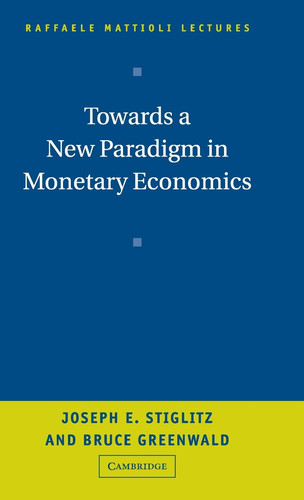
Towards a new paradigm in monetary economics

Stiglitz, Joseph E.
Expanding upon the literature of new institutional economics, the first part of this study stresses the significance of imperfections in information, bankruptcy and banks. The second part examines the policy implications of the new paradigm emphasizing loanable fund demand and supply, and demonstrates its relevance to our understanding of two recent historical episodes--the East Asian financial crisis and the 1991 U.S. recession and subsequent recovery and boom.
Cambridge University Press 2003-09-04 327 pages

Joseph Stiglitz and the World Bank: the rebel within

Stiglitz, Joseph E.
Comprises nine speeches by Joseph Stiglitz, the former Chief Economist of the World Bank. Covers the failure of shock therapy and transition economics, the limits of capital market liberalization, the myopia of the Washington Consensus, the role of knowledge in markets, the process of developing market institutions, and the primacy of openness and worker participation.
Anthem Press 2001 320 pages