29 results for "Biography"

The story of Anne Frank

Pressler, Mirjam
Presents the life of Anne Frank, the real girl who lies behind the words of her immortal diary. Provides insights into her early life, her relationships with family and friends and the family's harrowing two years spent hiding from the Nazis in the 'Secret Annexe'. Includes the terrible facts that lie beyond the end of her diary, of her imprisonment and death. Suggested level: secondary.
Macmillan Children's 1999 191 pages

Spinoza, life and legacy

Israel, Jonathan
"The boldest and most unsettling of the major early modern philosophers, Spinoza, had a much greater, if often concealed, impact on the international intellectual scene and on the early Enlightenment than philosophers, historians, and political theorists have conventionally tended to recognize. Europe-wide efforts to prevent the reading public and university students learning about Spinoza, the man and his work, in the years immediately after his death in 1677, dominated much of his early reception owing to the revolutionary implications of his thought for philosophy, religion, practical ethics and lifestyle, Bible criticism, and political theory. Nevertheless, contrary to what has sometimes been maintained, his general impact was immediate, very widespread, and profound. One of the main objectives of the book is to show how early and how deeply Leibniz, Bayle, Arnauld, Henry More, Anne Conway, Richard Baxter, Robert Boyle, Henry Oldenburg, Pierre-Daniel Huet, Richard Simon, and Nicholas Steno, among many others, were affected by and led to wrestle with his principal ideas"--
Oxford University Press 2023 1313 pages

Etty: the letters and diaries of Etty Hillesum, 1941-1943

Hillesum, Etty
The complete letters and diaries of Etty Hillesum are now available in this comprehensive English edition, allowing readers all over the world to fully appreciate the life of this remarkable woman. In the midst of the horrors of the Nazi Holocaust, Etty's writings reveal a young Jewish woman who celebrated life and remained an undaunted example of courage, sympathy, and compassion. Etty began her diary in 1941, nine months after Hitler invaded her home country of the Netherlands. The record she kept for the next two years contains arresting personal reflections and chronicles her intellectual and spiritual development. Letters that she wrote to friends during her internment at the Westerbork transit camp poignantly describe the day-to-day horrors that the Jewish prisoners faced. Etty's courage and determination remained strong, however, allowing her to rise above the hate around her and express her undying faith in humanity. As she wrote in her last letter, thrown from the train that took her to her death at Auschwitz, "We left the camp singing." Through this splendid translation by Arnold J. Pomerans, commissioned by the Etty Hillesum Foundation, readers everywhere will resonate with the spirit of this amazing young woman.
William B. Eerdmans Pub 2002 800 pages

The man with the miraculous hands

Kessel, Joseph
This amazing story of World War 2 chronicles the carrer of Dr Felix Kersten, physicain to the high-demon of the Third Reich, Heinrich Himmler. Kersten, an alternative medicine specialist, could alleviate Himmler's severe stomach pains with his hands, using massage and manipulation. In return, Kersten bargained with Himmler to order the release of innocent prisoners condemned to die. By war's end, thanks to Kersten, thousands of jews and other prisoners had eluded the fate of the concentration camp. This is a memorable account of a little-known miracle of World War 2.
Burford Books 2004 235 pages

Shores beyond shores: from Holocaust to hope : my true story

Butter, Irene H.,Bidwell, John,Holloway, Kris
As Irene's Pappi fights to save his family during the Holocaust, Irene's childhood is lost. Play is restricted. Family and friends disappear. Finally, with the Dutch police at their door comes the reality that Irene's father has not moved his family far enough from Hitler's Germany. By January 1945, the family is struggling to survive a death camp. Irene tends her ailing parents, cares for starving kids, and even helps bring clothes to her Amsterdam neighbor Anne Frank, before her family is offered a singular chance for freedom...providing the Nazi doctor says they are healthy enough. After two weeks of heart-lifting miracles and heart-breaking tragedies, Irene arrives in the Algerian desert to journey into redemption and womanhood, without her parents or brother. Irene's first person memoir, Shores Beyond Shores, is an account of how the heart keeps its common humanity in the most inhumane and turbulent of times. Irene's hard-earned lessons are a timeless inspiration. ______________________________________________________________________________________________________________________ Following publication of an article on the Holocaust on April 13, 2018, Irene wrote a letter to the Editor which was published April 17, 2018 in The New York Times: Holocaust Survivors 'Have Voices That Matter' April 17, 2018 Re "Getting Facts Wrong on the Holocaust" (news article, April 13): More than four decades passed before I could break the silence about my traumatic experiences during the Holocaust. It is a formidable challenge for survivors to speak and for others to listen. The number of survivors is dwindling; they are getting quite old and their memories are fading. Yet it is ever more important that the signs of authoritarian regimes and how they evolved are brought into the consciousness of youths and adults, as warning signals of what must be prevented from happening again. Survivors, when able, have the responsibility to bear witness and provide evidence so that the six million Jews who were murdered are not forgotten, so that perpetrators are not pardoned for their crimes, and so that deniers don't have a leg to stand on. While the voices of the victims have been silenced forever, we the survivors have voices that matter. After four decades of not speaking, I realized that silence was no longer an option. I told my stories to my children and grandchildren as well as to many students in many schools over a 30-year period. Schools and other organizations should take advantage of every opportunity to engage survivors to tell their stories. IRENE BUTTER, ANN ARBOR, MICH. The writer survived two concentration camps, Westerbork and Bergen-Belsen. She recently published her memoir, "Shores Beyond Shores: From Holocaust to Hope."
White River Press 2018 273 pages

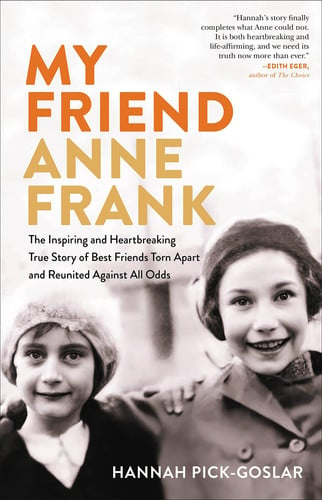
My friend Anne Frank: the inspiring and heartbreaking true story of best friends torn apart and reunited against all odds

Pick-Goslar, Hannah,Kraft, Dina
"In 1933, Hannah Pick-Goslar and her family fled Nazi Germany to live in Amsterdam, where she struck up a close friendship with her next-door neighbor, an outspoken and fun-loving young girl named Anne Frank. For several years, the inseparable pair enjoyed a carefree childhood of games, sleepovers, and treats with the other children in their neighborhood of Rivierenbuurt. But in 1942, Hannah and Anne's lives abruptly changed forever. As the Nazi occupation of Amsterdam progressed, Anne and the Frank family seemingly vanished, leaving behind unmade beds and dishes in the sink--but no trace of Anne's precious diary. Torn from her dear friend without warning, Hannah spent the next two years tormented by questions about Anne's fate, wondering if she had, by some miracle, managed to escape danger. In this long-awaited memoir, Hannah shares the story of her childhood during the Holocaust, from the introduction of anti-Jewish laws in Amsterdam to the gradual disappearance of classmates and, eventually, the Frank family, to Hannah and her family's imprisonment in the Bergen-Belsen concentration camp. As Hannah chronicles the experiences of her own life during and after the war, she provides a searing look at what countless children endured at the hands of the Nazi regime, as well as an intimate, never-before-seen portrait of the most recognizable victim of the Holocaust. Culminating in an astonishing fateful reunion, My Friend Anne Frank is the profoundly moving story of childhood and friendship during one of the darkest periods in the world's history"--Dust jacket flap.
Little, Brown Spark 2023 313 pages

An interrupted life: the diaries, 1941-1943 ; and, Letters from Westerbork

Hillesum, Etty
Contains the complete text of the diaries (pp. 1-231) of Etty Hillesum, and of her letters from Westerbork (pp. 233-360). Her diaries contain references to the Nazi anti-Jewish measures and her work for the Jewish Council in Amsterdam and in Westerbork, where she was interned from July 1942 until her deportation to Auschwitz in September 1943. Her letters describe life in camp Westerbork.
Henry Holt 1996 376 pages

My name is Anne, she said, Anne Frank

Maarsen, Jacqueline van
A touching and intimate autobiography, this account recalls the author's remarkable childhood friendship with Anne Frank while attending a special school for Jewish children in Amsterdam during the late 1930s. With the story of her initial meeting and bonding with Anne Frank, Jacqueline van Maarsen's memoir recollects her family's near escape from the Netherlands only months after the Frank family went into hiding-or moved to Switzerland, as van Maarsen was lead to believe-and provides a revealing look into life under Nazi occupation. Written by a one-time friend who only discovered the truth about Anne's fate after the war ended, this memoir is a moving, firsthand recollection of a youthful friendship in the foreboding days of World War II.
Arcadia 2008-03-28 176 pages

Inheriting Anne Frank

Maarsen, Jacqueline van
Jacqueline van Maarsen's first book My Name is Anne, She Said, Anne Frank ends in 1947, two years after the death of her close friend Anne Frank. But Anne's death did not spell the end of the friendship. Otto Frank clung desperately to his deceased daughter's dearest friend. Having remained silent about her friendship with Anne Frank for decades after the war, Jacqueline van Maarsen finally decided to tell her story, hoping to expose half-truths and fabrications surrounding her former friend and to respect Anne Frank's legacy for what it is. While her books have been written in close cooperation with the Anne Frank Foundation, there are times when she has felt obliged to disagree with the Foundation and she has not shied away from confrontation. In her second book, van Maarsen returns in detail to the most dominant person in her life, her French mother who died in 1992 at the age of 101. The aftermath of an inheritance question in France in which the author had an important role to play, takes on tragic proportions, although the hilarity of the sometimes grotesque situation surfaces now and then. Inheriting Anne Frank is the continuation of Jacqueline van Maarsen's My Name is Anne, She Said, Anne Frank, and is an important documentary contribution to our knowledge of Anne Frank and what happened to and on account of her renowned diary. It is also a stirring portrait of a woman's turbulent life in the twentieth century
Arcadia Books 2009 158 pages

Memories: my life as an international leader in health, suffrage, and peace

Jacobs, Aletta H.
"The first of Aletta Jacobs's major works available in English, Memories introduces American readers to a remarkable woman-a key Dutch feminist who herself broke new ground, and who worked alongside world-renowned leaders in the progressive movements of the early twentieth century. Aletta Jacobs learned to lvoe the medical profession from her physician father, who took her on his rounds. Despite a sex-segregated education system, she became the nations's first woman to earn a medical degree. Jacobs's experiences as a doctor led her to pioneering health care reforms for prostitutes and saleswomen, as well as campaigns for the acceptance and availability of reliable birth control. Aletta Jacob's career included equally remarkable achievements in the international woman's suffrage and peace movements, where she worked closely with U.S. activists Jane Addams and Carrie Chapman Catt. Jacobs and Catt made frequent lecture tours together, culminating in a tour of Africa and Asia that combined avid sightseeing with speaking engagements in every country they visited. In Memories, Jacobs recounts all of these experiences, and spiritedly imparts her opinions-such as her disdain for the customs that restricted women to theater balcony seats and chastised them for walking alone at night. By turns witty, impassioned, and poignant, Memories brings to life a time of enormous changes for women-and one of the women who helped bring about the changes."--Book desc. via amazon.ca.
Feminist Press 1996 248 pages

Two roads home: Hitler, Stalin, and the miraculous survival of my family

Finkelstein, Daniel
"An epic and beautifully written World War II family history that spans Europe, telling of two happy families uprooted by war, their incredible suffering in Hitler's and Stalin's camps, and the near-miraculous survival and rescue of the author's parents who met after the war. Daniel Finkelstein's grandfather Alfred Wiener was a German Jewish intellectual leader who tolled an early warning of the impending Holocaust and became an archivist of Nazi crimes. He relocated his family to safety in Amsterdam, where they became close with Anne Frank's family. But they were eventually separated, and Daniel's mother Mirjam was sent to Bergen-Belsen with her mother and sisters while Alfred worked feverishly to free them. Finkelstein's father, Ludwik, grew up in a prosperous Jewish family in Poland where his father was a patriotic hero of the Great War. But when Stalin took control, Finkelstein's grandfather was deported to Siberia, while Ludwik and his mother were sent to Kazahkstan, where they barely survived freezing winters and harrowing forced labor conditions. Love and Murder is a page-turning account of ingenuity, bravery and the almost unbelievable coincidences that brought Daniel's parents together. The story features secret archives, forgery and theft, and sweeps across Europe to show the expanse of the war. Moving, engrossing and inspiring, Love and Murder will profoundly touch all who read it"--
Doubleday 2023 374 pages

Menasseh ben Israel: rabbi of Amsterdam

Nadler, Steven M.
An illuminating biography of the great Amsterdam rabbi and celebrated popularizer of Judaism in the seventeenth century Menasseh ben Israel (1604-1657) was among the most accomplished and cosmopolitan rabbis of his time, and a pivotal intellectual figure in early modern Jewish history. He was one of the three rabbis of the "Portuguese Nation" in Amsterdam, a community that quickly earned renown worldwide for its mercantile and scholarly vitality. Born in Lisbon, Menasseh and his family were forcibly converted to Catholicism but suspected of insincerity in their new faith. To avoid the horrors of the Inquisition, they fled first to southwestern France, and then to Amsterdam, where they finally settled. Menasseh played an important role during the formative decades of one of the most vital Jewish communities of early modern Europe, and was influential through his extraordinary work as a printer and his efforts on behalf of the readmission of Jews to England. In this lively biography, Steven Nadler provides a fresh perspective on this seminal figure
Yale University Press 2018 298 pages

The ambiguity of virtue: Gertrude van Tijn and the fate of the Dutch Jews

Wasserstein, Bernard
A biography of Gertrude van Tijn (1891-1974), born as Gertrud Franzisca Cohn in Braunschweig, Germany. From 1911-15 she lived in London, but was forced to immigrate because of her status as an enemy alien. She then went to Holland, where she became a fervent Zionist. In 1920 she married Jacques van Tijn, a Dutch Jew, and gave birth to two children. As he was a mining engineer, they lived in different countries until 1932 when they returned to Holland; in 1937 they were divorced. Focuses on her life and activities during 1933-45, when she worked for organizations dealing with the resettlement of Jewish refugees from Germany who fled to Holland, as well as with emigration of Dutch Jews, in particular for the Committee for Jewish Refugees. In April-May 1941 van Tijn, with Nazi approval, traveled to Portugal to coordinate, together with Portuguese authorities and the Joint Distribution Committee, the transit of Jewish refugees through Portugal and across the Atlantic. Her task proved to be very difficult, but some Jews got through, including her daughter. Her son served in the Allied army in France and Belgium. Van Tijn became head of the emigration department of the Jewish Council in Amsterdam; however, her achievements in this capacity were modest. In September 1943 she was deported to Westerbork, and in March 1944 to Bergen-Belsen. In the summer of 1944 she was freed with a group of prisoners in exchange for Germans arrested in Palestine. She stayed in Palestine for a few months, traveled back to Europe in 1945, and eventually settled in the USA, living close to her daughter. While in Palestine she wrote a report of what she had witnessed, which is found in the Leo Baeck Archives in New York, but was never published. Soon after the war van Tijn was criticized and censured as a dupe of the Nazis, guilty at the least of false credulity and at the most of collaboration, but she was later exonerated.
Harvard University Press 2014-03-31 334 pages