24 results for "History"

The prize: the epic quest for oil, money, and power

Yergin, Daniel
The Prize: The Epic Quest for Oil, Money, and Power is Daniel Yergin's history of the global petroleum industry from the 1850s through 1990. The Prize became a bestseller, helped by its release date in December 1990, four months after the invasion of Kuwait ordered by Saddam Hussein and one month before the U.S.-led coalition began the Gulf War to oust Iraqi troops from that country. The book eventually went on to win a Pulitzer Prize.
Simon & Schuster 1991-01-15 32 pages

Hitler and the Holocaust

Wistrich, Robert S.
Robert Wistrich begins his history of the Holocaust by exploring the origins of anti-Semitism in Europe, and especially in Germany, to try explain how millions of Jews came to be killed systematically by the Third Reich. In the process of relating these events, he provides new and incisive answers to a number of central questions concerning the Shoah that have emerged over recent years: who, inside and outside Nazi Germany, knew that Jews were being murdered; how responsibility for the genocide should be divided between Hitler himself and ordinary Germans; and how historians have tried to make sense of the Holocaust. The book concludes by considering the legacy of Nazi crimes since 1945: the Nuremburg trials, the impact of the Holocaust on Diaspora Jewry (particularly in Israel and America), and the rise of neo-Nazism and Holocaust-denial.
The Modern Library 2003 295 pages

Israel: the will to prevail

Danon, Danny
Danny Danon has been a vocal opponent of disengaging in the Gaza Strip and West bank, and transforming the stalemate "two state/one state" dialogue to include regional partners, at times standing in direct opposition to his own party's leadership. A well-known and frequent speaker in the global arena, he is the rising voice for a fresh movement toward nationalism among the generation of Israelis currently coming to power. Here, Danon shares this vision with the world. It is a bold and uncompromising stance in the face of attacks on Israel's sovereignty by other Middle Eastern nations as the United States sends mixed signals of support to further its own goals in the region. Danon dissects the missteps and wrong turns that Israel's politicians have taken in the past by working to appease the United States and not offend their neighbors, instead of prioritizing their nation's own viability. With electrifying zeal, he tackles the challenges Israel faces today to undo what he sees as a consequence brought on by years of acquiescence to US policy. Danon believes "US pressure on Israel is hurting Israel and will do nothing to advance peace". Danon leads the charge toward a victorious future with an invitation for the United States and the Middle East to participate in, and not just dictate, Israel's international relations and policies (as opposed to an Israel cuckolded with an endless array of caveats toward those who would see it fall). No stranger to controversy, Danon's unabashed insights are a welcome revelation in the current quagmire of Middle-East international relations. A leading speaker to both Jewish groups and Christian Conservatives, the LA Jewish Journal says "What Danny says is what Bibi is actually thinking." For Danny Danon, this is only the beginning.
Palgrave Macmillan 2012-09-04 230 pages

The Final solution: origins and implementation

Cesarani,David
Although there is an immense amount of literature on the 'Final Solution' - the Nazis' attempt to exterminate the Jews of Europe during the Second World War - many critical questions still remain unresolved. The authoritative essays in The Final Solution set out to clarify the origins of the attempted genocide of the Jews, and to provide new answers to this period of history which often seems inexplicable." "The book draws on important new evidence, much of it from archives in Eastern Europe which have only recently become accessible. Contributors are among the leading experts in the field. The essays focus on the preconditions and antecedents for the 'Final Solution' and the immediate origins of the decision to murder Europe's Jewish population. They consider, too, the impact of the German invasion of Russia in June 1941 on the evolution of a genocidal policy and the response of the peoples and governments in Germany, occupied Europe, the Free World and the Jewish communities under the Nazis and in the West." "The results of this study are often controversial. The essays challenge many accepted notions about the behaviour of the German Army, how much the Germans knew, and the response of the non-Jewish population in Occupied Europe and the West." "The Final Solution will be of great interest to students of modern European history. It will also make invaluable reading for anyone seeking to understand further this most tragic chapter of recent history.
Routledge 1994-01 318 pages

The Jew as pariah: Jewish identity and politics in the modern age

Arendt, Hannah
The introduction by Feldman (pp. 15-52), "The Jew as Pariah: The Case of Hannah Arendt (1906-1975)", discusses her life and writings, including her views regarding antisemitism in the 19th-20th centuries. Pp. 240-279 contain material on the controversy over Arendt's book "Eichmann in Jerusalem" - exchanges between her and the scholars Gershom Scholem and Walter Laqueur stating their objections to her views, along with her responses.
Grove Press : distributed by Random House 1978 288 pages

Why we watched: Europe, America, and the Holocaust

Hamerow, Theodore S.
While today the Nazi genocide of Jews is seen as a massacre unique in its savagery and a central feature of World War II, in 1933-45 it was accepted in the USA, and in the Western world in general, as one of the many wartime brutalities, almost understandable and predictable. Political leaders, public opinion, and later the Allied military greeted the first news concerning the Nazi persecution and murder of Jews with disbelief; later, when the facts of the Nazi mass murder of Jews became apparent, they tended to conflate the Nazi victimization of Jews with that of other ethnic groups. There was a tendency to diminish the scope of the genocide and even to see it as, at least partly, deserved by the victims. These views found expression in a commonly shared reluctance to receive Jewish refugees from Nazism. Opinion polls of the late 1930s-early 1940s show that the American public was consistently against any relaxation of immigration restrictions. In Western Europe and the rest of the Americas, sentiments were similar: some countries were ready to admit Poles, Czechs, and other refugees, but not Jews. These sentiments can only partly be ascribed to the economic hardships of the 1930s; their main cause was antisemitism, ethnic opposition to the Jewish alien. In the postwar years, the tendency to silence and trivialize the Holocaust persevered; it was only in the 1960s that public opinion recognized the Holocaust as unique. Argues against Peter Novick's view, according to which Holocaust memory initially fell victim to the Cold War. Contends that, in the 1960s, most people thought that the "Jewish question" was finally solved - by emancipation, assimilation and, last but not least, by the Nazi mass murder.
W.W. Norton & Co 2008 520 pages

The ruling class of Judaea: the origins of the Jewish revolt against Rome, A.D. 66-70

Goodman, Martin
Goodman examines the background of the AD 66 Judean revolt against Rome. He attempts to explain both the rebellion itself and its temporary success by discussing the role of the Jewish ruling class in the sixty years preceding the war and in the independent state that lasted until AD 70. The author shows that the revolt's ultimate cause was a misunderstanding by Rome of the status criteria of Jewish society.
Cambridge University Press 1995 263 pages

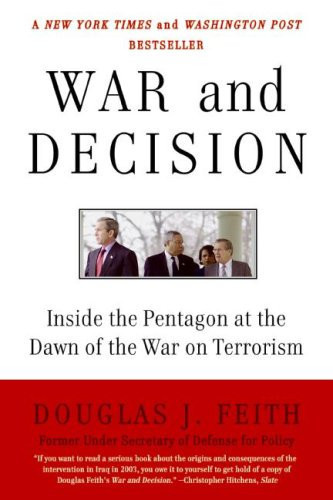
War and decision: inside the Pentagon at the dawn of the War on Terrorism

Feith, Douglas J.
Of all the players in the planning and evolution of the Bush Administration's war on terrorism, few were more integral--or more controversial--than Douglas Feith, the chief strategist on Donald Rumsfeld's Pentagon policy team. A highly influential international policy analyst for more than a quarter century, Feith worked closely with Rumsfeld, Paul Wolfowitz, Colin Powell, Condoleezza Rice, Vice President Cheney, and President Bush in defining the U.S. response to the attacks of 9/11--from the successful war on Afghanistan to the more challenging invasion of Iraq and its aftermath. Now, in this candid and revealing memoir, Feith--a charter member of the neoconservative movement and an architect of the administration's preventive strategy in the war on terrorism--offers the most in-depth and authoritative account yet of the Pentagon's evolving stance during one of the most controversial eras of American history. Drawing upon a unique trove of documents and records, this extraordinary chronicle will put the reader in the room for scores of previously unreported senior-level meetings, showing how hundreds of critical decisions were made in defense of American interests during and after the crisis of 9/11--decisions both successful and controversial. Where journalists like Bob Woodward could only speculate, Feith is the first inside player to reveal the inner workings of the Pentagon, at a time when history hung in the balance.--From publisher description.
HarperCollins 2009-02-03 674 pages

Foxbats over Dimona: the Soviets' nuclear gamble in the Six-Day War

Ginor, Isabella
A groundbreaking history that radically changes our understanding of the Six-Day War, how it started, and what its adversaries were willing to do to win Isabella Ginor and Gideon Remez's groundbreaking history of the Six-Day War in 1967 radically changes our understanding of that conflict, casting it as a crucial arena of Cold War intrigue that has shaped the Middle East to this day. The authors, award-winning Israeli journalists and historians, have investigated newly available documents and testimonies from the former Soviet Union, cross-checked them against Israeli and Western sources, and arrived at fresh and startling conclusions. Contrary to previous interpretations, Ginor and Remez's book shows that the Six-Day War was the result of a joint Soviet-Arab gambit to provoke Israel into a preemptive attack. The authors reveal how the Soviets received a secret Israeli message indicating that Israel, despite its official ambiguity, was about to acquire nuclear weapons. Determined to destroy Israel's nuclear program before it could produce an atomic bomb, the Soviets then began preparing for war--well before Moscow accused Israel of offensive intent, the overt trigger of the crisis. Ginor and Remez's startling account details how the Soviet-Arab onslaught was to be unleashed once Israel had been drawn into action and was branded as the aggressor. The Soviets had submarine-based nuclear missiles poised for use against Israel in case it already possessed and tried to use an atomic device, and the USSR prepared and actually began a marine landing on Israel's shores backed by strategic bombers and fighter squadrons. They sent their most advanced, still-secret aircraft, the MiG-25 Foxbat, on provocative sorties over Israel's Dimona nuclear complex to prepare the planned attack on it, and to scare Israel into making the first strike. It was only the unpredicted devastation of Israel's response that narrowly thwarted the Soviet design.
Yale University Press 2007 287 pages

Our hands are stained with blood: the tragic story of the Church and the Jewish people

Brown, Michael L.
"The pages of church history are marked by countless horrors committed against the Jewish people. From the first persecutions of the Jews in the fourth century to the horrors of the Holocaust, from Israel-bashing in today's press to anti-Semitism spouted from the pulpit, this painful book tells the tragic story that every Christian must read. In a freshly updated and expanded edition of this pivotal work, Dr. Michael Brown exposes the faulty theological roots that opened the door to anti-Semitism in Church history, explaining why well-meaning believers so often fall into the trap of hate... and showing how you can bring an end to the cycle of violence. This generation can make a difference. Now is the time for change! Discover the important role you play in helping to shape a Church that will bless Israel rather than curse Israel." -- From back cover.
Destiny Image Publishers, Inc 2019-09-17 300 pages

The triumph of the dark: European international history, 1933-1939

Steiner, Zara
"In this magisterial narrative, Zara Steiner traces the twisted road to war that began with Hitler's assumption of power in Germany. Covering a wide geographical canvas, from America to the Far East, Steiner provides an indispensable reassessment of the most disputed events of these tumultuous years. Steiner underlines the far-reaching consequences of the Great Depression, which shifted the initiative in international affairs from those who upheld the status quo to those who were intent on destroying it. In Europe, the 1930s were Hitler's years. He moved the major chess pieces on the board, forcing the others to respond. From the start, Steiner argues, he intended war, and he repeatedly gambled on Germany's future to acquire the necessary resources to fulfill his continental ambitions. Only war could have stopped him-an unwelcome message for most of Europe. Misperception, miscomprehension, and misjudgment on the part of the other Great Powers leaders opened the way for Hitler's repeated diplomatic successes. It is ideology that distinguished the Hitler era from previous struggles for the mastery of Europe. Ideological presumptions created false images and raised barriers to understanding that even good intelligence could not penetrate. Only when the leaders of Britain and France realized the scale of Hitler's ambition, and the challenge Germany posed to their Great Power status, did they finally declare war"- Publisher description
Oxford University Press 2013-05-23 1222 pages

On the eve: the Jews of Europe before the Second World War

Wasserstein, Bernard
Bernard Wasserstein presents a disturbing interpretation of the collapse of European Jewish civilization even before the Nazi onslaught. Wasserstein shows how the harsh realities of the age devastated the lives of communities and individuals. By 1939, the Jews faced an existential crisis that was as much the result of internal decay as of external attack.
Simon & Schuster 2012-05 552 pages

Genesis: Truman, American Jews, and the origins of the Arab/Israeli conflict

Judis, John B.
"A probing look at one of the most incendiary subjects of our time--the relationship between the United States and Israel. There has been more than half a century of raging conflict between Jews and Arabs--a violent, costly struggle that has had catastrophic repercussions in a critical region of the world. In Genesis, John B. Judis argues that, while Israelis and Palestinians must shoulder much of the blame, the United States has been the principal power outside the region since the end of World War II and as such must account for its repeated failed efforts to resolve this enduring strife. The fatal flaw in American policy, Judis shows, can be traced back to the Truman years. What happened between 1945 and 1949 sealed the fate of the Middle East for the remainder of the century. As a result, understanding that period holds the key to explaining almost everything that follows--right down to George W. Bush's unsuccessful and ill-conceived effort to win peace through holding elections among the Palestinians, and Barack Obama's failed attempt to bring both parties to the negotiating table. A provocative narrative history animated by a strong analytical and moral perspective, and peopled by colorful and outsized personalities, Genesis offers a fresh look at these critical postwar years, arguing that if we can understand how this stalemate originated, we will be better positioned to help end it"--
Farrar, Straus and Giroux 2014 432 pages

Yugoslavia: an avoidable war

Beloff, Nora
In this outstanding appraisal of the modern history of Yugoslavia and the factors surrounding its break-up, Nora Beloff takes sacred tenets of received wisdom and subjects them to close analysis. Interventions by foreign governments, the role of the United Nations, the recognition of the secessionists' political platforms, together with the diplomatic infighting and confusion are all chronicled in this concise account.
New European Publications 1997 146 pages

One state, two states: resolving the Israel/Palestine conflict

Morris, Benny
“What is so striking about Morris’s work as a historian is that it does not flatter anyone’s prejudices, least of all his own,” David Remnick remarked in a New Yorker article that coincided with the publication of Benny Morris’s 1948: A History of the First Arab-Israeli War. With the same commitment to objectivity that has consistently characterized his approach, Morris now turns his attention to the present-day legacy of the events of 1948 and the concrete options for the future of Palestine and Israel.The book scrutinizes the history of the goals of the Palestinian national movement and the Zionist movement, then considers the various one- and two-state proposals made by different streams within the two movements. It also looks at the willingness or unwillingness of each movement to find an accommodation based on compromise. Morris assesses the viability and practicality of proposed solutions in the light of complicated and acrimonious realities. Throughout his groundbreaking career, Morris has reshaped understanding of the Israeli-Arab conflict. Here, once again, he arrives at a new way of thinking about the discord, injecting a ray of hope in a region where it is most sorely needed --
Yale University Press 2010 240 pages