25 results for "History"

The Singularity is Near When Humans Transcend Biology

Ray Kurzweil
How Singular? How singular is the Singularity? Will it happen in an instant? Lets consider again the derivation of the word. In mathematics a singularity is a value that is beyond any limit - in essence, infinity. The Singularity as we have discussed it in this book, does not achieve infinite levels of computation, memory, as any other other measurable attribute. But it certainly achieves vast levels of all these qualities, including intelligence. With the reverse engineering of the human brain we will be able to apply the parallel, self-organizing, chaotic, algorithms of human intelligence to enormously powerful computational substrates. This intelligence will then be in a position to improve its own design, both hardware and software, in a rapidly accelerating iterative process.
Viking 2005 652 pages

Survival of the Sickest LP

Dr. Sharon Moalem,Jonathan Prince
Joining the ranks of modern myth busters, Dr. Sharon Moalem turns our current understanding of illness on its head and challenges us to fundamentally change the way we think about our bodies, our health, and our relationship to just about every other living thing on earth, from plants and animals to insects and bacteria. So why does disease exist? Moalem proposes that most common ailments--diabetes, hemochromatosis, cystic fibrosis, sickle cell anemia--came into existence for very good reasons. At some point they helped our ancestors survive some grand challenge to their existence. Examining the evolution of man, Moalem reveals the role genetic and cultural differences have played in the health and well-being of various races, including their susceptibility to disease. With mesmerizing insight, Moalem offers groundbreaking insight into: - How diabetes may be a biproduct of a mechanism that helped humans survive the Ice Age - Why African Americans living in the north might suffer from vitamin D deficiencies, - Why Asians can't drink as much alcohol as Europeans Revelatory, utterly engaging, and timely--Moalem ponders strongN1, the emerging Avian Flu virus--Why Redheads Feel More Pain and Asians Can't Drink will irrevocably change the way we think about our bodies and ourselves.
Harper Collins 2007-05-22 372 pages

Shadows of Forgotten Ancestors

Carl Sagan,Ann Druyan
NATIONAL BESTSELLER • “Exciting and provocative . . . A tour de force of a book that begs to be seen as well as to be read.”— The Washington Post Book World World renowned scientist Carl Sagan and acclaimed author Ann Druyan have written a Roots for the human species, a lucid and riveting account of how humans got to be the way we are. Shadows of Forgotten Ancestors is a thrilling saga that starts with the origin of the Earth. It shows with humor and drama that many of our key traits—self-awareness, technology, family ties, submission to authority, hatred for those a little different from ourselves, reason, and ethics—are rooted in the deep past, and illuminated by our kinship with other animals. Sagan and Druyan conduct a breathtaking journey through space and time, zeroing in on critical turning points in evolutionary history, and tracing the origins of sex, altruism, violence, rape, and dominance. Their book culminates in a stunningly original examination of the connection between primate and human traits. Astonishing in its scope, brilliant in its insights, and an absolutely compelling read, Shadows of Forgotten Ancestors is a triumph of popular science.
Random House Publishing Group 1993-09-07 528 pages

Why is the Penis Shaped Like That? And Other Reflections on Being Human

Jesse Bering
"Titillating and provocative essays from one of the freshest voices in science today -- Why do testicles hang the way they do? Is there an adaptive function to the female orgasm? What does it feel like to want to kill yourself? Does "free will" really exist? And why is the penis shaped like that anyway? In Why Is the Penis Shaped Like That?, the research psychologist and award-winning columnist Jesse Bering features more than thirty of his most popular essays from Scientific American and Slate, as well as two new pieces, that take readers on a bold and captivating journey through some of the most taboo issues related to evolution and human behavior. Exploring the history of cannibalism, the neurology of people who are sexually attracted to animals, the evolution of human body fluids, the science of homosexuality, and serious questions about life and death, Bering astutely covers a generous expanse of our kaleidoscope of quirks and origins. With his characteristic irreverence and trademark cheekiness, Bering leaves no topic unturned or curiosity unexamined, and he does it all with an audaciously original voice. Whether you are interested in the psychological history behind the many facets of sexual desire or the evolutionary patterns that have dictated our current mystique and phallic physique, Why Is the Penis Shaped Like That? is bound to create lively discussion and debate for years to come"--
Transworld Publishers Limited 2012 320 pages

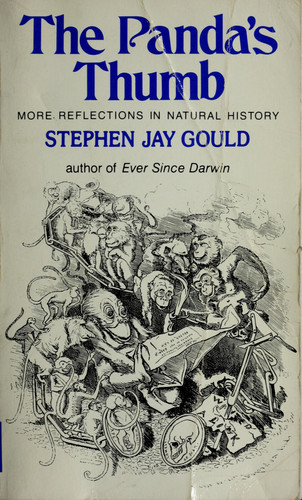
The panda's thumb: more reflections in natural history

Gould, Stephen Jay
A collection of essays by reknown scientist Jay Stephen Gould drawn from his columns in Natural History. The essays deal with topics such as: evolutionary opportunism (nature is a tinkerer, making the most of what's available in the course of adapting to the environment); new information on Darwin and his contemporaries; racism and cultural relativism; the evolutionary pattern of sudden rapid change; the origin of birds or the warm-bloodedness of dinosaurs; and, Teilhard de Chardin as a co-conspirator in the Piltdown hoax.
Norton 1980 343 pages

Ever since Darwin: reflections in natural history

Gould, Stephen Jay
More than any other modern scientists, Stephen Jay Gould has opened up to millions the wonders of evolutionary biology. His genius as an essayist lies in his unmatched ability to use his knowledge of the world, including popular culture, to illuminate the realm of science. Ever Since Darwin, Stephen Jay Gould's first book, has sold more than a quarter of a million copies. Like all succeeding collections by this unique writer, it brings the art of the scientific essay to unparalleled heights.
Norton 1979 285 pages

Unstoppable us: volume 2: why the world isn't fair

Harari, Yuval N.
Something really strange happened 10,000 years ago, and it changed everything. Why did millions of people agree to obey a few leaders? Where did kings and kingdoms come from? The answer to that is one of the strangest tales you'll ever hear. And it's a true story. Have you ever wondered how we got here? From gathering berries and hunting mammoths, to shopping at supermarkets and letting people tell us what to do? You might hear a lot of people say 'the world isn't fair'. But why isn't it? And how did it become so? In Unstoppable Us- Volume 1 , we learned how humans told stories to become rulers of the world - for good and bad. Now, in this next chapter of the incredible true tale of the Unstoppables, find out how humans learned to control animals like dogs, chicken and cows . . . And how a handful of humans learned to control everyone else. With full-colour illustrations showing the relentless rise and rise of the human race, this is history like you've never experienced it before.
Puffin Books 2024-03-07 187 pages

Dinosaurs at the Dinner Party How an Eccentric Group of Victorians Discovered Prehistoric Creatures and Accidentally Upended the World

Edward Dolnick
From the bestselling author of The Clockwork Universe and The Writing of the Gods , an “utterly delightful…hugely entertaining” ( Air Mail ) book about the eccentric Victorians who discovered dinosaur bones, leading to a whole new understanding of human history. In the early 1800s the natural world was a safe and cozy place, or so people believed. But then a twelve-year-old farm boy in Massachusetts stumbled on a row of fossilized three-toed footprints the size of dinner plates—the first dinosaur tracks ever found. Soon, in England, scientists unearthed enormous bones that reached as high as a man’s head. Outside of myths and fairy tales, no one had even imagined that creatures like three-toed giants had once lumbered across the land—nor dreamed that they could all have vanished, hundreds of millions years ago. In Dinosaurs at the Dinner Party , celebrated storyteller and historian Edward Dolnick leads us through a compelling true adventure as the paleontologists of the early 19th century puzzled their way through the fossil record to create the story of dinosaurs we know today. The tale begins with Mary Anning, a poor, uneducated woman who had a sixth sense for finding fossils buried deep inside cliffs; moves to William Buckland, an eccentric geologist who filled his home with specimens and famously pieced together a prehistoric scene from the fossil record inside a cave; and then on to the controversial Richard Owen, the era’s best-known scientist, and the one who coined the term “dinosaur.” “Exuberant” ( Kirkus Reviews ), entertaining, erudite, and featuring an unconventional cast of characters, Dinosaurs at the Dinner Party tells the story of how the accidental discovery of prehistoric creatures upended humanity’s understanding of the world and its own place within it.
Simon and Schuster 2025-08-12 352 pages

The Best American Science and Nature Writing 2004

Tim Folger,Steven Pinker
Since its inception in 1915, the Best American series has become the premier annual showcase for the country's finest short fiction and nonfiction. For each volume, a series editor reads pieces from hundreds of periodicals, then selects between fifty and a hundred outstanding works. That selection is pared down to the twenty or so very best pieces by a guest editor who is widely recognized as a leading writer in his or her field. This unique system has helped make the Best American series the most respected -- and most popular -- of its kind. The Best American Science and Nature Writing 2004, edited by Steven Pinker, is another "provocative and thoroughly enjoyable [collection] from start to finish" (Publishers Weekly). Here is the best and newest on science and nature: the psychology of suicide terrorism, desperate measures in surgery, the weird world of octopuses, Sex Week at Yale, the linguistics of click languages, the worst news about cloning, and much more.
Houghton Mifflin 2004 209 pages

Debating Darwin's Doubt A Scientific Controversy that Can No Longer be Denied

David Klinghoffer
In 2013 Stephen Meyer's book Darwin's Doubt: The Explosive Origin of Animal Life and the Case for Intelligent Design became a national bestseller, provoking a wide-ranging debate about the adequacy of Darwinian theory to explain life's history. In Debating Darwin's Doubt: A Scientific Controversy that Can No Longer Be Denied , leading scholars in the intelligent design community respond to critiques of Meyer's book and show that the core challenge posed by Meyer remains unanswered: Where did the influx of information essential to the creation of new body plans come from? In addition to ten chapters by Stephen Meyer, Debating Darwin's Doubt also includes contributions from biologists Richard Sternberg, Douglas Axe, and Ann Gauger; philosopher of biology Paul Nelson; mathematicians William Dembski and David Berlinski; and Center for Science and Culture research coordinator Casey Luskin. In forty-four chapters, these contributing authors explore topics such as orphan genes, cladistics, small shelly fossils, protein evolution, the length of the Cambrian explosion, the God-of-the-Gaps objection to intelligent design, and criticisms raised by proponents of theistic evolution. Anyone who wants to understand the cutting-edge of current scientific debates over modern Darwinian theory needs to read this book.
Discovery Institute Press 2015 350 pages

Global Brain The Evolution of Mass Mind from the Big Bang to the 21st Century

Howard Bloom
"As someone who has spent forty years in psychology with a long-standing interest in evolution, I'll just assimilate Howard Bloom's accomplishment and my amazement." --DAVID SMILLIE, Visiting Professor of Zoology, Duke University In this extraordinary follow-up to the critically acclaimed The Lucifer Principle, Howard Bloom--one of today's preeminent thinkers--offers us a bold rewrite of the evolutionary saga. He shows how plants and animals (including humans) have evolved together as components of a worldwide learning machine. He describes the network of life on Earth as one that is, in fact, a "complex adaptive system," a global brain in which each of us plays a sometimes conscious, sometimes unknowing role, and he reveals that the World Wide Web is just the latest step in the development of this brain. These are theories as important as they are radical. Informed by twenty years of interdisciplinary research, Bloom takes us on a spellbinding journey back to the big bang to let us see how its fires forged primordial sociality. As he brings us back via surprising routes, we see how our earliest bacterial ancestors built multitrillion-member research and development teams a full 3.5 billion years ago. We watch him unravel the previously unrecognized strands of interconnectedness woven by crowds of trilobites, hunting packs of dinosaurs, feathered flying lizards gathered in flocks, troops of baboons making communal decisions, and adventurous tribes of protohumans spreading across continents but still linked by primitive forms of information networking. We soon find ourselves reconsidering our place in the world. Along the way, Bloom offers us exhilarating insights into the strange tricks of body and mind that have organized a variety of life forms: spiny lobsters, which, during the Paleozoic age, participated in communal marching rituals; and bees, which, during the age of dinosaurs, conducted collective brainwork. This fascinating tour continues on to the sometimes brutal subculture wars that have spurred the growth of human civilization since the Stone Age. Bloom shows us how culture shapes our infant brains, immersing us in a matrix of truth and mass delusion that we think of as reality. Global Brain is more than just a brilliantly original contribution to the ongoing debate on the inner workings of evolution. It is a "grand vision," says the eminent evolutionary biologist David Sloan Wilson, a work that transforms our very view of who we are and why.
Turner Publishing Company 2001-08 384 pages

Biology under the influence: dialectical essays on ecology, agriculture, and health

Lewontin, Richard C.
How do we understand the world? While some look to the heavens for intelligent design, others argue that it is determined by information encoded in DNA. Science serves as an important activity for uncovering the processes and operations of nature, but it is also immersed in a social context where ideology influences the questions we ask and how we approach the material world. Biology Under the Influence: Dialectical Essays on the Coevolution of Nature and Society breaks from the confirms of determinism, offering a dialectical analysis for comprehending a dynamic social and natural world. In Biology Under the Influence , Richard Lewontin and Richard Levins provide a devastating critique of genetic determinism and reductionism within science while exploring a broad range of issues including the nature of science, biology, evolution, the environment, pubic health, and dialectics, They dismantle the ideology that attempts to naturalize social inequalities, unveil the alienation of science and nature, and illustrate how a dialectical position serves as a basis for grappling with historical developments and a world characterized by change. Biology Under the Influence brings together the illuminating essays of two prominent scientists who work to demystify and empower the public's understanding of science and nature.
Monthly Review Press 2007-11-01 400 pages

The evolution of childhood: relationships, emotion, mind

Konner, Melvin
Takes a comprehensive Darwinian interpretation of human development. Looking at the entire range of human evolutionary history, Konner tells the story of how cross-cultural and universal characteristics of our growth from infancy to adolescence became rooted in genetically inherited characteristics of the human brain--From publisher description.
Belknap Press of Harvard University Press 2010-05-31 943 pages

Our kind: who we are, where we came from, where we are going

Harris, Marvin
Before consciousness formed and tools were made, before speech was learned and cultures were established, before religion, society, politics, and war, came a simple evolutionary change: one primate, our common ancestor, took the first upright step. So begins our family history ... the story told by Marvin Harris in Our Kind. The tale explores topics as varied as how the different races arose; why marriage and the nuclear family were established; why we overeat; how men came to dominate politics; why women have longer life-spans; why yuppies are such conspicuous consumers; how war has come to overshadow us, and whether it always will ... and a great deal more. --
HarperPerennial 1990-09-26 547 pages

Women after all: sex, evolution, and the end of male supremacy

Konner, Melvin
Overview: A lively, richly informed argument for the natural superiority of women from the acclaimed author of The Tangled Wing. There is a human genetic fluke that is surprisingly common, due to a change in a key pair of chromosomes. In the normal condition the two look the same, but in this disorder one is malformed and shrunken beyond recognition. The result is a shortened life span, higher mortality at all ages, an inability to reproduce, premature hair loss, and brain defects variously resulting in attention deficit, hyperactivity, conduct disorder, hypersexuality, and an enormous excess of both outward and self-directed aggression. It is called maleness. In Women After All, Melvin Konner traces the arc of evolution to explain the relationships between women and men. With patience and wit he explores the knotty question of whether men are necessary in the biological destiny of the human race. He draws on multiple, colorful examples from the natural world-such as the mating habits of the octopus, black widow, angler fish, and jacana-and argues that maleness in humans is hardly necessary to the survival of the species. In characteristically humorous and engaging prose, Konner sheds light on our biologically different identities, while noting the poignant exceptions that challenge the male/female divide. We meet hunter-gatherers such as those in Botswana, whose culture gave women a prominent place, invented the working mother, and respected women's voices around the fire. Recent human history has upset this balance, as a dense world of war fostered extreme male dominance. But our species has been recovering over the past two centuries, and an unstoppable move toward equality is afoot. It will not be the end of men, but it will be the end of male supremacy and a better, wiser world for women and men alike. Provocative and richly informed, Women After All is bound to be controversial across the sexes
W.W. Norton & Company 2015-02-24 404 pages

The plausibility of life: resolving Darwin's dilemma

Kirschner, Marc
In the 150 years since Darwin, the field of evolutionary biology has left a glaring gap in understanding how animals developed their astounding variety and complexity. The standard answer has been that small genetic mutations accumulate over time to produce wondrous innovations such as eyes and wings. Drawing on cutting-edge research across the spectrum of modern biology, Marc Kirschner and John Gerhart demonstrate how this stock answer is woefully inadequate. Rather they offer an original solution to the longstanding puzzle of how small random genetic change can be converted into complex, useful innovations. In a new theory they call "facilitated variation,” Kirschner and Gerhart elevate the individual organism from a passive target of natural selection to a central player in the 3-billion-year history of evolution. In clear, accessible language, the authors invite every reader to contemplate daring new ideas about evolution. By closing the major gap in Darwin’s theory Kirschner and Gerhart also provide a timely scientific rebuttal to modern critics of evolution who champion "intelligent design.”
Yale University Press 2005-01-01 314 pages