21 results for "Science"

Smoke and Mirrors Short Fictions and Illusions

Neil Gaiman
From #1 New York Times bestselling author Neil Gaiman, an outstanding array of short fiction that surveys the terrain between the illusory and the ordinary and reveals the terrors and wonders reflected in the funhouse mirrors of our dreams―one of ten classic Gaiman works repackaged with elegant original watercolor art by acclaimed artist Henry Sene Yee "He is a treasure-house of story, and we are lucky to have him." --Stephen King Spanning the realms of dark imagination, Smoke and Mirrors surveys the terrain between the illusory and the ordinary, treating readers to a gift of wonder and delight from one of the most unique literary artists of our time. The miraculous inventions contained herein - stories, novellas, and poems - reveal Gaiman to be a writer of immense talent and sophisticated invention. In his deft hands, magic is no mere illusion, but a powerful means of illumination, revelation, and reflection on what it means to be human. Poignant and haunting, humorous and unorthodox, Smoke and Mirrors is an outstanding array of short fiction from one of the world's most distinguished literary masters.
HarperCollins Publishers 2021-06-15 368 pages

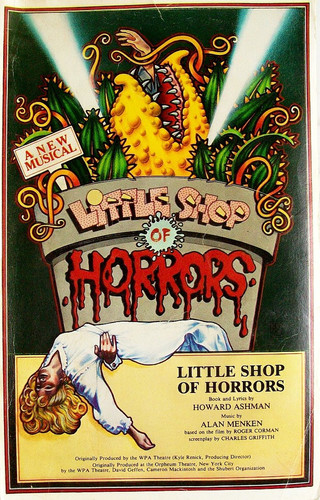
Little Shop of Horrors

Ashman, Howard
Little Shop of Horrors is a rock musical, by composer Alan Menken and writer Howard Ashman, about a hapless florist shop worker (Seymour) who nurtures a plant (Audrey II) and discovers that it's bloodthirsty and highly intelligent, forcing him to kill to feed it. The musical is based on the low-budget 1960 black comedy film The Little Shop of Horrors, directed by Roger Corman. The music, composed by Menken in the style of early 1960s rock and roll, doo-wop and early Motown, includes several well-known tunes, including the title song, "Skid Row (Downtown)", "Somewhere That's Green", and "Suddenly, Seymour". Author's Little Shop of Horrors satirizes many science fiction, "B" movies, musical comedy itself, and even the Faust legend. There will, therefore, be a temptation to play it for camp and low comedy. This is a great and potentially fatal mistake. The script keeps its tongue firmly in cheek, so the actors should not. Instead, they should play with simplicity, honesty, and sweetness-- even when events are at their most outlandish. The show's individual "style" will evolve naturally from the words themselves and an approach to acting and singing them that is almost child-like in its sincerity and intensity. By way of example, AUDREY poses like Fay Wray from time to time. But she does this because she's in genuine fear and happens to see the world as her private "B" movie--not because she's "commenting" to the audience on the stillness of her situation. Having directed the original New York production of LITTLE SHOP myself, and subsequently having seen it in many versions and even many languages, I can vouch for the fact that when LITTLE SHOP is at its most honest, it is also at its funniest and most enjoyable. -- Howard Ashman
Samuel French Inc Plays 2004 112 pages

The hard problem

Stoppard, Tom
"Hilary, a young psychology researcher at the Krohl Institute for Brain Science, is nursing a private sorrow and a troubling question. She and other researchers at the institute are grappling with what science calls the 'hard problem'--if there is nothing but matter, what is consciousness? What Hilary discovers puts her fundamentally at odds with her colleagues, who include her first mentor and onetime lover, Spike; her boss, Leo; and the billionaire founder of the institute, Jerry. Hilary needs a miracle, and she is prepared to pray for one."--Back cover.
Grove Press 2015 76 pages

Sex in an age of technological reproduction: ICSI and Taboos

Djerassi, Carl
Carl Djerassi is one of "the fathers of the Pill"--he was awarded the National Medal of Science for the first synthesis of a steroid oral contraceptive--and has had a prolific additional career as a writer of fiction, plays, and dialogues about science. In these two plays, ICSI and Taboos , he dramatizes the social transformations and contested viewpoints created by advances in reproductive science and technology. Two of the most startling developments in contemporary science have radically disrupted the historical connection between sex and reproduction: in vitro fertilization and intracytoplasmic sperm injection (ICSI)--an assisted reproductive technique that directly injects a single sperm into an egg. The word play ICSI --designed for classroom readings--presents, in the format of a contentious talk-show dialogue, the science of direct-injection fertilization and the ethical issues connected with it. A DVD included in the book provides video of the ICSI injection process as viewed through a microscope, to be used in performances of the ICSI one-act dialogue. Taboos, a full-length play, turns the screws on characters that reflect a polarized America. Two couples--lesbian partners and a conservative husband and wife struggling with infertility--must make choices in a drama that examines the disjunction of sexual reproduction and the physical act of sex.
University of Wisconsin Press 2008 115 pages

Oliver's Story

Erich Segal
The sequel to the phenomenal national bestseller and enduring classic Love Story. Can the love of your life appear twice in a lifetime? Oliver Barrett IV found his soulmate in Jenny Cavilleri. Their love was magical and exhilarating...and though heartbreakingly brief, it was a love to last a lifetime. Two years have passed since Jenny was taken from him, and Oliver believes he will never love again. Then one day, Marcie--beautiful and mysterious--enters his world and suddenly the future holds new promise. From the running track in New York's Central Park to the hushed executive suites of a mightly department store empire, from a snowy Massachusetts Christmas to a shattering moment of turth in exotic Hong Kong--the story of Oliver Barrett IV is a story of passion and principle, of a young man's journey out of sadness, into love.
HarperCollins Publishers 2020-02-04 272 pages

Oxygen: a play in two acts

Djerassi, Carl
Was treibt Wissenschaftler an? Der Konkurrenzkampf, das Bestreben etwas Neues als erster zu entdecken, ist eine wichtige Motivation. Die moralischen Konsequenzen werden in dem Stück "Oxygen" behandelt, in dem es um die Entdeckung von Sauerstoff geht, dem für das Leben auf der Erde wichtigsten Element. Im Zentrum des Stückes stehen chemische und politische Revolutionen sowie der Nobel-Preis, der 2001 zum 100. Mal vergeben wird. Das Stück spielt 1777 und 2001; zur Aufführung werden drei Schauspieler und drei Schauspielerinnen benötigt, die elf Personen darstellen. Die Urauffühung wird im Frühjahr 2001 in San Diego stattfinden, die deutsche Premiere im September. Die weltberühmten Autoren Carl Djerassi und Roald Hoffmann bürgen aufgrund ihrer Erfahrungen als Wissenschaftler - Carl Djerassi ist bekannt als "Vater der Pille" und Roald Hoffmann erhielt 1982 den Nobelpreis für Chemie - und als Schriftsteller - Djerassi schrieb mehrere erfolgreiche Romane, Hoffmann viel beachtete Lyrik - für Kompetenz und Spannung.
Wiley-VCH 2001-03-05 119 pages

All new people

Braff, Zach
"All New People" is a slick, lively and contemporary comedy written by award-winning screenwriter and well-known actor Zach Braff. The dead of winter, Long Beach Island, New Jersey, Charlie, has hit rock bottom. Away from the rest of the world, this perfect escape is interrupted by a motley parade of misfits who show up and change his plans. A hired beauty, a fireman, and an eccentric British real estate agent desperately trying to stay in the country all suddenly find themselves tangled together in a beach house where the mood is anything but sunny. This pithy piece portrays a scenario of attempted suicide with mordant humour, where a basis of social alienation leads to unexpected connections. The richly-drawn characters are quick-witted and narcissistic yet self-aware and the dialogue is fluid and witty. "All New People" is centred around a clever concept which works as a catalyst for both angst-fuelled scrutiny and morbid humour.
Dramatists Play Service Inc 2012 43 pages

Completeness

Moses, Itamar
How does a computer scientist hook up with a molecular biologist? He blinds her with science, of course. When Elliot builds a computer program to help Molly with her research project, the variables in their evolving relationship shift as rapidly as the terms of their experiment. This deft and imaginative new ROM-comedy shows that even the most sophisticated algorithm may freeze in the face of life's infinite possibilities. -- Publisher's website.
Samuel French 2019 83 pages

The death of tragedy

Steiner, George
"This book is important--and portentous--for if it is true that tragedy is dead, we face a vital cultural loss. . . . The book is bound to start controversy. . . . The very passion and insight with which he writes about the tragedies that have moved him prove that the vision still lives and that words can still enlighten and reveal."--R.B. Sewall, New York Times Book Review "A remarkable achievement. . . . The knowledge is marshalled here with the skill and authority of a great general, and from it a large strategic argument emerges with clarity and force. . . . A brilliantly thoughtful and eloquent book which deserves to be read with the greatest attention and respect."--Philip Toynbee, The Observer "As brilliant, thorough, and concerned a contemplation of the nature of dramatic art as has appeared in many years."--Richard Gilman, Commonweal "A rich and illuminating study, full of intelligence and sensibility."-- Times Literary Supplement (London) "His merits are shining and full of the capacity to give both delight and illumination. . . . His style is throughout vigorous, sensitive, and altogether worthy of its subject."--Harold Hobson, Christian Science Monitor "Immensely useful and [a book] to be reckoned with by everyone working in this field."--Raymond Williams, The Guardian
Yale University Press 1996-01-01 368 pages

Jubilee

Jarman, Derek
Faith in the establishment collapsing everywhere. The far right on the march. Culture wars and random violence – all decked out in red, white and blue. But a spirit of anarchy hangs in the air, the desire to burn it all down and start over. Derek Jarman's iconic film captured punk at its giddy height: a riot of music, DIY fashion, and every kind of sex – with a little pyromania thrown in. Forty years on, this new stage adaptation of Jubilee remixes it for the social and political turmoil of 2017. The cast of the original production at the Royal Exchange Manchester was led by one of the film's original cast members, legendary punk warrior Toyah Willcox. Centred around a marauding girl gang on a killing spree and a time-travelling Queen Elizabeth I, it's a story of what happens when creativity and nihilism collide.
[distributor] Marston Book Services Ltd 2017-11-02 96 pages

Impromptu man: J.L. Moreno and the origins of psychodrama, encounter culture, and the social network

Moreno, Jonathan D.
""Impromptu Man captures the remarkable impact of a singular genius, J.L. Moreno, whose creations-the best-known being psychodrama-have shaped our culture in myriad ways, many unrecognized. The record will be set straight for all time by this can't-put-down biography, a tribute by Jonathan D. Moreno to his father's masterly legacy." -DANIEL GOLEMAN, author of Emotional Intelligence: Why It Can Matter More Than IQ J.L. Moreno (1889-1974), the father of psychodrama, was an early critic of Sigmund Freud, wrote landmark works of Viennese expressionism, founded an experimental theater where he discovered Peter Lorre, influenced Martin Buber, and became one of the most important psychiatrists and social scientists of his time. ?? A mystic, theater impresario and inventor in his youth, Moreno immigrated to America in 1926, where he trained famous actors, introduced group therapy, and was a forerunner of humanistic psychology. As a social reformer, he reorganized schools and prisons, and designed New Deal planned communities for workers and farmers. Moreno's methods have been adopted by improvisational theater groups, military organizations, educators, business leaders, and trial lawyers. His studies of social networks laid the groundwork for social media like Twitter and Facebook. ?? Featuring interviews with Clay Shirky, Gloria Steinem, and Werner Erhard, among others, original documentary research, and the author's own perspective growing up as the son of an innovative genius, Impromptu Man is both the study of a great and largely unsung figure of the last century and an epic history, taking readers from the creative chaos of early twentieth-century Vienna to the wired world of Silicon Valley. Jonathan D. Moreno, called the "most interesting bioethicist of our time" by the American Journal of Bioethics, is a professor at the University of Pennsylvania and a Senior Fellow at the Center for American Progress. "--
Bellevue Literary Press 2014 319 pages

Harlan Ellison's Endlessly Watching

Harlan Ellison
This follow-up to Ellison's 1989 Stoker Award-winning book of film (and by extension, cultural) criticism picks up precisely where its predecessor left off: with the 35th installment-dated July 1989-of his column in THE MAGAZINE OF FANTASY & SCIENCE FICTION, and continues through his 50th entry, written for this volume in September 2014. But wait, there's more: buy now, and at no extra cost, you'll get three pieces of twenty-first century film criticism bringing the collection bang -up-to-date, as well as a long-lost assessment of PSYCHO that predates even the 1965 entries in HARLAN ELLISON'S WATCHING; if that's not value for money, we don't know what is. Did I mention the stunning Overton Loyd cover? The Harlan Ellison's Watching columns included are: From 1989: Installment 35: In Which the Phantasmagorical Pales Before the Joys of the Mimetic Installment 36: In Which, Darkly and Deliciously, We Travel From Metropolis to Metropolis, Two Different Cities, Both Ominous Installment 37: In Which Not Only is No Answer Given, But No One Seems to Know the Question to Ask Installment 38: In Which, Though Manipulated, We Acknowledge That Which All Men Seek From 1990: Installment 39: In Which We Hum a Merry Tune While Waiting for New Horrors, New Horrors Installment 40: In Which We Scrutinize the Sedulousness to Their Hippocratic Oath of Troglodytic, Blue, Alien Proctologists Installment 41: In Which an Extremely Nervous Fool with His Credentials Taped to His Forehead Tacks Trepidatiously Between Scylla and Charybdis Knowing that Angels and Wise Men Would Fear Even to Dog-Paddle This Route Installment 42: In Which It Waddles Like a Duck, Sheds Water Like a Duck, and Goes Steady With Ducks, But Turns Out to be a Tortoise Installment 43: In Which We Lament, "There Goes the Neighborhood " Installment 44: In Which the Good Ship Coat-Tail-Ride Sinks, Abandoning Hundreds in Treacherous Waters From 1991: Installment 45: In Which Tempus Fidgets, Fugits, and Inevitably Omnia Revelats Installment 46: In Which We Bend So Far Over Backwards To Be Unbiased That You Can See The Nose Hairs Quiver With Righteousness Installment 47: In Which Artful Vamping Saves the Publisher $94.98 From 1994: Installment 48: In Which the Wee Child's Icons are Demeaned From 1995: Installment 49: In Which the Old Man of the Sea Bites the Head off Yet Another Chicken From 2014: Installment 50: In Which the Playroom of the Prodigal Gives One Last Gasp Pre-dating Ellison's column in The Magazine of Fantasy and Science Fiction, ENDLESSLY WATCHING collects a review of PSYCHO from a 1960 fanzine, 1974's "Total Impact: THE TERMINAL MAN," and Ellison's 1966 treatise on terror: "3 Faces of Fear," making its debut in a non-fiction Ellison collection. Bridging the nearly two decades between Watching columns are: 2007's "I Saw GHOST RIDER Today at the Galleria," and 2013's review of 12 YEARS A SLAVE and "Death to All Hollywood Award Shows " As an added bonus, we've exhumed two unpublished reviews...or, rather, one unpublished review of BRAM STOKER'S DRACULA and an unpublished refusal to review HONEY, I BLEW UP THE BABY.
Edgeworks Abbey 2014-09-30 198 pages

Newton's darkness: two dramatic views

Djerassi, Carl
”What purpose is served by showing that England's greatest natural philosopher is flawed … like other mortals?” asks one of the characters in Newton's Darkness. “We need unsullied heroes ” But what if the hero is sullied? At stake is an issue that is as germane today as it was 300 years ago: a scientist's ethics must not be divorced from scientific accomplishments. There is probably no other scientist of whom so many biographies and other historical analyses have been published than Isaac Newton — all of them in the standard format of documentary prose because of their didactic purpose to transmit historical information. Newton's Darkness, however, illuminates the darker aspects of Newton's persona through two historically grounded plays dealing with two of the bitterest struggles in the history of science.The name of Isaac Newton appears in virtually every survey of the public's choice for the most important persons of the second millennium. Yet the term “darkness” can be applied to much of Newton's personality. Adjectives that have been used to describe facets of his personality include “remote”, “lonely”, “secretive”, “introverted”, “melancholic”, “humorless”, “puritanical”, “cruel”, “vindictive” and, perhaps worst of all, “unforgiving”. The trait most relevant to the present book is Newton's obsessively competitive nature, which was often out of proportion to the warranted facts, as demonstrated in three of Newton's best-known bitter conflicts: with the physicist Robert Hooke, the astronomer royal John Flamsteed, and a German contemporary of almost equal intellectual prowess, Gottfried Wilhelm Leibniz — the last fight eventually turning into an England vs Continental Europe competition. It is two of these three relentless drawn-out battles that are illuminated in Newton's Darkness in the form of historically grounded drama.After a summary of the historical evidence, the book starts with the Newton-Hooke struggle (Chapter 2), which was conducted mano a mano, and is then followed by little-known aspects of the Newton-Leibniz confrontation (Chapter 3), which was fought largely through surrogates — notably the infamous, anonymous committee of 11 Fellows of the Royal Society.
Imperial College Press 2003 184 pages

Chemistry in theatre: insufficiency, phallacy or both

Djerassi, Carl
This book examines the questions "What can science do for the theatre?" and "What can the theatre do for science?" which raise challenges for both theatre professionals and scientists. Unusually, this book deals with plays first and foremost as reading material -- as texts to be read alone or in dramatic readings -- rather than emphasizing performances on the stage. Concrete examples are given to demonstrate the potential pedagogic value of using the dialogic style and plot structure of plays in science, with a special focus on chemistry.Very few books have dealt with the subject of science-in-theatre and virtually none with chemistry-in-theatre. Texts of the author's two recent plays, Insufficiency and Phallacy, are included in their entirety to offer concrete examples of plays dealing with actual (rather than invented) chemistry. Insufficiency represents an example from the field of beer and champagne bubbles, where the topics of academic tenure and fashion in chemistry are analyzed, whereas in Phallacy, a case history of the similarities and differences between science and art is presented for debate.
Imperial College Press 2012 112 pages

The texts of Othello and Shakespearean revision

Honigmann, E. A. J.
In a groundbreaking piece of scholarly detective work, Professor Honigmann - editor of the forthcoming Arden 3 edition of Othello - uncovers in more detail than any previous study the hidden history of the two early texts of Othello, the Quarto and the Folio. He traces the crucial role played by two men in transforming Shakespeare's almost illegible manuscript to print: Thomas Walkley, the publisher of the Quarto, and Ralph Crane, the scribe who prepared the printer's copy for the Folio. Through careful analysis of particular passages Honigmann exposes the extent to which versions of Othello adopted by editors and widely regarded as fundamentally 'Shakespearean' were profoundly influenced by others than Shakespeare himself. Questioning time-honoured editorial procedures the findings of Texts of Othello have implications for many other of the plays of the Shakespeare canon, and more widely for questions of authorship and the doctrine of the 'better text'.
Routledge 2013-10-25 208 pages

King René's Daughter A Danish Lyrical Drama

Henrik Hertz
This is a reproduction of the original artefact. Generally these books are created from careful scans of the original. This allows us to preserve the book accurately and present it in the way the author intended. Since the original versions are generally quite old, there may occasionally be certain imperfections within these reproductions. We're happy to make these classics available again for future generations to enjoy!
Hard Press 2020-02-12 134 pages