50 results for "Science"

Making Sense Conversations on Consciousness, Morality, and the Future of Humanity

Sam Harris
A New York Times New and Noteworthy Book From the bestselling author of Waking Up and The End of Faith, an adaptation of his wildly popular, often controversial podcast "Civilization rests on a series of successful conversations." --Sam Harris Sam Harris--neuroscientist, philosopher, and bestselling author--has been exploring some of the most important questions about the human mind, society, and current events on his podcast, Making Sense. With over one million downloads per episode, these discussions have clearly hit a nerve, frequently walking a tightrope where either host or guest--and sometimes both--lose their footing, but always in search of a greater understanding of the world in which we live. For Harris, honest conversation, no matter how difficult or controversial, represents the only path to moral and intellectual progress. This book includes a dozen of the best conversations from Making Sense, including talks with Daniel Kahneman, Timothy Snyder, Nick Bostrom, and Glenn Loury, on topics that range from the nature of consciousness and free will, to politics and extremism, to living ethically. Together they shine a light on what it means to "make sense" in the modern world.
HarperCollins Publishers 2021-08-17 464 pages

The Writing of the Gods The Race to Decode the Rosetta Stone

Edward Dolnick
The fast-paced and “engrossing account” ( The New York Times Book Review ) of “one of the greatest breakthroughs in archaeological history” ( The Christian Science Monitor ): two rival geniuses in a race to decode the writing on one of the world’s most famous documents—the Rosetta Stone. The Rosetta Stone is one of the most famous objects in the world, attracting millions of visitors to the British museum every year, and yet most people don’t really know what it is. Discovered in a pile of rubble in 1799, this slab of stone proved to be the key to unlocking a lost language that baffled scholars for centuries. Carved in ancient Egypt, the Rosetta Stone carried the same message in different languages—in Greek using Greek letters, and in Egyptian using picture-writing called hieroglyphs. Until its discovery, no one in the world knew how to read the hieroglyphs that covered every temple and text and statue in Egypt. Dominating the world for thirty centuries, ancient Egypt was the mightiest empire the world had ever known, yet everything about it—the pyramids, mummies, the Sphinx—was shrouded in mystery. Whoever was able to decipher the Rosetta Stone would solve that mystery and fling open a door that had been locked for two thousand years. Two brilliant rivals set out to win that prize. One was English, the other French, at a time when England and France were enemies and the world’s two great superpowers. Written “like a thriller” ( Star Tribune , Minneapolis), The Writing of the Gods chronicles this high-stakes intellectual race in which the winner would win glory for both himself and his nation. A riveting portrait of empires both ancient and modern, this is an unparalleled look at the culture and history of ancient Egypt, “and also a lesson…in what the human mind does when faced with a puzzle” ( The New Yorker ).
Simon and Schuster 2022-11-22 336 pages

How the World Works

Noam Chomsky,David Barsamian
An eye-opening introduction to the timelessly relevant ideas of Noam Chomsky, "arguably the most important intellectual alive" (The New York Times ), this book is a penetrating, illusion-shattering look at how things really work Offering something not found anywhere else, How the World Works is pure Chomsky, but tailored for those who are new to his work. The book is made up of meticulously edited speeches and interviews, and every dazzling idea and penetrating insight is kept intact and delivered in clear, accessible, reader-friendly prose. Originally published as a series of short works— What Uncle Sam Really Wants ; The Prosperous Few and the Restless Many ; Secrets, Lies and Democracy ; and The Common Good —these volumes together sold nearly 600,000 copies. Now collected into one comprehensive anthology, How the World Works reveals how Chomsky’s then-revolutionary ideas have only become more relevant as time has gone by. From the concept that extreme wealth and democracy cannot exist side-by-side; to how the assumptions of mainstream media purposefully limit the spectrum of acceptable opinion; to the decline of unions and workers’ rights thanks to corporations and their unconstrained quest for profit, Chomsky’s prescient theories of the future—not only the future of the United States, but of the world—make it very clear that our society is paying the price now for not heeding him then.
Catapult 2011-09-20 416 pages

Getting Past the Pain Between Us Healing and Reconciliation Without Compromise

Marshall B. Rosenberg
In this important and insightful work, Marshall B. Rosenberg, PhD, demonstrates the powerful healing potential of the Nonviolent Communication (NVC) process. You can transform emotional pain, depression, shame, and conflict into empowering connections. Rosenberg shares that behind all emotional pain are unmet needs. He provides simple steps to create the heartfelt presence necessary for healing to occur. Learn how to transform your relationships, find satisfying reconciliation, and move beyond pain to a place of clear, honest communication. Through role-play dialogues and every-day examples, Rosenberg demonstrates the keys to healing pain and conflict without compromise. The healing power of NVC provides practical and effective tools for individuals, mental health practitioners, mediators, families and couples.
PuddleDancer Press 2004-09 48 pages

The Best American Science and Nature Writing 2004

Tim Folger,Steven Pinker
Since its inception in 1915, the Best American series has become the premier annual showcase for the country's finest short fiction and nonfiction. For each volume, a series editor reads pieces from hundreds of periodicals, then selects between fifty and a hundred outstanding works. That selection is pared down to the twenty or so very best pieces by a guest editor who is widely recognized as a leading writer in his or her field. This unique system has helped make the Best American series the most respected -- and most popular -- of its kind. The Best American Science and Nature Writing 2004, edited by Steven Pinker, is another "provocative and thoroughly enjoyable [collection] from start to finish" (Publishers Weekly). Here is the best and newest on science and nature: the psychology of suicide terrorism, desperate measures in surgery, the weird world of octopuses, Sex Week at Yale, the linguistics of click languages, the worst news about cloning, and much more.
Houghton Mifflin 2004 209 pages

At Home in the World Collected Writings from the Wall Street Journal

Daniel Pearl
¿Wall Street Journal¿ reporter Daniel Pearl became the focus of international concern when he was kidnapped by Islamic extremists in Pakistan while investigating a story. News of his brutal murder in Feb. 2002 was universally denounced, a tragic loss of a good man & a compassionate journalist who was at home anywhere in the world. This vol. celebrates Pearl¿s life through 50 of his best stories. It gives testimony to Mr. Pearl¿s extraordinary skill as a writer & to his talent for friendship & collaboration. With datelines from the U.S. & abroad, the articles showcase a dogged reporter who never lost sight of the humanity behind the news. Anecdotes from friends & colleagues provide background, context & a glimpse of his life at the ¿Journal.¿
DIANE Publishing Company 2007-08

Arrogance Rescuing America from the Media Elite

Bernard Goldberg
In his #1 New York Times bestseller, Bias, Emmy Award-winning journalist Bernard Goldberg created a national firestorm when he exposed the liberal biases of the so-called mainstream media. Now Goldberg takes on Big Journalism and punctures the bubble in which the media elites live and work-a culture of denial where contrary views are not welcome. With blistering wit and passion, Goldberg offers a twelve-step program to help journalists overcome their addiction to slanted news and exposes the main culprits of arrogance in the media. He reveals: How the media's coverage of the Jayson Blair scandal missed far more serious problems at the New York Times, Why the media refuse to shoot straight when the subject turns to guns, Which CBS News icon is "transparently liberal," according to commentator Andy Rooney, Why some think the top journalism school in America is an intellectual gulag, How some journalists, like Bob Costas and Tim Russert, do get it-and how they think American journalism can be made better. Book jacket.
Thorndike Press 2004 496 pages

Syntactic Structures

Noam Chomsky
2015 Reprint of 1957 Edition. Full facsimile of the original edition. Not reproduced with Optical Recognition Software. American linguist Paul Postal wrote in 1964 that most of the "syntactic conceptions prevalent in the United States" were "versions of the theory of phrase structure grammars in the sense of Chomsky". British linguist John Lyons wrote in 1966 that "no work has had a greater influence upon the current linguistic theory than Chomsky's Syntactic Structures." Prominent historian of linguistics R. H. Robins wrote in 1967 that the publication of Chomsky's "Syntactic Structures" was "probably the most radical and important change in direction in descriptive linguistics and in linguistic theory that has taken place in recent years". Another historian of linguistics Frederick Newmeyer considers "Syntactic Structures" "revolutionary" for two reasons. Firstly, it showed that a formal yet non-empiricist theory of language was possible and more importantly, it demonstrated this possibility in a practical sense by formally treating a fragment of English grammar. Secondly, it put syntax at the center of the theory of language. Syntax was recognized as the focal point of language production, in which a finite set of rules can produce an infinite number of sentences. As a result, morphology and phonology were relegated in importance. "Syntactic Structures" also initiated an interdisciplinary dialog between philosophers of language and linguists. American philosopher John Searle wrote that "Chomsky's work is one of the most remarkable intellectual achievements of the present era, comparable in scope and coherence to the work of Keynes or Freud. It has done more than simply produce a revolution in linguistics; it has created a new discipline of generative grammar and is having a revolutionary effect on two other subjects, philosophy and psychology". With its formal and logical treatment of language, Syntactic Structures also brought linguistics and the new field of computer science closer together.
Martino Fine Books 2015-03-27 120 pages

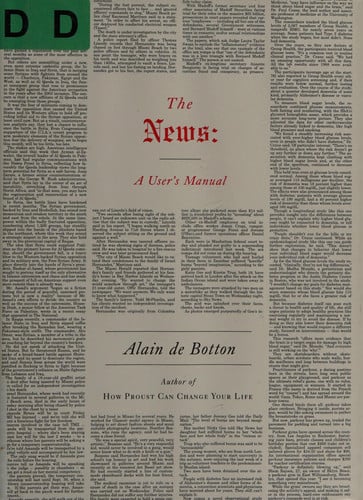
The News A User's Manual

Alain De Botton
From the author of The Architecture of Happiness , a thought-provoking look at the position that news has achieved in our lives. The news is everywhere. We can't stop constantly checking it on our computer screens, but what is this doing to our minds? We are never really taught how to make sense of the torrent of news we face every day, writes Alain de Botton, but this has a huge impact on our sense of what matters and of how we should lead our lives. In his dazzling new book, de Botton takes twenty-five archetypal news stories--including an airplane crash, a murder, a celebrity interview and a political scandal--and submits them to unusually intense analysis with a view to helping us navigate our news-soaked age. He raises such questions as: Why are disaster stories often so uplifting? What makes the love lives of celebrities so interesting? Why do we enjoy watching politicians being brought down? Why are upheavals in far-off lands often so boring? In The News: A User's Manual , de Botton has written the ultimate guide for our frenzied era, certain to bring calm, understanding and a measure of sanity to our daily (perhaps even hourly) interactions with the news machine.
McClelland & Stewart 2014-12-02 272 pages

After the tall timber: collected nonfiction

Adler, Renata
A visionary reporter, novelist, essayist and critic, Renata Adler is one of our most renowned and unmissable literary figures. But she is first and foremost a journalist. This collection of her her non-fiction showcases her rigorous journalistic voice in twenty-one pieces that are concerned with, in her words, misrepresentation, coercion, and abuse of public process - and, to a degree, the journalist's role in it. With a brilliant literary and legal mind, Adler parses power by analysing language: of courts, of journalists, of political figures, of the man on the street. In doing so, she unravels the tangled narratives that pass for the resolution of scandal and finds the threads that others miss. In these essays, Adler draws on Toward a Radical Middle (a selection of her earliest New Yorker pieces), A Year in the Dark (her film reviews), and Canaries in the Mineshaft (a selection of essays on politics and media), as well as uncollected work from the past two decades.
Weidenfeld & Nicolson 2025-02-13 528 pages

Rosset My Life in Publishing and how I Fought Censorship

Barney Rosset
Genet...Beckett...Burroughs...Miller...Ionesco, Oe, Duras. Harold Pinter and Tom Stoppard. Hubert Selby Jr. and John Rechy. The legendary film I Am Curious (Yellow) . The books that assaulted the fort of propriety that was the United States in the 1950s and '60s, Lady Chatterley's Lover and The Tropic of Cancer. The Evergreen Review. Victorian "erotica." The Autobiography of Malcolm X . A bombing, a sit-in, and a near-fistfight with Norman Mailer. The common thread between these disparate elements, a number of which reshaped modern culture, was Barney Rosset. Rosset was the antidote to the trope of the "gentleman publisher" personified by other pioneering figures of the industry such as Alfred A. Knopf, Bennett Cerf and James Laughlin. If Barney saw a crowd heading one way--he looked the other. If he knew something was forbidden, he regarded it as a plus. Unsurprisingly, financial ruin, along with the highs and lows of critical reception, marked his career. But his unswerving dedication to publishing what he wanted made him one of the most influential publishers ever. Rosset began work on his autobiography a decade before his death in 2012, and several publishers and a number of editors worked with him on the project. Now, at last, in his own words, we have a portrait of the man who reshaped how we think about language, literature--and sex. Here are the stories behind the filming of Norman Mailer's Maidstone and Samuel Beckett's Film ; the battles with the US government over Tropic of Cancer and much else; the search for Che's diaries; his romance with the expressionist painter Joan Mitchell, and more. At times appalling, more often inspiring, never boring or conventional: this is Barney Rosset, uncensored. Illustrated with black-and-white photographs; includes index
OR Books, in partnership with Counterpoint Press 2018-02-13 331 pages

Marxism and the French Left Studies on Labour and Politics in France, 1830-1981

Tony Judt
During the 1970s radical politics in France underwent major changes, transformed by the rise of the Socialist Party, the decline of the Communists, and the loss of faith in Marxism. These changes, together with the lessened impact of the industrial proletariat and the problems presented by Mitterrand's sweeping Socialist victory in 1981, signalled a veritable turning point in modern French history. This book offers a historical and political analysis of the history of labor, Socialism, and Communism in France since the Revolution, an analysis that is essential for understanding recent French political developments. Unlike most books, which treat labor, Socialist and Communist history separately and view French Marxism as a self-contained philosophical phenomenon, Marxism and the French Left offers a refreshingly different approach to the subject. Judt emphasizes the complex and interwoven themes that unify the topics of his essays to construct a distinctive and original interpretation of French left-wing politics over the past 150 years.
Oxford University Press, Incorporated 1989 350 pages

Language, Nation and State Identity Politics in a Multilingual Age

T. Judt,D. Lacorne
This edited collection examines the role that language has played in forming modern European nations. With language an omnipresent issue within the European Union, the importance languages have played within the histories and present situations of member nations is a crucial topic. Drawing on an international cast of contributors, the book explores the issues of monolingualism vs. plurilingualism within individual nations, the revival of languages in nations such as former soviet republics, and concludes with a look at language in the electronic age.
Palgrave Macmillan US 2004-12-16 249 pages

Practical Spirituality The Spiritual Basis of Nonviolent Communication

Marshall B. Rosenberg
According to Marshall B. Rosenberg, Ph.D., our most basic spiritual need is to contribute to the well being of others and ourselves. His brief, unscripted reflections on the spiritual basis of Nonviolent Communication (NVC) will inspire you not only to connect with the Divine in yourself and others, but to begin to create a world of empathy and compassion, where the language we use is the key to enriching life. Discover an intensely satisfying and joyful spiritual experience that begins with you. In these rich pages, learn how NVC can help you achieve a more practical, applied spirituality. Discover how to: - Strengthen the connection between your actions and your spiritual values - Let go of enemy images and moralistic judgments, and experience our common humanity - Connect with others from a place of compassionate energy
PuddleDancer Press 2005-04 42 pages

An Introduction to the Study of Language

Leonard Bloomfield
Excerpt from An Introduction to the Study of Language This little book is intended, as the title implies, for the general reader and for the student who is entering upon linguistic work. Its purpose is the same, accordingly, as that of Whitney's Language and the Study of Language and The Life and Growth of Language, hooks which fifty years ago represented the attainments of linguistic science and, owing to their author's clearness of view and conscientious discrimination between ascertained fact and mere surmise, contain little to which we cannot today subscribe. The great progress of our science in the last half-century is, I believe, nevertheless sufficient excuse for my attempt to give a summary of what is now known about language. That the general reader needs such information as is here given was recognized by Whitney, who wrote, in the preface of his first-named book: 'It can hardly admit of question that at least so much knowledge of the nature, history, and classifications of language as is here presented ought to be included in every scheme of higher education.' While questions of a linguistic nature are everywhere a frequent subject of discussion, it is surprising how little even educated people are in touch with the scientific study of language. About the Publisher Forgotten Books publishes hundreds of thousands of rare and classic books. Find more at www.forgottenbooks.com This book is a reproduction of an important historical work. Forgotten Books uses state-of-the-art technology to digitally reconstruct the work, preserving the original format whilst repairing imperfections present in the aged copy. In rare cases, an imperfection in the original, such as a blemish or missing page, may be replicated in our edition. We do, however, repair the vast majority of imperfections successfully; any imperfections that remain are intentionally left to preserve the state of such historical works.
LULU Press 2015-06-14 345 pages

Worlds of Wonder On Writing Science Fiction & Fantasy

David Gerrold
The highest purpose of storytelling is to shift the perception of what's possible in the universe. The writing process is not mysterious. It is not uncontrollable. You just think it is. This book can help. David Gerrold, award-winning screenwriter and novelist, gives advice for would-be science fiction and fantasy writers, covering such topics as setting, plot, character, and dialogue, as well as the mechanics of grammar, tense, sentence structure, and paragraph transition... and why the heck you're writing at all.
Comicmix LLC 2022-02 268 pages

Ascent of the A-Word Assholism, the First Sixty Years

Geoffrey Nunberg
It first surfaced in the gripes of GIs during World War II and was captured early on by the typewriter of a young Norman Mailer. Within a generation it had become a basic notion of our everyday moral life, replacing older reproaches like lout and heel with a single inclusive category––a staple of country outlaw songs, Neil Simon plays, and Woody Allen movies. Feminists made it their stock rebuke for male insensitivity, the est movement used it for those who didn’t “get it,” and Dirty Harry applied it evenhandedly to both his officious superiors and the punks he manhandled. The asshole has become a focus of collective fascination for us, just as the phony was for Holden Caulfield and the cad was for Anthony Trollope. From Donald Trump to Ann Coulter, from Mel Gibson to Anthony Weiner, from the reality TV prima donnas to the internet trolls and flamers, assholism has become the characteristic form of modern incivility, which implicitly expresses our deepest values about class, relationships, authenticity, and fairness. We have conflicting attitudes about the A-word––when a presidential candidate unwittingly uttered it on a live mic in 2000, it confirmed to some that he was a man of the people and to others that he was a boor. But considering how much the word does for us, and to us, it hasn’t gotten nearly the attention it deserves––at least until now.
PublicAffairs 2013-06-11 272 pages

Political Awakenings Conversations with History

Harry Kreisler
As a kid, Noam Chomsky handed out the Daily Mirror at his uncle's newsstand on 72nd Street, inadvertently finding himself in a buzzing intellectual and political hub for European immigrants in New York. Iranian human rights Nobelist Shirin Ebadi and her husband signed their own legal contract, attempting to restore equality to their marriage after the Iranian Revolution effectively erased the legal rights of women. Elizabeth Warren set out to expose those frauds declaring bankruptcy and taking advantage of the system-only to discover, in her research, a very different story of hard-working middle-class families facing economic collapse in the absence of a social safety net. While studying at Oxford, a young Tariq Ali made a bet with a friend that he could work the Vietnam War into every single answer on his final exams. In this rousing, thoughtful, often funny, and always inspiring volume, a diverse and impressive group of thinkers reflect on those formative experiences that shaped their own political commitments. A fascinating new window into the revealing links between the personal and the political, Political Awakenings will engage readers across generations.
ReadHowYouWant.com 2011-03 384 pages