214 results for "American History"

The uses of history: understanding the Soviet Union and Russia

Dallin, Alexander
Exploring Soviet and Russian history, politics, and foreign policy, The Uses of History brings together the classic essays of renowned scholar Alexander Dallin. The author provides insightful analysis and nuanced interpretations of such key-and controversial-issues as the domestic sources of Soviet foreign policy, Stalin's leadership in World War II, Russian-American relations in the Reagan era, the causes of the collapse of the USSR, and the disappointments of Russia's post-Soviet evolution. With his incisive assessment of the biases and blunders in American interpretations, Dallin rejects single-factor explanations for Soviet and Russian domestic and foreign policies, instead examining the complex interplay of internal and external conditions, institutions, mindsets, and the role of individual leaders. All readers interested in Soviet and post-Soviet history will find this collection a stimulating and deeply knowledgeable resource.
Rowman & Littlefield Publishers 2009-10-16 271 pages

The Americanist

Aaron, Daniel
“I have read all of Daniel Aaron’s books, and admired them, but in The Americanist I believe he has composed an intellectual and social memoir for which he will be remembered. His self-portrait is marked by personal tact and admirable restraint: he is and is not its subject. The Americanist is a vision of otherness: literary and academic friends and acquaintances, here and abroad. Eloquently phrased and free of nostalgia, it catches a lost world that yet engendered much of our own.” —Harold Bloom “ The Americanist is the absorbing intellectual autobiography of Daniel Aaron, who is the leading proponent and practitioner of American Studies. Written with grace and wit, it skillfully blends Daniel Aaron’s personal story with the history of the field he has done so much to create. This is a first-rate book by a first-rate scholar.” —David Herbert Donald, Professor Emeritus, Harvard University The Americanist is author and critic Daniel Aaron’s anthem to nearly a century of public and private life in America and abroad. Aaron, who is widely regarded as one of the founders of American Studies, graduated from the University of Michigan, received his Ph.D. from Harvard, and taught for over three decades each at Smith College and Harvard. Aaron writes with unsentimental nostalgia about his childhood in Los Angeles and Chicago and his later academic career, which took him around the globe, often in the role of America’s accidental yet impartial critic. When Walt Whitman, whom Aaron frequently cites as a touchstone, wrote, “I am large, I contain multitudes,” he could have been describing Daniel Aaron—the consummate erudite and Renaissance individual whose allegiance to the truth always outweighs mere partisan loyalty. Not only should Aaron’s book stand as a resplendent and summative work from one of the finest thinkers of the last hundred years, it also succeeds on its own as a first-rate piece of literature, on a par with the writings of any of its subjects. The Americanist is a veritable Who’s Who of twentieth-century writers Aaron interviewed, interacted with, or otherwise encountered throughout his life: Ralph Ellison, Robert Frost, Lillian Hellman, Richard Hofstadter, Alfred Kazin, Sinclair Lewis, Malcolm Muggeridge, John Crowe Ransom, Upton Sinclair, Edmund Wilson, Leonard Woolf, and W. B. Yeats, to name only a few. Aaron’s frank and personal observations of these literary lights make for lively reading. As well, scattered throughout The Americanist are illuminating portraits of American presidents living and passed—miniature masterworks of astute political observation that offer dazzlingly fresh approaches to well-trod subjects.
University of Michigan Press 2007-02-26 199 pages

Democratization in America: a comparative-historical analysis

Desmond King,Robert C. Lieberman,Gretchen Ritter,Laurence Whitehead
The essays in this volume examine democracy’s development in the United States, demonstrating how that process has shaped—and continues to shape—the American political system. Scholars of American politics commonly describe the political development of the United States as exceptional and distinct from that of other advanced industrial democracies. They point to the United States as the longest-lived and most stable liberal democracy in history. What they often fail to mention, though, is that it took considerable time to extend democracy throughout the country. The contributors to this volume suggest that it is intellectually fruitful to consider the U.S. case in comparison to other countries. They argue that the development of democracy is ongoing in America; that even with a written constitution grounded in liberal democracy, the meaning and significance of U.S. democracy are still evolving. This volume shows that democratization and the pursuit of democracy are processes affected by multiple and continuing challenges—including such issues as citizenship, race, institution building, and political movements—as patterns and practices of politics and governance continue to change. This innovative approach contributes significantly to comparative democratization studies, a field normally confined to Latin America and former communist countries. The U.S. case is a unique reference point for students of American political development and comparative democratization.
Johns Hopkins University Press 2009-08-05 337 pages

Views in review: politics and culture in the state of the Jews

Margalit, Avishai
When Zionists first advocated a national home for the Jewish people, they also propounded a revolution in the values that Jews should live by, a whole new way of thinking about Jewish life and Jewish history. Has this revolution in fact occurred? And what the consequences been for Jews and their neighbors? Especially given the extraordinary circumstances that link the United States and Israel, Americans may find the answers to such questions vexing - but the remarkable work of Avishai Margalit goes far to clarify the issues and enlighten the debate. Over the past two decades, Margalit has written major essays for American readers about the political leaders, cultural crises, and historical background of the contemporary Israeli scene. In Views in Review these essays are brought together with new commentary and observations, and their publication in one volume clearly shows that the whole is much more that the sum of its parts. From Ben Gurion to Netanyahu, from "Israeli kitsch" to the meaning of the Holocaust for "the seventh million," Margalit's work traverses the terrain of Israeli life and history and brings a tragically conflicted country into sharp and memorable focus.
Farrar, Straus and Giroux 1998 336 pages

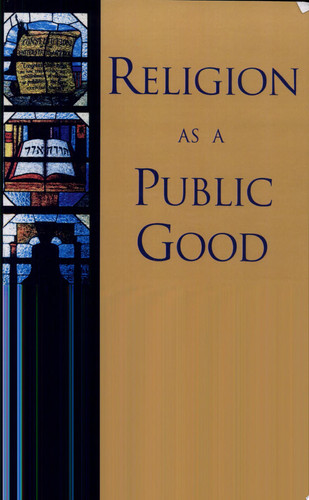
Religion as a public good: Jews and other Americans on religion in the public square

Alan Mittleman
Religion as a Public Good: Jews and Other Americans on Religion in the Public Square explores the often controversial topic of how religion ought to relate to American public life. The sixteen distinguished contributors, both Jewish and Christian, reflect on the topic out of their own disciplines-social ethics, political theory, philosophy, law, history, theology, and sociology. and take a stand based on their religious convictions and political beliefs. The volume is at once scholarly and committed, polemic and civil, reflective and activist. Written in the shadow of 9/11, it invites a new consideration of how religion enhances democratic public life with full awareness of the dangers that religion can sometimes pose. The volume is polemical, as befits the topic, but also civil, as befits a dialogue about an issue of profound significance for democratic citizenship.
Rowman & Littlefield 2003-12-09 336 pages

Antisemitism and the American far left

Norwood, Stephen H.
"Stephen H. Norwood has written the first systematic study of the American far left's role in both propagating and combating antisemitism. This book covers Communists from 1920 onward, Trotskyists, the New Left and its black nationalist allies, and the contemporary remnants of the New Left. Professor Norwood analyzes the deficiencies of the American far left's explanations of Nazism and the Holocaust. He explores far left approaches to militant Islam, from condemnation of its fierce antisemitism in the 1930s to recent apologies for jihad. Norwood discusses the far left's use of long-standing theological and economic antisemitic stereotypes that the far right also embraced. The study analyzes the far left's antipathy to Jewish culture, as well as its occasional efforts to promote it. He considers how early Marxist and Bolshevik paradigms continued to shape American far left views of Jewish identity, Zionism, Israel, and antisemitism"--
Cambridge University Press 2013-08-19 318 pages

The paradox of American democracy: elites, special interests, and the betrayal of the public trust

Judis, John B.
John B. Judis, one of our most insightful political commentators, most rational and careful thinkers, and most engaged witnesses in Washington, has taken on a challenge that even the most concerned American citizens shrink from: forecasting the American political climate at the turn of the century. The Paradox of American Democracy is a penetrating examination of our democracy that illuminates the forces and institutions that once enlivened it and now threaten to undermine it. It is the well-reasoned discussion we need in this era of unrestrained expert opinions and ideologically biased testimony. The disenchantment with our political system can be seen in decreasing voter turnout, political parties co-opted by consultants and large contributors, the corrupting influence of "soft money," and concern for national welfare subverted by lobbying organizations and special-interest groups. Judis revisits particular moments -- the Progressive Era, the New Deal, the 1960s -- to discover what makes democracy the most efficacious and, consequently, most inefficacious. What has worked in the past is a balancing act between groups of elites --- trade commissions, labor relations boards, policy groups -- whose mandates are to act in the national interest and whose actions are governed by a disinterested pursuit of the common good. Judis explains how the displacment of such elites by a new lobbying community in Whashington has given rise to the cynicism that corrodes the current political system. The Paradox of American Democracy goes straight to the heart of every political debate in this country.
Pantheon Books 2000-02-15 305 pages

The dispersion of Egyptian Jewry: culture, politics, and the formation of a modern diaspora

Beinin, Joel
Egypt's indigenous Jewish population comprised Arabic-speaking Rabbanite and Karaite Jews, some of whom had been in the country since the early Islamic era. Jews expelled from Spain in 1492 took refuge in Egypt, and their numbers were augmented in the mid-nineteenth century by Sephardic immigrants. Originally welcomed elsewhere in the Ottoman Empire, these Spanish Jews came to Egypt seeking economic opportunity in the era of Suez Canal construction and the cotton boom. The late nineteenth century brought Ashkenazi Jews fleeing persecution in Eastern Europe. The different groups formed a heterogeneous community of cosmopolitan hybrids, which was both an element of strength and a factor in its eventual demise. The Dispersion of Egyptian Jewry examines the history of the Egyptian Jewish community after 1948, focusing on three major areas: the life of the majority of the community, which remained in Egypt from the1948 Arab-Israeli War until the aftermath of the 1956 Suez/Sinai War; the dispersion and reestablishment of Egyptian Jewish communities in the United states, France, and Israel; and contested memories of Jewish life in Egypt since President Anwar al-Sadat's visit to Jerusalem in 1977. Beinin argues that the experiences of Egyptian Jews cannot be adequately accounted for by either Egyptian nationalist or Zionist narratives. Fusing history, ethnography, literary analysis, and autobiography, Joel Beinin conducts an interdisciplinary investigation into identity, dispersion, and the retrieval of identity that is relevant for anyone interested in Egypt, the Jewish diaspora, or the formation of cultures and identities.
American University in Cairo Press 2005 329 pages

In search of Germany

Michael Mertes,Steven Muller,Heinrich August Winkler
Much that has happened in the world since 1989 gives cause for elation, but there is also much that gives reason for alarm. The euphoria that attended the dismantling of the Berlin Wall and the collapse of communism has been compromised by tragic events in recent years, such as the bitter ethnic rivalries in Yugoslavia, the civil war in Rwanda, and the terrorist bombings in New York City and Oklahoma City. In Search of Germany seeks to accomplish three purposes: to initiate a review of the whole of the post-World War II period and consider what actually happened in the Federal Republic and in the German Democratic Republic during those forty years; to acknowledge that the present "age of anxiety" did not originate in 1989; and to see that Europe today is indeed in trouble and the difficulties that the world is experiencing have social, political, and intellectual roots. In Search of Germany is an augmented and enlarged collection derived from a special issue of Daedalus. Additions that have been made to the book include a chapter by Timothy Garton Ash entitled "Germany's Choice," a concluding section by the editors, and an index. While the book focuses on Germany, it serves a wider purpose as well by also studying Europe, democracy, and modernity. The prejudices and fears of Germany, precisely because they are specific to and yet not peculiar to Germany, tell a great deal of why an earlier European (and American) optimism has been lost, and why so much contemporary political discourse avoids explicit consideration of really sensitive issues. Half a century after the end of World War II, there is interest not only in the policies pursued by the Nazi regime, the crimes it perpetrated throughout Europe, and the suffering it inflicted on hundreds of millions, but also on what preceded that unprecedented tragedy and what has followed it. In Search of Germany is a timely and significant analysis of contemporary world politics and will be necessary reading for political scientists, historians, and scholars of international studies.
Routledge 2018 319 pages

Federalists reconsidered

Ben-Atar, Doron
These essays demonstrate that American political culture was fashioned in a dialogue between Federalists and Jeffersonians. They portray an active Federalist coalition that offered a vibrant intellectual and political alternative throughout the era of the early republic. Cutting across boundaries of region, culture, race, gender, and class, Federalists struggled with the problems of nation building, national identity, and economic development.
University Press of Virginia 1998 310 pages

Inside the Nixon administration: the secret diary of Arthur Burns, 1969-1974

Burns, Arthur F.
As chairman of the Federal Reserve Board in the seventies, Arthur Burns had a unique view of the Nixon administration. Burns first joined the Nixon administration as an advisor in 1969 and was privy to the dynamics of the president's coterie over the course of six tumultuous years. Now the recently released secret diary of this top-level economist offers a surprisingly candid inside look at Richard Nixon's fall. The diary tracks Burns's growing awareness of Nixon's behind-the-scenes maneuverings and worrisome behavior (such as "insane shouting") and reveals how such things undermined his respect and enthusiasm for the president. Perhaps even more telling, Burns's evaluations of his colleagues provide piercing insights into the president's inner circle, including Henry Kissinger ("a brilliant political analyst, but admittedly ignorant of economics"), George Schultz ("a no less confused amateur economist"), John Connally ("a thoroughly confused politician"), and the "vulgarians" H. R. Haldeman and John Ehrlichman-the only people he thought Nixon felt relaxed around. The Burns diary also offers rare and telling glimpses into the era's economy--particularly an account of how Nixon exerted political pressure to shape monetary policies that helped to fuel the stagflation of the 1970s. The administration sought to close the so-called gold window, an approximate valuation of dollars with gold bullion, by floating the dollar, and the consensus over many years has been that Nixon himself arranged this-speculation now confirmed by Burns's diary. It also underscores the growing pressure Burns felt to serve the needs of Nixon's reelection bid rather than the economic welfare of the nation. Sequestered for decades and unavailable until 2008, this document reveals an honest and relatively apolitical man surrounded by partisans in top administrative positions who were dishonest, inept-or both. "The President has many shortcomings," wrote Burns. "He has few convictions, but now and then he gets into a euphoric mood where he wants to persuade himself that he's a statesman. But his sycophantic advisers cannot even recognize that." Deftly annotated by distinguished historian Robert Ferrell, who provides effective historical context and perspective, the Burns diary is a potent-and poignant-testament to the Machiavellian and often Byzantine world of American presidential politics.
University Press of Kansas 2010-10-28 140 pages

A life with history

Blum, John Morton
The author of such classic works as The Republican Roosevelt, V Was for Victory, and Years of Discord, John Morton Blum is one of a small group of intellectuals who for more than a quarter of a century dominated the writing of American political history. Writing now of his own career, Blum provides a behind-the-scenes look at Ivy League education and political power from the 1940s to the 1980s. Blum insightfully recounts a long and distinguished journey that began at Phillips Academy, where he first realized he could make a career of teaching and writing history. He tells how young men were socialized to the values of the Northeastern establishment in those years before World War II, and how as a non-practicing Jew he learned to overcome bigotry both at Andover and at Harvard, which then had no Jewish professors. In 1957 Blum joined the faculty of Yale University's history department, widely regarded as the nation's best, where he became both influential and popular and where his students included one future U.S. president as well as others who aspired to the office. He reveals much about the inner workings of Ivy League education and tells of controversies over the Vietnam War and the Black Panthers, his role in Eugene McCarthy's presidential campaign, and how he searched for common ground between reactionary faculty and radical students. More than a recounting of a singular life, Blum's story explains how political history was researched and written during the second half of the twentieth century, describing how the discipline evolved, gained ascendancy, and was challenged as historical fashions changed. It also offers revealing glimpses of such prominent academics as Kingman Brewster, Arthur Schlesinger, Jr., C. Vann Woodward, and William Sloan Coffin. Over a distinguished career, Blum witnessed considerable change in elite educational institutions, where minorities and women were grossly underrepresented when he first entered academia. In a memoir brimming with insight and laced with humor, he looks back at the academy—"not a refuge from reality but an alternative reality"—as he reflects upon his intellectual journey and his contributions to the study and writing of twentieth-century American history.
University Press of Kansas 2004 283 pages

Conservative at the Core: a new history of American conservatism

Lichtman, Allan J.
"Allan J. Lichtman investigates the foundations and history of conservative thought to identify and reveal the central crisis that lies at the heart of conservative principles and today's politics. He explores a century of American conservative politics to demonstrate that professed conservative principles-free enterprise, limited government, fiscal responsibility, states' rights, law and order, personal morality, and American sovereignty-are dispensable notions for public appeal only. Instead, conservatives have only consistently advanced their version of traditional Christian values and support for private (not free) enterprise. Lichtman provides a sweeping history of the American conservative movement from the end of World War I to the present day. He draws on leaders like Calvin Coolidge, Herbert Hoover, Richard Nixon, Ronald Reagan, George W. Bush, Donald J. Trump, and the conservative Democrats responsible for Jim Crow discrimination in the South. Contrary to those who have described Trump as a deviation from professed core principles, Conservative at the Core ultimately argues that Trump and his allies represents the culmination of the American conservative tradition, consistently upholding and fulfilling conservative nationalist values"-- Provided by publisher.
University of Notre Dame Press 2025-09 364 pages

Democracies and tyrannies of the Caribbean

Krehm, William
William Krehm was a correspondent for Time magazine in the 1940s and during this period he wrote a day-by-day account of what he saw and learned on this assignment. The countries he covered included El Salvador, Guatemala, Costa Rica, Venezuela, Panama, Honduras, the Dominican Republic and Haiti. Very little of what he wrote ever appeared in Time, due to the unwillingness of the magazine's editors at the time to offend the large corporations which had investments in the region, but Krehm's research eventually became a book that vividly describes the tyrannical and corrupt forces that controlled most of the Central American countries, with American support. At the time, no U.S. publisher was willing to issue such a controversial book, but it was translated into Spanish and widely distributed throughout Central and South America. Now it is being published for the first time in English, and it will prove invaluable to those who are closely following historical developments in that very volatile part of the world. Gregorio Selser, the well-known Mexican journalist, introduces each chapter with notes bringing the history of the countries covered up to date and tracing the changes that have taken place. An essential background work.
Lawrence Hill & Co 1984 244 pages

Left out: the politics of exclusion : essays, 1964-2002

Duberman, Martin B.
"One would be hard-pressed to name a more admirable contemporary American example of the intellectual engage than Martin Duberman. Historian, playwright, memoirist, biographer, social commentator, teacher, activist and assured podium performer, Duberman is an unapologetic, uncategorizable and nonsectarian radical whose constant questioning of conventional wisdoms - even on the left - has made him one of this country's pre-eminent participants in the political and cultural wars that have riven public life."â__In These Times"A marvelous collection of a lifetime of courageous writing by a deeply moral and reflective man who has engaged the greatest struggles of our times with an unflinching nerve, a wise heart and a brilliant intellect informed at all times by compassion."â__Jonathan KozolThe lives of â__outsidersâ__ have been the focus of Martin Duberman's work as a public intellectual for the past four decades. Best known for his biography of Paul Robeson, Duberman highlights the "banding together" of the excluded in Left Out. These identity-based movementsâ__black power, gay liberation, feminismâ__have created a vital and controversial change in American consciousness in recent decades. Duberman's collected essays trace this evolution of thought to the history of dissent from abolitionism through the New Left to today's organizing.Presenting summations of Duberman's views on such matters as race, foreign policy, gender and sexuality, Left Out offers incisive analyses of the split between class-based and identity-based politics on the Left. The "godfather" of the gay studies movement, Duberman has taken many brave and prescient stands. His writing shows why he is considered a deeply moral and wise man. For the first time available in paperback, this edition, updated through 2002, includes three new essays: "The State of Gay Studies," "Queer Economic Justice," and "Jewish Radicals, Effeminacy, and the Rise of Gay Chauvinism".
South End Press 2002 504 pages

The politics and public culture of American Jews

Goren, Arthur A.
These strikingly lucid and accessible essays, ranging over nearly a century of Jewish communal life, examine the ways in which immigrant Jews grappled with issues of group survival in an open and accepting American society. Ten case studies focus on Jewish strategies for maintaining a collective identity while participating fully in American society and public life. Readers will find that these essays provide a fresh, provocative, and compelling look at the fundamental question facing American Jewry at the end of the 20th century, as at its start: how to assure Jewish survival in the benign conditions of American freedom.
Indiana University Press 1999 274 pages

The American presidency: an interpretation

Laski, Harold J.
First Published in 1940, The American Presidency is the first full length study of the presidency in action in America to be written by an Englishman. It explains the working of the complicated system over which the President presides and particularly the vexed question of the dual control of foreign relations in the United States. Professor Laski offers a new theory of the place of the presidency in American life and, incidentally, throws light on the inner nature of the other great Anglo-Saxon democracy. His Book is more than a formal description. It is essentially a novel interpretation of the greatest elective office in the democratic world. This is a must-read historical reference work for students of politics, American politics, and American history.
Routledge 2024-09-02 282 pages

Conservatism in America: making sense of the American right

Gottfried, Paul
This book argues that the American conservative movement, as it now exists, does not have deep roots. It began in the 1950s as the invention of journalists and men of letters reacting to the early Cold War and trying to construct a rallying point for likeminded opponents of international Communism. The resulting movement has exaggerated the permanence of its values; while its militant anti-Communism, instilled in its followers, and periodic suppression of dissent have weakened its capacity for internal debate. Their movement came to power at least partly by burying an older anti-welfare state Right, one that in fact had enjoyed a social following that was concentrated in a small-town America. The newcomers played down the merits of those they had replaced; and in the 1980's the neoconservatives, who took over the postwar conservative movement from an earlier generation, belittled their predecessors in a similar way. Among the movement's major accomplishments has been to recreate its own past. The success of this revised history lies in the fact that even the movement's critics are now inclined to accept it.
Palgrave 2007-09-25 189 pages