377 results for "Educational"

Freud and education

Britzman, Deborah P.
The concept of education—its dangers and promises and its illusions and revelations—threads throughout Sigmund Freud’s body of work. This introductory volume by psychoanalytic authority, Deborah P. Britzman, explores key controversies of education through a Freudian approach. It defines how fundamental Freudian concepts such as the psychical apparatus, the drives, the unconscious, the development of morality, and transference have changed throughout Freud’s oeuvre. An ideal text for courses in education studies, human development, and curriculum studies, Freud and Educationconcludes with new Freudian-influenced approaches to the old dilemmas of educational research, theory, and practice.
Routledge 2011 165 pages

Hothouse Kids How the Pressure to Succeed Threatens Childhood

Alissa Quart
A devastating indictment of the “gifted child” myth The effort to produce “gifted” children through an exhausting regimen of early (and ever-earlier) training has grown into a troubling national phenomenon. With less free playtime and overwhelming pressure to achieve, the kids are the ones who suffer. Investigative journalist Alissa Quart knows the terrain firsthand, having herself negotiated the gifted-child label. With phenomenal research and sharp insight, she takes a damning look at the industry that profits from marketing educational products to enhance giftedness and questions the correlation between rigorous early enrichment and higher achievement. A thoughtful, sometimes critical look at the excessive ambition foisted upon children, Hothouse Kids is essential reading for parents, teachers, and anyone concerned about education.
Penguin 2007 260 pages

Tackling selective mutism: a guide for professionals and parents

Benita Rae Smith,Alice Sluckin
Bringing together the latest research and understanding on selective mutism, this edited book gives essential information on the various treatment and therapy options. Experts in the fields of speech and language therapy, psychology, music therapy education and communication offer a wide range of professional perspectives on the condition, while case studies from people with selective mutism, past sufferers and parents reveal the personal impact. The book also clarifies what support a person with selective mutism is likely to need at home, school and in social situations. This definitive volume on selective mutism will be key reading for professionals such as speech and language therapists, educational psychologists, child psychiatrists, child and adolescent mental health workers, teachers, SENCOs and anyone working with selective mutism in therapeutic and educational settings, as well as family members wanting a closer understanding of what selective mutism is and how they can help.
Jessica Kingsley Publishers 2015 308 pages

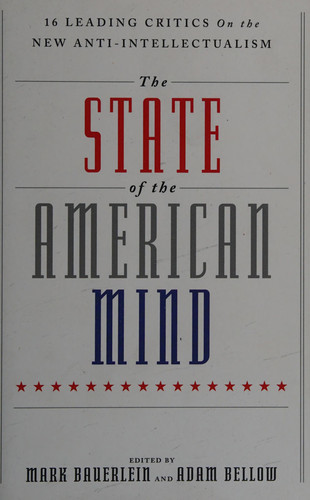
The state of the American mind: 16 leading critics on the new anti-intellectualism

Mark Bauerlein,Adam Bellow
In 1987, Allan Bloom’s The Closing of the American Mind was published; a wildly popular book that drew attention to the shift in American culture away from the tenants that made America—and Americans—unique. Bloom focused on a breakdown in the American curriculum, but many sensed that the issue affected more than education. The very essence of what it meant to be an American was disappearing. That was over twenty years ago. Since then, the United States has experienced unprecedented wealth, more youth enrolling in higher education than ever before, and technology advancements far beyond what many in the 1980s dreamed possible. And yet, the state of the American mind seems to have deteriorated further. Benjamin Franklin’s “self-made man” has become a man dependent on the state. Independence has turned into self-absorption. Liberty has been curtailed in the defense of multiculturalism. In order to fully grasp the underpinnings of this shift away from the self-reliant, well-informed American, editors Mark Bauerlein and Adam Bellow have brought together a group of cultural and educational experts to discuss the root causes of the decline of the American mind. The writers of these fifteen original essays include E. D. Hirsch, Nicholas Eberstadt, and Dennis Prager, as well as Daniel Dreisbach, Gerald Graff, Richard Arum, Robert Whitaker, David T. Z. Mindich, Maggie Jackson, Jean Twenge, Jonathan Kay, Ilya Somin, Steve Wasserman, Greg Lukianoff, and R. R. Reno. Their essays are compiled into three main categories: States of Mind: Indicators of Intellectual and Cognitive Decline These essays broach specific mental deficiencies among the population, including lagging cultural IQ, low Biblical literacy, poor writing skills, and over-medication. Personal and Cognitive Habits/Interests These essays turn to specific mental behaviors and interests, including avoidance of the news, short attention spans, narcissism, and conspiracy obsessions. National Consequences These essays examine broader trends affecting populations and institutions, including rates of entitlement claims, voting habits, and a low-performing higher education system. The State of the American Mind is both an assessment of our current state as well as a warning, foretelling what we may yet become. For anyone interested in the intellectual fate of America, The State of the American Mind offers an accessible and critical look at life in America and how our collective mind is faring.
Templeton Press 2015-06-16 260 pages

Fortunate sons: the 120 Chinese boys who came to America, went to school, and revolutionized an ancient civilization

Leibovitz, Liel
In 1872, the Qing Empire sent 120 boys to America in the hope that they would unlock the mysteries of Western innovation. They studied at New England's finest schools, befriended luminaries such as Mark Twain and Ulysses S. Grant, and exchanged ideas with their American peers that would change the course of both nations. But when anti-Chinese fervor forced them back home, the young men faced a new set of obstacles, having to overcome a suspicious imperial court and a culture deeply resistant to change. Filled with colorful characters and vivid historical detail, this book unearths the dramatic stories of these young men who led China at the pivotal moment when it teetered between modernity and tradition.--From publisher description.
W.W. Norton 2011 319 pages

Continuity in History and Other Essays

Gerschenkron, Alexander
This collection of essays by Alexander Gerschenkron, who has been called “the doyen of economic history in the United States,” is a companion volume to the author’s highly acclaimed Economic Backwardness in Historical Perspective. The essays range over a wide variety of subjects, but the major theme, as in Gerschenkron’s previous book, is the conditions of industrial development, particularly in regard to nineteenth-century Europe. The book is divided into three parts. In Part I, Methodology, the essays are: “On the Concept of Continuity in History,” “Some Methodological Problems in Economic History,” and “Reflections on Ideology as a Methodological and Historical Problem.” Part II, Problems in Economic History, deals with “The Typology of Industrial Development as a Tool of Analysis,” “The Industrial Development of Italy: A Debate with Rosario Romeo,” “The Modernization of Entrepreneurship,” “Russia: Agrarian Policies and Industrialization, 1861–1914,” and “City Economies Then and Now.” In Part III, The Political Framework, the essays are: “Reflections on the Economic Aspects of Revolution,” “The Changeability of a Dictatorship,” and “The Stability of Dictatorships.” A series of appendices presents reviews and review articles by Gerschenkron.
Belknap Press: An Imprint of Harvard University Press 1968-01-01 560 pages

Sociology as political education

Mannheim, Karl
German professors and academic intellectuals are often blamed for passivity or complicity in the National Socialist rise to power. Karl Mannheim was a leading representative of a vital minority of university personalities who devoted themselves to making sociology and higher education contribute to democratization. Sociology as Political Education is both an analytical account of Mannheim's efforts as well as an illustration of the application of sociological knowledge to the world of practical action. Together with a second biographical volume by the editors, forthcoming next season, it comprisesa complete record of Karl Mannheim in the university life of the Weimar period. The comparatively new discipline of sociology was looked upon with favor by the Weimar Republic's reformers of higher education. In advancing its methods Mannheim had first to contend first with prominent and influential figures who attacked sociology as a mere political device to undermine cultural and national values for the sake of narrow interests and partisanship. He then had to meet the objections of fellow sociologists who were convinced that the discipline could prosper only as an area of specialized study with no claim to educational goals beyond the technical reproduction. Finally, he had to separate himself from proponents of politicized sociology. Sociological thought should be rigorous, critical, and attentive to evidence, but, Mannheim argued, its system had to be open and congruent with the ultimate responsibility of human beings for their acts. Loader and Kettler supplement Mannheim's groundbreaking volume with previously untranslated Mannheim texts, among them a transcript of his 1930 sociology course in which Mannheim answered his critics and clarified his intentions. Sociology as Political Education is not only of historical significance, but also shows Mannheim's relevance for current discussions of academic integrity and politicization. This volume will be of interest to sociologists, cultural historians, and political scientists. Colin Loader is professor of sociology at the University of Nevada, Las Vegas. David Kettler is scholar in residence at Bard College and professor emeritus at Trent University. He is the author (with Volker Meja) of Karl Mannheim and the Crisis of Liberalism (available from Transaction).
Transaction Publishers 2001 207 pages

Too soon to tell

Trillin, Calvin
The topical essays of Too Soon to Tell reveal Calvin Trillin at his barbed and irrepressible best. Dealing with matters of the family, he tells the tale of a couple who were at first pleased that their twenty-six-year-old son had finally moved out ("If Jeffrey's going to find himself, it would probably help for him to look somewhere other than his own room") and then realized that they had lost the ability to videotape. Grappling with educational issues, he discusses whether the presence of Michael Milken as a lecturer at the UCLA business school means that its religion department will get around to employing Jim Bakker ("Church Management 101: Imaginative Ideas in Religious Fund-Raising"). In the field of world affairs, he deals with the role of astrologers ("The planets are perfect for trading arms for hostages and saying you didn't") and whether the language laws in Quebec really require the hiring of a mime who doesn't speak French rather than a mime who doesn't speak English. Trillin's short takes send us back to life refreshed and delighted.
Farrar, Straus, Giroux 1995 292 pages

Late love: mating in maturity

Wittenberg-Cox, Avivah
Many women, and a minority of men, are deciding that "adequate" marriages are inadequate. They are driving an explosion of "grey" divorce and remarriage in the over-50s. With children departing into their own journeys and ever-longer lives stretching out ahead, more mature adults are leaping, unconventionally and aspirationally, at a last chance at love. Most of the existing literature discourages them. The dominant mantra of books, counsellors and media is that "staying together" is the superior, admirable choice. They insist that romantic dreams of great sex and soul mates are the Disney-esque yearnings of the naively immature. This book argues the contrary. Great relationships are not only attainable; they are a natural and admirable goal for ageing humans. And if your current mate isn't interested in working with you to craft an ever-deeper and finer partnership, then it may be your mate that requires changing a not your dreams. As a gender expert, Avivah Wittenberg-Cox frames her reflections in the context of an unprecedented, millennial shift in gender relations. As women's educational, social and economic empowerment increases, they continue to demand more for the world a and from it. This is true both at home and at work. Settling for anything less than mutually supportive, seductive and stretching relationships is so yesterday. As the number of late leavers and lovers swells, their thirst for more is redefining what relationships look like in a greying, gender-balanced world. And it looks pretty good. Many women, and a minority of men, are deciding that aadequate' marriages are inadequate. They are driving an explosion of agrey' divorce and remarriage in the over-50s. With children departing into their own journeys and ever-longer lives stretching out ahead, more mature adults are leaping, unconventionally and aspirationally, at a last chance at love. Most of the existing literature discourages them. The dominant mantra of books, counsellors and media is that astaying together' is the superior, admirable choice. They insist that romantic dreams of great sex and soul mates are the Disney-esque yearnings of the naively immature. This book argues the contrary. Great relationships are not only attainable; they are a natural and admirable goal for ageing humans. And if your current mate isn't interested in working with you to craft an ever-deeper and finer partnership, then it may be your mate that requires changing a not your dreams. As a gender expert, Avivah Wittenberg-Cox frames her reflections in the context of an unprecedented, millennial shift in gender relations. As women's educational, social and economic empowerment increases, they continue to demand more for the world a and from it. This is true both at home and at work. Settling for anything less than mutually supportive, seductive and stretching relationships is so yesterday. As the number of late leavers and lovers swells, their thirst for more is redefining what relationships look like in a greying, gender-balanced world. And it looks pretty good.
Motivational Press 2018-02-14 198 pages

Innovations in educational psychology: perspectives on learning, teaching, and human development

David D. Preiss, PhD,Robert J. Sternberg, PhD
The book comprehensively reviews some of the most exciting, state-of-the-art developments in educational psychology and applied cognitive science. Drawing on research methods and perspectives ranging from education and psychology to artificial intelligence and economics, these forward-looking work encompasses a breadth of knowledge that links teaching, learning, and human development. Chapters authors, culled from the best educational researchers across the globe, present cutting-edge findings from cognitive science research that center in critical thinking, the relationship between schooling and human mental development, cultural considerations in education, and much more. Both psychologists and researchers in the fields of cognitive, developmental, educational, and cultural psychology will want this groundbreaking resource on their bookshelves. - Back cover
Springer Pub 2010-01-26 476 pages

The test: why our schools are obsessed with standardized testing - but you don't have to be

Kamenetz, Anya
"[The anti-testing] movement now has a guidebook. . . . Kamenetz shows how fundamentally American it would be to move toward a more holistic system." - New York Times Book Review The Test is an essential and critically acclaimed book for any parent confounded by our national obsession with standardized testing. It recounts the shocking history and tempestuous politics of testing and borrows strategies from fields as diverse as games, neuroscience, and ancient philosophy to help children cope. It presents the stories of families, teachers, and schools maneuvering within and beyond the existing educational system, playing and winning the testing game. And it points the way toward a hopeful future of better tests and happier kids.
PublicAffairs 2016-01-05 272 pages

Into the tempest: essays on the new global capitalism

Robinson, William I.
In this critical new work, sociologist William I. Robinson offers an engaging and accessible introduction to his theory of global capitalism. He applies this theory to a wide range of contemporary topics, among them, globalization, the trans- national capitalist class, immigrant justice, educational reform, labor and anti-racist struggles, policing, Trumpism, the resurgence of a neo-fascist right, and the rise of a global police state. Sure to spark debate, this is a timely contribution to a renewal of critical social science and Marxist theory for the new century. William I. Robinson's many award-winning books include: Global Capitalism and the Crisis of Humanity (2014), Latin America and Global Capitalism (2008), and A Theory of Global Capitalism (2004).
Haymarket Books 2019 270 pages

Religion and the Public Schools

Paul A. Freund,Robert Ulich
In "Constitutional Mandates and Choices," Paul Freund discusses the recent Supreme Court school-prayer decisions and the Constitution. Acknowledging the need for instilling tradition, morality, and reverence-the "religious component" called for by many-Freund still maintains that "the school-prayer decisions are more important for the doors they leave open than for those they shut. The study of religious tradition, training in moral analysis, and the cultivation of sensibilities beyond the intellectual are all left open and beckoning... Today the need is not to reform the First Amendment but to examine and reform our ideas and practices of moral education in the schools." After presenting a brief historical description of religious education in our Western Judeo-Christian civilization, and outlining the present situation in our public schools, Mr. Ulich, in "The Historical Present," declares that if by "religion" we do not mean allegiance to a particular creed, then, "whatever is the decision of the Supreme Court, it will never be able to divorce the religious from the educational spheres in our education system."
Harvard University Press 1965 84 pages

Out of control: a 15-year battle against control unit prisons

Kurshan, Nancy
The men held captive in the Marion control unit lived in an 8 x 10 foot cell for about 23 hours a day, seven days a week. There was no contact with other human beings. There was no way to know when it would end. Days, months, years would go by... Out of Control: A Fifteen-Year Battle Against Control Unit Prisons tells the inspiring story of the Committee to End the Marion Lockdown (CEML). Founded in 1985 to organize against control unit prisons and related inhumane practices at the notorious federal prison in Marion, Illinois, the committee's work and influence spread nationwide, even as the practices at Marion became widespread in many other prisons in the U.S. and internationally. Written in a very accessible and eloquent style by Nancy Kurshan, a CEML co-founder and leading activist throughout its history, the book recounts how the committee led and organized hundreds of educational programs and demonstrations in many parts of the country and sought to build a national movement to expose and abolish "end-of-the-line" prisons. Along the way the Committee wrote thousands of pages of educational and agitational literature, and developed new ways of analyzing and fighting against the "prison industrial complex."
Freedom Archives 2013 229 pages

The crusade against slavery, 1830-1860

Filler, Louis
Perhaps no other crusade in the history of the U.S. provoked so much passion and fury as the struggle over slavery. Many of the problems that were a part of that great debate are still with us. Louis Filler has brought together much information both known and new on those who organized to defeat slavery. He has also re-examined the anti-slavery movement's ideals, heroes, and martyrs with historical perspective and precision. Contrary to popular belief, the anti-slavery movement was far from united. It included abolitionists as well as a variety of reformers whose activities place them among the anti-slavery forces. These included men as different in background and temperament as William Lloyd Garrison and John Quincy Adams. Portraits of the many protagonists, their hardships, and their quarrels with Southerners and Northerners alike, bring to life this exciting and tumultuous period. Filler also examines the many related reform movements that characterized the period: feminism, spiritualism, utopian societies, and educational reform. The volume traces the relationship of the antislavery movement to abolition and probes their connection with the several reforms that dominated the period. He brilliantly recaptures a sense of the contemporary consequences of the reformers efforts. This is an absorbing and important survey of the problems—political, social, and economic—that made this period so crucial in the history of the U.S.
Transaction Publishers 2011 318 pages