14302 results for "History"

Dark money: the hidden history of the billionaires behind the rise of the radical right

Mayer, Jane
Why is America living in an age of profound economic inequality? Why, despite the desperate need to address climate change, have even modest environmental efforts been defeated again and again? Why have protections for employees been decimated? Why do hedge-fund billionaires pay a far lower tax rate than middle-class workers? --Publisher.
Doubleday 2016 449 pages

The Sopranos sessions

Seitz, Matt Zoller,Sepinwall, Alan
A mobster walked into a psychiatrist's office ... No, it wasn't the start of a joke: it was the start of a program that changed TV history. By shattering preconceptions about the kinds of stories the medium should tell, The Sopranos launched our current age of prestige television. Television critics Alan Sepinwall and Matt Zoller Seitz were among the first to write about the series before it became a cultural phenomenon. To celebrate the twentieth anniversary of the show's debut, they reunite to produce a collection of recaps, conversations, and critical essays covering every episode, as well as new interviews with series creator David Chase. They explore the show's artistry, themes, and legacy, examining its portrayal of Italian Americans, its graphic depictions of violence, and its deep connection to other cinematic and television classics.
Abrams Press 2019-01-08 471 pages

Don't panic: Douglas Adams & the hitchiker's guide to the galaxy

Gaiman, Neil
This is the story of an ape-descended human called Douglas Adams who, in a field in Innsbruck in 1971, had an idea. This is also the story of what that idea became: The Hitchhiker's Guide to the Galaxy - of the original radio series which started it all and the five book trilogy, the TV series, almost-film, computer game, towel and website that followed. This revised edition comes up to date, covering Adams' recent work, his untimely death in May 2001 and posthumous publications.
Titan 2002 242 pages

Cue the sun! the invention of reality TV

Nussbaum, Emily
"From beloved New Yorker TV critic Emily Nussbaum comes a groundbreaking narrative detailing the fights, egos, drama, and future presidents of reality television. Cue the Sun is a rollicking, deeply reported story about how the early reality TV business metastasized into an industry that now dominates entertainment in the United States. Starting in 1948, Nussbaum pulls back the curtain on the cultural meat grinder that created a generation-defining form of entertainment, examining shows from The Real World to Survivor to The Apprentice. Through extensive interviews, Nussbaum follows the reality TV industry from its inception with shows like Candid Camera to its 90s heyday and 00s aftermath. The book dives into some of the industry's most remarkable stories--for instance, the one where a serial killer on the run once appeared on The Dating Game"--
Random House 2024-06-25 440 pages

Leonardo da Vinci

Isaacson, Walter
"He was history's most creative genius. What secrets can he teach us? The author of the acclaimed bestsellers Steve Jobs, Einstein, and Benjamin Franklin brings Leonardo da Vinci to life in this exciting new biography. Based on thousands of pages from Leonardo's astonishing notebooks and new discoveries about his life and work, Walter Isaacson weaves a narrative that connects his art to his science. He shows how Leonardo's genius was based on skills we can improve in ourselves, such as passionate curiosity, careful observation, and an imagination so playful that it flirted with fantasy. He produced the two most famous paintings in history, The Last Supper and the Mona Lisa. But in his own mind, he was just as much a man of science and technology. With a passion that sometimes became obsessive, he pursued innovative studies of anatomy, fossils, birds, the heart, flying machines, botany, geology, and weaponry. His ability to stand at the crossroads of the humanities and the sciences, made iconic by his drawing of Vitruvian Man, made him history's most creative genius"--
Simon & Schuster 2017-10-17 599 pages

From Beirut to Jerusalem

Friedman, Thomas L.
National Bestseller Winner of the National Book Award Updated with a New Chapter Author of The World Is Flat and That Used to Be Us One of the most thought-provoking books ever written about the Middle East, From Beirut to Jerusalem remains vital to our understanding of this complex and volatile region of the world. Three-time Pulitzer Prize winner Thomas L. Friedman drew upon his ten years of experience reporting from Lebanon and Israel to write this now-classic work of journalism. Rich with anecdote, history, analysis, and autobiography, From Beirut to Jerusalem will continue to shape how we see the Middle East for many years to come.
Picador 2012-01-17 632 pages

Marvel masterworks presents The Incredible Hulk. Volume 1. 1962-64

Lee, Stan
Collecting classic tales from the 60s, this volume is timed to coincide with Marvel's brand new Hulk movie due for release June 20th 2008. Featuring the works of Stan Lee, Jack Kirby and Steve Ditko, it plots the origins of The Incredible Hulk, including his very first appearance. Perfect for seasoned comic fans and new-comers alike, this is an essential read for those wanting to experience the rise of the most famous monster in comic history.
Panini Publishing 2008 209 pages

Abraham Lincoln: Vampire Hunter

Seth Grahame-Smith
Indiana, 1818. Moonlight falls through the dense woods that surround a one-room cabin, where a nine-year-old Abraham Lincoln kneels at his suffering mother's bedside. She's been stricken with something the old-timers call "Milk Sickness." "My baby boy..." she whispers before dying. Only later will the grieving Abe learn that his mother's fatal affliction was actually the work of a vampire. When the truth becomes known to young Lincoln, he writes in his journal, " henceforth my life shall be one of rigorous study and devotion. I shall become a master of mind and body. And this mastery shall have but one purpose ..." Gifted with his legendary height, strength, and skill with an ax, Abe sets out on a path of vengeance that will lead him all the way to the White House. While Abraham Lincoln is widely lauded for saving a Union and freeing millions of slaves, his valiant fight against the forces of the undead has remained in the shadows for hundreds of years. That is, until Seth Grahame-Smith stumbled upon The Secret Journal of Abraham Lincoln , and became the first living person to lay eyes on it in more than 140 years. Using the journal as his guide and writing in the grand biographical style of Doris Kearns Goodwin and David McCullough, Seth has reconstructed the true life story of our greatest president for the first time-all while revealing the hidden history behind the Civil War and uncovering the role vampires played in the birth, growth, and near-death of our nation.
Grand Central Publishing 2011-04-19 352 pages

Waking up: a guide to spirituality without religion

Harris, Sam
For the millions of Americans who want spirituality without religion, Sam Harris's new book is a guide to meditation as a rational spiritual practice informed by neuroscience and psychology. Waking Up is for the 30 percent of Americans who follow no religion, but who suspect that Jesus, Buddha, Lao Tzu, Rumi, and the other saints and sages of history could not have all been epileptics, schizophrenics, or frauds. Throughout the book, Harris argues that there are important truths to be found in the experiences of such contemplatives -- and, therefore, that there is more to understanding reality than science and secular culture generally allow. Waking Up is part seeker's memoir and part exploration of the scientific underpinnings of spirituality
Bantam Press 2014 245 pages

Waking up: a guide to spirituality without religion

Harris, Sam
For the millions of Americans who want spirituality without religion, Sam Harris's new book is a guide to meditation as a rational spiritual practice informed by neuroscience and psychology. Waking Up is for the 30 percent of Americans who follow no religion, but who suspect that Jesus, Buddha, Lao Tzu, Rumi, and the other saints and sages of history could not have all been epileptics, schizophrenics, or frauds. Throughout the book, Harris argues that there are important truths to be found in the experiences of such contemplatives -- and, therefore, that there is more to understanding reality than science and secular culture generally allow. Waking Up is part seeker's memoir and part exploration of the scientific underpinnings of spirituality
Simon & Schuster 2014 245 pages

The Warburgs: the twentieth-century odyssey of a remarkable Jewish family

Chernow, Ron
From the Pulitzer Prize–winning bestselling author of Alexander Hamilton , the inspiration for the hit Broadway musical, comes this definitive biography of the Warburgs, one of the great German-Jewish banking families of the twentieth century. Bankers, philanthropists, scholars, socialites, artists, and politicians, the Warburgs stood at the pinnacle of German (and, later, of German-American) Jewry. They forged economic dynasties, built mansions and estates, assembled libraries, endowed charities, and advised a German kaiser and two American presidents. But their very success made the Warburgs lightning rods for anti-Semitism, and their sense of patriotism became increasingly dangerous in a Germany that had declared Jews the enemy. Ron Chernow's hugely fascinating history is a group portrait of a clan whose members were renowned for their brilliance, culture, and personal energy yet tragically vulnerable to the dark and irrational currents of the twentieth century.
Vintage Books, a division of Random House LLC 2016-11-15 820 pages

The years of Lyndon Johnson

Caro, Robert A.
The Years of Lyndon Johnson is the political biography of our time. No president—no era of American politics—has been so intensively and sharply examined at a time when so many prime witnesses to hitherto untold or misinterpreted facets of a life, a career, and a period of history could still be persuaded to speak. The Path to Power, Book One, reveals in extraordinary detail the genesis of the almost superhuman drive, energy, and urge to power that set LBJ apart. Chronicling the startling early emergence of Johnson’s political genius, it follows him from his Texas boyhood through the years of the Depression in the Texas hill Country to the triumph of his congressional debut in New Deal Washington, to his heartbreaking defeat in his first race for the Senate, and his attainment, nonetheless, of the national power for which he hungered. We see in him, from earliest childhood, a fierce, unquenchable necessity to be first, to win, to dominate—coupled with a limitless capacity for hard, unceasing labor in the service of his own ambition. Caro shows us the big, gangling, awkward young Lyndon—raised in one of the country’s most desperately poor and isolated areas, his education mediocre at best, his pride stung by his father’s slide into failure and financial ruin—lunging for success, moving inexorably toward that ultimate “impossible” goal that he sets for himself years before any friend or enemy suspects what it may be. We watch him, while still at college, instinctively (and ruthlessly) creating the beginnings of the political machine that was to serve him for three decades. We see him employing his extraordinary ability to mesmerize and manipulate powerful older men, to mesmerize (and sometimes almost enslave) useful subordinates. We see him carrying out, before his thirtieth year, his first great political inspiration: tapping-and becoming the political conduit for-the money and influence of the new oil men and contractors who were to grow with him to immense power. We follow, close up, the radical fluctuations of his relationships with the formidable “Mr. Sam” Raybum (who loved him like a son and whom he betrayed) and with FDR himself. And we follow the dramas of his emotional life-the intensities and complications of his relationships with his family, his contemporaries, his girls; his wooing and winning of the shy Lady Bird; his secret love affair, over many years, with the mistress of one of his most ardent and generous supporters . . . Johnson driving his people to the point of exhausted tears, equally merciless with himself . . . Johnson bullying, cajoling, lying, yet inspiring an amazing loyalty . . . Johnson maneuvering to dethrone the unassailable old Jack Garner (then Vice President of the United States) as the New Deal’s “connection” in Texas, and seize the power himself . . . Johnson raging . . . Johnson hugging . . . Johnson bringing light and, indeed, life to the worn Hill Country farmers and their old-at-thirty wives via the district’s first electric lines. We see him at once unscrupulous, admirable, treacherous, devoted. And we see the country that bred him: the harshness and “nauseating loneliness” of the rural life; the tragic panorama of the Depression; the sudden glow of hope at the dawn of the Age of Roosevelt. And always, in the foreground, on the move, LBJ. Here is Lyndon Johnson—his Texas, his Washington, his America—in a book that brings us as close as we have ever been to a true perception of political genius and the American political process.
Knopf 1982-11-12 882 pages

Master of the Senate

Caro, Robert A.
Master of the Senate, Book Three of The Years of Lyndon Johnson, carries Johnson’s story through one of its most remarkable periods: his twelve years, from 1949 to 1960, in the United States Senate. A Los Angeles Times Best Nonfiction Book of the Last 30 Years At the heart of the book is its unprecedented revelation of how legislative power works in America, how the Senate works, and how Johnson, in his ascent to the presidency, mastered the Senate as no political leader before him had ever done. It was during these years that all Johnson’s experience—from his Texas Hill Country boyhood to his passionate representation in Congress of his hardscrabble constituents to his tireless construction of a political machine—came to fruition. Caro introduces the story with a dramatic account of the Senate itself: how Daniel Webster, Henry Clay, and John C. Calhoun had made it the center of governmental energy, the forum in which the great issues of the country were thrashed out. And how, by the time Johnson arrived, it had dwindled into a body that merely responded to executive initiatives, all but impervious to the forces of change. Caro anatomizes the genius for political strategy and tactics by which, in an institution that had made the seniority system all-powerful for a century and more, Johnson became Majority Leader after only a single term-the youngest and greatest Senate Leader in our history; how he manipulated the Senate’s hallowed rules and customs and the weaknesses and strengths of his colleagues to change the “unchangeable” Senate from a loose confederation of sovereign senators to a whirring legislative machine under his own iron-fisted control. Caro demonstrates how Johnson’s political genius enabled him to reconcile the unreconcilable: to retain the support of the southerners who controlled the Senate while earning the trust—or at least the cooperation—of the liberals, led by Paul Douglas and Hubert Humphrey, without whom he could not achieve his goal of winning the presidency. He shows the dark side of Johnson’s ambition: how he proved his loyalty to the great oil barons who had financed his rise to power by ruthlessly destroying the career of the New Dealer who was in charge of regulating them, Federal Power Commission Chairman Leland Olds. And we watch him achieve the impossible: convincing southerners that although he was firmly in their camp as the anointed successor to their leader, Richard Russell, it was essential that they allow him to make some progress toward civil rights. In a breathtaking tour de force, Caro details Johnson’s amazing triumph in maneuvering to passage the first civil rights legislation since 1875. Master of the Senate, told with an abundance of rich detail that could only have come from Caro’s peerless research, is both a galvanizing portrait of the man himself—the titan of Capital Hill, volcanic, mesmerizing—and a definitive and revelatory study of the workings and personal and legislative power.
Knopf 2002-04-23 1167 pages

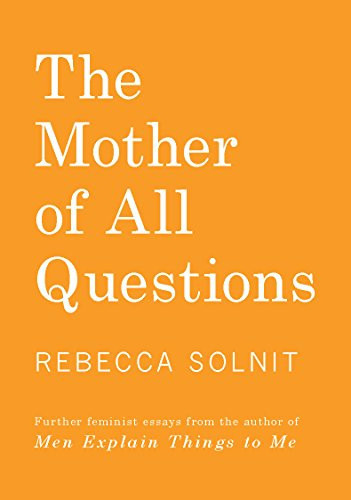
The Mother of All Questions

Rebecca Solnit
In a timely follow-up to her national bestseller Men Explain Things to Me, Rebecca Solnit offers indispensable commentary on women who refuse to be silenced, misogynistic violence, the fragile masculinity of the literary canon, the gender binary, the recent history of rape jokes, and much more. In characteristic style, Solnit mixes humor, keen analysis, and powerful insight in these essays.
Haymarket Books 2019-09-20 192 pages

Hope in the dark: untold histories, wild possibilities

Solnit, Rebecca
With Hope in the Dark, Rebecca Solnit makes a radical case for hope as a commitment to act in a world whose future remains uncertain and unknowable. Drawing on her decades of activism and a wide reading of environmental, cultural, and political history, Solnit argued that radicals have a long, neglected history of transformative victories, that the positive consequences of our acts are not always immediately seen, directly knowable, or even measurable, and that pessimism and despair rest on an unwarranted confidence about what is going to happen next.
Haymarket Books 2016 152 pages

On Fire The (Burning) Case for a Green New Deal

Naomi Klein
#1 New York Times and internationally bestselling author Naomi Klein makes the case for a Green New Deal in this “keenly argued, well-researched, and impassioned” manifesto ( The Washington Post ). An instant bestseller, On Fire shows Klein at her most prophetic and philosophical, investigating the climate crisis not only as a profound political challenge but also as a spiritual and imaginative one. Delving into topics ranging from the clash between ecological time and our culture of “perpetual now,” to the soaring history of humans changing and evolving rapidly in the face of grave threats, to rising white supremacy and fortressed borders as a form of “climate barbarism,” this is a rousing call to action for a planet on the brink. An expansive, far-ranging exploration that sees the battle for a greener world as indistinguishable from the fight for our lives, On Fire captures the burning urgency of the climate crisis, as well as the fiery energy of a rising political movement demanding a catalytic Green New Deal. “Naomi Klein’s work has always moved and guided me. She is the great chronicler of our age of climate emergency, an inspirer of generations.” —Greta Thunberg, climate activist "If I were a rich man, I’d buy 245 million copies of Naomi Klein’s 'On Fire' and hand-deliver them to every eligible voter in America…Klein is a skilled writer." —Jeff Goodell, The New York Times
Simon and Schuster 2020-09-01 336 pages

Donald Trump v. the United States: inside the struggle to stop a President

Schmidt, Michael S. (Journalist)
"In the early days of the Trump presidency, the people who work in the institutions that make America America saw Trump up close in the Oval Office and became convinced that they had to stand up to an unbound president. These officials faced a situation without parallel in American history: What do you do, and who do you call, if you are the only one standing between the president, his extraordinary powers, and the abyss? Michael S. Schmidt's Donald Trump v. The United States tells the dramatic, high-stakes story of those who felt compelled to confront and try to contain the most powerful man in the world as he shredded norms and sought to expand his power." -- inside front jacket flap.
Random House 2023 471 pages