2220 results for "History"

James Stern Killen the Kkk

James Stern
An evil man's appetite for hate dose not choose who he hates, all things and people fulfi l his hunger to do evil. While we go about debating what right or wrong, there are those who could care less about that debate and simply carry out evil for no cause other than they are evil. This book contains historical answers about a time only the Imperial Wizard of the KKK himself could answer. The letters Killen wrote to James Stern while they were incarcerated answers the long standing questions about Mississippi Burning that was turned into a movie based on a true case. WHO, WHAT, WHERE, WHY. This book covers from civil rights to modern day Gang wars, to fi nally disbanding the KKK.
Racial Reconciliation Outreach Ministries 1918-04-19 256 pages

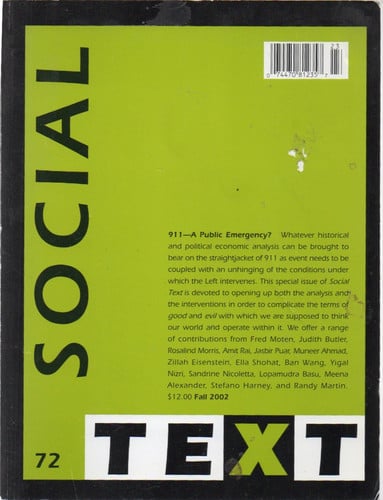
911 a Public Emergency?

Brent Hayes Edwards,Stefano Harney,Randy Martin,Ella Shohat,Timothy Mitchell,Fred Moten
Since September 11, public discourse has often been framed in terms of absolutes: an age of innocence gives way to a present under siege, while the United States and its allies face off against the Axis of Evil. This special issue of Social Text aims to move beyond these binaries toward thoughtful analysis. The editors argue that the challenge for the Left is to develop an antiterrorism stance that acknowledges the legacy of U.S. trade and foreign policy as well as the diversity of the Muslim faith and the dangers presented by fundamentalism of all kinds. Examining the strengths and shortcomings of area, race, and gender studies in the search for understanding, this issue considers cross-cultural feminism as a means of combating terrorism; racial profiling of Muslims in the context of other racist logics; and the homogenization of dissent. The issue includes poetry, photographic work, and an article by Judith Butler on the discursive space surrounding the attacks of September 11. This impressive range of contributions questions the meaning and implications of the events of September 11 and their aftermath. Contributors . Muneer Ahmad, Meena Alexander, Lopamudra Basu, Judith Butler, Zillah Eisenstein, Stefano Harney, Randy Martin, Rosalind C. Morris, Fred Moten, Sandrine Nicoletta, Yigal Nizri, Jasbir K. Puar, Amit S. Rai, Ella Shohat, Ban Wang
Duke University Press 2002-09-20 208 pages

The unveiling of the national icons: a plea for patriotic iconoclasm in a nationalist era

Boime, Albert
In The Unveiling of the National Icons, Albert Boime analyses the creation and reception of several American national monuments as a means of understanding the politics of memory and national icons. In engaging, 'behind the scenes' accounts of several highly visible symbols, such as the American flag, the Statue of Liberty, and Mount Rushmore, among others, he demonstrates how these icons have been manipulated for patriotic purposes. Boime also shows how these monuments express individual and collective needs and how they are subject to contested readings, despite their origins in the creative imaginations of conservatives and privileged members of America. Examining these symbols as a group for the first time, this book is also the first serious investigation of visual artifacts that are too often taken for granted.
Cambridge University Press 1998 427 pages

Contemporary Jewish philosophies

Kaufman, William E.
New forms of Jewish philosophic inquiry in response to the Holocaust, the American Jewish experience, and the establishment of the State of Israel, present a necessity for a clear and comprehensive framework in which contemporary Jewish thought may be studied. This is what William E. Kaufman has done in "Contemporary Jewish Philosophies". Examining the present parameters of Jewish thought – Existentialism, naturalism, supernaturalism, and transnaturalism – he formulates the criteria for dealing with modern Jewish thinking. He traces the effects of this new philosophic vocabulary through the writings of such established luminaries as Franz Rosenzweig, Martin Buber, Leo Baeck, and Mordecai Kaplan as well as seeking the sources of the thought of such contemporary figures as Emil Fackenheim, Jacob Agus, Arthur Cohen, Eugene Borowitz, Richard Rubenstein, and Abraham Joshua Heschel in the traditional roots of covenant, salvation, and transcendence. Dr. Kaufman deals in depth with the age-old questions: What conception of God can I accept? What is the relation of God to the universe? How shall we concieve the relation of man to God? But he goes further still. What is salvation in light of the Holocaust and the establishment of Israel? Can we find an analogue in the past to the situation of Jews today? Probing these questions, along with the primary concerns of Jewish philosophy, he illumines and enlivens the complex dialogues which from the basis of Jewish philosophic thought. Each philosopher is analyzed and critiqued, utilizing a a uniform criteria which focuses the key concerns and commentaries of each in relation to the entire realm of Jewish thought today. "Contemporary Jewish Philosophies" in essential not only to the student of philosophy but to the reader who is seriously concerned with confronting today's problems with today's sensibility. --
Reconstructionist Press 1976 276 pages

Another little piece of my heart: my life of rock and revolution in the '60s

Goldstein, Richard
"In 1966, at the ripe age of 22, Richard Goldstein approached The Village Voice with a novel idea. "I want to be a rock critic," he said. "What's that?" the editor replied. It was a logical question, since rock criticism didn't yet exist. In the weekly column he would produce for the Voice, Goldstein became the first person to write regularly in a major publication about the music that changed our lives. He believed deeply in the power of rock, and, long before it was acceptable, he championed the idea that this music was a serious art form. From his unique position in journalism, he saw the full arc of events that shaped culture and politics in the 1960s--and participated in them, too. He toured with Janis Joplin, spent a day at the Grateful Dead house in San Francisco, and dropped acid with Brian Wilson and the Beach Boys. He was present for Martin Luther King's "I Have a Dream" speech, the student uprising at Columbia, and the riots at the 1968 Democratic Convention. He was challenged to a boxing match by Norman Mailer, and took Susan Sontag to her first disco. Goldstein developed close relationships with several rock legends--Janis Joplin and Jim Morrison, to name two--and their early deaths came as a wrenching shock, fueling his disillusionment as he watched the music he loved rapidly evolve from a communal rite to a vast industry--and the sense of hope for radical social upheaval fade away. Another Little Piece of My Heart is the intimate memoir of the writer as a young man with profound ambition. It is also a sweeping personal account of a decade that no one else could provide--a deeply moving, unparalleled document of rock and revolution in America"--
Bloomsbury USA 2015-04-14 223 pages

A Question of quality: popularity and value in modern creative writing

Filler, Louis
This collection of essays probes the values in a variety of authors who have had in common the fact of popularity and erstwhile reputation. Why were they esteemed? Who esteemed them? And what has become of their reputations, to readers, to the critic himself? No writer here has been asked to justify the work of his subject, and reports and conclusions about this wide variety of creative writers vary, sometimes emphasizing what the critic believes to be enduring qualities in the subject, in several cases finding limitations in what that writer has to offer us today.
Bowling Green University Popular Press 1976 193 pages