4260 results for "World History"

The lost tribes of Israel: the history of a myth

Parfitt, Tudor
Tudor Parfitt examines a myth which is based on one of the world's oldest mysteries - what happened to the lost tribes of Israel? Christians and Jews alike have attached great importance to the legendary fate of these tribes which has had a remarkable impact on their ideologies throughout history. Each tribe of Israel claimed descent from one of the twelve sons of Jacob and the land of Israel was eventually divided up between them. Following a schism which formed after the death of Solomon, ten of the tribes set up an independent northern kingdom, whilst those of Judah and Levi set up a separate southern kingdom. In 721BC the ten northern tribes were ethnically cleansed by the Assyrians and the Bible states they were placed: 'in Halah and in Habor by the river of Gozan and in the city of Medes.' The Bible also foretold that one day they would be reunited with the southern tribes in the final redemption of the people of Israel. Their subsequent history became a tapestry of legend and hearsay. The belief persisted that they had been 'lost' in some remote part of the world and there were countless suggestions and claims as to where. At a lecture Parfitt gave some years ago in Cape Town he was approached by a group of Africans who claimed to be members of the Lemba tribe from a mysterious lost city of Sena, and of Jewish descent. The final chapter will attempt to reveal, using a combination of linguistics and genetics, what did become of these lost tribes.
Weidenfeld & Nicolson 2002 277 pages

Terms of survival: the Jewish world since 1945

Robert S. Wistrich
"The emergence of the state of Israel has fundamentally changed the conditions of Jewish existence. The issues now facing Jews everywhere are totally different to those that confronted them only fifty years ago.This book provides the only thoroughly worldwide modern history of the Jews of the Diaspora. Robert Wistrich has drawn together an outstanding collection of authors from the United States, Europe and Israel in order to analyse the immense changes that have taken place since 1945 in a comprehensive, yet original, manner.Cultural, religious, domestic, political, economic and occupational transformations in Jewry are addressed in up-to-date studies.Terms of Survival reframes the nature of the debate by highlighting continuity and change in the position of the Jews throughout the world." --
Routledge 1995 461 pages

World Without Fish

Mark Kurlansky
A KID’S GUIDE TO THE OCEAN "Can you imagine a world without fish? It's not as crazy as it sounds. But if we keep doing things the way we've been doing things, fish could become extinct within fifty years. So let's change the way we do things!" World Without Fish is the uniquely illustrated narrative nonfiction account—for kids—of what is happening to the world’s oceans and what they can do about it. Written by Mark Kurlansky, author of Cod, Salt, The Big Oyster , and many other books, World Without Fish has been praised as “urgent” ( Publishers Weekly ) and “a wonderfully fast-paced and engaging primer on the key questions surrounding fish and the sea” (Paul Greenberg, author of Four Fish ). It has also been included in the New York State Expeditionary Learning English Language Arts Curriculum. Written by a master storyteller, World Without Fish connects all the dots—biology, economics, evolution, politics, climate, history, culture, food, and nutrition—in a way that kids can really understand. It describes how the fish we most commonly eat, including tuna, salmon, cod, swordfish—even anchovies— could disappear within fifty years, and the domino effect it would have: the oceans teeming with jellyfish and turning pinkish orange from algal blooms, the seabirds disappearing, then reptiles, then mammals. It describes the back-and-forth dynamic of fishermen, who are the original environmentalists, and scientists, who not that long ago considered fish an endless resource. It explains why fish farming is not the answer—and why sustainable fishing is, and how to help return the oceans to their natural ecological balance. Interwoven with the book is a twelve-page graphic novel. Each beautifully illustrated chapter opener links to the next to form a larger fictional story that perfectly complements the text.
Workman Publishing Company 2014-11-04 208 pages

The world of lucha libre: secrets, revelations, and Mexican national identity

Levi, Heather
The World of Lucha Libre is an insider’s account of lucha libre , the popular Mexican form of professional wrestling. Heather Levi spent more than a year immersed in the world of wrestling in Mexico City. Not only did she observe live events and interview wrestlers, referees, officials, promoters, and reporters; she also apprenticed with a retired luchador (wrestler). Drawing on her insider’s perspective, she explores lucha libre as a cultural performance, an occupational subculture, and a set of symbols that circulate through Mexican culture and politics. Levi argues that the broad appeal of lucha libre lies in its capacity to stage contradictions at the heart of Mexican national identity: between the rural and the urban, tradition and modernity, ritual and parody, machismo and feminism, politics and spectacle. Levi considers lucha libre in light of scholarship about sport, modernization, and the formation of the Mexican nation-state, and in connection to professional wrestling in the United States. She examines the role of secrecy in wrestling, the relationship between wrestlers and the characters they embody, and the meanings of the masks worn by luchadors. She discusses male wrestlers who perform masculine roles, those who cross-dress and perform feminine roles, and female wrestlers who wrestle each other. Investigating the relationship between lucha libre and the mass media, she highlights the history of the sport’s engagement with television: it was televised briefly in the early 1950s, but not again until 1991. Finally, Levi traces the circulation of lucha libre symbols in avant-garde artistic movements and its appropriation in left-wing political discourse. The World of Lucha Libre shows how a sport imported from the United States in the 1930s came to be an iconic symbol of Mexican cultural authenticity.
Duke University Press 2008-10-24 265 pages

Blood from a Stone The Quest for the Life Diamonds

Richard Hammer,Yaron Svoray
The search for the Life Diamonds--the subject of the compelling documentary produced by the History Channel. They were known as Life Diamonds--rough uncut diamonds of high quality bought by Jews in Eastern Europe to use as passports to safety. After 1939 and the Nazi blitzkrieg, after the extermination camps began belching black smoke into the skies and the railroad station at Auschwitz II-Birkenau became the busiest train station in the world, they became Death Diamonds. Blood from a Stone is the amazing story of forty of those diamonds, of their journey across continents and oceans, from the mines of South Africa to the diamond centers in Antwerp and Amsterdam, to the Jews of Eastern Europe, to the Death Camps . . . and to the two American soldiers who liberated them from the SS, finally, and buried them in a forest in Alsace on the border between France and Germany. It is the story of the curse believed to lie over the fabulous wealth of these stones, bringing death and disaster to all who touched them. It is the story of Yaron Svoray, who spent more than a decade in search of one small foxhole somewhere in a thousand square miles of forest . . . and of his unbelievable success. Blood from a Stone is a unique story, a story unlike any to come out of World War II. Blood from a Stone will more than over a dozen exclusive photos from the two-hour History Channel documentary.
Tom Doherty Associates 2004-05-01 304 pages

Don't wait for the next war: a strategy for American growth and global leadership

Clark, Wesley K.
With the end of the Cold War came not the end of history, but the end of America's sense of its strategic purpose in the world. Then, after a decade of drift, the US was violently dragged back into international conflict. Its armed forces responded magnificently but its leaders' objectives were substantially flawed. We fought the wrong war—twice—for reasons that were opaque, and few American citizens understood the cause for which their sons and daughters were fighting and dying. War is a poor substitute for strategic vision, and decisions made in the heat of imminent conflict are often limited by the emotions of the moment. In Don't Wait for the Next War , Wesley K. Clark, a retired four-star general of the US army and former Democratic candidate for president, presents a compelling argument for continued American global leadership and the basis on which it can succeed—a new American strategy. America needs both new power and deeper perspective. The platform for American leadership is to use America's energy resources to spark sustainable economic growth, building new strength to deal with pressing domestic issues like the deficit as well as the longer term challenges to US security—terrorism, cyber threats, the next financial crisis, China's rising power, and climate change. Such a strategy is not only achievable but essential, and it is urgently needed. This is the true test of American leadership for the next two decades, but it must start now, so America has the power and vision to deal with the acute crises that will inevitably come—in the Mideast, Europe, or Asia.
PublicAffairs 2016-06-14 272 pages

Queen Victoria and the Bonapartes

THEO. ARONSON
One would expect the rulers of England and France to have a relationship of some kind, if only political. But the personal relationships that developed between Victoria and Albert of Great Britain, and their counterparts across the channel, were rather surprising. Ambitious and flamboyant, Napoleon III of France and his wife the Empress Eugenie could hardly have been more different to the British monarch and her consort. And while Victoria was enchanted by that very difference, over the years their relationship was frequently strained by political and military events. But when the world of Napoleon III and Eugenie began to crumble, it was to their British friends that they fled. And when Eugenie lost her husband and her only child in swift succession, the publicly ice-cool Queen Victoria revealed her true character as she welcomed a heartbroken Eugenie into her own family. In Queen Victoria and the Bonapartes , Theo Aronson reveals a little-known aspect of Queen Victoria's life and deploys his skill as a writer and researcher to great effect, showing us the complex and often surprising characters behind the great names of history. Praise for Queen Victoria and the Bonapartes : 'Relying primarily on correspondence between the Queen, Empress, Emperor and other family members and officials (much of it previously unpublished), Aronson delivers another superbly readable and engaging history' - Shawn Day, Randomosity 'I enjoyed reading this book very much indeed, & would most certainly recommend it to those seeking a more human experience of history' - Goodreads review Theo Aronson is the author of over twenty works of royal historical biography, published in eleven languages. Among the widely read are Grandmama of Europe, The King in Love, Napoleon and Josephine and a biography of Princess Margaret . In the course of researching and writing these books he has interviewed major and minor members of Britain's royal family and members of the royal households, as well as various officials, servants, friends and others whose lives are in some way connected with the monarchy.
Amazon Digital Services LLC - Kdp 2023-03-30 268 pages

Learning on the left: political profiles of Brandeis University

Whitfield, Stephen J.
Brandeis University is the United States' only Jewish-sponsored nonsectarian university, and while only being established after World War II, it has risen to become one of the most respected universities in the nation. The faculty and alumni of the university have made exceptional contributions to myriad disciplines, but they have played a surprising formidable role in American politics. Stephen J. Whitfield makes the case for the pertinence of Brandeis University in understanding the vicissitudes of American liberalism since the mid-twentieth century. Founded to serve as a refuge for qualified professors and students haunted by academic antisemitism, Brandeis University attracted those who generally envisioned the republic as worthy of betterment. Whether as liberals or as radicals, figures associated with the university typically adopted a critical stance toward American society and sometimes acted upon their reformist or militant beliefs. This volume is not an institutional history, but instead shows how one university, over the course of seven decades, employed and taught remarkable men and women who belong in our accounts of the evolution of American politics, especially on the left. In vivid prose, Whitfield invites readers to appreciate a singular case of the linkage of political influence with the fate of a particular university in modern America.
Brandeis University Press 2020-09-15 581 pages

Rediscovering Russia in Asia: Siberia and the Russian Far East

Stephen Kotkin,David Wolff
In 1581 a Cossack raider crossed the Ural Mountains to plunder and claim for Tsar Ivan IV the land called "Sibir" by its Tatar inhabitants. Within half a century, Moscow's reach would extend nearly six thousand miles to the east. Thus Russia has a long history as part of Asia. Does it have a future there as well? Rediscovering Russia in Asia takes the reader on a trans-Siberian expedition to encounter the peoples, cultures, and riches of Russia's eastern expanses. The expert guides are scholars with the language skills and the sense of adventure to explore a "crossroads of civilizations" at long last reopened to the world.
M.E. Sharpe 1995 356 pages

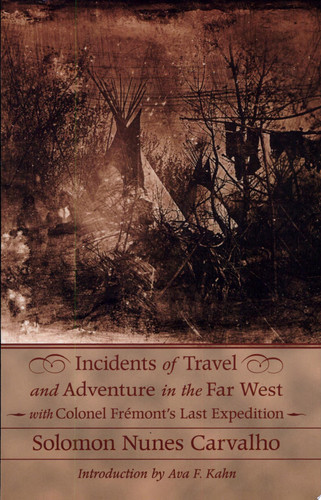
Incidents of travel and adventure in the Far West: with Colonel Fremont's last expedition across the Rocky Mountains, including three months' residence in Utah, and a perilous trip across the great American desert to the Pacific

Carvalho, Solomon Nunes
n August 1853, an American-born Sephardic Jew, Solomon Nunes Carvalho, accepted John Fremont's invitation to join his fifth expedition to find the best overland route to California. A Baltimore artist, inventor, and daguerreotypist, Carvalho was given the job of creating a photographic record of the lands and peoples along the way. Fremont's party left the Missouri on September 14, 1853, traveled up the Kansas River, overland to the Arkansas, upriver past Bent's Fort to the Huerfano, and traversed the Sandhill Pass into the Rocky Mountains. Beset by heavy snows and intense cold, they were reduced to eating their horses and mules and the occasional beaver or porcupine while making their way in midwinter across the Grand, Green, and Sevier Rivers. Suffering from frostbite, scurvy, and dysentery, Carvalho left the expedition in Utah; spent four months among the Mormons in Salt Lake City, where he observed with keen interest their system of spiritual wives; and reached California in 1854. Carvalho became the first Jewish writer to publish accounts of the Great American West and was also one of the first people to photograph the American West. Although only one of his plates is known to survive, others became the models for wood and steel engravings that broadcast the image of the West throughout the world. This Bison Books edition restores the discourses on Mormon doctrine omitted from previous twentieth-century editions. Ava F. Kahn is a visiting scholar at the California Studies Center, University of California, Berkeley. Her books include Jewish Voices of the California Gold Rush: A Documentary History, 1849-1880; Jewish Life in the American West: Perspectives on Migration, Settlement, and Community; and California Jews (coedited with Marc Dollinger).
University of Nebraska Press 2004-01-01 130 pages

Day One

Peter H. Wyden
From the author of Bay of Pigs and Betrayal and Survival in Hitler’s Germany comes a full scope look at the bombing of Hiroshima, from the race to create the bomb to its detrimental dropping on Japan and the terrifying consequences that are still affecting the world over seventy years later. Hiroshima was an event of such magnitude that it divided history into two periods: before and after the bomb. It led to the first day of a new age in which all life would be at risk. Almost seventy years later, as Peter Wyden began this book, the world was still dealing with the fallout of the bomb’s creation. Wyden draws on eyewitness accounts, interviews, and documents never before published in order to trace the nuclear state of the modern world to the historical roots of Hiroshima. Skillfully weaving together all the strands, stories, and characters, including the scientific, political, moral, military, and human viewpoints, Wyden provides a full understanding of how the bomb was created, why it was used, and what the aftermath of those decisions has been.
Simon & Schuster 2014-04-09 456 pages

Savage reprisals

Gay, Peter
A revelatory work that examines the intricate relationship between history and literature, truth and fiction—with some surprising conclusions. Focusing on three literary masterpieces—Charles Dickens's Bleak House (1853), Gustave Flaubert's Madame Bovary (1857), and Thomas Mann's Buddenbrooks (1901)—Peter Gay, a leading cultural historian, demonstrates that there is more than one way to read a novel. Typically, readers believe that fiction, especially the Realist novels that dominated Western culture for most of the nineteenth century and beyond, is based on historical truth and that great novels possess a documentary value. That trust, Gay brilliantly shows, is misplaced; novels take their own path to reality. Using Dickens, Flaubert, and Mann as his examples, Gay explores their world, their craftsmanship, and their minds. In the process, he discovers that all three share one overriding quality: a resentment and rage against the society that sustains the novel itself. Using their stylish writing as a form of revenge, they deal out savage reprisals, which have become part of our Western literary canon. A New York Times Notable Book and a Best Book of 2002.
W W Norton 2003-12-17 192 pages

Al Smith and his America

Handlin, Oscar
The legendary image of America as a land of opportunity was challenged in 1928 by Al Smith's race for the presidency. Could the governor from New York, a Catholic from the Lower East Side, really become president? His candidacy began a dark episode in American history as Al Smith found himself a victim of the very society that, ironically, gave him his greatest opportunity. p This sympathetic account of Smith's political career demonstrates that a changing society in the decades after World War I propelled Americans toward isolationism and a reassertion of comfortable verities about religion and ethnicity. Oscar Handlin notes that Americans were fundamentalists in 1928, and their anti-Catholicism affected the outcome of the presidential election. But religion was only one symptom of the American anxiety that prejudiced attitudes toward the city, toward foreigners, toward the League of Nations and Prohibition. Disillusioned and betrayed by an unsuccessful peace, Americans searched for external causes on which to lay blame, and Al Smith seemed to epitomize the alien forces that were undermining the nation.
Northeastern University Press 1987-10-30 207 pages

Flags Over the Warsaw Ghetto

Moshe Arens
The Warsaw Ghetto Uprising has become a symbol of heroism throughout the world. A short time before the uprising began, Pawel Frenkel addressed a meeting of the Jewish Military fighters: Of course we will fight with guns in our hands, and most of us will fall. But we will live on in the lives and hearts of future generations and in the pages of their history.... We will die before our time but we are not doomed. We will be alive for as long as Jewish history lives! On the eve of Passover, April 19, 1943, German forces entered the Warsaw ghetto equipped with tanks, flame throwers, and machine guns. Against them stood an army of a few hundred young Jewish men and women, armed with pistols and Molotov cocktails. Who were these Jewish fighters who dared oppose the armed might of the SS troops under the command of SS General Juergen Stroop? Who commanded them in battle? What were their goals? In this groundbreaking work, Israel s former Minister of Defense, Prof. Moshe Arens, recounts a true tale of daring, courage, and sacrifice that should be accurately told out of respect for and in homage to the fighters who rose against the German attempt to liquidate the Warsaw ghetto, and made a last-ditch fight for the honor of the Jewish people. The generally accepted account of the Warsaw Ghetto Uprising is incomplete. The truth begins with the existence of not one, but two resistance organizations in the ghetto. Two young men, Mordechai Anielewicz of the Jewish Fighting Organization (ZOB), and Pawel Frenkel of the Jewish Military Organization (ZZW), rose to lead separate resistance organizations in the ghetto, which did not unite despite the desperate battle they were facing. Included is the complete text of The Stroop Report translated into English.
Amazon Digital Services LLC - Kdp 2019-04-16 416 pages

A childhood under Hitler and Stalin: memoirs of a "certified" Jew

Wieck, Michael
A bestseller in Germany, Michael Wieck's account of his childhood in Königsberg recalls a German city obliterated by fire-bombing during the Second World War. As the child of a Jewish mother and Gentile father, Wieck was persecuted first as a "certified Jew" by the Nazis, then as a German by the Russian occupiers, including horrific internment in the Rothenstein concentration camp. His emigration to the West in 1948 marked the end of the 408-year history of the Jewish community in Königsberg. From the earliest delights of a childhood filled with music, family, and the smell of pines and the sea, Wieck retraces his life. He tells of his school days and their sudden end, the shock of Kristallnacht, his Aunt Fanny being sent by train to a destination unknown, the chemical factory where Jewish workers gradually disappeared, the bombs falling on Königsberg. The Russian occupation was anything but the expected delivery from the horrors of the war. In the midst of privation, savagery, and death, there were moments of absurdity, and Wieck powerfully depicts them in this unforgettable memoir.
the University of Wisconsin Press 2003 293 pages

Theatres in Los Angeles

Suzanne Tarbell Cooper,Amy Ronnebeck Hall,Marc Wanamaker
Los Angeles and the movies grew up together, and a natural extension of the picture business was the premium presentation of the product--the biggest, best, and brightest theatres imaginable. The magnificent movie palaces along Broadway in downtown Los Angeles still represent the highest concentration of vintage theatres in the world. With Hollywood and the movies practically synonymous, the theatres in the studios' neighborhood were state-of-the-art for showbiz, whether they were designed for film, vaudeville, or stage productions. From the elegant Orpheum and the exotic Grauman's Chinese to the modest El Rey, this volume celebrates the architecture and social history of Los Angeles's unique collection of historic theatres past and present. The common threads that connect them all, from the grandest movie palace to the smallest neighborhood theatre, are stories and the ghosts of audiences past waiting in the dark for the show to begin.
Arcadia Publishing Library Editions 2008-01-16 130 pages

Cochinchine

Werth, Leon
"Cochinchine" is a vivid and penetrating account of the author's travels through French Indochina in the early 20th century. Written by the acclaimed journalist and critic Léon Werth, this work stands as a landmark of anti-colonial literature, offering a stark contrast to the romanticized depictions of the East common during the era. Werth's observations are both sharp and empathetic, providing a detailed look at the social, political, and economic realities of Southern Vietnam under colonial rule. The narrative delves into the complexities of the relationship between the French administration and the local population, highlighting the tensions and inequalities inherent in the colonial system. Through a series of sketches and reflections, Werth captures the essence of the landscape, the bustle of the cities, and the quiet dignity of the people he encounters. "Cochinchine" is not merely a travelogue but a profound social commentary that questions the ethics of imperialism and the impact of cultural displacement. This book remains a vital resource for readers interested in the history of Southeast Asia, French colonial studies, and the development of political consciousness in modern literature. This work has been selected by scholars as being culturally important, and is part of the knowledge base of civilization as we know it. This work was reproduced from the original artifact, and remains as true to the original work as possible. Therefore, you may see the original copyright references, library stamps (as most of these works have been housed in our most important libraries around the world), and other notations in the work. This work is in the public domain in the United States of America, and possibly other nations. Within the United States, you may freely copy and distribute this work, as no entity (individual or corporate) has a copyright on the body of the work. As a reproduction of a historical artifact, this work may contain missing or blurred pages, poor pictures, errant marks, etc. Scholars believe, and we concur, that this work is important enough to be preserved, reproduced, and made generally available to the public. We appreciate your support of the preservation process, and thank you for being an important part of keeping this knowledge alive and relevant.
Tradd Street Press 2026-02-14 290 pages

Wonder women: feminisms and superheroes

Robinson, Lillian S.
In her sparkling new book, Lillian Robinson looks at Wonder Women - all of them - Supergirl, Invisible Girl, Invisible Woman, She Hulk - and examines what these cartoon heroines mean for everyday life. Can you balance a home, career, and the struggle for justice? What about men? Does flying help? Drawing upon her long career as a formidable feminist critic yet wearing her knowledge lightly, Lillian Robinson finds the essence of wonder women in our non-animated three-dimensional world. This book will delight and provoke anyone interested in the history of feminism or the importance of comics in contemporary life.
Routledge Taylor & Francis Group 2006 148 pages

Wonder women: feminisms and superheroes

Robinson, Lillian S.
In her sparkling new book, Lillian Robinson looks at Wonder Women - all of them - Supergirl, Invisible Girl, Invisible Woman, She Hulk - and examines what these cartoon heroines mean for everyday life. Can you balance a home, career, and the struggle for justice? What about men? Does flying help? Drawing upon her long career as a formidable feminist critic yet wearing her knowledge lightly, Lillian Robinson finds the essence of wonder women in our non-animated three-dimensional world. This book will delight and provoke anyone interested in the history of feminism or the importance of comics in contemporary life.
Routledge 2004 148 pages