5744 results for "Literature"

The Mesopotamian riddle: an archaeologist, a soldier, a clergyman, and the race to decipher the world's oldest writing

Hammer, Joshua
"It was one of history's great vanishing acts. As early as 3500 BCE, scribes in the mud-walled city-state of Sumer used a reed stylus to press tiny wedge-shaped symbols into clay. For three thousand years, the script chronicled the military conquests, scientific discoveries, and epic literature of the grand kingdoms of Mesopotamia - Assyria, Babylon, the mighty Achaemenid Empire - along with precious minutia about everyday life so long ago. But as the palaces of these once great kingdoms sank beneath the desert sands, the meaning of these characters was lost. London, 1857. Colossal sculptures of winged bulls and alabaster bas-reliefs depicting cities under siege and vassals bearing tributes to Biblical kings lined the halls of the British Museum. In the Victorian era's obsession with the triumph of human progress, the mysterious kingdoms of ancient Mesopotamia - the very cradle of civilization - had captured the public imagination. Yet Europe's best philologists struggled to decipher the strange characters. Cuneiform seemed to have thousands of symbols - with some scholars claiming each could be pronounced in up to eight, nine, even ten different ways. Others insisted they'd cracked the code and deciphered inscriptions that corresponded precisely to the Old Testament - proving the veracity of the Word of God. Was it all a hoax? A delusion? A rollicking adventure through the golden age of archaeology, The Writing on the Wall tracks the decades-long race to decipher the oldest script in the world. It's the story of a swashbuckling young archeologist, a suave British military officer, and a curmudgeonly Irish rector, all vying for glory - from the ruins of Persepolis to the opulence of Ottoman-era Baghdad - in a quest to unearth the relics of lost civilizations and unlock the secrets of humanity's past"--
Simon & Schuster 2025 380 pages

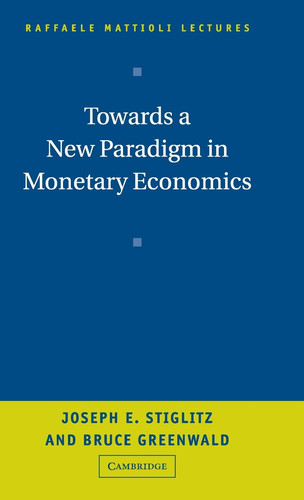
Towards a new paradigm in monetary economics

Stiglitz, Joseph E.
Expanding upon the literature of new institutional economics, the first part of this study stresses the significance of imperfections in information, bankruptcy and banks. The second part examines the policy implications of the new paradigm emphasizing loanable fund demand and supply, and demonstrates its relevance to our understanding of two recent historical episodes--the East Asian financial crisis and the 1991 U.S. recession and subsequent recovery and boom.
Cambridge University Press 2003-09-04 327 pages

Listening for God in Torah and creation: a weekly encounter with conscience and soul

Wittenberg, Jonathan
Tap into the wisdom of one of the world's ancient religions by meditating on Rabbi Wittenberg's engaging, contemporary, spiritual, social and ethical insights. Relevant to Jews, Christian and spiritual seekers of all faiths and none, this book is rooted in decades of devoted immersion in Jewish learning, humanist literature, concern for people at all ages and stages of life, environmental activism and a love of nature. Over the hundred and more passages, key issues considered includes: Compassion and kindness; Creation and wonder; Emotional struggle; Environment and our relationship to nature; Ethical challenges; Illness and suffering; Identity and community; Justice and Social Justice; Refugess and strangers; Remorse and repentance; Responsibility; Searching for meaning; Seeking God.
Hodder & Stoughton 2023 411 pages

Qol tamid: the shofar in ritual, history, and culture

Jonathan L. Friedmann,Joel D. Gereboff
From biblical times until today the shofar has served an array of practical purposes and communicated a range of symbolic meanings. The roughly seventy references to the shofar in the Hebrew Bible show four stereotypical functions: announcing the divine presence, accompanying sacred ceremonies, proclaiming kingship, and signaling on the battlefield. In addition to the above purposes, the shofar served as a symbol for messages of joy, fear, group identity, and redemption. This volume, written by prominent Jewish scholars and faith leaders, examines the role of the shofar in the Hebrew Bible and subsequent Jewish life, including even appearances in popular literature of the present day.
Claremont School of Theology Press 2017 323 pages

Peoples of an almighty god: competing religions in the ancient world

Goldstein, Jonathan A.
Some ancient civilizations, notably the Babylonians and the Israelites, held fast to the belief that their particular god (or gods) were stronger than all other heavenly powers and gods combined, supremely able to protect their well-being and success as a nation. This belief (which resounds in the modern-day rallying cry "God is on our side") led to some foolhardy and rash decisions, particularly when it came to war. For a nation defeated or conquered by a foreign power inevitably faced the profound, perplexing question: "Why did our God, who has sworn to protect us, allow this to happen?" Jonathan A. Goldstein turns to the religious literature of these ancient peoples to discover how they reconciled their beliefs with the realities of history. In a magnificent blend of several academic disciples (literary criticism, political theory, biblical and classical history), he compares and contrasts the responses of different eras and nations–from the Israelites, Babylonians, and Egyptians to the Zoroastrians, Iranians, and Persians under Alexander the Great. Goldstein’s close readings of literature written following such devastating events as the fall of the Israelites to the Assyrians and the Babylonians demonstrate that theology, far from being a static and unchanging set of beliefs, evolves with the course of history. Revealing how each defeat helped to shape and define the religious beliefs of the conquered, Peoples of an Almighty God clearly demonstrates that no belief can remain unchanged or untouched by the beliefs of other people.
Yale University Press 2009 575 pages

The Oxford book of comic verse

John Gross,John J. Gross
"Comic verse," writes editor John Gross, "is verse that is designed to amuse--and perhaps that is as far as any attempt at a definition ought to go." In The Oxford Book of Comic Verse, Gross has combed the annals of literature in English from the middle ages to the present, gathering poems that provoke laughter, smiles, and even reflections on the human condition--but always poems that amuse. From limericks to social satire, The Oxford Book of Comic Verse offers a remarkable collection of outstanding light poetry. Gross has brought together the finest writers in the history of the English language--from Chaucer and Skelton to Shakespeare and Swift, Lord Byron to Robert Browning, Emily Dickinson to John Updike--offering delightful examples of their comic verse. Many of these lines dance with whimsy, such as John Skelton's Colin Clout ("For though my rhyme be ragged,/ Tattered and jagged,/ Rudely rain-beaten,/ Rusty and moth-eaten,/ If ye take well therewith,/ It hath in it some pith"); others float heavier thoughts on light rhymes--as in Matthew Prior's succinct Human Life ("What trifling coil do we poor mortals keep;/ Wake, eat, and drink, evacuate and sleep."). The range of writers who have composed comic verse is astonishing, as is the delight of the poems themselves. Here we read T.S. Eliot mocking himself ("How unpleasant to meet Mr. Eliot!/ With his features of clerical cut"); poet and Soviet historian Robert Conquest, mingling his two professions in a limerick ("There was a great Marxist called Lenin/ Who did two or three million men in/ --That's a lot to have done in/ --But where he did one in/ That grand Marxist Stalin did ten in"); and Wendy Cope commenting on her disillusionment with poets ("I used to think all poets were Byronic./ They're mostly wicked as ginless tonic/ And wild as pension plans"). And along the way, we are treated to witty song lyrics as well, from First World War soldiers' tunes, to Irving Berlin, to Cole Porter, to Lorenz Hart ("When love congeals/It soon reveals/ the faint aroma of performing seals/The double-crossing of a pair of heels/I wish I were in love again!"). Whether it comes from anonymous popular culture or the icons of the literary canon, comic verse has been a source of pleasure and diversion through the ages--a combination of wit, verbal artistry, and even serious contemplation. This collection, compiled by one of our finest critics and anthologists, brings this tradition into the hands of today's readers, offering hours of delight.
Oxford University Press 1995 512 pages

The economics of the industrial revolution

Joel Mokyr
In recent years, scholars from a variety of disciplines have addressed many perplexing questions about the Industrial Revolution in all its aspects. Understandably, economics has become the focal point for these efforts as professional economics have sought to resolve some of the controversies surrounding this topic. First published in 1985, this collection contains ten key essays written by leading economists on the subject of the Industrial Revloution. Among the questions discussed are the causes for the pre-eminence of Britian, the roles of the inputs for growth (capital, labor, technical progress), the importance of demand factors, the relation between agricultural progress and the Industrial Revolution, and the standard of living debate. The essays demonstrate that the application of fresh viewpoints to the literature has given us a considerable new body of data at our disposal, making it possible to test commonly held hypotheses. In addition, this new data has enabled economists to apply a more rigorous logic to the thinking about the Industrial Revolution, thus sharpening many issues heretofore blurred by slipshod methodology and internal inconsistencies.
Routledge 2012-11-22 267 pages

Feminine sentences: essays on women and culture

Wolff, Janet
Until recently, women have been noticeably absent from historical and sociological accounts of modernity. As a step toward remedying this situation, the essays gathered here challenge the continuing separation of sociological from textual analysis in cultural (and feminist) theory and inquiry. They address critically the question of women's writing, exploring the idea that women may begin to define their own lives and construct their own identities in a patriarchal culture through the very process of writing. They also present a cogent defense of a feminist cultural politics, including a politics of the body. Integrating material drawn from a variety of sources--feminist theory, cultural and literary analysis, sociology, and art history-- Feminine Sentences is an original discussion of women's relationship to modern and postmodern culture. Janet Wolff's book represents a major statement of her distinctive position, and will be of interest to everyone working in the areas of cultural and literary theory, women's studies, and sociology. FROM THE BOOK: "Women . . . are sentenced to containment and silence. . . . This collection is intended as a contribution to the overthrow of that 'sentence,' and to the process whereby women find ways to intervene in an excluding culture, and to articulate their own experience. Feminine sentences are those formulations and expressions, in a variety of cultural forms and media, of women's own voice." "The literature of modernity describes the experience of men. It is essentially a literature about transformations in the public world and its associated consciousness. . . . In so far as the experience of 'the modern' occurred mainly in the public sphere, it was primarily men's experience." "I want to argue that a feminist cultural politics of the body is a possibility. . . . There is every reason . . . to propose the body as a privileged site of political intervention, precisely because it is the site of repression and possession."
University of California Press 1990 146 pages

The fish prince and other stories: mermen folk tales

Yolen, Jane
Mermen? Yes. Long before mermaids emerged to people our inner seas, long before they established their restless, inviting niche in human fantasy, there was the merman. Born of the human need to dominate the great fruitful oceans, to control the vast destructive seas, to regulate the healing rains, to understand the tides, the merman emerged. The merman was water personified. The imposing water gods could be wheedled, cozened, implored, but―in the end―they were never fooled. How often were Poseidon or Neptune, Lir, Njord and the rest pictured riding the waves along inhospitable shores, shaking their magical tridents or spears or fists at the weak, imploring humans on land? The sea gods called up storms or quieted waves. They flooded the lands. They drowned the unwary. Yet despite the importance of early fish-tailed gods such as Ea-Enki and Dagon; despite the preponderance of mermen in the mythologies of Babylon, Greece, the British Isles, the Scandinavian peninsula, Germany; despite the mermen ranging along Slavic shores and inland seas; despite the mermen found in Chinese and Japanese lakes, along Polynesian island coasts, and in the lore and literature of the Middle East, the merman has become Legend’s Forgotten Man. With its 27 stories from around the world, this volume reconstructs the unnatural history of the Merman.
Interlink Books 2001-04-01 160 pages

Contemporary Halakhic Problems

David J. Bleich
This series, an outstanding example of the traditional approach to the halakhah, deals with the application of Jewish law to contemporary social, political, technological and religious problems. Chapters in these volumes are devoted to questions of personal and social status, the State of Israel, the Sabbath and Holy Days, medical halakhah, education and business law. Major issues such as assisted procreation, abortion, fetal tissue research, the agunah problem, intermarriage, conversion, the role of the Bet Din, capital punishment, preemptive warfare and many, many more are analyzed in detail. Many of these topics have been matters of heated controversy within the Jewish community. The author, a distinguished talmudic scholar and halakhist, has culled relevant material from the vast responsa literature. He examines each question by carefully delineating the issues, showing the various positions taken by rabbinic scholars, clarifying areas of divergence and analyzing the reasons for disagreement. This work is an invaluable source book for all students of traditional Jewish law and practice. This best-selling series has been universally acclaimed as a classic of its genre. A Jerusalem Post reviewer observed that it is scholarly, lucid and good-tempered.....Direct, comprehensive, realistic.....enjoy this treasury of halakhic knowledge.
Ktav Publishing House, Incorporated 1995-08

Jewish liturgy: a comprehensive history

Elbogen, Ismar
The Jewish prayer book, the siddur, is the longest continuous record of the history, philosophy, literature, and ethos of the Jewish people. It has been read and reread in every generation, in every Jewish community. Now, for the first time, Ismar Elbogen's Jewish Liturgy: A Comprehensive History, the most complete scholarly study of Jewish liturgy in existence today, is available to the English-speaking community. Originally published in German, the work was reissued in.
Jewish Publication Society 1993 501 pages

Neoconservatism: the autobiography of an idea

Kristol, Irving
Neoconservatism is the movement that has provided the intellectual foundation for the resurgence of American conservatism in our time. And if neoconservatism can be said to have a father or an architect, that person is Irving Kristol. Neoconservatism is the most comprehensive selection of Kristol's influential writings on politics and economics, as well as the best of his now-famous essays on society, religion, culture, literature, education, and - above all - the "values" issues that have come to define the neo-conservative critique of contemporary life. These essays provide an unparalleled insight into the 50-year development of Kristol's social and political ideas, from an uneasy socialism tempered with religious orthodoxy, to a vigilant optimism about the future of the American experiment. Those already familiar with Kristol's work will especially enjoy the new autobiographical essay that introduces this volume; it is sprinkled with personal recollections about such luminaries as Lionel Trilling, Leo Strauss, Saul Bellow, Sidney Hook, Daniel Patrick Moynihan, and historian Gertrude Himmelfarb (who is also Mrs. Kristol). Those relatively new to Kristol's writings will be treated to some of the most lucid, insightful, entertaining, and intellectually challenging essays of our time.
Free 1995-09-20 493 pages

Mesillat Yesharim: the path of the upright

Stone, Ira F.
Thanks to this generous donor for making the publication of this book possible: The Lerman Family Foundation. Connecting the wisdom of tradition with contemporary spirituality Mesillat Yesharim is a classic of Jewish ethical literature. Written by one of the leading kabbalists of the late Middle Ages, it is also a window into the kabbalist’s understanding of the connection between ethics and mystical vision. Luzzatto, one of the great Hebrew stylists of his time, is acknowledged by some as the first writer of modern Hebrew; thus Mesillat Yesharim is also important for its place in Hebrew literature. This translation, published originally in 1936 by JPS, is a landmark in Jewish publishing. It made this Hebrew text finally available to English readers, and it gave us insights into the groundbreaking work that Kaplan did in orienting American Jews to the deep connection between ethical living and religious belief. It is no wonder that this book has become the centerpiece of the modern-day Mussar Movement, which inspires so many on their spiritual path. Rabbi Ira Stone, consummate teacher and stirring speaker, is a major force in the resurgence of the Mussar Movement. In his introduction, he presents Luzzatto and Mesillat Yesharim in their historical context, and gives us new insights into Kaplan’s emerging theology. Stone also explains the principles of reading that he uses in his commentary and teaching to make this medieval text so inspiring to readers today. This volume contains the original Kaplan translation, as well as those sections of the text that Kaplan omitted, along with Stone’s new commentary. The original Hebrew text is in the back of the book.
The Jewish Publication Society 2010-09-15 509 pages

White ink: interviews on sex, text and politics

Cixous, Hélène
Helene Cixous is widely regarded as one of the world's most influential feminist writers and thinkers. "White Ink" brings together her most revealing interviews, available in English for the first time. Spanning over four decades and including a new interview with the editor Susan Sellers, this collection presents a brilliant, running commentary on the subjects at the heart of Cixous' writing. Here, Cixous discusses her books and her creative process, her views on and insights into literature, philosophy, theatre, politics, aesthetics, faith and ethics, human relations and the state of the world.As she responds to interviewers' questions, Cixous is prompted to reflect on her roles and activities as poet, playwright, feminist theorist, professor of literature, philosopher, woman, Jew. Each interview is a remarkable performance, an event in language and thought where Cixous' celebrated intellectual and poetic force can be witnessed 'in action'. The accessibility of the interview format provides an excellent starting-point for readers new to Cixous, while those already familiar with her work will find unexpected insights and fresh elucidations of her thought.
Acumen 2008 199 pages

Mr. Skylark John Bennett and the Charleston Renaissance

Harlan Greene
Based on years of research and thousands of notes left by John Bennett, Mr. Skylark is an unusually intimate biography of a pivotal figure in the Charleston Renaissance, the brief period between the two World Wars that first witnessed many of the cultural and artistic changes soon to sweep the South. The book not only examines Bennett's life but also reveals the rich tapestry of the literary and social history of Charleston. An outsider who became an insider by marrying into the local aristocracy, Bennett was perfectly placed to observe social and artistic change and to prompt it. He published the first scholarly treatise on Gullah, the language of the coastal Southern blacks, and collected African American spirituals and tales. But after breaking several racial taboos of the time, he was publicly condemned, and it was only through mentoring such writers as Hervey Allen and DuBose Heyward that he was eventually welcomed back into the heart of the city. Today, the Charleston aesthetic, which mourned the loss of beauty in a modernizing South, is often overlooked in the study of Southern literature, but Bennett, through his extensive private correspondence and notes, offers insight into the forces that shaped this cultural movement. Restored to us in all his complexity and humor, Bennett is important for his own accomplishments, but also for providing a lens through which to view southern literary history and the complexities of a changing South.
University of Georgia Press 2010-06-01 408 pages

The Sexual Crisis: A Critique Of Our Sex Life

Meisel-Hess, Grete
This scarce antiquarian book is a facsimile reprint of the original. Due to its age, it may contain imperfections such as marks, notations, marginalia and flawed pages. Because we believe this work is culturally important, we have made it available as part of our commitment for protecting, preserving, and promoting the world's literature in affordable, high quality, modern editions that are true to the original work.
Kessinger Publishing, LLC 2007-07-25 348 pages

The Divine Comedy The New Translation by Gerald J. Davis

Gerald J. Davis
The Divine Comedy (Italian: Divina Commedia [diˈviːna komˈmɛːdja]) is a long Italian narrative poem by Dante Alighieri, begun c. 1308 and completed in 1320, a year before his death in 1321. It is widely considered to be the pre-eminent work in Italian literature and one of the greatest works of world literature. The poem's imaginative vision of the afterlife is representative of the medieval world-view as it had developed in the Western Church by the 14th century. It helped establish the Tuscan language, in which it is written, as the standardized Italian language. It is divided into three parts: Inferno, Purgatorio, and Paradiso.
Independently Published 2021-05-11 363 pages