4260 results for "World History"

Bakst

Levinson, André,Bakst, Léon,Modigliani, Amedeo
Delve into the dazzling world of early 20th-century art and theatre with "Bakst: The story of Leon Bakst's life" by André Levinson. This meticulously prepared republication chronicles the life and career of Léon Bakst, the visionary artist who revolutionized stage and costume design for the Russian ballet. Explore Bakst's pivotal role in shaping the aesthetic of iconic productions. Levinson expertly details Bakst's contributions to art history, revealing the man behind the groundbreaking designs that captivated audiences worldwide. This book illuminates Bakst's innovative approach to visual storytelling. A captivating biography for enthusiasts of Russian ballet, stage design, and costume design. Discover the enduring legacy of Léon Bakst, whose artistic vision continues to inspire and influence the performing arts. This work has been selected by scholars as being culturally important, and is part of the knowledge base of civilization as we know it. This work is in the public domain in the United States of America, and possibly other nations. Within the United States, you may freely copy and distribute this work, as no entity (individual or corporate) has a copyright on the body of the work. Scholars believe, and we concur, that this work is important enough to be preserved, reproduced, and made generally available to the public. We appreciate your support of the preservation process, and thank you for being an important part of keeping this knowledge alive and relevant.
Anson Street Press 2025-03-29 146 pages

In the wake

Kron, Lisa
"Funny, moving, and undeniably sexy. The heady blend of smart dialogue and characters. . .makes it a candidate to be the "Angels in America" of the Bush II decade."--"San Francisco Chronicle" "The two works ["Angels in America" and "In the Wake"] use a volatile chapter in American history as background in their exploration of how the sociopolitical maladies of an age play out in the personal conduct of characters."-- Charles McNulty, "Los Angeles Times" Lisa Kron, author of Broadway's "Well" and the OBIE-winning solo show "2.5 Minute Ride," has taken on the big question of our country's character. On the Thanksgiving after the controversial 2000 election, political junkie Ellen gathers with family and friends in her cramped New York apartment. But she soon discovers--with an unexpected passionate encounter--that ideas about America and our own selves are not as fixed as they once seemed. A play with plenty of humor and passion to go with its politics, Kron's work premiered last year at Berkeley Rep and Los Angeles' Center Theater Group, and debuted at The Public Theater in New York this fall. Lisa Kron's plays have been performed on Broadway, off-Broadway, and around the world. She is a founding member of the award-winning theater group The Five Lesbian Brothers, and teaches playwriting at Yale University.
Dramatists Play Service Inc 2012 81 pages

Bookends: two women, one enduring friendship

Rostenberg, Leona
The rare book dealers who delighted readers with the history of their bookselling days in "Old Books, Rare Friends" now offer the other side of their story -- an intimate look at the joys of a relationship that has lasted more than half a century. When their friendship and business partnership began in the 1940s, Leona Rostenberg and Madeleine Stern were pioneers in a man's world. Now approaching their nineties, the duo, who -- among their many discoveries -- unearthed Louisa May Alcott's pseudonymous blood-and-thunder stories, remains a vibrant institution in the rare book trade, even as the Internet changes their field -- and their community -- forever. After publishing "Old Books, Rare Friends," Rostenberg and Stern received a flood of fan mail asking about their personal lives, and they have responded with poignant honesty and the warmth for which they are famous, as they reflect on their lives and their remarkable partnership. "Bookends" recounts their fascinating histories: family backgrounds, business adventures, the men they did not marry, and their approach to the bittersweet trials of aging. More than just a dual memoir, "Bookends" is also a chronicle of the cultural changes of twentieth-century American life and a loving farewell to the golden age of book collecting. Filled with wisdom and humor, this volume is a tribute to Rostenberg and Stern's passion for the written word -- and for life itself. Catching us off guard with their candor, they offer their insights regarding their business, their way of life, and their worldview. Above all, they present the story of a special relationship. At a time when people find it increasingly difficult to connect, here wehave the seamless story of a shared life. It is the unique product of an earlier time, yet it is a timeless reflection on the very nature of friendship. Though their fantastic partnership is un-reproducible, the ideal they have established, for the integration of one life so completely with another, contains lessons for all of us. Without husband or children they created a loving home when this was uncharted territory for women. They nurtured a business and life partnership that has lasted more than half a century and has only gotten stronger with time. When the passing years began to claim one's hearing and the other's sight, they became each other's eyes and ears. A meditation on aging and togetherness, this book is also the narrative of two pioneering single, Jewish women making their way in tandem through a world largely organized to keep them in their place. It is a gentle, wise story, told in their inimitable style, sparse, unadorned, and honest. Their affirmations supersede their uncertainties. As they write, "Bookends support books and come in pairs...If the word encapsulates our past, it looks also to the future, and to the books -- lived together, written together -- that will follow." They confront the challenges of aging in a no-nonsense tone, and, in facing them, give us an ideal of enduring human friendship that can't help but touch the heart.
Free Press 2001 246 pages

The beginning of wisdom: reading Genesis

Kass, Leon
Imagine that you could really understand the Bible...that you could read, analyze, and discuss the book of Genesis not as a compositional mystery, a cultural relic, or a linguistic puzzle palace, or even as religious doctrine, but as a philosophical classic, precisely in the same way that a truth-seeking reader would study Plato or Nietzsche. Imagine that you could be led in your study by one of America's preeminent intellectuals and that he would help you to an understanding of the book that is deeper than you'd ever dreamed possible, that he would reveal line by line, verse by verse the incredible riches of this illuminating text -- one of the very few that actually deserve to be called seminal. Imagine that you could get, from Genesis, the beginning of wisdom. The Beginning of Wisdom is a hugely learned book that, like Genesis itself, falls naturally into two sections. The first shows how the universal history described in the first eleven chapters of Genesis, from creation to the tower of Babel, conveys, in the words of Leon Kass, "a coherent anthropology" -- a general teaching about human nature -- that "rivals anything produced by the great philosophers." Serving also as a mirror for the reader's self-discovery, these stories offer profound insights into the problematic character of human reason, speech, freedom, sexual desire, the love of the beautiful, pride, shame, anger, guilt, and death. Something as seemingly innocuous as the monotonous recounting of the ten generations from Adam to Noah yields a powerful lesson in the way in which humanity encounters its own mortality. In the story of the tower of Babel are deep understandings of the ambiguous power of speech, reason, and the arts; the hazards of unity and aloneness; the meaning of the city and its quest for self-sufficiency; and man's desire for fame, immortality, and apotheosis -- and the disasters these necessarily cause. Against this background of human failure, Part Two of The Beginning of Wisdom explores the struggles to launch a new human way, informed by the special Abrahamic covenant with the divine, that might address the problems and avoid the disasters of humankind's natural propensities. Close, eloquent, and brilliant readings of the lives and educations of Abraham, Isaac, Jacob, and Jacob's sons reveal eternal wisdom about marriage, parenting, brotherhood, education, justice, political and moral leadership, and of course the ultimate question: How to live a good life? Connecting the two "parts" is the book's overarching philosophical and pedagogical structure: how understanding the dangers and accepting the limits of human powers can open the door to a superior way of life, not only for a solitary man of virtue but for an entire community -- a life devoted to righteousness and holiness. This extraordinary book finally shows Genesis as a coherent whole, beginning with the creation of the natural world and ending with the creation of a nation that hearkens to the awe-inspiring summons to godliness. A unique and ambitious commentary, a remarkably readable literary exegesis and philosophical companion, The Beginning of Wisdom is one of the most important books in decades on perhaps the most important -- and surely the most frequently read -- book of all time.
Free Press 2003-05-20 700 pages

Maybe Esther

Petrowskaja, Katja
Zusammenfassung: Katja Petrowskaja's family story is inextricably entangled with the history of twentieth-century Europe. There is her great-uncle, who shot a German diplomat in Moscow in 1932 and was sentenced to death. There is her Ukrainian grandfather, who disappeared during World War II and reappeared forty years later. And there is her great-grandmother - whose name may or may not have been Esther - who was too old and frail to leave Kiev when the Jews there were rounded up, and was killed by a Nazi outside her house. Taking the reader from Berlin to Warsaw, to Moscow, to Kiev, from Google searches, strange encounters and coincidences to archives, anecdotes and jokes, Katja Petrowskaja undertakes a journey in search of her own place in past and present, memory and history, languages and countries. The result is Maybe Esther - a singular, haunting, unforgettable work of literature.
4th Estate 2019 254 pages

The Memory of All That George Gershwin, Kay Swift, and My Family's Legacy of Infidelities

Katharine Weber
The Memory of All That is Katharine Weber’s memoir of her extraordinary family. Her maternal grandmother, Kay Swift, was known both for her own music (she was the first woman to compose the score to a hit Broadway show, Fine and Dandy ) and for her ten-year romance with George Gershwin. Their love affair began during Swift’s marriage to James Paul Warburg, the multitalented banker and economist who advised (and feuded with) FDR. Weber creates an intriguing and intimate group portrait of the renowned Warburg family, from her great-great-uncle, the eccentric art historian Aby Warburg, whose madness inspired modern theories of iconography, to her great-grandfather Paul M. Warburg, the architect of the Federal Reserve System whose unheeded warnings about the stock-market crash of 1929 made him “the Cassandra of Wall Street.” As she throws new light on her beloved grandmother’s life and many amours, Weber also considers the role the psychoanalyst Gregory Zilboorg played in her family history, along with the ways the Warburg family has been as celebrated for its accomplishments as it has been vilified over the years by countless conspiracy theorists (from Henry Ford to Louis Farrakhan), who labeled Paul Warburg the ringleader of the so-called international Jewish banking conspiracy. Her mother, Andrea Swift Warburg, married Sidney Kaufman, but their unlikely union, Weber believes, was a direct consequence of George Gershwin’s looming presence in the Warburg family. A notorious womanizer, Weber’s father was a peripatetic filmmaker who made propaganda and training films for the OSS during World War II before producing the first movie with smells, the regrettable flop that was AromaRama. He was as much an enigma to his daughter as he was to the FBI, which had him under surveillance for more than forty years, and even noted Katharine’s birth in a memo to J. Edgar Hoover. Colorful, evocative, insightful, and very funny, The Memory of All That is an enthralling look at a tremendously influential—and highly eccentric—family, as well as a consideration of how their stories, with their myriad layers of truth and fiction, have both provoked and influenced one of our most prodigiously gifted writers.
Crown 2012-06-12 296 pages

Julian Schnabel

Schnabel, Julian
'Julian Schnabel' (b. 1951) is regarded throughout the world as one of the most important artists of our time. Yet, remarkably, there has never been - until now - a book that addresses the extraordinary range of his entire creative output. This lavishly produced volume presents many artworks that have never before been exhibited, published, or even seen, filling a major gap in the history of contemporary art. More than 300 of Schnabel's works - paintings, photographs, sculptures, and film stills spanning a career of nearly 40 years - are reproduced here, along with texts drawn from the artist's interviews, essays, and notes. From the broken-plate paintings of the 1980s that brought him fame, to the recent, massively scaled Big Girls series, the artist's work is set in the context of his overall sensibility, becoming part of an ongoing pictorial diary of a life. Rather than a retrospective look at Schnabel's work, the book provides readers with a view of life and art as they collide. 'Julian Schnabel' is certain to be welcomed as one of the season's most significant art publications.
Harry N. Abrams 2004 367 pages

Scruples two

Krantz, Judith
"Scruples, Judith Krantz's electrifying, world wide bestseller appeared fifteen years ago and made book publishing history. Now that unforgettable story, a story that marks an era, a story that millions of readers wish had never ended . . . continues. Only a single night's sleep seperates the lives of the characters in "Scruples from this mesmerizing sequel. Billy Ikehorn is a contemporary woman living on a grand scale. A self-made beauty and the exquisite owner of a fabled Beverley Hills boutique called Scruples and married to the Oscar-winning producer Vito Orsini. To those who only know her from afar, she seems to lead a dream existence, wrapped in all the power of glamout, riches, and success. Then a stranger arrives in Billy's life--Gigi Orsini, Vito's sixteen-year-old daughter by an early marriage. Independent, deeply interesting, street-smart, and enchantingly humorous, Gigi captures Billy's heart and sets in motion a train of utterly unexpected events. Life with Gigi hold both joy and pain for Spider Elliot and Valentine O'Neill, Billy's partners in Scruples. The many new freinds Gigi makes during the next five years will grow important to Billy in ways she could never have forseen. "Scruples Two moves swiflty and unexpectadly, filled with breathtaking change, from California to New York to Paris, following two of the most fascinating and touching females in modern fiction, Billy Ikehorn and Gigi Orsini. "From the Paperback edition.
Crown Publishers 1992-05-31 517 pages

The book of stone: a novel

Papernick, Jon
"A searing psychological thriller set in pre-9/11 Brooklyn in which a family's dark history and an estranged son's attempt to find meaning and purpose converge. Matthew Stone has inherited a troubling legacy: a gangster grandfather and a distant father--who is also a disgraced judge. After his father's death, Matthew is a young man alone. He turns to his father's beloved books for comfort, perceiving within them guidance that leads him to connect with a group of religious extremists. As Matthew immerses himself in this unfamiliar world, the FBI seeks his assistance to foil the group's violent plot. Caught between these powerful forces, haunted by losses past and present, and desperate for redemption, Matthew charts a course of increasing peril--for himself and for everyone around him. From the author of The Ascent of Eli Israel and There is No Other, The Book of Stone examines the evolution of the terrorist mentality and the complexities of religious extremism, as well as how easily a vulnerable mind can be exploited for dark purposes" -- cover flap
Fig Tree Books 2015-05 389 pages

Austerity baby

Wolff, Janet
"Austerity Baby might best be described as an "oblique memoir". Janet Wolff's fascinating volume is a family history - but one that is digressive and consistently surprising. The central underlying and repeated themes of the book are exile and displacement; lives (and deaths) during the Third Reich; mother-daughter and sibling relationships; the generational transmission of trauma and experience; transatlantic reflections; and the struggle for creative expression. Stories mobilised, and people encountered, in the course of the narrative include: the internment of aliens in Britain during the Second World War; cultural life in Rochester, New York, in the 1920s; the social and personal meanings of colour(s); the industrialist and philanthropist, Henry Simon of Manchester, including his relationship with the Norwegian explorer, Fridtjof Nansen; the liberal British campaigner and MP of the 1940s, Eleanor Rathbone; reflections on the lives and images of spinsters. The text is supplemented and interrupted throughout by images (photographs, paintings, facsimile documents), some of which serve to illustrate the story, others engaging indirectly with the written word."--Publisher's description.
Manchester University Press 2017 262 pages

Essays on Hitler's Europe

Deák, István
Istv¾n De¾k is one of the world's most knowledgeable and clearheaded authorities on the Second World War, and for decades his commentary has been among the most illuminating and influential contributions to the vast discourse on the politics, history, and scholarship of the period. Writing chiefly for the New York Review of Books and the New Republic , De¾k has crafted review essays that cover the breadth and depth of the huge literature on this ominous moment in European history when the survival of democracy and human decency were at stake. ø Collected here for the first time, these articles chart changing reactions and analyses by the regimes and populations of Europe and reveal how postwar governments, historians, and ordinary citizens attempt to come to terms with?or to evade?the realities of the Holocaust, war, fascism, and resistance movements. They track the acts of scoundrels and the collusion of ordinary citizens in the so-called Final Solution but also show how others in authority and on the street heroically opposed the evil of the day. With its depth, conciseness, and interpretive power, this collection allows readers to consider more clearly and completely than ever before what has been said, how thought has shifted, and what we have learned about these momentous, world-changing events.
University of Nebraska Press 2001-01-01 222 pages

#StayWoke Go Broke: Why South Africa Won't Survive America's Culture Wars (and what You Can Do about It)

Helen Zille
It's time to fight back. Each day, more South Africans are targeted, labelled, and hounded out of society for expressing their opinions - ordinary opinions that just a few years ago were accepted as rational common sense. Have you been "cancelled" by an online mob that won't stop harassing you until you're fired from your job? Helen Zille almost was - but she survived by fighting back. In #StayWoke: Go Broke , the bestselling author and defining South African political figure explains why the woke Left constitutes a greater threat to South Africa's future than the populist Right does. Now more than ever, liberals must strengthen their spines and fight for their values - or be eviscerated in the Culture Wars raging across the English-speaking world. If you're looking for an incisive, indispensable survival guide through this tumultuous period of South African history, then #StayWoke: Go Broke is for you. Buy it now.
Independently Published 2021-04-25 216 pages

The idea of nationalism: a study in its origins and background

Kohn, Hans
In this sixtieth anniversary edition of The Idea of Nationalism , Craig Calhoun probes the work of Hans Kohn and the world that first brought prominence to this unparalleled defense of the national ideal in the modern West. At its publication, Saturday Review called it "an enduring and definitive treatise.... [Kohn] has written a book which is less a history of nationalism than it is a history of Western civilization from the standpoint of the national idea." This edition includes an extensive new introduction by Craig Calhoun, which in itself is a substantial contribution to the history of ideas. The Idea of Nationalism comprehensively analyzes the rise of nationalism, the idea's content, and its worldwide implications from the days of Hebrew and Greek antiquity to the eve of the French Revolution. As Calhoun explains, Kohn was particularly qualified to undertake this study. He grew up in Prague, the vigorous heart of Czech nationalism, participated in the Zionist student movement, studied the question of nationality in multinational cultures, spent the World War One years in Asian Russia, and later traveled extensively in the Near East studying the nationalist movements of western and southern Asia. The work itself is the product of Kohn's later years at Harvard University. In The Idea of Nationalism, Kohn presents the single most influential articulation of the distinction between civic and ethnic nationalism. This has shaped nearly all ensuing research and public discussion and deeply informed parallel oppositions of early and late, Western and Eastern varieties of nationalism. Kohn also argues that the age of nationalism represents the first period of universal history. Civilizations and continents are brought into ever closer contact; popular participation in politics is enormously increased; and the secular state is ever more significant. The Idea of Nationalism is important both in itself and because it so deeply shaped all the work that followed it. After sixty years his interpretations and analyses remain acute and instructive.
Transaction Publishers 2005 735 pages

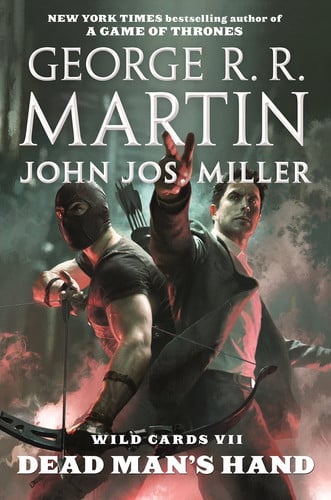
Wild Cards VII: Dead Man's Hand Book Four of the Puppetman Quartet

George R. R. Martin,John Jos. Miller,Wild Cards Trust
Dead Man's Hand combines the writing talents of George R. R. Martin & John Jos. Miller Chrysalis, the glass-skinned queen of the Joker underworld, has been found brutally murdered in her popular restaurant, the Crystal Palace. New two men are out to find her killer: Jay Ackroyd, the Ace private investigator who discovered her ruined body, and the vigilante archer known as the Yeoman, who has been framed for the crime. Their quest leads them on a nightmare odyssey of madness, violence, passion, and political intrigue that will forever alter the fates of Aces and Jokers everywhere. Experience this gripping tale of mystery and suspense, brought to you from the incredible imaginations of George R. R. Martin and John Jos. Miller in their first collaborative novel. EXPLORE THE WILD CARDS UNIVERSE An alien virus has changed the course of history, and the surviving population of Manhattan struggles to understand the new world left in its wake. Natural humans share the rough city with those given extraordinary—and sometimes terrifying—traits. While most manage to coexist in an uneasy peace, not everyone is willing to adapt. The Wild Cards Universe The Original Triad #1 Wild Cards #2 Aces High #3 Jokers Wild The Puppetman Quartet #4: Aces Abroad #5: Down and Dirty #6: Ace in the Hole #7: Dead Man’s Hand The Rox Triad #8: One-Eyed Jacks #9: Jokertown Shuffle #10: Dealer’s Choice #11: Double Solitaire #12: Turn of the Cards The Card Sharks Triad #13: Card Sharks #14: Marked Cards #15: Black Trump #16: Deuces Down #17: Death Draws Five The Committee Triad #18: Inside Straight #19: Busted Flush #20: Suicide Kings The Fort Freak Triad #21: Fort Freak #22: Lowball #23: High Stakes The American Triad #24: Mississippi Roll #25: Low Chicago #26: Texas Hold 'Em
Tor Publishing Group 2017-06-13 352 pages

The Crisis of German Ideology: Intellectual Origins of the Third Reich

George L. Mosse
In our time two major revolutionary movements - Marxism and National Socialism - have left their mark upon the world. Yet, whereas Marxism is generally recognized as representing an intellectual and ideological tradition extending back for at least a century, National Socialism is not. Rather, to many, the ideological bases of National Socialism were the product of a small group of unbalanced minds. To others, the Nazi ideology was merely a propaganda tactic designed to win the support of the masses. Still others have found the ideas underlying National Socialism so nebulous and incomprehensible that they have dismissed them as unimportant.In fact, though, these ideas are deeply embedded in German history. They were current - indeed, eminently respectable - among several generations of Germans prior to Hitler's rise. Strange, even demonic ideas they were, certainly - racial thought, Germanic Christianity, nature mysticism, sun worship, theosophy - but for many Germans long before the Hitler period they suggested the possibility of political and historical salvation.In this book, George L. Mosse traces these currents of thought through 19th and 20th century German history, discussing the role they played and the longings they gratified during nearly a century of German life. He reveals how the anti-liberal and anti-democratic ideology comprising these peculiarly German ideas became institutionalized in the schools, youth movements, veterans' groups, political parties; how the "German revolution" called for by the ideology's exponents was transformed by Hitler into an "anti-Jewish revolution"; and how the Nazis fully assimilated these ideas into an effective political program as they rose to power.
Howard Fertig 1997-03-01

The recollections of Eugene P. Wigner as told to Andrew Szanton

Wigner, Eugene Paul
Eugene P. Wigner, indisputedly one of the world's greatest physicists of the twentieth century, recounts the breathtaking story of his singular life. Dr. Wigner's wining of the Nobel Prize crowned a lifetime of achievements in physics - achievements that profoundly affect our understanding of science today. His enormous contributions to the Manhattan Project and his insights into quantum physics stand as hallmarks of his incomparable talent. But equally important are his musings on his long and uniquely fascinating life. This memoir, a fruitful collaboration between Eugene Wigner and writer Andrew Szanton, reveals a story by turns endearing, painful, and ultimately triumphant. A witness to many of the changes of the twentieth century, Wigner grew up amid the political turmoil of Hungary. He later experienced the Berlin of the early 1930s as Hitler rose to power. During World War II, he took an active role in the Manhattan Project, the building of the world's first atomic bomb. In his recollections, he conveys the exultation of observing the first successfully controlled nuclear chain reaction. Eugene Wigner's friends and acquaintances comprise a Who's Who of twentieth-century scientists, and the book is replete with their vivid, candid, and amusing portrayals. Having enjoyed many years working with Albert Einstein, he paints an engaging portrait of that most famous of geniuses. He also sketches distinctive pictures of the trio of his fellow Hungarians: Leo Szilard, one of the first men to dream seriously about the atom bomb; Johnny von Neumann, perhaps the greatest mathematician of the century; and Edward Teller, the prime architect of the hydrogen bomb. This is the first major bookever written about Eugene P. Wigner. It makes a significant contribution to the history of the Manhattan Project and to the history of nuclear physics. But in a much larger sense, physics is only its backdrop. The real story is that of an extraordinary man and his unforgettable life.
Plenum 1992-01-01 335 pages

The Street Sweeper

Elliot Perlman
How breathtakingly close we are to lives that at first seem so far away. From the civil rights struggle in the United States to the Nazi crimes against humanity in Europe, there are more stories than people passing one another every day on the bustling streets of every crowded city. Only some stories survive to become history. Recently released from prison, Lamont Williams, an African American probationary janitor in a Manhattan hospital and father of a little girl he can’t locate, strikes up an unlikely friendship with an elderly patient, a Holocaust survivor who was a prisoner in Auschwitz-Birkenau. A few blocks uptown, historian Adam Zignelik, an untenured Columbia professor, finds both his career and his long-term romantic relationship falling apart. Emerging from the depths of his own personal history, Adam sees, in a promising research topic suggested by an American World War II veteran, the beginnings of something that might just save him professionally, and perhaps even personally. As these men try to survive in early-twenty-first-century New York, history comes to life in ways neither of them could have foreseen. Two very different paths—Lamont’s and Adam’s—lead to one greater story as The Street Sweeper , in dealing with memory, love, guilt, heroism, the extremes of racism and unexpected kindness, spans the twentieth century to the present, and spans the globe from New York to Chicago to Auschwitz. Epic in scope, this is a remarkable feat of storytelling.
Penguin Publishing Group 2012-12-04 640 pages

Dangerous liaisons: gender, nation, and postcolonial perspectives

Anne McClintock,Aamir Mufti,Ella Shohat
The first collection to emphasize the complex interaction between gender and postcoloniality. Most people in the world, from Africa to Asia and beyond, live in the aftermath of colonialism. Their day-to-day lives are defined by their past history as colonized peoples, often in ways that are subtle or hard to define. In Dangerous Liaisons, eminent contributors address the issues raised by the postcolonial condition, considering nationhood, history, gender, and identity from an inter-disciplinary perspective. Among the questions they address are: What are the boundaries of race and ethnicity in a diasporic world? How have women been so effectively excluded from national power? What have been the historical aftermaths of different forms of colonialism? What are the cultural and political consequences of colonial partitions of the nation-state? Representing an essential intervention, Dangerous Liaisons is a crucial guidebook for those concerned with understanding postcoloniality at the moment when it is becoming more and more widely discussed.
University of Minnesota Press 1997 551 pages

Interconnecting the network of networks

Noam, Eli M.
This book describes the transformation of telecommunications from national network monopolies to a new system, the "network of networks," and the glue that holds it together, interconnection. By their very nature, monopoly-owned networks provided a small number of standardized, nationwide services. Over the past two decades, however, new forces in the world economy began to unravel this traditional system. The driving force behind the change was the shift toward an information-based economy. Especially for large organizations, the price, control, security, and reliability of telecommunications became variables requiring organized attention. Thus, monopoly began to give way to the "network of networks," the foundation of today's telecommunications and Internet infrastructure. Taking a broad, multidisciplinary perspective Eli Noam discusses the importance and history of interconnection policy, as well as recent policy reforms both within the United States and around the globe. Other important topics he discusses include interconnection prices, the unbundling of interconnection, and the technology of interconnection. He concludes with an examination of social and policy issues, including the free flow of content, universal service and privacy protection, and the future of telecommunications.
MIT Press 2001 318 pages

The Japanese discovery of Europe, 1720-1830

Keene, Donald
This is an account of the growth and uses of Western learning in Japan from 1720 to 1830. These are the dates of the beginning of official interest in Western learning and of the expulsion of Siebold from the country, the first stage of a crisis that could be resolved only by the opening of the country of the West. The century and more included by the two dates was a most important period in Japanese history, when intellectuals, rebelling at the isolation of their country, desperately sought knowledge from abroad. The amazing energy and enthusiasm of men like Honda Toshiaki made possible the spectacular changes in Japan, which are all too often credited to the arrival of Commodore Perry. The author chose Honda Toshiaki (1744-1821) as his central figure. A page from any one of Honda's writings suffices to show that with him one has entered a new age, that of modern Japan. One finds in his books a new spirit, restless, curious and receptive. There is in him the wonder at new discoveries, the delight in widening horizons. Honda took a kind of pleasure even in revealing that Japan, after all, was only a small island in a large world. To the Japanese who had thought of Chinese civilization as being immemorial antiquity, he declared that Egypt's was thousands of years older and far superior. The world, he discovered, was full of wonderful things, and he insisted that Japan take advantage of them. Honda looked at Japan as he thought a Westerner might, and saw things that had to be changed, terrible drains on the country's moral and physical strength. Within him sprang the conviction that Japan must become one of the great nations of the world.
Stanford University Press 1969-06-01 255 pages