1644 results for "Biography"

Sandy Koufax: a lefty's legacy

Leavy, Jane
In an era when too many heroes have been toppled from too many pedestals, Sandy Koufax stands apart and alone, a legend who declined his own celebrity. As a pitcher, he was sublime, the ace of baseball lore. As a human being, he aspired to be the one thing his talent and his fame wouldn't allow: a regular guy. A Brooklyn kid, he was the product of the sedate and modest fifties who came to define and dominate baseball in the sixties. In Sandy Koufax: A Lefty's Legacy, former award-winning Washington Post sportswriter Jane Leavy delivers an uncommon baseball book, vividly re-creating the Koufax era, when presidents were believed and pitchers aspired to go the distance. He was only a teenager when Dodgers owner Walter O'Malley proclaimed him "the Great Jewish Hope" of the franchise. But it wasn't until long after the team had abandoned Brooklyn that the man became the myth. Old-fashioned in his willingness to play when he was injured and in his acute sense of responsibility to his team, Koutax answered to an authority higher than manager Walter Alston. When he refused to pitch the opening game of the 1965 World Series because it fell on Yom Kippur, the holiest day of the Jewish calendar, he inadvertently made himself a religious icon and an irrevocably public figure. A year later, he was gone -- done with baseball at age thirty. No other sports hero had retired so young, so well, or so completely. Despite Sandy Koufax's best efforts to protect his privacy, his legend has grown larger ever since. Part biography, part cultural history, Sandy Koufax: A Lefty's Legacy gets as close to that legend as he will allow. Through meticulous reporting and interviews with five hundred of his friends, teammates, and opponents, Leavy penetrates the mythology to discover a man more than worthy of myth.
HarperCollins 2002-09-17 282 pages

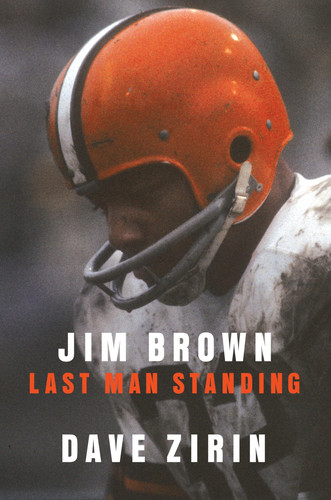
Jim Brown: last man standing

Zirin, Dave
A unique biography of Jim Brown—football legend, Hollywood star, and controversial activist—written by acclaimed sports journalist Dave Zirin. Jim Brown is recognized as perhaps the greatest football player to ever live. But his phenomenal nine-year career with the Cleveland Browns is only part of his remarkable story, the opening salvo to a much more sprawling epic. Brown parlayed his athletic fame into stardom in Hollywood, where it was thought that he could become “the black John Wayne.” He was an outspoken Black Power icon in the 1960s, and he formed Black Economic Unions to challenge racism in the business world. For this and for his decades of work as a truce negotiator with street gangs, Brown—along with such figures as Muhammad Ali, Bill Russell, and Billie Jean King—is revered as a socially conscious athlete. On the most hypermasculine cultural canvases of the United States—NFL football, the Black Power movement, Hollywood's blaxploitation films, gang intervention both inside and outside prison walls—Jim Brown has made his mark. Yet in the landscape of the most toxic expression of “what makes a man”—numerous accusations of violence against women—he has left a jagged mark as well. Dave Zirin's book redefines an American icon, and not always in a flattering light. At eighty-one years old, Brown continues to speak out and look for fights. His recent public support of Donald Trump and criticism of Colin Kaepernick are just the latest examples of someone who seems restless if he is not in conflict. Jim Brown is a raw and thrilling account of Brown's remarkable life and a must-read for sports fans and students of the black freedom struggle.
Blue Rider Press 2018-05-15 320 pages

The Romanovs: 1613-1918

Sebag Montefiore, Simon
The Romanovs were the most successful dynasty of modern times, ruling a sixth of the world's surface for three centuries. How did one family turn a war-ruined principality into the world's greatest empire? And how did they lose it all? This is the intimate story of twenty tsars and tsarinas, some touched by genius, some by madness, but all inspired by holy autocracy and imperial ambition. Simon Sebag Montefiore's gripping chronicle reveals their secret world of unlimited power and ruthless empire-building, overshadowed by palace conspiracy, family rivalries, sexual decadence and wild extravagance, with a global cast of adventurers, courtesans, revolutionaries and poets, from Ivan the Terrible to Tolstoy and Pushkin, to Bismarck, Lincoln, Queen Victoria and Lenin. To rule Russia was both imperial-sacred mission and poisoned chalice: six of the last twelve tsars were murdered. Peter the Great tortured his own son to death while making Russia an empire, and dominated his court with a dining club notable for compulsory drunkenness, naked dwarfs and fancy dress. Catherine the Great overthrew her own husband (who was murdered soon afterward), enjoyed affairs with a series of young male favorites, conquered Ukraine and fascinated Europe. Paul I was strangled by courtiers backed by his own son, Alexander I, who in turn faced Napoleon's invasion and the burning of Moscow, then went on to take Paris. Alexander II liberated the serfs, survived five assassination attempts and wrote perhaps the most explicit love letters ever composed by a ruler. The Romanovs climaxes with a fresh, unforgettable portrayal of Nicholas II and Alexandra, the rise and murder of Rasputin, war and revolution--and the harrowing massacre of the entire family. Dazzlingly entertaining and beautifully written from start to finish, The Romanovs brings these monarchs--male and female, great and flawed, their families and courts--blazingly to life. Drawing on new archival research, Montefiore delivers an enthralling epic of triumph and tragedy, love and murder, encompassing the seminal years 1812, 1914 and 1917, that is both a universal study of power and a portrait of empire that helps define Russia today.
Alfred A. Knopf 2016 744 pages

William Howard Taft

Rosen, Jeffrey
The only man to serve as president and chief justice, who approached every decision in constitutional terms, defending the Founders’ vision against new populist threats to American democracy William Howard Taft never wanted to be president and yearned instead to serve as chief justice of the United States. But despite his ambivalence about politics, the former federal judge found success in the executive branch as governor of the Philippines and secretary of war, and he won a resounding victory in the presidential election of 1908 as Theodore Roosevelt’s handpicked successor. In this provocative assessment, Jeffrey Rosen reveals Taft’s crucial role in shaping how America balances populism against the rule of law. Taft approached each decision as president by asking whether it comported with the Constitution, seeking to put Roosevelt’s activist executive orders on firm legal grounds. But unlike Roosevelt, who thought the president could do anything the Constitution didn’t forbid, Taft insisted he could do only what the Constitution explicitly allowed. This led to a dramatic breach with Roosevelt in the historic election of 1912, which Taft viewed as a crusade to defend the Constitution against the demagogic populism of Roosevelt and Woodrow Wilson. Nine years later, Taft achieved his lifelong dream when President Warren Harding appointed him chief justice, and during his years on the Court he promoted consensus among the justices and transformed the judiciary into a modern, fully equal branch. Though he had chafed in the White House as a judicial president, he thrived as a presidential chief justice.
Times Books, Henry Holt and Company 2018-03-20 183 pages

The big Fat Duck cookbook

Blumenthal, Heston
Takes you inside the head of maverick restaurateur, Heston Blumenthal. Separated into three sections (History; Recipes; Science), Blumenthal chronicles his improbable background and unorthodox rise to fame and, for the first time ever, offers a mouth-watering and eyes-widening selection of recipes from his award-winning restaurant. He also explains the science behind his culinary masterpieces, the technology and implements that make his alchemic dishes come to life.
Bloomsbury 2008 529 pages

Sagan, Paris 1954

Berest, Anne
From the bestselling author of The Postcard and How To Be Parisian Wherever You Are , this unique book charts Françoise's Sagan journey to publication for her legendary novel, Bonjour Tristesse . 'Fascinating' Stylist Before Françoise Sagan the literary icon, there was Françoise Quoirez, an eighteen-year-old Parisian girl, who wrote a novel and needed a publisher for it. This intimate narrative details the months in 1954 leading up to the publication of the legendary Bonjour Tristesse. We encounter Françoise, her family and friends close up, in a post-war world that is changing radically; and Mlle Quoirez, in her new guise of Françoise Sagan, will be at the heart of that social change. Sagan was always focused on her writing, though at times the fame of her books was to be eclipsed by her wild-child reputation. Yet, as Anne Berest herself testifies, Sagan's fearless approach to life lived on her own terms remains an inspiration even now.
Gallic Books 2015 173 pages

Shimon Peres: the biography

Bar-Zohar, Michael
Twice Israel’s prime minister, winner of the Nobel Peace Prize, bold leader in a war-torn region, Shimon Peres was one of the great statesmen of the modern world. Peres was also a fascinating, complex man–a brilliant intellectual who was entirely at home in the corridors of power; an individual revered by the world and yet highly controversial in his own country; at once a hero and a figure of tragedy. Now, in this definitive biography, Michael Bar-Zohar takes the full measure of a towering, enigmatic leader. Drawing on his decades-long association with Peres, as well as the full cooperation of the leader’s family, friends, supporters, and political rivals, Bar-Zohar has crafted a vibrant, daring, richly textured portrait of a man whose life and career span the entire history of Israel. Born in Poland in 1923, Peres emigrated to the Holy Land at the age of twelve, already a fiercely idealistic Zionist. Peres joined a kibbutz and, while still in his teens, became the leader of a major youth movement. When the struggle for Israeli independence broke out, future prime minister David Ben-Gurion tapped him to join his inner circle.As director general of the Defense Ministry under Ben-Gurion, Peres spearheaded a far-reaching campaign to turn Israel into a major military power. He jump-started Israel’s aircraft industry, forged a secret alliance with France, and successfully pursued his dream of making Israel a nuclear power. And yet Peres’s real triumph came not as a man of war but as a peacemaker.Elected prime minister in 1984, Peres brought new hope by pulling Israeli troops out of the quagmire in Lebanon, defusing tensions with Jordan, and, at the risk of his own political future, making serious overtures to the Palestinians. Peres and his longtime rival Yitzhak Rabin together secured the top-secret Oslo Accords of 1993, which won them and Yasser Arafat the Nobel Peace Prize–only to see the hope of peace shattered in a resurgence of regional violence.In a half-century of leadership, Peres has worked beside–or fought against–such giants as Moshe Dayan, Golda Meir, Menachem Begin, Ariel Sharon, and, tragically, Rabin, who was slain at the rally that marked his reconciliation with Peres. In this stunning, courageously frank, and scrupulously factual biography, Michael Bar-Zohar gives an eminent man his due.
Random House 2007-02-27 554 pages

The House of Government: a saga of the Russian Revolution

Slezkine, Yuri
"On the 100th anniversary of the Russian Revolution, the epic story of an enormous apartment building where Communist true believers lived before their destruction. The House of Government is unlike any other book about the Russian Revolution and the Soviet experiment. Written in the tradition of Tolstoy's War and Peace, Grossman's Life and Fate, and Solzhenitsyn's The Gulag Archipelago, Yuri Slezkine's gripping narrative tells the true story of the residents of an enormous Moscow apartment building where top Communist officials and their families lived before they were destroyed in Stalin's purges. A vivid account of the personal and public lives of Bolshevik true believers, the book begins with their conversion to Communism and ends with their children's loss of faith and the fall of the Soviet Union. Completed in 1931, the House of Government, later known as the House on the Embankment, was located across the Moscow River from the Kremlin. The largest residential building in Europe, it combined 550 furnished apartments with public spaces that included everything from a movie theater and a library to a tennis court and a shooting range. Slezkine tells the chilling story of how the building's residents lived in their apartments and ruled the Soviet state until some eight hundred of them were evicted from the House and led, one by one, to prison or their deaths. Drawing on letters, diaries, and interviews, and featuring hundreds of rare photographs, The House of Government weaves together biography, literary criticism, architectural history, and fascinating new theories of revolutions, millennial prophecies, and reigns of terror. The result is an unforgettable human saga of a building that, like the Soviet Union itself, became a haunted house, forever disturbed by the ghosts of the disappeared."--Publisher description
Princeton University Press 2017 1104 pages

Marie Antoinette

Zweig, Stefan
“The most influential biography of Marie Antoinette.” — Guardian “Bids fair to be the definitive life of that tragic queen.” —New York Times International Bestseller: One of the great writers of the 20th century paints a vivid portrait of one of the most famous, complex, and controversial characters in European history. Stefan Zweig based his biography of Marie Antoinette, who became the Queen of France at the age of fifteen, on the correspondence between her and her mother, and her great love the Count Axel von Fersen. Zweig analyzes the chemistry of a woman’s soul from her intimate pleasures to her public suffering as a Queen under the weight of misfortune and history. Zweig describes Marie Antoinette in the King’s bedroom, in the enchanted and extravagant world of the Trianon, and with her children. And in his account of The Revolution, he describes her resolve during the failed escape to Varennes, her imprisonment in the Conciergerie and her final tragic destiny under the guillotine. Stefan Zweig’s account has been the definitive biography of Marie Antoinette since its publication, inspiring Antonia Fraser and the recent film adaptation.
Pushkin Press 2010 590 pages

Tito Puente, Mambo King: Tito Puente, Rey del Mambo

Brown, Monica
In this vibrant bilingual picture book biography of musician Tito Puente, readers will dance along to the beat of this mambo king's life. Tito Puente loved banging pots and pans as a child, but what he really dreamed of was having his own band one day. From Spanish Harlem to the Grammy Awards—and all the beats in between—this is the true life story of a boy whose passion for music turned him into the "King of Mambo." Award-winning author-illustrator duo Monica Brown and Rafael López bring the remarkable story of this talented legend to life in this Pura Belpré Honor Book. Supports the Common Core State Standards.
HarperCollins Publishers 2013-03-05 32 pages

Pablo Neruda: poet of the people

Brown, Monica
A stunning picture book biography from Monica Brown and illustrator Julie Paschkis about one of the world's most enduring and popular poets, Pablo Neruda Once there was a little boy named Neftalí who loved wild things wildly and quiet things quietly. From the moment he could talk, he surrounded himself with words. Neftalí discovered the magic between the pages of books. When he was sixteen, he began publishing his poems as Pablo Neruda. Pablo wrote poems about the things he loved—things made by his friends in the café, things found at the marketplace, and things he saw in nature. He wrote about the people of Chile and their stories of struggle. Because above all things and above all words, Pablo Neruda loved people.
Henry Holt and Co 2011-03-29 32 pages

Alger Hiss and the battle for history

Jacoby, Susan
Books on Whittaker Chambers and Alger Hiss abound, as countless scholars havelabored to uncover the facts behind Chambers s shocking accusation before the House Committee on Un-American Activities in the summer of 1948 that Alger Hiss, a former rising star in the State Department, had been a Communist and engaged in espionage. In this highly original work, Susan Jacoby turns her attention to the Hiss case, including his trial and imprisonment for perjury, as a mirror of shifting American political views and passions. Unfettered by political ax-grinding, the author examines conflicting responses, from scholars and the media on both the left and the right, and the ways in which they have changed from 1948 to our present post Cold War era. With a brisk, engaging style, Jacoby positions the case in the politics of the post World War II eraand then explores the ways in which generations of liberals and conservatives have put Chambers and Hiss to their own ideological uses. An iconic event of the McCarthy era, the case of Alger Hiss fascinates political intellectuals not only because of its historical significance but because of its timeless relevance to equally fierce debates today about the difficult balance between national security and respect for civil liberties."
Yale University Press 2009 256 pages

Ethics into action: learning from a tube of toothpaste

Singer, Peter
More than twenty years after its publication, Peter Singer's Ethics into Action continues to inspire new generations of activists through its portrayal of Henry Spira and the animal rights movement. With a new preface from the author, this edition celebrates the continued importance of social movements and provides a path towards furthering changes in our world. Singer, one of the world's most influential living philosophers, reveals how Henry Spira influenced major corporations by simultaneously applying targeted pressures and removing existing obstacles to achieve his ethical goals. As people all over the world continues to struggle for justice, Spira's method of affecting change serves as a proven model for activists fighting across a wide range of causes
Rowman & Littlefield 2019 215 pages

Clara and Davie

Polacco, Patricia
From bestselling author Patricia Polacco's family tree -- the true story of young Clara Barton. Animals and flowers were Clara's best friends. She had a special way with critters and found joy in the beauty that sprang from the soil. But whenever Clara talked, her words didn't come out right. As hard as she tried, she could not get over her lisp. Clara's older brother Davie understood that his sister was gifted. When folks made fun of Clara's stilted words, Davie was always at her side reminding her that she had a talent for healing creatures. Davie told his sister, "Some day you are going to be a very great lady." And that's exactly what happened. Clara Barton became one of the most famous medical practitioners of all time, and founded the American Red Cross.
Scholastic Press 2014 40 pages

The long hard road out of hell

Manson, Marilyn,Strauss, Neil
The best-selling autobiography of America’s most controversial celebrity icon, Marilyn Manson (with a bonus chapter not in the hardcover). In his twenty-nine years, rock idol Manson has experienced more than most people have (or would want to) in a lifetime. Now, in his shocking and candid memoir, he takes readers from backstage to gaol cells, from recording studios to emergency rooms, from the pit of despair to the top of the charts, and recounts his metamorphosis from a frightened Christian schoolboy into the most feared and revered music superstar in the country. Illustrated with dozens of exclusive photographs and featuring a behind-the-scenes account of his headline-grabbing Dead to the World tour.
Regan 1999-03-03 269 pages

The house of Barnes: the man, the collection, the controversy

Rudenstine, Neil L.
"The House of Barnes: The Man, The Collection, The Controversy is a beautifully written study of the extraordinary art collector and volatile personality Albert C. Barnes. The book places him in the context of his own era, shedding new light on the ideas and movements (about art collecting, education, and aesthetics) that shaped so much of his thinking"--
The American Philosophical Society 2024 229 pages