278 results for "Children"

The way it's never been done before: my friendship with Marlon Brando

Englund, George
Marlon Brando was the brightest, boldest, and most iconoclastic acting talent of our time. But while his courage and imagination as an artist brought applause and attention from around the world, Brando shunned nearly everything that goes with celebrity status. He was one of the most reclusive personalities in modern times and a legend beyond compare. He was also an equal opportunity provocateur -- a dazzling baffler -- be it on stage, on screen, or in his private life. Always true to his nature, he never failed to surprise. He did things his way -- The Way It's Never Been Done Before. No one shared as much of Brando's private fields as his lifelong friend and business confidant, George Englund. For more than five decades, Brando and Englund were each other's most trusted ally and closest compadre. Even at their first meeting, at a Hollywood party in 1956 -- the kind of occasion where Brando was most on guard against any who would attempt to get close to him -- he and Englund forged close ties. From that initial meeting right up to the eve of the superstar's death in the summer of 2004, Brando and Englund were in nearly constant contact. They traveled together, worked together, and played together. They consoled and cajoled each other through their marriages and divorces, the births and tragic deaths of their children, good and bad business deals, and the onset of aging, concluding with Brando's death at the age of eighty. "I remembered what Mark Twain wrote," Englund says, "'that everybody is a moon with a dark side he doesn't show anyone else.' I felt this was an appropriate hour for a book that looked at the other side of Marlon, that told of the man and friend and father he was. There has not been such a book in Marlon's lifetime, even including his autobiography, and I felt that after our long years of friendship, perhaps I should attempt to write it. I knew the difficulty I would encounter; to write about Marlon is to work with delicate glass, for he was, without question, the most complicated personality I ever met or knew about. "I once thought what a grand time he and I would have writing the book about our friendship together. That possibility has passed away, for Marlon is gone now -- I must make the attempt to write of us alone. I summon to the task the sacredness, which, when we were at our best, Marlon and I laid upon our friendship."
HarperEntertainment 2004-11-01 292 pages

Playing the future: what we can learn from digital kids

Rushkoff, Douglas
Do "The Simpsons" represent a leap forward in media consciousness? Do Sega video games andchannel-surfing offer new strategies for coping in a world fraught with unpredictability? Canraves, snowboarding, or online chatting teach us something about adapting to cultural change?Douglas Rushkoff, "one of the great thinkers and writers of our time" (Timothy Leary) says yes, yes, and yes.
Riverhead Books 1999 278 pages

Abandoned in the wasteland: children, television, and the First Amendment

Minow, Newton N.
In 1961, when Newton N. Minow was President Kennedy's chairman of the Federal Communications Commission, he astonished the American public with his blunt criticism of television broadcasting as a "vast wasteland". To Mr. Minow today, after decades in communications and public service, and to his colleague Craig L. LaMay, the problem is more urgent than ever, for we all - broadcasters, parents, public officials, and teachers - have abandoned our children to a wasteland of vacuous, often violent, and openly consumerist television programming that represents none of the values we claim to cherish and that threatens our future. The commercial interests dominating television today argue that the Constitution gives them the right to broadcast whatever they wish. But Minow and LaMay persuasively demonstrate that this is a false application of the First Amendment. They remind us that broadcasters are required by law to serve the public interest, and that the Supreme Court and Congress regard service to children as a broadcaster's obligation under law. They argue that the First Amendment can be used on behalf of children, to help make television a force that will nurture and not harm them. They offer many hardheaded, workable ideas for an effective children's television policy (America is alone among the Western democracies in not yet having one) and for new ways to ensure that our children travel safely on the information superhighway.
Hill and Wang 1995 237 pages

Miseducation: preschoolers at risk

Elḳind, Daṿid
David Elkind’s new book is designed to help parents avoid the miseducation of young children that is on the increase today. Across the country—in schools and in homes—educational programs intended for school-age children are being misappropriated for the instruction of preschoolers. Books, lectures, and the media propagate the idea that only a “superkid” can grow up to compete successfully in the adult world—thereby encouraging parents to teach infants and young children academic and athletic skills. Yet, there is considerable evidence that early instruction can do lasting harm—that young children subjected to this kind of pressure are, in fact, at psychological and physical risk. Dr. Elkind shows us the very real difference between the mind of a preschool child (how it works) and that of a school-age child. He makes clear how much young children can and do learn when they are presented with developmentally appropriate parenting practices and education. He shows us how healthy education supports and encourages the spontaneous learning process through which young children explore and understand their immediate world, and how miseducation ignores it, attempting to teach the wrong things at the wrong time. And, in turn, we see how early miseducation can cause permanent damage to a child’s self-esteem, the loss of the positive attitude a child needs for learning the blocking of natural gifts and potential talents. Finally, Dr. Elkind discusses what parents should look for when deciding upon the initial stages of their children’s education and what preschool programs are the most considerate of the individual child. In a special section, he answers the most common questions he’s heard from parents.
Knopf 1987-11-12 221 pages

Memoirs of a Jewish extremist: the story of a transformation

Klein Halevi, Yossi
Now available in paperback for the first time, with a new introduction, the poignant and insightful memoir from Yossi Klein Halevi, the award-winning journalist and author of the acclaimed Like Dreamers—a coming-of-age story about a traumatic family history, radical politics, and spiritual transformation that speaks to a new generation struggling to understand what it means to be Jewish in America. The child of a Holocaust survivor, Yossi Klein Halevi grew up in 1960s Brooklyn perceiving reality through the lens of his family’s brutal past. Increasingly identifying with their history of suffering, he regarded the non-Jewish world with fear and loathing. Determined to take action—and seek retribution—he became a disciple of the late rabbi Meir Kahane and a member of the radical fringe of the American Jewish community. In this wry and moving account, Halevi explores the deep-rooted anger of his adolescence and early adulthood that fueled his increasingly aggressive activism. He reveals how he started to question his beliefs—and his self-inflicted suffering as a hostage of history—and see the world from his own clear perspective. As a journalist and author, Halevi has dedicated himself to fostering interfaith reconciliation. Memoirs of a Jewish Extremist explains how such a transformation can happen—giving hope that peaceful coexistence between faiths is possible.
Harper/Perennial 2014-10-07 352 pages

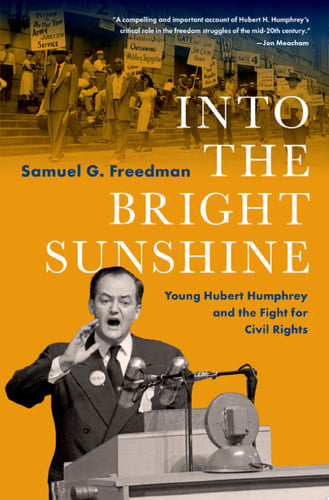
Into the bright sunshine: young Hubert Humphrey and the fight for civil rights

Freedman, Samuel G.
"Hubert Humphrey, a fallen hero and a dying man, rose on rickety legs to approach the podium of the Philadelphia Convention Hall, his pulpit for the commencement address at the University of Pennsylvania. He clutched a sheaf of paper with his speech for the occasion, typed and double-spaced by an assistant from his extemporaneous dictation, and then marked up in pencil by Humphrey himself. A note on the first page, circled to draw particular attention, read simply, "30 years ago--Here." In this place, at that time, twenty-nine years earlier to be precise, he had made history. From the dais now, Humphrey beheld five thousand impending graduates, an ebony sea of gowns and mortarboards, broken by one iconoclast in a homemade crown, two in ribboned bonnets, and another whose headgear bore the masking-tape message HI MA PA. In the horseshoe curve of the arena's double balcony loomed eight thousand parents and siblings, children, and friends. Wearing shirtsleeves and cotton shifts amid the stale heat, they looked like pale confetti from where Humphrey stood, and their flash cameras flickered away, a constellation of pinpricks"--
Oxford University Press 2023 488 pages

Valley Forge

MacKinlay Kantor
MACKINLAY KANTOR Pulitzer Prize-winning author of Andersonville VALLEY FORGE Poignant, tender, and powerful, VALLEY FORGE brings into sharp new focus one of the most tensely dramatic episodes of the American Revolution. With warmth and wit, compassion and sensitivity, MacKinlay Kantor evokes the flavor, pulse and texture of the last quarter of the eighteenth century, transporting the reader into the houses and workshops, kitchens and stables, parlors and bedrooms of ordinary citizens. Here are not only the soldiers of Valley Forge, but the panorama of the Revolution itself. George Washington, lamenting the remoteness and lack of valor in the Congress, anticipating new battle; the sprightly, good-humored Martha, always loyal and loving to a fault; the Marquis de Lafayette, whose poise and dignity belied his youth; Baron von Steuben whose halting English made the soldiers laugh, but whose fierce devotion won their respect. And the multitude-young Mum, a sixteen-year-old deserter savagely trampled by Tarleton's Raiders; Malachi Lennan whose gift of a horse gained him entry into Mad Anthony Wayne's Drovers; Billy, the turncoat, wailing for his mother as he was dragged to the gallows. Sons of farmers and tradesmen, trappers and teachers-some too young to fight, and some too old-surge through these pages, giving life, breath, scope and humanity to the American Revolution and the winter at Valley Forge. MacKINLAY KANTOR was born in Webster City, Iowa in 1904. He began to write seriously at sixteen, became a newspaper reporter at seventeen, and an author at twenty-three. Since his first-published novel in 1928, more than forty books have appeared in print, including verse, short stories, novellas, histories, and books for children. His best-selling, and Pulitzer Prize- winning Andersonville was published in 1955. MacKinlay Kantor's other than book accomplishments range from Hollywood screenwriting to police patrolling (N. Y. P. D.), to combat experience (RAF and U.SAF) in two wars. VALLEY FORGE is grandly conceived, but the quality is equal to the concept. The climate of the war, its taste and smell and the harsh texture of its life, are evoked with mystery. Neither souped-up nor toned-down under fashionable pressures, this is an extraordinarily honest and human book. I am greatly impressed.-MARY RENAULT
Speaking Volumes, LLC 2016-11-28 350 pages

Bookends: two women, one enduring friendship

Rostenberg, Leona
The rare book dealers who delighted readers with the history of their bookselling days in "Old Books, Rare Friends" now offer the other side of their story -- an intimate look at the joys of a relationship that has lasted more than half a century. When their friendship and business partnership began in the 1940s, Leona Rostenberg and Madeleine Stern were pioneers in a man's world. Now approaching their nineties, the duo, who -- among their many discoveries -- unearthed Louisa May Alcott's pseudonymous blood-and-thunder stories, remains a vibrant institution in the rare book trade, even as the Internet changes their field -- and their community -- forever. After publishing "Old Books, Rare Friends," Rostenberg and Stern received a flood of fan mail asking about their personal lives, and they have responded with poignant honesty and the warmth for which they are famous, as they reflect on their lives and their remarkable partnership. "Bookends" recounts their fascinating histories: family backgrounds, business adventures, the men they did not marry, and their approach to the bittersweet trials of aging. More than just a dual memoir, "Bookends" is also a chronicle of the cultural changes of twentieth-century American life and a loving farewell to the golden age of book collecting. Filled with wisdom and humor, this volume is a tribute to Rostenberg and Stern's passion for the written word -- and for life itself. Catching us off guard with their candor, they offer their insights regarding their business, their way of life, and their worldview. Above all, they present the story of a special relationship. At a time when people find it increasingly difficult to connect, here wehave the seamless story of a shared life. It is the unique product of an earlier time, yet it is a timeless reflection on the very nature of friendship. Though their fantastic partnership is un-reproducible, the ideal they have established, for the integration of one life so completely with another, contains lessons for all of us. Without husband or children they created a loving home when this was uncharted territory for women. They nurtured a business and life partnership that has lasted more than half a century and has only gotten stronger with time. When the passing years began to claim one's hearing and the other's sight, they became each other's eyes and ears. A meditation on aging and togetherness, this book is also the narrative of two pioneering single, Jewish women making their way in tandem through a world largely organized to keep them in their place. It is a gentle, wise story, told in their inimitable style, sparse, unadorned, and honest. Their affirmations supersede their uncertainties. As they write, "Bookends support books and come in pairs...If the word encapsulates our past, it looks also to the future, and to the books -- lived together, written together -- that will follow." They confront the challenges of aging in a no-nonsense tone, and, in facing them, give us an ideal of enduring human friendship that can't help but touch the heart.
Free Press 2001 246 pages

Models of my life

Simon, Herbert A.
In this candid and witty autobiography, Nobel laureate Herbert A. Simon looks at his distinguished and varied career, continually asking himself whether (and how) what he learned as a scientist helps to explain other aspects of his life. A brilliant polymath in an age of increasing specialization, Simon is one of those rare scholars whose work defines fields of inquiry. Crossing disciplinary lines in half a dozen fields, Simon's story encompasses an explosion in the information sciences, the transformation of psychology by the information-processing paradigm, and the use of computer simulation for modeling the behavior of highly complex systems. Simon's theory of bounded rationality led to a Nobel Prize in economics, and his work on building machines that think&-- based on the notion that human intelligence is the rule-governed manipulation of symbols&--laid conceptual foundations for the new cognitive science. Subsequently, contrasting metaphors of the maze (Simon's view) and of the mind (neural nets) have dominated the artificial intelligence debate. There is also a warm account of his successful marriage and of an unconsummated love affair, letters to his children, columns, a short story, and political and personal intrigue in academe.
MIT Press 1996-10-08 415 pages

Company C An AmericanS Life As a Citizen-Soldier in the Israeli Army

Haim Watzman
When American-born Haim Watzman immigrated to Israel, he was drafted into the army and, after eighteen months of compulsory service, was assigned to Company C, the reserve infantry unit that would define the next twenty years of his life. From 1984 until 2002, for at least a month a year, Watzman, who had never aspired to military adventure, was a soldier. Watzman was a soldier as he adjusted to his new country, raised his children, and pursued a career as a writer and translator. At times he defended his adopted country’s borders; at other times he patrolled beyond them, or that gray area, the occupied territories. A religiously observant Jew who opposed Israel’s presence in the West Bank and Gaza Strip, he served in uniform in conflicts that he demonstrated against in civilian clothes. Throughout, he developed a deep and abiding bond with the diverse men of Company C--a fellowship that cemented his commitment to reserve service even as he questioned the occupation he was enforcing. In this engrossing account of the first Intifada, the period of the Oslo Accords, and Israel’s reoccupation of the West Bank as lived by citizen-soldiers in the field, Watzman examines our obligations to country, friends, family, and God--and our duty to protect our institutions even as we fight to reform them.
Argo Navis 2012-10-20 328 pages

The hard way around: the passages of Joshua Slocum

Wolff, Geoffrey
A masterful biographer now offers a thrilling, definitive portrait of one of history’s most legendary icons of adventure. In 1860, sixteen-year-old Joshua Slocum escaped a hardscrabble childhood in Nova Scotia by signing on as an ordinary seaman to a merchant ship bound for Dublin. Despite having only a third-grade education, Slocum rose through the nautical ranks at a mercurial pace; just a decade later he was commander of his own ship. His subsequent journeys took him nearly everywhere: Liverpool, China, Japan, Cape Horn, the Dutch East Indies, Manila, Hong Kong, Saigon, Singapore, San Francisco, and Australia—where he met and married his first wife, Virginia, who would sail along with him for the rest of her life, bearing and raising their children at sea. He commanded eight vessels and owned four, enduring hurricanes, shipwrecks, pirate attacks, cholera, smallpox, a mutiny, and the death of his wife and three of his children. Yet his ultimate adventure and crowning glory was still to come. In 1895 Slocum set sail from Gloucester, Massachusetts—by himself—in the Spray, a small sloop of thirty-seven feet. More than three years and forty-six thousand miles later, he became the first man to circumnavigate the globe solo, a feat that wouldn’t be replicated until 1925. His account of that voyage, Sailing Alone Around the World , soon made him internationally famous. He met President Theodore Roosevelt on several occasions and became a presence on the lecture circuit, selling his sea-saga books whenever and wherever he could. But scandal soon followed, and a decade later, with his finances failing, he set off alone once more—and was never seen again. Geoffrey Wolff captures this singular life and its flamboyant times—from the Golden Age of Sail to a shockingly different new century—in vivid, fascinating detail.
Alfred A. Knopf 2010 218 pages

The making of Americans: democracy and our schools

Hirsch, E. D.
From the bestselling author of Cultural Literacy , a passionate and cogent argument for reforming the way we teach our children "Ought to be read by anyone interested in the education and training of the next generation of Americans."--Glenn C. Altschuler, Boston Globe Why, after decades of commissions, reforms, and efforts at innovation, do our schools continue to disappoint us? In this comprehensive and thought-provoking book, educational theorist E. D. Hirsch, Jr. offers a masterful analysis of how American ideas about education have veered off course, what we must do to right them, and most importantly why . He argues that the core problem with American education is that educational theorists, especially in the early grades, have for the past sixty years rejected academic content in favor of "child-centered" and "how-to" learning theories that are at odds with how children really learn. The result is failing schools and widening inequality, as only children from content-rich (usually better-off) homes can take advantage of the schools' educational methods. Hirsch unabashedly confronts the education establishment, arguing that a content-based curriculum is essential to addressing social and economic inequality. A nationwide, specific, grade-by-grade curriculum established in the early school grades can help fulfill one of America's oldest and most compelling dreams: to give all children, regardless of language, religion, or origins, the opportunity to participate as equals and become competent citizens. Hirsch not only reminds us of these inspiring ideals, he offers an ambitious and specific plan for achieving them.
Yale University Press 2009 261 pages

Going out: the rise and fall of public amusements

Nasaw, David
There was a time not very long ago when "going out" was only for the rich and the reckless. At the turn of the century, "going out" became part of everyday life as vaudeville halls, photograph parlors, penny arcades, nickelodeons, nightclubs, dance halls, world's fair midways, amusement parks, ballparks, and movie palaces opened their doors to the people of the city. The new amusement centers welcomed women, men, and children, native-born and immigrant, rich, poor, and middling. Only African Americans were excluded or segregated in the audience, though they were overrepresented on stage. Going Out chronicles the twentieth-century entertainment revolution that changed forever the ways we live, work, and play. In a matter of decades, a new public world of amusements was created where ethnic, class, and neighborhood differences were subordinated to the common pursuit of a good time. Clerks and bankers, sales girls and society ladies "turkey trotted" to ragtime in nightclubs and dance halls; "shot the chute" and clutched one another in "barrels of love"; visited "Darkest Africa" on the world's fair midways; and sat together in the dark watching pictures move on a screen. In Going Out, we meet the colorful characters who invented show business: Thomas Alva Edison, who was astonished when his phonograph made money playing music (he had designed it to take business dictation); Benjamin Franklin Keith, the circus grifter who opened a dime museum in Boston in the 1880s and within a decade owned the world's largest vaudeville theater circuit; Adolph Zukor and Marcus Loew, the New York furriers who made millions in the early picture-show business; and the dozens of small-time show businessmen who rode the rails with their "shows" in their trunks. And we hear the stories of the early black performers and their struggles to maintain their dignity and livelihood while audiences demanded their public humiliation. Going Out is a history of twentieth-century show business and of the new American public that assembled in the city's wondrous pleasure palaces, parks, and theaters. The book concludes with an account of the fall or relocation of this entertainment world, as central city amusement parks, movie palaces, and ballparks were uprooted and transported to the suburbs in the decades following World War II.
Harvard University Press 1999-04-15 312 pages

Ties that stress : the new family imbalance

Elkind, David
What has happened to the American family in the last few decades? And what are these changes doing to our children? A renowned child psychologist and author of several influential works on child development, David Elkind has devoted his career to these urgent questions. This eloquent book - the culmination of his inquiry - puts together all the pieces, puzzling facts, and conflicting accounts, and shows us as never before what the American family has become. Today's postmodern family is under enormous stress. And as a result, the needs of hurried children have been sacrificed to the needs of their harried parents. Childhood innocence has been supplanted by the illusion of childhood competence; teenage immaturity has given way to pseudo-sophistication; and parental intuition has been traded in for a mechanical reliance on technique. These changes and a host of others have undermined the well-being of children and adolescents. From Freud to Friedan to Foucault, Elkind traces the roots of the postmodern family back to the failure of the modern nuclear family and its supporting institutions - the media, the so-called helping professions, the legal system, and the schools - to meet the needs of parents. The new postmodern family is more flexible, more permeable, more urbane, but also out of balance because it fails to meet the needs of children. Treated like miniature adults, today's children and adolescents go without the protection and security they need, while their once-sheltered baby-boomer parents, facing new economic pressures for which they are unprepared, secretly wonder why they've never really felt like grown-ups. But all is not bleak. Elkind finds evidence of an emerging vital family that melds the best of the modern and postmodern, one in which the needs of all family members are held in a dynamic, if delicate, balance. Many books have decried the decline in family values, the negative impact of divorce, the increase in single-mother families, and impoverished prospects for our children. But none has pulled all these fragments together as Elkind's does and put them into a solid framework, one that finally makes sense of the way we were, and what we as families may become.
Harvard University Press 1995 260 pages

The last gift of time: life beyond sixty

Heilbrun, Carolyn G.
As a young woman, Carolyn Heilbrun made a resolution not to live past "three score years and ten." Taking her own life at the age of seventy, she reasoned, would lend clean closure to a life well lived, and would keep her from the many tragedies of aging--becoming a burden to her children, witnessing the deterioration of her body, falling prey to a crippling disease. But on the advent of her seventieth birthday, she looked back on the past ten years and found, to her surprise, that her sixties had been the happiest decade of all: after fifty years, her marriage had matured into a happy balance of companionship and respect for solitude; she had developed deep friendships with her grown children and a small circle of peers; she had mastered a highly successful career as a scholar and writer. In the poignant, essayistic writing that best showcases her elegant talent and provocative mind, Carolyn Heilbrun celebrates the many pleasures of a mature life. Filled with wisdom, knowledge, wry humor, and literary allusion, The Last Gift of Time is a moving book for all women invested in the pursuit of leading a woman's life to its fullest capacity.
Dial Press 1997 225 pages

Peter Spier's Circus

Peter Spier
Come join the circus as Caldecott Medal-winner Peter Spier takes you for a look under the big top! The circus is coming to town! Take your front row seat to see how a circus runs—from setting up the tent to performing center ring. Go soaring through the air on the flying trapeze and see how performers from all over the world come together to put on a show. With showbiz excitement that only the circus can create—and Peter Spier's signature humorous details waiting to be discovered on every page—this book is a guaranteed ticket to fun and adventure.
Random House Children's Books 1995-05-01 48 pages

When We Were Bad

Mendelson, Charlotte
Critics in Britain are already raving about Charlotte Mendelson’s excoriatingly funny yet deeply humane novel about a glamorous London family that happens to be falling apart. The Rubins are the perfect family. They’re wonderfully happy and very glamorous. The mother, Claudia, is the ultimate Jewish a powerful rabbi known for her charm, brains, and determination. Now this dynastic Jewish family is getting ready to marry off the perfect eldest son. History, community, and even gastronomy unite the guests lucky enough to attend this joyous occasion. But when the groom -- one minute before exchanging vows -- bolts with the wrong woman, the myths that have defined this family take on darker overtones. Mendelson’s astonishing eye for detail, as well as her just-right balance of plot and character, makes the unfolding of this story an uncommon treat. In a marvelously compressed style that also bursts with life, she reveals how all four adult Rubin children, and their parents, struggle with huge secrets, sexual frustration and sexual experimentation, and many betrayals. Charlotte Mendelson opens a window on a realm rarely explored in British the complicated world of English Jewry. But to watch this seemingly blessed family drastically, disastrously fall apart before regaining balance is to understand that their struggles -- like all of ours -- are universal ones.
Harper Perennial 2008 336 pages