449 results for "Economics"

Incredible!

Rabbi Nachman Seltzer
This is a true story so full of non-stop action, physical and spiritual courage, Divine Providence, spine-tingling adventure -- and an utter dedication to Torah -- that it can only be called: Incredible! As CEO of Arachim, the ultra-successful global kiruv organization, Rabbi Yossi Wallis has touched and transformed the lives of tens of thousands of Jews, and has developed personal, warm relationships with many of our greatest Torah leaders. Before he became a renowned kiruv master, Yossi ("Joe") Wallis lived a life of breathtaking exploits and hair-raising escapes. It began on the tough New York streets, where Joe led the Bronx's first all-Jewish gang, black leather jackets and all. It was a life that included dangerous encounters with the Mafia underworld, a stint in the Israeli air force, and an unexpected discovery of his Torah heritage while waiting in a restaurant for his treife sandwich. Rabbi Wallis wasn't the only illustrious member of his family. Under the deft hands of master storyteller Rabbi Nachman Seltzer we meet Rabbi Wallis's ancestor, Rafael Vallis, one of the three last Jews to be publicly burned in a Spanish auto-da-fe. And Yeedle Wallis, Rabbi Wallis's father, whose against-all-odds survival in the Holocaust and journey to pre-State Palestine is something you'd expect only to find in fiction. This is a story that reads like a thriller, and, at the same time, it is an inspiring account of a spiritual journey. This is a story that is simply Incredible!
Mesorah Publications, Limited 2016 440 pages

The Laws of Spirit A Tale of Transformation

Dan Millman
The Laws of Spirit opens with the story of Dan Millman's encounter with a sage in the wooded hills near his home. Through stories, tests, and experiences in the wild, the sage challenges Millman to examine 12 core principles that underlie human existence: balance, choice, process, presence, compassion, faith, expectation, integrity, action, cycles, surrender, and unity. The book shows how these keys -- at the heart of every religion, culture, and moral system -- can lead to a deeper sense of meaning, connection, and harmony with the world. It also shows readers how these principles can transform relationships, careers, finance, and health. Quotations and reminders from across the centuries inform and inspire readers as they accompany Millman on his journey.
H J Kramer 2001-08 120 pages

Optimum Quantity of Money A Comprehensive Presentation of the Body of Monetary Thought of One of the World's Leading Monetary Economists

Milton Friedman
This classic set of essays by Nobel Laureate and leading monetary theorist Milton Friedman presents a coherent view of the role of money, focusing on specific topics related to the empirical analysis of monetary phenomena and policy. The early chapters cover factors determining the real quantity of money held in a community and the welfare implications of policies that affect the quantity held. The following chapters formally restate why quantity analysis has become central to the science of economics. Friedman's presidential address to the American Economic Association, included here, provides a general summary of his views on the role of monetary policy, with an emphasis on its limitations and its possibilities. This theoretical framework is used in examining a number of empirical the demand for money, the explanation of price changes in wartime periods, and the role of money in business cycles. These essays summarize some of the most important results of Friedman's extensive research over the course of his lifetime. The chapters on policy that follow survey the positions of earlier economists and deal with the importance of lags and the implications of destabilizing speculation in foreign markets. Taken as a whole, The Optimum Quantity of Money provides a comprehensive view of the body of monetary theory developed in leading centers of monetary analysis. This work is essential reading for economists and graduate students in the field. The volume will be no less important for practicing business and banking personnel as well. The new statement by Michael Bordo, a student of Friedman's and an expert in the field, provides a sense of where the field now stands in the economy and academy.
Aldine Transaction 1969 308 pages

Putting poor people to work: how the work-first idea eroded college access for the poor

Kathleen M. Shaw,Sara Goldrick-Rab,Christopher Mazzeo,Jerry A. Jacobs
Today, a college education is increasingly viewed as the gateway to the American Dream—a necessary prerequisite for social mobility. Yet recent policy reforms in the United States effectively steer former welfare recipients away from an education that could further their career prospects, forcing them directly into the workforce where they often find only low-paying jobs with little opportunity for growth. In Putting Poor People to Work, Kathleen Shaw, Sara Goldrick-Rab, Christopher Mazzeo, and Jerry A. Jacobs explore this troubling disconnect between the principles of "work-first" and "college for all." Using comprehensive interviews with government officials and sophisticated data from six states over a four year period, Putting Poor People to Work shows how recent changes in public policy have reduced the quantity and quality of education and training available to adults with low incomes. The authors analyze how two policies encouraging work—the federal welfare reform law of 1996 and the Workforce Investment Act of 1998—have made moving people off of public assistance as soon as possible, with little regard to their long-term career prospects, a government priority. Putting Poor People to Work shows that since the passage of these "work-first" laws, not only are fewer low-income individuals pursuing postsecondary education, but when they do, they are increasingly directed towards the most ineffective, short-term forms of training, rather than higher-quality college-level education. Moreover, the schools most able and ready to serve poor adults—the community colleges—are deterred by these policies from doing so. Having a competitive, agile workforce that can compete with any in the world is a national priority. In a global economy where skills are paramount, that goal requires broad popular access to education and training. Putting Poor People to Work shows how current U.S. policy discourages poor Americans from seeking out a college education, stranding them in jobs with little potential for growth. This important new book makes a powerful argument for a shift in national priorities that would encourage the poor to embrace both work and education, rather than having to choose between the two. Institute for Research on Poverty Affiliated Books on Poverty and Public Policy">An Institute for Research on Poverty Affiliated Book on Poverty and Public Policy
Russell Sage Foundation 2009-12-04 199 pages

Theory of Rational Option Pricing

Robert C. Merton
This work has been selected by scholars as being culturally important, and is part of the knowledge base of civilization as we know it. This work is in the "public domain in the United States of America, and possibly other nations. Within the United States, you may freely copy and distribute this work, as no entity (individual or corporate) has a copyright on the body of the work. Scholars believe, and we concur, that this work is important enough to be preserved, reproduced, and made generally available to the public. We appreciate your support of the preservation process, and thank you for being an important part of keeping this knowledge alive and relevant.
Creative Media Partners, LLC 2022-10-27 124 pages

Uncommon Sense

Richard A. Posner
On December 5, 2004, the still-developing blogosphere took one of its biggest steps toward mainstream credibility, as Nobel Prize - winning economist Gary S. Becker and renowned jurist and legal scholar Richard A. Posner announced the formation of the Becker-Posner Blog. In no time, the blog had established a wide readership and reputation as a reliable source of lively, thought-provoking commentary on current events, its pithy and profound weekly essays highlighting the value of economic reasoning when applied to unexpected topics. Uncommon Sense gathers the most important and innovative entries from the blog, arranged by topic, along with updates and even reconsiderations when subsequent events have shed new light on a question. Whether it's Posner making the economic case for the legalization of gay marriage, Becker arguing in favor of the sale of human organs for transplant, or even the pair of scholars vigorously disagreeing about the utility of collective punishment, the writing is always clear, the interplay energetic, and the resulting discussion deeply informed and intellectually substantial. To have a single thinker of the stature of a Becker or Posner addressing questions of this nature would make for fascinating reading; to have both, writing and responding to each other, is an exceptionally rare treat. With Uncommon Sense, they invite the adventurous reader to join them on a whirlwind intellectual journey. All they ask is that you leave your preconceptions behind.
ReadHowYouWant.com 2010-10-19 600 pages

Beyond Capital Marx's Political Economy of the Working Class

Michael A. Lebowitz
"Was Marx's Capital intended as a study of capitalism as a whole or was it meant as an analysis of capital? In Beyond 'Capital', Michael A. Lebowitz explores the implications of the book on wage-labour that Marx originally intended to write. Focusing on critical assumptions in Capital that were to be removed in Wage-Labour and upon Marx's methodology, Lebowitz stresses the one-sidedness of Marx's Capital and argues that the side of the workers, their goals and their struggles in capitalism have been ignored by a one-sided Marxism characterized by determinism, reductionism and a silence on human experience. In this completely reworked edition of his 1992 book, Lebowitz introduces three new chapters and explores problems in Marx's wage theory, the place of the workers' state in Marx's theory and the importance of the concept of the collective worker."--BOOK JACKET.
St. Martin's Press 1992 187 pages

The Works of David Ricardo

David Ricardo,John Ramsay McCulloch
David Ricardo [1772-1823] has been called ".the principle founder of what has been called the classical school of political economy" (Dictionary of National Biography) and "first 'scientific' economist" (Printing and the Mind of Man 277). Here McCulloch's authoritative Life and Writings of Mr. Ricardo prefaces this collection of Ricardo's pamphlets and other works, including his influential treatise on the distribution of wealth, The Principles of Political Economy and Taxation.
University Press of the Pacific 2002-11-30 620 pages

Branson

Tom Bower
'Bower's book is a devastating indictment' Sunday Times 'Explosive ... Bower reveals a remarkable and sinister picture of the man who likes to appear as the ever-smiling hero' Daily Mail A sensational critical biography of the man and his business practices. No British tycoon is better known, few claim to be richer and none has masterminded a more recognisable brand than Richard Branson. What is behind the success of the buccaneering balloonist, the tabloids' favourite celebrity nude, the 'grinning jumper' and the scourge of corporate goliaths? Tom Bower has a uncovered a different tale to the one so eagerly promoted by Virgin's publicists. Here is the full story of Branson: his businesses, his friendships, his ambition, his law-breaking, his drug-taking, his bullying. Offering an intimate scrutiny of exactly how Richard Branson created and sold himself, this biography reveals Branson to be a single-minded profiteer who, while occasionally generous to others, has a fixed purpose to enhance his family's wealth in secret off-shore trust funds. Instead of a glittering saint, Branson emerges as a devious actor, proud of plucking for his own profit the good ideas of others.
Fourth Estate 2001 393 pages

Bullies, Tyrants, and Impossible People How to Beat Them Without Joining Them

Ronald M. Shapiro,Mark A. Jankowski,James M. Dale
The impossible people who make life’s journey so difficult are everywhere—at the office, in restaurants, on airplanes, living next door, members of your own family. They’re . . . • your “nothing is ever good enough” boss • the “no price is ever low enough” client • the next-door neighbor who redefines the meaning of paranoia • the maître d’ who looks through you as if you don’t exist • the father-in-law who you know is always thinking about how much better a life his Janey or Joey would have if only married to someone other than you Ron Shapiro and Mark Jankowski give you a simple and highly effective 4-point plan for dealing with all of them and more—N.I.C.E. Their system shows you how to neutralize your emotions so you don’t just react but act purposefully and wisely. It enables you to identify the type of bully, tyrant, or impossible person you’re facing—the situationally difficult (something has happened that turns an otherwise reasonable person into a temporary terror); the strategically difficult (she has empirical evidence that being difficult is a strategy that gets results); or simply difficult (being difficult is his 24/7 M.O.). Then you’ll learn how to shape the outcome by controlling the encounter and, finally, how to get “unstuck” by exploring your options. Using colorful stories from all walks of life— “He called me the scum of the earth and it went downhill from there,” “First, lock all your vendors in a small room,” and “The boss from hell”—the authors bring their lessons to life, from business life to family life.
Crown 2007-04-24 288 pages

America's Great Depression

Murray N. Rothbard,Murray Rothbard
Rothbard opens with a theoretical treatment of business cycle theory, showing how an expansive monetary policy generates imbalances between investment and consumption. He proceeds to examine the Fed's policies of the 1920s, demonstrating that it was quite inflationary even if the effects did not show up in the price of goods and services. He showed that the stock market correction was merely one symptom of the investment boom that led inevitably to a bust. The Great Depression was not a crisis for capitalism but merely an example of the downturn part of the business cycle, which in turn was generated by government intervention in the economy. Had the book appeared in the 1940s, it might have spared the world much grief. Even so, its appearance in 1963 meant that free-market advocates had their first full-scale treatment of this crucial subject. The damage to the intellectual world inflicted by Keynesian- and socialist-style treatments would be limited from that day forward.--Amazon.com
Martino Fine Books 2019-02-06 372 pages

Changing the Rules Adventures of a Wall Street Maverick

Muriel Siebert
When Mickie Siebert arrived in New York in the mid-1950s, she had $500 in her wallet and drove a used Studebaker. Almost fifty years later she is known as the "First Woman of Finance," the only woman to head a publicly traded national brokerage firm. Pithy, vastly entertaining, and full of behind-the-scenes anecdotes, Changing the Rules reveals how Siebert forged her phenomenal success in the chaotic and cutthroat world of Wall Street. Three four-letter words are behind Siebert's career success: One is work -- she learned everything there was to know about a company before recommending its stock. The second is luck -- as an analyst in training, she had the good fortune to follow a fledgling industry that nobody else wanted. (The "dog" industry was airlines.) The third word is risk -- she knew how to assess liability and make a decision. Siebert recounts the resistance of the good gray Stock Exchange when she dared to infiltrate the boys' club, threatening to have a Port-O-San delivered to the NYSE luncheon club if they didn't add a women's bathroom. She reveals the backstage stories about saving Lockheed and selling Conrail (at the time, the largest stock offering in Wall Street history), as well as the changes on the Street that led to May Day, 1975, when she was first in line as a discount broker (and considered a pariah by industry standards). She tells of her memorable encounters with such legendary figures as Captain Eddie Rickenbacker, the World War I flying ace who ran Eastern Airlines, and Robert Brimberg, the iconoclastic "Scarsdale Fats" whose investing acumen was the envy of the Street. Writing with equal candor about the politics of finance and the finance of politics, Siebert recalls her five years as Superintendent of Banking for New York State -- when she helped to prevent a national fiscal crisis during the Iran hostage situation -- and her experiences as a pro-choice Republican senatorial candidate. Siebert's reputation for rocking the boat is legendary, and Changing the Rules is both a fascinating biography of a true pioneer, and a valuable strategic and informational tool for anyone who deals with or dabbles in the money game.
Free Press 2007-08-22 240 pages

Barons of Labor The San Francisco Building Trades and Union Power in the Progressive Era

Michael Kazin
From the depression of the 1890s through World War I, construction tradesman held an important place in San Francisco's economic, political, and social life. Michael Kazin's award-winning study delves into how the city’s Building Trades Council (BTC) created, accumulated, used, and lost their power. He traces the rise of the BTC into a force that helped govern San Francisco, controlled its potential progress, and articulated an ideology that made sense of the changes sweeping the West and the country. Believing themselves the equals of officeholders and corporate managers, these working and retired craftsmen pursued and protected their own power while challenging conservatives and urban elites for the right to govern. What emerges is a long-overdue look at building trades as a force in labor history within the dramatic story of how the city's 25,000 building workers exercised power on the job site and within the halls of government, until the forces of reaction all but destroyed the BTC.
University of Illinois Press 1988-12 338 pages

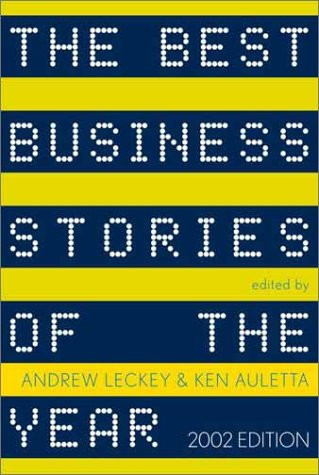
The Best Business Stories of the Year

Andrew Leckey,Ken Auletta
"[The editors] cast their net wide, picking up some excellent stories from nontraditional sources that even avid readers of the business press may have missed."-"USA Today," on the 2001 edition Series editor Andrew Leckey and guest editor Ken Auletta have scoured the print media, consulted with the editors of major business and general interest publications, and surveyed journalism school deans to find the best business stories from the last twelve months. Among those selected: Michael Lewis on teenage stock trader Jonathan Lebed, from "The New York Times Magazine"; James B. Stewart on the irrepressible Michael Milken, from "The New Yorker"; and many others from the pages of "The Wall Street Journal, Rolling Stone, Fortune, Rocky Mountain News, "and" Wired. " The second annual edition continues the excellence and comprehensive range of this fascinating anthology series.
Pantheon Books 2002 470 pages

Mr. & Mrs. Hollywood Edie and Lew Wasserman and Their Entertainment Empire

Kathleen Sharp
Ever wonder why so many B actors wind up as A-grade politicians? Or how the casting couch worked? Acclaimed author Kathleen Sharp traces the influence of show business through the lives of its first power couple. Edie and Lew Wasserman built the world's largest talent agency, MCA, created the multibillion-dollar Universal Studios, and helped shape Washington, DC. Starting from MCA's birth in gangland Chicago, Lew represented stars such as Jimmy Stewart and Marilyn Monroe; pioneered TV with Leave It to Beaver and Miami Vice ; spawned the blockbuster movie model with Psycho and Jaws ; and developed a mega-theme park. His savvy wife, Edie, was the daughter of a mob attorney, the queen of A-list parties, and Lew's secret agent who boosted their status. Yet, the couple was attacked by rivals, federal prosecutors, and their own protégés. Even so, over the course of seven decades they managed to vanquish their enemies and parlay their influence far beyond Sunset Strip into governors' mansions, Senate chambers, and the White House. At the end, Edie and Lew became diplomats, kingmakers, and philanthropists, who elevated the fortunes of middle-class workers and California itself. Based on some four hundred interviews, this book features Janet Leigh, Clark Gable, Grace Kelly, John Belushi, Jean Stein, and Steven Spielberg along with the Kennedys, the Johnsons, the Reagans, and the Clintons. It's a fascinating read about how two kids from Cleveland created the largest entertainment conglomerate in the world and wound up ruling twentieth-century America.
Blackstone Publishing 2017-12-05 538 pages