364 results for "History"

German Jews Beyond Judaism

George L. Mosse
Jews were emancipated at a time when high culture was becoming an integral part of German citizenship. German Jews felt a powerful urge to integrate, to find their Jewish substance in German culture and craft an identity as both Germans and Jews. In this reprint edition, based on the 1983 Efroymson Memorial Lectures given at Hebrew Union College-Jewish Institute of Religion in Cincinnati, George Mosse argues that they did this by adopting the concept of Bildung-the idea of intellectual and moral self-cultivation-and combining it with key Enlightenment ideas such as optimism about human potential, individualism and autonomy, and a connection between knowledge and morality through aesthetics. Personal friendships could be devoted to common pursuit of Bildung and become a means of overcoming differences, becoming a means for integration into German society. Mosse traces how Jewish artists, writers, and thinkers actively sought to participate in German culture and communicate these ideals through popular culture, scholarship, and political activity. From the historical biographies, novels, and short stories of Stefan Zweig and Emil Ludwig; to the psychoanalysis of Freud, which sought to subject irrationality to reason; to the revolutionary thought of Walter Benjamin-Jews sought to influence a mass political culture that was fast drifting into irrationality. As individualism was subsumed into nationalism, and eventually the German political right's racist version of nationalism, German-Jewish dialogue became more difficult. Jews remained idealistic as German society became less rational, their ideas corresponded less and less to the realities of German life, and they drifted out of the mainstream into an intellectual isolation. Yet out of this German-Jewish dialogue, what had once been part of German culture became a central Jewish heritage. The ideal of cultivating a personal identity beyond religion and nationality, the liberal outlook on society and politics, and the desire to transcend history by stressing what united rather than divided individuals and nations infiltrated Jewish life became an inspiration for many men and women searching to humanize their society and their own lives. Mosse's lectures trace the emergence of a form of Jewishness which resisted cultural ghettoization in favor of the pursuit of that which is universally human.
Hebrew Union College Press 1997 98 pages

Jews, Christians and Muslims in Encounter

Edward Kessler
This book reflects on one of the most pressing challenges of our time: the current and historical relationships that exist between the faith-traditions of Judaism, Christianity and Islam. It begins with discussion on the state of Jewish-Christian relations, examining antisemitism and the Holocaust, the impact of Israel and theological controversies such as covenant and mission. Kessler also traces different biblical stories and figures, from the Hebrew Bible and the New Testament, demonstrating Jewish-Christian contact and controversy. Jews and Christians share a sacred text, but more surprisingly, a common exegetical tradition. They also need to deal with some of the more problematic and violent biblical texts. Jews, Christians and Muslims includes reflection on the encounter with Islam, including topics associated with a divergent history and memory as well contemporary relations between the three Abrahamic faiths. Kessler's writings shed light on common purpose as well as how to manage difference, both vital in forming a positive identity and sustaining a flourishing community.
Hymns Ancient & Modern Limited 2013-05-31 290 pages

A nation dedicated to religious liberty: the constitutional heritage of the religion clauses

Adams, Arlin M.
Here is a concise overview of the historical development and judicial interpretation of the First Amendment religion clauses. It begins with a survey of the history of American religious liberty, goes on to present the views of the Founding Fathers, and then considers the core value of religious liberty and the constitutional purposes that implement that value. the book ends on a practical note by applying these principles to questions of equal access, religious symbolism in public life, and the task of defining religion for constitutional purposes. As the authors note in their introduction, "the historical principles that animate the religion clauses are more than an abstract intellectual exercise. . . . They provide an essential context for guiding the resolution of modern religious liberty issues."
University of Pennsylvania Press 1990-08-29 172 pages

Legends of Jerusalem

Zev Vilnay
First published in 1973. Includes black and white photos and illustrations. This classic work contains over 300 legends about sites in Jerusalem: the old and new city. Included are tales about sacred places, walls and gates, mountains and valleys, springs and rivers, rocks and caves, legendary explanations of place-names and folkloristic interpretations. The legends encompass three great religions: Judaism, Christianity, and Isalm.
Sefer Ve Sefel Publishing 2004 338 pages

Annotated Edition of The Authorised Daily Prayer Book With Historical and Explanatory Notes, and Additional Matter

Simeon Singer
This work has been selected by scholars as being culturally important, and is part of the knowledge base of civilization as we know it. This work is in the "public domain in the United States of America, and possibly other nations. Within the United States, you may freely copy and distribute this work, as no entity (individual or corporate) has a copyright on the body of the work. Scholars believe, and we concur, that this work is important enough to be preserved, reproduced, and made generally available to the public. We appreciate your support of the preservation process, and thank you for being an important part of keeping this knowledge alive and relevant.
Creative Media Partners, LLC 2022-10-27 970 pages

The Jewish Religion

Michael Friedländer
The Jewish Religion is an unchanged, high-quality reprint of the original edition of 1891. Hansebooks is editor of the literature on different topic areas such as research and science, travel and expeditions, cooking and nutrition, medicine, and other genres.As a publisher we focus on the preservation of historical literature.Many works of historical writers and scientists are available today as antiques only. Hansebooks newly publishes these books and contributes to the preservation of literature which has become rare and historical knowledge for the future.
hansebooks 2016-10-12 546 pages

Louis Finkelstein and the Conservative Movement Conflict and Growth

Michael B. Greenbaum
The relationship of the Seminary and its chancellor to the Conservative Movement has long been a subject of debate, if not a source of tension, among the national organizations of the movement as well as its rank and file. This is no less true today than it was eighty years ago. In order for one to understand the nature of JTS and the movement today, it seems necessary to understand the source(s) of this issue and the efforts from inside and outside the Seminary to grapple with it. To what extent is the JTS-Conservative Movement relationship particular to JTS or similar to that of other seminaries and the religious movement with which they are connected? This is the question that the author, Michael B. Greenbaum, seeks to answer within this study.
Jewish Theological Seminary of America 2009-05 324 pages

They Must Go

Rabbi Meir Kahane,Meir Kahane
"Every day," writes Rabbi Meir Kahane, "the Arabs of Israel move closer to becoming a majority. Are we [Israel] committed to national suicide? Should we allow demography, geography, and democracy to push Israel closer to the abyss? According to Rabbi Kahane, Israel can only be sustained by a permanent Jewish majority and a small, insignificant, and placid Arab minority. But the Arab population continues to grown quantitatively and qualitatively. They feel no ties for a state that breathes Jewishness. They mockingly accept moneys from the National Insurance Institute for medical services, tuition, and social welfre; yet they pay little or no tax. Even worse, they openly vow to destroy the Jewish state - not with bullets or bombs, but with the democratic vote. Is there a solution? Rabbi Kahane insists, "Yes." In this explosive manifesto Rabbi Kahane sets forth the only plan to save Israel. Israeli Arabs would be given the options of accepting noncitizenship, leaving willingly with compensation, or being forcibly expelled without compensation. Controversial? Yes. Could the Arabs be convinced to leave? "We will not come to the Arabs to request, argue, or convince," says Kahane. "For Jews and Arabs in Israel there is only one answer - separation. Jews in their land, Arabs in theirs. Separation. Only separation." They Must Go was written in 1980 while Rabbi Meir Kahane was jailed in Ramle Prison by the Israeli government under an unprecedented administrative detention order that imprisoned him without a trial, without his being informed of any specific charge, and without opportunity to know or to question any alleged evidence or witness. His crime: his philosophy concerning the danger that exists to the state of Israel by the very presence of its large and growing Arab population. Rabbi Kahane's ideas were suppressed, twisted, defamed, and subjected to emotional and hysterical diatribes by people who were too frightened to consider them intelligently or to debate them intellectually. Is there a time bomb ticking away relentlessly in the Holy Land? Can Arabs and Jews ultimately coexist in a Jewish-Zionist state? Rabbi Kahane's only answer: "They Must Go."
www.bnpublishing.com 2019-04-08 292 pages

Judaism and Hellenism in Antiquity Conflict or Confluence?

Lee I. Levine
One of the chief tasks facing the interpreter in any investigation of Second Temple Judaism involves sorting out the relationship between Judaism and Hellenism. How much influence did Greco-Roman culture exert on Diaspora Judaism? To what extent did Hellenism affect the material culture of Judaism and its social and religious practices? Hebrew University professor Lee Levine looks at literary, epigraphical, and archaeological evidence in an effort to sift through the relevant issues. His assessments argue against oversimplification and instead encourage a more nuanced and balanced view. This volume not only introduces the fundamental issues but supplies an informed reading of the sources as well. Anyone wrestling with the relationship between Judaism and Hellenism will find this essential reading.
Baker Publishing Group 1999-06-01 248 pages

From Suburb to Shtetl The Jews of Boro Park

Egon Mayer,William B. Helmreich
"From Suburb to Shtetl" is an outstanding ethnography that moves beyond simple demographics. Mayer weaves an intricate tapestry of how family, school, and community leaders influence each other. Whether discussing the role of the rebbe or the matchmaker, those who know these communities will find what he says as relevant today as it was when first penned. This is hardly surprising, for the ultra-Orthodox community takes great pride in not changing, in maintaining itself as it was in Europe despite the allure of modern American society. His discussion of synagogue life is particularly informative and evocative. Those in charge of helping immigrants adopted the path of least resistance, allowing and even encouraging them to retain their identities except for those few aspects that might threaten the country's national interests. The American Orthodox community was tremendously augmented by the arrival from Europe, after World War Two, of thousands of Orthodox Jews who remained devoted to that way of life. Egon Mayer was himself part of a smaller, but significant group of Jews who came to the U.S. and settled mostly in Boro Park in the wake of the 1956 Hungarian Revolution. The interaction between the Hasidim and their less fervent Orthodox counterparts described and analyzed in this volume tells us a great deal about how people negotiate their beliefs, values, and norms when forced into close contact with each other in an urban setting within the larger American culture. By exploring these and many other related issues Mayer has given us the chance to assess and forecast the future of American Jewish life as a whole.
Taylor & Francis Group 2017-10-12 214 pages

Covenantal Rights: A Study in Jewish Political Theory

Novak, David
Covenantal Rights is a groundbreaking work of political theory: a comprehensive, philosophically sophisticated attempt to bring insights from the Jewish political tradition into current political and legal debates about rights and to bring rights discourse more fully into Jewish thought. David Novak pursues these aims by presenting a theory of rights founded on the covenant between God and the Jewish people as that covenant is constituted by Scripture and the rabbinic tradition. In doing so, he presents a powerful challenge to prevailing liberal and conservative positions on rights and duties and opens a new chapter in contemporary Jewish political thinking. For Novak, "covenantal rights" are rooted in God's primary rights as creator of the universe and as the elector of a particular community whose members relate to this God as their sovereign. The subsequent rights of individuals and communities flow from God's covenantal promises, which function as irrevocable entitlements. This presents a sharp contrast to the liberal tradition, in which rights flow above all from individuals. It also challenges the conservative idea that duties can take precedence over rights, since Novak argues that there are no covenantal duties that are not backed by correlative rights. Novak explains carefully and clearly how this theory of covenantal rights fits into Jewish tradition and applies to the relationships among God, the covenanted community, and individuals. This work is a profound and provocative contribution to contemporary religious and political theory.
Princeton University Press 2009-11-22 248 pages

Prophecy and History in Relation to the Messiah

Alfred Edersheim
For two millennia Christianity has stated that Jesus of Nazareth is the Messiah prophesized about in Jewish scripture. But how have Christians justified these claims? And from what sources do they draw their evidence that Jesus was in fact the Messiah? Biblical scholar, Alfred Edersheim, in an extremely thorough study of Jewish scripture examines how Jesus Christ fulfilled the Messianic hopes of many Old Testament prophecies. Through the course of twelve lectures Edersheim provides brilliant insight into the Old Testament and how the texts within it provide clear evidence of prophecy for the coming of Jesus Christ. Yet, Edersheim does not stop at studying the Old Testament alone but also uses the Pentateuch, the Apocrypha and Pseudepigrapha to provide further examples that Jesus was indeed prophesized about by Jewish texts many centuries before he was born. This book is essential reading for anyone who wishes to understand more fully how Jesus' life was intertwined with old Jewish texts and for those who are looking for a scholarly, yet accessible, account of this fascinating topic. Alfred Edersheim (1825-89) was a Vienna-born biblical scholar who converted from Judaism to Christianity. A veteran minister and missionary to the Jews of Romania, Edersheim left an enduring and priceless legacy to followers of Christ. Among his most widely read works are The Life and Times of Jesus the Messiah, The Temple: Its Ministry and Services, and Bible History Old Testament.
Independently Published 2018-08 192 pages

Between Jesus and Paul Studies in the Earliest History of Christianity

Martin Hengel
More happened in the period between Jesus and Paul, Professor Hengel argues, than in the whole of the next seven centuries, up to the time when the doctrine of the early church was completed. Certainly these decades are crucial to our understanding of the development of earliest Christianity. However, they are very much a "tunnel" period, and there is little to shed light on it. This volume does something to pierce the darkness. Among other issues, it considers the origins of the Christian mission, the role of the Hellenists, the reliability of Luke as a geographer when he is dealing with events in Palestine in the Acts of the Apostles, and the development of christological belief, particularly in Christian worship. Those familiar with Professor Hengel's work will know that they will find here a wealth of valuable insight based on painstaking examination of all available sources.
Wipf and Stock Publishers 2003-03-14 240 pages

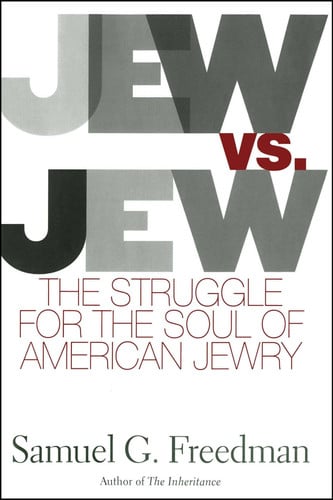
Jew Vs Jew The Struggle For The Soul Of American Jewry

Samuel G. Freedman
At a time when American Jews should feel more secure and cohesive than ever, civil war is tearing apart their community. Congregations, neighborhoods, even families are taking sides in battles about Jewish identity and Jewish authenticity. The conflict pits fundamentalist against secularist, denomination against denomination, even liberal against conservative within each branch of Jewry. Jew vs. Jew tells the story of how American Jewry has increasingly -- and perhaps terminally -- broken apart in the last forty years. Jew vs. Jew stretches in time from 1960 to 2000. It travels the country from Florida to New England, from Los Angeles to the Catskills in New York, from Cleveland to Denver, and it also crosses the ocean to Israel to show how tensions within the Jewish state inflame those among American Jews. The flash-points range from conversion standards to the role of women, from the peace process in Israel to the sexual climate on an Ivy League campus. But behind them all, as Samuel Freedman writes, lie common causes. First, far from unifying American Jews, Israel now divides them on both political and religious grounds. Second, neither America nor the larger world presents Jews with a single enemy against whom to coalesce. Third, and most important, nothing in the Jewish history of persecution, oppression, and exile prepared the Chosen People for the challenge posed by America, the challenge of being absorbed into a tolerant and diverse nation, being accepted so thoroughly that the intermarriage rate tops 50 percent. Jew vs. Jew introduces readers to memorable places and characters. Freedman describes one of the final summers at a Labor Zionist camp in the Catskills whose brand of secular Jewishness is becoming obsolete because Zionism succeeded in creating Israel. He tells the story of Orthodox and Reform Jews in a Cleveland suburb who are fighting about the construction of several synagogues -- and, on a deeper level, about whether unity or pluralism ought to be the goal of Jewish life. He portrays a Florida Jew so violently opposed to the Oslo peace accords that he planted a bomb in a synagogue where Shimon Peres was speaking. He tells about a Los Angeles congregation that spent three years debating whether or not to honor the Biblical matriarchs in its liturgy.We come to know the Long Island neighbors who cannot tolerate sharing even a property line because their versions of Jewish identity are so irreconcilably different. Jew vs. Jew is a work of vigorous reporting, lucid writing, and intellectual curiosity. And even as it chronicles an embittered and polarized community, it refuses to take sides or pass judgment. Instead, with compassion and acuity, Jew vs. Jew bears witness.
Simon & Schuster 2007-09-21 400 pages