490 results for "Memoir"

The dream: a memoir

Bernstein, Harry
During the hard and bitter years of his youth in England, Harry Bernstein’s selfless mother never stops dreaming of a better life in America, no matter how unlikely. Then, one miraculous day when Harry is twelve years old, steamship tickets arrive in the mail, sent by an anonymous benefactor. Suddenly, a new life full of the promise of prosperity seems possible–and the family sets sail for America, meeting relatives in Chicago. For a time, they get a taste of the good life: electric lights, a bathtub, a telephone. But soon the harsh realities of the Great Depression envelop them. Skeletons in the family closet come to light, mafiosi darken their doorstep, family members are lost, and dreams are shattered. In the face of so much loss, Harry and his mother must make a fateful decision–one that will change their lives forever. And though he has struggled for so long, there is an incredible bounty waiting for Harry in New York: his future wife, Ruby. It is their romance that will finally bring the peace and happiness that Harry’s mother always dreamed was possible.
Ballantine Books 2009-04-07 279 pages

This is not my memoir

Gregory, André,London, Todd
The autobiography-of-sorts of André Gregory, an iconic figure in American theater and the star of My Dinner with André This Is Not My Memoir tells the life story of André Gregory, iconic theater director, writer, and actor. For the first time, André shares memories from a life lived for art, including stories from the making of My Dinner with André . Taking on the dizzying, wondrous nature of a fever dream, This Is Not My Memoir includes fantastic and fantastical stories that take the reader from wartime Paris to golden-age Hollywood, from avant-garde theaters to monasteries in India. Along the way we meet Jerzy Grotowski, Helene Weigel, Gregory Peck, Gurumayi Chidvilasananda, Wallace Shawn, and many other larger-than-life personalities. This Is Not My Memoir is a collaboration between André and Todd London, who together create a portrait of an artist confronting his later years. Here, too, are the reflections of a man who only recently learned how to love. What does it mean to create art in a world that often places little value on the process of creating it? And what does it mean to confront the process of aging when your greatest work of art may well be your own life?
Picador USA 2021-11-16 240 pages

Blood, sweat, and my rock 'n' roll years: is Steve Katz a rock star?

Katz, Steve
On paper Steve Katz's career rivals anyone's except the 1960s' and '70's biggest stars: the Monterey Pop Festival with the legendary Blues Project, Woodstock with Blood, Sweat & Tears, and even producing rock's most celebrated speed addict, Lou Reed. There were world tours, and his résumé screams "Hall of Fame" -- it won't be long before BS&T are on that ballot. He has three Grammies (ten nominations), three Downbeat Reader's Poll Awards, three gold records, one platinum record, and one quadruple platinum platter (the second Blood, Sweat & Tears album), not to mention three gold singles with BS&T. All together, he's sold close to 29 million records. He had affairs with famous female folk singers, made love to Jim Morrison's girlfriend Pam when Jim was drunk and abusive, partied with Elizabeth Taylor and Groucho Marx, dined with Rudolf Nureyev, conversed with Martin Luther King, Jr. and Tennessee Williams, hung out with Andy Warhol, jammed with everyone from Mose Allison to Jimi Hendrix, and was told to get a haircut by both Mickey Spillane and Danny Thomas. But his memoir is more Portnoy's Complaint than the lurid party-with-your-pants-down memoir that has become the norm for rock 'n' roll books. It's an honest and personal account of a life at the edge of the spotlight--a privileged vantage point that earned him a bit more objectivity and earnest outrage than a lot of his colleagues, who were too far into the scene to lay any honest witness to it. Set during the Greenwich Village folk/rock scene, the Sixties' most celebrated venues and concerts, and behind closed doors on international tours and grueling studio sessions, this is the unlikely story of a rock star as nerd, nerd as rock star, a nice Jewish boy who got to sit at the cool kid's table and score the hot chicks.
Lyons Press 2015 244 pages

Turning right at Hollywood and Vine: the perils of coming out conservative in Tinseltown

Simon, Roger L.
An Academy Award-nominated screenwriter and a mystery novelist, Roger L. Simon is the only American writer to pull off the amazing trick of being profiled positively in both Mother Jones and National Review in one lifetime. The stunning story of his political odyssey is told in this memoir, where Simon recounts his migration from financier of the Black Panther Breakfast Program to pioneer blogosphere mogul beloved by the right as a 9/11 Democrat. But Simon is beholden to neither right nor left in this tale of Hollywood chic run amuck, as he talks out of school about his adventures with, among many others, Richard Pryor, Warren Beatty, Timothy Leary, Richard Dreyfuss, Woody Allen, and Julian Semyonov, the Soviet Union's version of Robert Ludlum and also a KGB colonel who tempted Simon to join the KGB himself. Among the topics covered along the way: Is there a new blacklist in Hollywood, this one targeting conservatives? Simon's red-carpet tours of the People's Republic of China, Cuba, and the Soviet Union with Hollywood screenwriters and famous mystery novelists. Why Al Gore's documentary on global warming didn't deserve the Oscar on artistic grounds alone; and why the Academy's voting system is so corrupt. And, as they say, there is much, much more besides.
Encounter Books 2010 209 pages

Near-death experiences ... and others

Gottlieb, Robert
A new collection of immersive essays from the most acclaimed editor of the second half of the twentieth century This new collection from the legendary editor Robert Gottlieb features twenty or so pieces he’s written mostly for The New York Review of Books , ranging from reconsiderations of American writers such as Dorothy Parker, Thornton Wilder, Thomas Wolfe (“genius”), and James Jones, to Leonard Bernstein, Lorenz Hart, Lady Diana Cooper (“the most beautiful girl in the world”), the actor-assassin John Wilkes Booth, the scandalous movie star Mary Astor, and not-yet president Donald Trump. The writings compiled here are as various as they are provocative: an extended probe into the world of post-death experiences; a sharp look at the biopics of transcendent figures such as Shakespeare, Molière, and Austen; a soap opera-ish movie account of an alleged affair between Chanel and Stravinsky; and a copious sampling of the dance reviews he’s been writing for The New York Observer for close to twenty years. A worthy successor to his expansive 2011 collection, Lives and Letters , and his admired 2016 memoir, Avid Reader , Near-Death Experiences displays the same insight and intellectual curiosity that have made Gottlieb, in the words of The New York Times ’s Dwight Garner, “the most acclaimed editor of the second half of the twentieth century.”
Farrar, Straus and Giroux 2018-06-12 350 pages

Remembering America A Voice from the Sixties

Richard N. Goodwin
From the speechwriter and top adviser to presidents Kennedy and Johnson: A behind-the-scenes history of the most momentous decade in American politics. Richard N. Goodwin entered public service in 1958 as a law clerk for Supreme Court Associate Justice Felix Frankfurter. He left politics ten years later in the aftermath of Senator Robert F. Kennedy's assassination. Over the course of one extraordinary decade, Goodwin orchestrated some of the noblest achievements in the history of the US government and bore witness to two of its greatest tragedies. His eloquent and inspirational memoir is one of the most captivating chronicles of those turbulent years ever published. From the Twenty-One quiz-show scandal to the heady days of John F. Kennedy's presidential campaign to President Lyndon Johnson's heroic vote wrangling on behalf of civil rights legislation, Remembering America brings to life the most fascinating figures and events of the era. As a member of the Kennedy administration, Goodwin charted a new course for US relations with Latin America and met in secret with Che Guevara in Uruguay. He wrote Johnson's historic civil rights speech, "We Shall Overcome," in support of the Voting Rights Act of 1965 and formulated the concept of the Great Society and its programs, which sought to eradicate poverty and racial injustice. After breaking with Johnson over the president's commitment to the Vietnam War, Goodwin played a pivotal role in bringing antiwar candidate Eugene McCarthy to within a few hundred votes of victory in the 1968 New Hampshire primary. Three months later, he was with his good friend Robert F. Kennedy in Los Angeles the night that the young senator's life--and the progressive movement that had rapidly brought about such significant change--came to a devastating end. Throughout this critical decade, Goodwin held steadfast to the passions and principles that had first led him to public service. Remembering America is a thrilling account of the breathtaking victories and heartbreaking disappointments of the 1960s, and a rousing call to action for readers committed to justice today.
Open Road Integrated Media, Incorporated 2014-09-30 828 pages

Adventures of a bystander

Drucker, Peter F.
"It is [a] belief in diversity and pluralism and the uniqueness of each person that underlies all my writings . . . " -from the Preface. Regarded as the most influential and widely read thinker on modern organizations and their management, Peter Drucker has also established himself as an unorthodox and independent analyst of politics, the economy, and society. A man of impressive scope and expertise, he has paved significant inroads in a number of key areas, sharing his knowledge and keen insight on everything from the plight of the employee and the effects of technology to the vicissitudes of the markets and the future of the new world order. Adventures of a Bystander is Drucker's rich collection of autobiographical stories and vignettes, in which this legendary figure paints a portrait of his remarkable life, and of the larger historical realities of his time. In a style that is both unique and engaging, Drucker conveys his life story -from his early teen years in Vienna through the interwar years in Europe, the New Deal era, World War II, and the postwar period in America-through intimate profiles of a host of fascinating people he's known through the years. Their personal histories are, as Drucker tells us, the beads for which his own life serves as the string. A colorful group, these diverse, often unpredictable, always multidimensional individuals were chosen "because each of them, in his or her own highly personal way, reflects and refracts the thirty crucial years from the end of World War I to the first post-World War II decade-the thirty years that largely formed the world in which we now live." An amazing pageant of characters, both famous and otherwise, springs from these pages, illuminating and defining one of the most tumultuous periods in world history. Along with bankers and courtesans, artists, aristocrats, prophets, and empire-builders, we meet members of Drucker's own family and close circle of friends, among them such prominent figures as Sigmund Freud, Henry Luce, Alfred Sloan, John Lewis, and Buckminster Fuller. Playing to perfection their roles as those who "reflect and refract" the customs, beliefs, and attitudes of the times, these singular personalities lend Adventures of a Bystander a striking "you-are-there" feel. A brief encounter with Freud becomes the catalyst for an absorbing, multidimensional description of the economics, politics, and social psychology of pre-World War II Europe. Drucker introduces us to Fritz Kraemer, a brilliant, monocle-wearing eccentric who became an influential mentor to the young Henry Kissinger. His personal memoir of Henry Luce documents the development of modern journalism, while in "The Indian Summer of Innocence," he rescues and preserves the very heart of the American experience during the last New Deal years before World War II. Shedding light on a turbulent and important era, Adventures of a Bystander also reflects Peter Drucker himself as a man of imaginative sympathy and enormous interest in people, ideas, and history. These enthralling stories complement and complete the groundbreaking analytical writing for which he is so revered. Luminous autobiographical stories by one of the greatest thinkers of our time "The cast of characters among whom Drucker moves is superbly rich, and the informed glimpse he provides of a vanished social and political universe is an education in itself. Adventures of a Bystander is better than a novel, more lively than an essay, and as thoughtful as both at their best." -The Harvard Business Review. "Adventures of a Bystander is a virtuoso performance in which Drucker displays a dazzling diversity of personal interests and knowledge, an awesome power of recall, and a crisp, highly readable writing style." -BusinessWeek. "Adventures of a Bystander appears in a stroke to have restored the art of the memoir and of the essay. It will doubtless be a while before its like comes round again." -The Washington Post.
Wiley 1997 344 pages

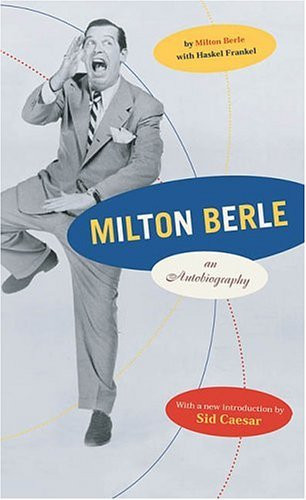
Milton Berle: an autobiography

Berle, Milton
(Applause Books). When Milton Berle died in the Spring of 2002, THE NEW YORK TIMES declared that the legendary comic "may have had a more profound influence on our way of life than some presidents or Nobel Prize winners." This landmark memoir, as startling today as it was when it was first published, reveals the life and times of the man known affectionately to millions as Uncle Miltie. Told with unflinching candor, here is one of the most fabled and influential show business careers of all time: from performing as a child in Vaudeville and making silent movies with Charlie Chaplin and Mary Pickford, to nightclub performances for Al Capone, working on radio during World War II, performing in Broadway musicals, and, finally, superstardom on television. Perhaps even more fascinating is Berle's scandal-ridden private life: his star-crossed love affair with a 1930's movie queen and the child they had out of wedlock, his numerous affairs with women ranging from evangelist Aimee Semple McPherson to Marilyn Monroe, and his stormy relationship with beautiful showgirl Joyce Mathews, whom Berle married twice. It is Berle's unsparing account of his life and his determination to show the world his real face that led Frank Sinatra, at the time, to call this "the gutsiest book I've read in years." Told with equal amounts of comedy and pathos, and featuring colorful appearancesby all the major stars of his day, MILTON BERLE is simply one of the best show business memoirs ever written.
Applause Theatre & Cinema Books 2002-09-01 337 pages

Heroic conservatism: why Republicans need to embrace America's ideals (and why they deserve to fail if they don't)

Gerson, Michael J.
Journalist and speechwriter Gerson uses his own experiences in the upper tier of the Bush White House to show why America needs a conservatism that is heroic in its aspirations--including "compassionate conservative" proposals to confront global AIDS, combat poverty in America, and promote human rights and dignity abroad--initiatives that Gerson fought for during his time in government. Gerson has a unique ability to frame complex issues in a way that both challenges and inspires, and here he delivers a new manifesto for the Republican Party and a memoir of a history-shaping Presidency.--From publisher description.
HarperOne 2007-10-30 302 pages

Crazy rhythm: Richard Nixon and all that jazz

Garment, Leonard
Crazy Rhythm is a smart, swinging memoir that answers the question "How did a liberal Jewish jazz musician from Brooklyn become one of President Richard Nixon's most trusted advisers and one of Washington's most influential lawyers?" Leonard Garment was probably the hippest man ever to serve in the White House - a jazz musician with an affinity for artists, African-Americans, Jews, American Indians, and the "rabble-rousers" of post-1960s American politics, a man as comfortable with Dick Gregory as he was with Dick Nixon. Garment presents a rare view of Nixon, showing us the man as he ascended to the presidency - brilliant, fascinating, and complex. Garment describes his advocacy on behalf of Israel at the United Nations, his efforts to expand government support for the arts, his crisis management of American Indian protests, and his ideological wrestling matches with Pat Buchanan. He also writes poignantly of his tumultuous first marriage to Grace Albert, a talented television writer who, one day, mysteriously disappeared.
Times Books 1997 418 pages

Let's face it: 90 years of living, loving, and learning

Douglas, Kirk
He has been one of the brightest stars in Hollywood, a hard-charging actor whose intensity on the screen has been mirrored in his personal life. As Kirk Douglas has grown older - he turned ninety in December 2006 - he has become less impetuous and more reflective. In this poignant and inspiring new memoir, Douglas contemplates what life is all about, weighing current events from his present frame of mind while summoning the passions of his younger days. Kirk Douglas is a born storyteller, and throughout Let's Face It he tells wonderful tales and shares favorite jokes and hard-won insights. In the book, he explores the mixed blessings of growing older and looks back at his childhood, his young adulthood, and his storied, glamorous, and colorful life and career in Hollywood. He tells delightful stories of the making of such films as Spartacus, Lust for Life, Champion, The Bad and the Beautiful, and many others. He includes anecdotes about his friends Frank Sinatra, Burt Lancaster, Lauren Bacall, Ronald Reagan, Ava Gardner, Henry Kissinger, Fred Astaire, Yul Brynner, John Wayne, and Johnny Cash. He reveals the secrets that have kept him and his wife, Anne, happily married for more than five decades, and talks fondly and movingly of times spent with his sons, Michael, Peter, Eric, and Joel, and his grandchildren. Douglas's life has been filled with pain as well as joy. In Let's Face It , he writes frankly for the first time about the tragic death of his son Eric from a drug overdose at age forty-five. Douglas tells what it was like to recover from several near-death episodes, including a helicopter crash, a stroke, and a cardiac event. He writes of his sadness that many of his closest friends are no longer with us; the book includes many moving stories such as one about a regular poker game at Frank Sinatra's house at which he and Anne have been fixtures along with Gregory Peck, Jack Lemmon, and their wives. Though many of the players are gone, the game continues to this day. In Let's Face It , Douglas reflects on how his Jewish faith has become more and more important to him over the years. He offers strong opinions on everything from anti-Semitism to corporate greed, from racism to Hurricane Katrina, and from the war in Iraq to the situation in Israel. He writes about the importance in his life of the need to improve education for all children and about how we need to care more about the world and less about ourselves. A must-read for every fan, this engrossing memoir provides an indelible self-portrait of a great star - while sharing the wit and wisdom Kirk Douglas has accumulated over a lifetime.
John Wiley & Sons 2007 238 pages

Poker Face A Girlhood Among Gamblers

Katy Lederer
“The intricacies of family and the complexities of the games they play mingle wonderfully here in a memoir quite unlike any other.”—George Plimpton, author of Truman Capote Katy Lederer grew up on the bucolic campus of an exclusive East Coast boarding school where her father taught English, her mother retreated into crosswords and scotch, and her much older siblings played “grown-up” games like gin rummy and chess. But Katy faced much more than the typical trials of childhood. Within the confines of the Lederer household an unlikely transformation was brewing, one that would turn this darkly intellectual and game-happy group into a family of professional gamblers. Poker Face is Katy Lederer’s perceptive account of her family’s lively history. From the long kitchen table where her mother played what seemed an endless game of solitaire, to the seedy New York bars where her brother first learned to play poker, to the glamorous Bellagio casino in Las Vegas, where her sister and brother wager hundreds of thousands of dollars a night at the tables, Lederer takes us on a tragicomic journey through a world where intelligence and deceit are used equally as currency. Not since Mary McCarthy’s Memories of a Catholic Girlhood has a writer cast such a witty and astringently analytic eye on the demands of growing up. An unflinching exploration of trust and betrayal, competition, suspicion, and unconventional familial love, Poker Face is a testament to the human spirit’s inventiveness when faced with unusually difficult odds.
Three River Press 2003 209 pages

Oppenheimer: portrait of an enigma

Bernstein, Jeremy
A Revealing Profile of the Father of the Atomic Bomb Highly praised by New York Review of Books, The Spectator, Los Angeles Times, Booklist, & More J. Robert Oppenheimer was a puzzle to everyone. The nuclear physicist most responsible for the creation of the atomic bomb, he was a genius both scientifically and otherwise. His standards were impossibly high. He read widely in many languages, wrote poetry, and did superb science. Yet in Jeremy Bernstein's intensely interesting biographical memoir, Oppenheimer emerges as a man unsure of his identity and captive to an element of self-destructiveness in his makeup. Oppenheimer is the long-awaited book that many people feel Mr. Bernstein was almost born to write. As a former colleague of Oppenheimer's, he has composed a book that is both personal and historical, bringing the reader close to the life and workings of an extraordinary and controversial man. Oppenheimer once told the author that during the now-famous hearing in which he lost his security clearance—one of the most spectacular attacks of the McCarthy era—he felt it was happening to someone else. His lawyer at the hearing, after being with Oppenheimer day in and day out for several months, said he did not know him in any real sense at all. Yet everyone in the scientific community and in government agreed that without Oppenheimer's totally remarkable leadership at Los Alamos, the atomic bomb would not have happened, and the Second World War would have ended very differently. Filled with revealing insights and details that set the historical record straight, Oppenheimer is that rare quantity: a vastly entertaining study of one of the most important and enigmatic scientists of the atomic age. Illustrated with black-and-white photographs.
Ivan R. Dee 2004-03-01 223 pages

Crusaders in the courts: how a dedicated band of lawyers fought for the civil rights revolution

Greenberg, Jack
This book is both a powerful personal memoir and the definitive history of an organization that helped change American society. Jack Greenberg was a key figure at the NAACP Legal Defense and Educational Fund (LDF) for some thirty-five years. Most of the cases we associate from that period--school integration, equal employment, fair housing, voter registration--were LDF cases, either argued by Greenberg himself or litigated under his direction. Greenberg represented Martin Luther King, Jr., in Birmingham and won for him the right to march from Selma to Montgomery. Under Greenberg's leadership, the LDF forced the University of Mississippi to admit James Meredith and integrated the University of Alabama when George Wallace stood in the schoolhouse door. Greenberg won the cases in which the Supreme Court repudiated the "all deliberate speed" doctrine, which had made school desegregation intolerably slow. Through the 1970s and 1980s, LDF tackled most of the important cases that enforced the new civil rights legislation of the 1960s involving public accommodations, employment, education, and health care, and started the campaigns for prisoners' rights and against capital punishment. More than a history of the litigation that made the LDF so important, the book offers unique insights into its strategies, courtroom techniques, values, and personal relationships. Filled with stories only Greenberg could tell of his experiences with Thurgood Marshall, Martin Luther King, Jr., Marian Wright Edelman, Lani Guinier, Roy Wilkins, Vernon Jordan, Charlayne Hunter-Gault, Lyndon Johnson, and scores of others, Crusaders in the Courts is an epic saga of a critical period in American history as well as the poignant personal story of the evolution of a white Jewish lawyer into a major civil rights advocate.
BasicBooks 1994 634 pages

After Woodstock: the true story of a Belgian movie, an Israeli wedding, & a Manhattan breakdown

Tiber, Elliot
During the summer of '69, Elliot Tiber first helped start the Gay Liberation Movement and then saved the Woodstock Festival from cancellation. However, the best and most significant of Tiber's life adventures did not happen until after Woodstock. In this third and final memoir, following the critically acclaimed, Palm Trees on the Hudson, and his break-out bestseller, Taking Woodstock, Tiber chron[Bokinfo]
Square One 2014 462 pages

War and decision: inside the Pentagon at the dawn of the War on Terrorism

Feith, Douglas J.
Of all the players in the planning and evolution of the Bush Administration's war on terrorism, few were more integral--or more controversial--than Douglas Feith, the chief strategist on Donald Rumsfeld's Pentagon policy team. A highly influential international policy analyst for more than a quarter century, Feith worked closely with Rumsfeld, Paul Wolfowitz, Colin Powell, Condoleezza Rice, Vice President Cheney, and President Bush in defining the U.S. response to the attacks of 9/11--from the successful war on Afghanistan to the more challenging invasion of Iraq and its aftermath. Now, in this candid and revealing memoir, Feith--a charter member of the neoconservative movement and an architect of the administration's preventive strategy in the war on terrorism--offers the most in-depth and authoritative account yet of the Pentagon's evolving stance during one of the most controversial eras of American history. Drawing upon a unique trove of documents and records, this extraordinary chronicle will put the reader in the room for scores of previously unreported senior-level meetings, showing how hundreds of critical decisions were made in defense of American interests during and after the crisis of 9/11--decisions both successful and controversial. Where journalists like Bob Woodward could only speculate, Feith is the first inside player to reveal the inner workings of the Pentagon, at a time when history hung in the balance.--From publisher description.
HarperCollins 2009-02-03 674 pages