
1467 results for "Science"

Second class: how the elite betrayed America's working men and women

Ungar-Sargon, Batya
A personal, journalistic ethnography of the modern American working class, based on the travels and interactions of the author through the American heartland. " Second Class is the most important book you will read all year. A political realignment is coming, and it's my hope that the end result will work in favor of our all-too-neglected American working class. When that realignment comes, Batya and her book will help lead the way." --Greg Lukianoff, CEO of the Foundation for Individual Rights in Education, and co-author of The Coddling of the American Mind Who is the American working class? Do they still have a fair shot at the American Dream? What do they think about their chances to secure the hallmarks of a middle-class life? While writing this book, Batya Ungar-Sargon visited states across the nation to speak with members of the American working class who are fighting tooth and nail to survive. In Second Class , working-class Americans of all races, political orientations, and occupations share their stories--cleaning ladies, health care aides, cops, truck drivers, fast food workers, electricians, and more. In their own words, these working-class Americans explain the struggles and triumphs of their increasingly precarious lives--as well as what policies they think would improve them. Second Class combines deep reporting with a look at the data and expert opinions on America's emergent class divide, in which the most basic elements of a secure and stable life are increasingly out of reach for those without a college education. America has broken its contract with its laboring class. So, how do we get back to the American Dream? How do we once again become the land of opportunity, the promised land, where hard work and commitment to family are enough to protect you from poverty? It's not that hard actually. All it would take, as this book illustrates, is for those in power to once again respect the dignity of work--and the American worker.
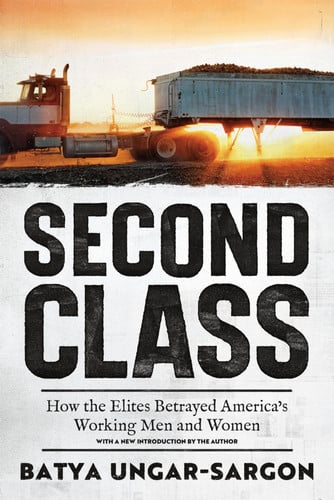
Encounter Books 2025 248 pages

The Columbia history of Western philosophy

Richard Henry Popkin
Richard Popkin has assembled 63 leading scholars to forge a highly approachable chronological account of the development of Western philosophical traditions. From Plato to Wittgenstein and from Aquinas to Heidegger, this volume provides lively, in-depth, and up-to-date historical analysis of all the key figures, schools, and movements of Western philosophy. The Columbia History significantly broadens the scope of Western philosophy to reveal the influence of Middle Eastern and Asian thought, the vital contributions of Jewish and Islamic philosophers, and the role of women within the tradition. Along with a wealth of new scholarship, recently discovered works in 17th- and 18th-century philosophy are considered, such as previously unpublished works by Locke that inspire a new assessment of the evolution of his ideas. Popkin also emphasizes schools and developments that have traditionally been overlooked. Sections on Aristotle and Plato are followed by a detailed presentation on Hellenic philosophy and its influence on the modern developments of materialism and scepticism. A chapter has been dedicated to Jewish and Moslem philosophical development during the Middle Ages, focusing on the critical role of figures such as Averroës and Moses Maimonides in introducing Christian thinkers to classical philosophy. Another chapter considers Renaissance philosophy and its seminal influence on the development of modern humanism and science. Turning to the modern era, contributors consider the importance of the Kaballah to Spinoza, Leibniz, and Newton and the influence of popular philosophers like Moses Mendelssohn upon the work of Kant. This volume gives equal attention to both sides of the current rift in philosophy between continental and analytic schools, charting the development of each right up to the end of the 20th century. Each chapter includes an introductory essay, and Popkin provides notes that draw connections among the separate articles. The rich bibliographic information and the indexes of names and terms make the volume a valuable resource. Combining a broad scope and penetrating analysis with a keen sense of what is relevant for the modern reader, The Columbia History of Western Philosophy will prove an accessible introduction for students and an informative overview for general readers.
Columbia University Press 1999 836 pages

The tragic mind: fear, fate, and the burden of power

Kaplan, Robert D.
A moving meditation on recent geopolitical crises, viewed through the lens of ancient and modern tragedy "Spare, elegant and poignant. . . . If there is a single contemporary book that should be pressed into the hands of those who decide issues of war and peace, this is it."--John Gray, New Statesman "It is tragic that Robert D. Kaplan's luminous The Tragic Mind is so urgently needed."--George F. Will Some books emerge from a lifetime of hard-won knowledge. Robert D. Kaplan has learned, from a career spent reporting on wars, revolutions, and international politics in Europe, the Middle East, and East Asia, that the essence of geopolitics is tragedy. In The Tragic Mind , he employs the works of ancient Greek dramatists, Shakespeare, German philosophers, and the modern classics to explore the central subjects of international politics: order, disorder, rebellion, ambition, loyalty to family and state, violence, and the mistakes of power. The great dilemmas of international politics, he argues, are not posed by good versus evil--a clear and easy choice--but by contests of good versus good, where the choices are often searing, incompatible, and fraught with consequences. A deeply learned and deeply felt meditation on the importance of lived experience in conducting international relations, this is a book for everyone who wants a profound understanding of the tragic politics of our time.
Yale University Press 2023 135 pages

The Sweet Spot The Pleasures of Suffering and the Search for Meaning

Paul Bloom
"This book will challenge you to rethink your vision of a good life. With sharp insights and lucid prose, Paul Bloom makes a captivating case that pain and suffering are essential to happiness. It's an exhilarating antidote to toxic positivity." --Adam Grant, #1 New York Times bestselling author of Think Again and host of the TED podcast WorkLife One of Behavioral Scientist's "Notable Books of 2021" From the author of Against Empathy, a different kind of happiness book, one that shows us how suffering is an essential source of both pleasure and meaning in our lives Why do we so often seek out physical pain and emotional turmoil? We go to movies that make us cry, or scream, or gag. We poke at sores, eat spicy foods, immerse ourselves in hot baths, run marathons. Some of us even seek out pain and humiliation in sexual role-play. Where do these seemingly perverse appetites come from? Drawing on groundbreaking findings from psychology and brain science, The Sweet Spot shows how the right kind of suffering sets the stage for enhanced pleasure. Pain can distract us from our anxieties and help us transcend the self. Choosing to suffer can serve social goals; it can display how tough we are or, conversely, can function as a cry for help. Feelings of fear and sadness are part of the pleasure of immersing ourselves in play and fantasy and can provide certain moral satisfactions. And effort, struggle, and difficulty can, in the right contexts, lead to the joys of mastery and flow. But suffering plays a deeper role as well. We are not natural hedonists--a good life involves more than pleasure. People seek lives of meaning and significance; we aspire to rich relationships and satisfying pursuits, and this requires some amount of struggle, anxiety, and loss. Brilliantly argued, witty, and humane, Paul Bloom shows how a life without chosen suffering would be empty--and worse than that, boring.
HarperCollins Publishers 2021-11-02 304 pages

Mesmerized How Ben Franklin Solved a Mystery that Baffled All of France

Mara Rockliff
“Together, Rockliff and Bruno make the scientific method seem exciting, and kids interested in science and history will likely be, well, mesmerized.” — Booklist (starred review) When American inventor Benjamin Franklin arrives in Paris, he is upstaged by a compelling and enigmatic figure: Dr. Mesmer. In elaborately staged shows, Mesmer has Parisians believing he can control a magic force that changes the taste of water, cures illness, and controls thoughts! Can Ben Franklin’s approach of observing, hypothesizing, and testing get to the bottom of Mesmer’s tricks? A rip-roaring, lavishly illustrated peek into a fascinating moment in history shows the development of the scientific method — and reveals the amazing power of the human mind.
National Geographic Books 2017-09-12 48 pages

Ideology and Utopia An Introduction to the Sociology of Knowledge

Karl Mannheim
This work has been selected by scholars as being culturally important, and is part of the knowledge base of civilization as we know it. This work is in the "public domain in the United States of America, and possibly other nations. Within the United States, you may freely copy and distribute this work, as no entity (individual or corporate) has a copyright on the body of the work. Scholars believe, and we concur, that this work is important enough to be preserved, reproduced, and made generally available to the public. We appreciate your support of the preservation process, and thank you for being an important part of keeping this knowledge alive and relevant.
Creative Media Partners, LLC 2022-10-26 352 pages

The Destruction of Hillary Clinton

Bordo, Susan
"If you want to understand not only what happened in 2016, but what's going to happen tomorrow, this book is essential reading. Susan Bordo brings a scholar's rigor and a lioness' heart to this important work." --Paul Begala "Among the best books I've read on the 2016 election . . . the perfect companion to Clinton's What Happened ." --Peter Daou The Destruction of Hillary Clinton is an answer to the question many have been asking: How did an extraordinarily well-qualified, experienced, and admired candidate--whose victory would have been as historic as Barack Obama's--come to be seen as a tool of the establishment, a chronic liar, and a talentless politician? In this masterful narrative of the 2016 campaign year and the events that led up to it, Susan Bordo unpacks the Rights' assault on Clinton and her reputation, the way the left provoked suspicion and indifference among the youth vote, the inescapable presence of James Comey, questions about Russian influence, and the media's malpractice in covering the candidate. Urgent, insightful, and engrossing, The Destruction of Hillary Clinton is an essential guide to understanding the most controversial presidential election in American history.
Melville House 2017 244 pages

The Age of Fallibility

George Soros
George Soros made billions anticipating seismic changes in the financial markets and has used that money to try and change the world. In this book he brings that commitment to the subject that has preoccupied him since 2001: the state of America. He looks at the fatal flaws not merely of the current Administration - with whom his antagonism is well documented-but with the wider American view of the world. The "stateless statesman," uninhibited by the need to temper his message to suit partisan politics, here delivers his most forceful and penetrating description of how the country that should provide a beacon for good governance around the world has lost direction - such that it believes its own rhetoric and myth-making, in defiance of the facts that will shape all our futures. Soros insists that "America must undergo a change of heart." And if we're looking for somewhere to start, he says, America had better begin by renouncing the "feel-good" misconceptions implicit in the War on Terror.
Orion Publishing Group, Limited 2007-03 288 pages

Induction and Analogy in Mathematics

George Pólya
This work has been selected by scholars as being culturally important and is part of the knowledge base of civilization as we know it. This work is in the public domain in the United States of America, and possibly other nations. Within the United States, you may freely copy and distribute this work, as no entity (individual or corporate) has a copyright on the body of the work. Scholars believe, and we concur, that this work is important enough to be preserved, reproduced, and made generally available to the public. To ensure a quality reading experience, this work has been proofread and republished using a format that seamlessly blends the original graphical elements with text in an easy-to-read typeface. We appreciate your support of the preservation process, and thank you for being an important part of keeping this knowledge alive and relevant.
HASSELL STREET Press 2021-09-09 304 pages

Last best hope: America in crisis and renewal

Packer, George
2020: A ruthless pandemic, an inept and malign government response, polarizing protests, and an election marred by conspiracy theories left many citizens in despair about their country and its democratic experiment. Packer explores four narratives that now dominate American life: Free America, which imagines a nation of separate individuals and serves the interests of corporations and the wealthy; Smart America, the world view of Silicon Valley and the professional elite; Real America, the white Christian nationalism of the heartland; and Just America, which sees citizens as members of identity groups that inflict or suffer oppression. He shows that none of these narratives can sustain a democracy: we must look for a common American identity and find it in the passion for equality that Americans of diverse persuasions have held for centuries. -- adapted from jacket
Farrar, Straus and Giroux 2021-06-15 226 pages

Flashpoints the emerging crisis in Europe

George Friedman
Europe is ready to explode. Where will the explosion take place and what will the damage be? This major new book from the bestselling author and geopolitical forecaster George Friedman presents a bold and provocative thesis about the likeliest locations for the coming eruptions. George Friedman forecasted coming global trends in The Next 100 Years and The Next Decade . Now, in Flashpoints , he zooms in on Europe and examines the dry tinder of the region: culture. Walking the faultlines that have existed here for centuries, Friedman inspects all the dormant social and political fissures still smouldering just beneath the continent's surface, and identifies those likely to erupt first. The book begins with a fascinating history of the events leading up to the horrific wars that nearly tore apart Western civilisation, and shows how modern efforts to overcome Europe's geopolitical tensions – including the formation of the European Union – have largely failed. Homing in on half a dozen pivotal locations, George Friedman gauges what the future holds, both in terms of conflict and also opportunity. Flashpoints details how events in Europe will affect the rest of the world – from USA to Russia, from China to Latin America – and reveals a new yet familiar political landscape in what is at once a gripping history lesson and a terrifying forecast of the potential devastation ahead.
Scribe Publications 2015-03-02 288 pages

The Decision to Use the Atomic Bomb and the Architecture of an American Myth

Gar Alperovitz
Alperovitz (president, Center for Economic Alternatives) examines the fateful decision of August 1945 and concludes that the US did not need to deploy the atomic bomb to win the war. He shows that Japan was close to surrender and reveals that Truman was advised of alternatives to the bomb by civilian and military advisors, pinning partial blame on incoming secretary of state James F. Byrnes, who was convinced the bomb would be an important diplomatic instrument in dealing with the Soviets. For general readers. Annotation copyright by Book News, Inc., Portland, OR
DIANE Publishing Company 1998-12 847 pages

America's Real War

Rabbi Daniel Lapin
There is a tug of war going on for the future of America. At one end of the rope are those who think America is a secular nation; at the other end are those who believe religion is at the root of our country's foundation. In this paperback release of the thought-provoking America's Real War, renowned leader and speaker Rabbi Daniel Lapin encourages America to re-embrace the Judeo-Christian values on which our nation was founded, and logically demonstrates why those values are crucial to America's strength in the new millennium.
Doubleday Religious Publishing Group 1999-06 384 pages

Red, White & Liberal How Left Is Right & Right Is Wrong

Alan Colmes
As one of the foremost liberal voices in television and radio today, Alan Colmes has long been braving the wilds of controversial issues and conservative slander. The host of the talk-radio show Fox News Live with Alan Colmes and cohost of Fox News Channel's hit debate show Hannity & Colmes, Colmes now offers this witty, passionate wake-up call to America. Colmes takes on the fundamental question: How can we protect our nation without diminishing our liberties, and regain our place in the world as an example of democracy? Colmes urges Americans to see past the government's manipulation of the War on Terror to silence critics; the lies we've been force-fed about the war in Iraq and Afghanistan; and the conservative smear campaign that has turned "liberal" into a four-letter word. From debunking the myth of the liberal media to exposing conservative hypocrisy, Colmes presents the issues with thoughtful, provocative arguments, hard facts and logic, and searing humor. Certain to spark debate and cause readers to reevaluate and reaffirm their beliefs, Red, White & Liberal powerfully argues that despite our differences, we must extend our hands across party lines to find solutions, protect our shores, and preserve our freedoms.
HarperCollins 2004-10-12 352 pages

Theory and History

Ludwig von Mises
Like Hayek, Mises moved beyond economics in his later years to address questions regarding the foundation of all social science. But unlike Hayeks attempts, Misess writings on these matters have received less attention than they deserve. Theory and Histor, writes Rothbard in his introduction, "remains by far the most neglected masterwork of Mises. Here Mises defends his all-important idea of methodological dualism: one approach to the hard sciences and another for the social sciences. He defends the epistemological status of economic proposition. He has his most extended analysis of those who want to claim that there is more than one logical structure by which we think about reality. He grapples with the problem of determinism and free will. And presents philosophy of history and historical research. Overall, this is a tremendously lucid defense of the fundamental Misesian approach to social philosophy. "It is Misess great methodological work, explaining the basis of his approach to economics, and providing scintillating critiques of such fallacious alternatives as historicism, scientism, and Marxian dialectical materialism. Austrian economics will never enjoy a genuine renaissance until economists read and absorb the vital lessons of this unfortunately neglected work." Theory and History should be required for any student of 20th century ideas.
Ludwig von Mises ,Institute 2007 384 pages

The Jesus Family Tomb LP

Simcha Jacobovici,Charles Pellegrino
The Jesus Family Tomb tells the story of what may be the greatest archaeological find of all time—the discovery of the family tomb of Jesus of Nazareth The Jesus Family Tomb includes: A gripping real-life detective story that combines history, archaeology and cutting-edge science, and reveals the truth behind 2,000 years of mystery Scientific details about the Jesus family tomb ossuaries Results from DNA tests performed on human residue taken out of the Jesus ossuary and the Mary Magdalene ossuary
Harper Collins 2007-03-27 384 pages

Death in Life: Survivors of Hiroshima

LIFTON, Robert Jay
In Japan, "hibakusha" means "the people affected by the explosion"--specifically, the explosion of the atomic bomb in Hiroshima in 1945. In this classic study, winner of the 1969 National Book Award in Science, Lifton studies the psychological effects of the bomb on 90,000 survivors. He sees this analysis as providing a last chance to understand--and be motivated to avoid--nuclear war. This compassionate treatment is a significant contribution to the atomic age.
Random House 1967 594 pages