1247 results for "Science"

Morality Restoring the Common Good in Divided Times

Jonathan Sacks
A distinguished religious leader's "brilliant, urgent" (The Washington Post) case for reconstructing a shared framework of values. With liberal democracy embattled, our public discourse growing increasingly toxic, family life breaking down, and drug abuse and depression on the rise, many fear what the future holds. In Morality , respected faith leader and public intellectual Jonathan Sacks traces today's crisis to our loss of a strong, shared moral code and our elevation of self-interest over the common good. Sacks leads readers from ancient Greece to the Enlightenment to the present day to show that there is no liberty without morality and no freedom without responsibility, arguing that we all must play our part in rebuilding a common moral foundation. A major work of philosophy, this is an inspiring vision of a world in which we can all find our place and face the future without fear.
Basic Books 2022-08-30 384 pages

Passionate declarations: essays on war and justice

Zinn, Howard
"From the bestselling author of A People's History of the United States comes this selection of passionate, honest, and piercing essays looking at American political ideology." " Howard Zinn brings to Passionate Declarations the same astringent style and provocative point of view that led more than a million people to buy his book A People's History of the United States. He directs his critique here to what he calls "American orthodoxies" -- that set of beliefs guardians of our culture consider sacrosanct: justifications for war, cynicism about human nature and violence, pride in our economic system, certainty of our freedom of speech, romanticization of representative government, confidence in our system of justice. Those orthodoxies, he believes, have a chilling effect on our capacity to think independently and to become active citizens in the long struggle for peace and justice." -- Book Jacket.
Perennial 2003 341 pages

Media madness: Donald Trump, the press, and the war over the truth

Kurtz, Howard
"According to the media, Donald Trump could never become president. Now many are on a mission to prove he shouldn't be president. The Trump administration and the press are at war -- and as in any war, the first casualty has been truth. Bestselling author Howard Kurtz, host of Fox News's Media Buzz and former Washington Post columnist, offers a stunning exposé of how supposedly objective journalists, alarmed by Trump's success, have moved into the opposing camp. Kurtz's exclusive, in-depth, behind-the-scenes interviews with reporters, anchors, and insiders within the Trump White House reveal the unprecedented hostility between the media and the president they cover."--Jacket.
Regnery Publishing, a division of Salem Media Group 2018-01-29 288 pages

Kissinger on Kissinger Reflections on Diplomacy, Grand Strategy, and Leadership

Winston Lord,Henry Kissinger
In a series of riveting interviews, America's senior statesman discusses the challenges of directing foreign policy during times of great global tension. As National Security Advisor to Richard Nixon, Henry Kissinger transformed America's approach to diplomacy with China, the USSR, Vietnam, and the Middle East, laying the foundations for geopolitics as we know them today. Nearly fifty years later, escalating tensions between the US, China, and Russia are threatening a swift return to the same diplomatic game of tug-of-war that Kissinger played so masterfully. Kissinger on Kissinger is a series of faithfully transcribed interviews conducted by the elder statesman's longtime associate, Winston Lord, which captures Kissinger's thoughts on the specific challenges that he faced during his tenure as NSA, his general advice on leadership and international relations, and stunning portraits of the larger-than-life world leaders of the era. The result is a frank and well-informed overview of US foreign policy in the first half of the 70s—essential reading for anyone hoping to understand tomorrow's global challenges.
St. Martin's Publishing Group 2019-05-14 176 pages

Our Man Richard Holbrooke and the End of the American Century

George Packer
*Finalist for the Pulitzer Prize for Biography* *Winner of the Los Angeles Times Prize for Biography* *Winner of the 2019 Hitchens Prize* Portrays Holbrooke in all of his endearing and exasperating self-willed glory...Both a sweeping diplomatic history and a Shakespearean tragicomedy... If you could read one book to comprehend American's foreign policy and its quixotic forays into quicksands over the past 50 years, this would be it.--Walter Isaacson, The New York Times Book Review By the end of the second page, maybe the third, you will be hooked...There never was a diplomat-activist quite like [Holbrooke], and there seldom has been a book quite like this -- sweeping and sentimental, beguiling and brutal, catty and critical, much like the man himself.--David M. Shribman, The Boston Globe Richard Holbrooke was brilliant, utterly self-absorbed, and possessed of almost inhuman energy and appetites. Admired and detested, he was the force behind the Dayton Accords that ended the Balkan wars, America's greatest diplomatic achievement in the post-Cold War era. His power lay in an utter belief in himself and his idea of a muscular, generous foreign policy. From his days as a young adviser in Vietnam to his last efforts to end the war in Afghanistan, Holbrooke embodied the postwar American impulse to take the lead on the global stage. But his sharp elbows and tireless self-promotion ensured that he never rose to the highest levels in government that he so desperately coveted. His story is thus the story of America during its era of supremacy: its strength, drive, and sense of possibility, as well as its penchant for overreach and heedless self-confidence. In Our Man, drawn from Holbrooke's diaries and papers, we are given a nonfiction narrative that is both intimate and epic in its revelatory portrait of this extraordinary and deeply flawed man and the elite spheres of society and government he inhabited.
Random House Large Print 2019 896 pages

The Next Decade Where We've Been ... and where We're Going

George Friedman
The author of the acclaimed New York Times bestseller The Next 100 Years now focuses his geopolitical forecasting acumen on the next decade and the imminent events and challenges that will test America and the world, specifically addressing the skills that will be required by the decade's leaders. The next ten years will be a time of massive transition. The wars in the Islamic world will be subsiding, and terrorism will become something we learn to live with. China will be encountering its crisis. We will be moving from a time when financial crises dominate the world to a time when labor shortages will begin to do so. In The Next Decade, George Friedman offers readers a pro_vocative and endlessly fascinating prognosis for the immedi_ate future. Using Machiavelli's The Prince as a model, Friedman focuses on the world's leadersÑparticularly the American presidentÑand, with his trusted geopolitical insight analyses the complex chess game they will all have to play. The book also asks how to be a good president in a decade of extraordinary challenge, and puts the world's leaders under a microscope to explain how they will arrive at the decisions they will makeÑand the consequences these actions will have for us all.
Scribe Publications 2011 243 pages

How to Beat the Democrats, and Other Subversive Ideas

David Horowitz
Behind all the "bipartisanship, " dimpled-chad Democrats are sharpening their knives for the fall election. But David Horowitz is back with an indispensable manual for wartime politics. If the Democrats thought we'd forget who demoralized our military, eviscerated the CIA, and let America become a playground for terrorists, they're in for a rude awakening. For Democrats, politics is permanent war. Every conflict is a contest for power, every battle is about burying their enemies -- Republicans. With racial shakedown artists and intolerant "progressives" rearing their heads at home -- and terrorists striking at us from abroad -- Horowitz's uncompromising and principled commitment to freedom is more needed than ever. Horowitz's opening salvo shows why the Democrats can't be trusted with the nation's security. For years, the party has subordinated sound defense policy to a radical ideology untamed even by September 11. Horowitz's unmatched strategic powers are on full display in his enumeration of the principles for a winning political campaign, which he then applies to the specific issues that shape elections. Returning to the subject of war, he concludes with an exposi of the anti-American escapades of Noam Chomsky and his comrades of the unrepentant left.
Spence Publishing Company 2002 261 pages

Direct Action An Ethnography

David Graeber
Anthropologist David Graeber undertakes the first detailed ethnographic study of the global justice movement. The case study at the center of Direct Action is the organizing and events that led to the one of the most dramatic and militant mass protests in recent years -- against the Summit of the Americas in Quebec City. Written in a clear, accessible style (with a minimum of academic jargon), this study brings readers behind the scenes of a movement that has changed the terms of debate about world power relations. From informal conversations in coffee shops to large "spokescouncil" planning meetings and tear gas-drenched street actions, Graeber paints a vivid and fascinating picture. Along the way, he addresses matters of deep interest to anthropologists: meeting structure and process, language, symbolism and representation, the specific rituals of activist culture, and much more. Starting from the assumption that, when dealing with possibilities of global transformation and emerging political forms, a disinterested, "objective" perspective is impossible, Graeber writes as both scholar and activist. At the same time, his experiment in the application of ethnographic methods to important ongoing political events is a serious and unique contribution to the field of anthropology, as well as an inquiry into anthropologyʹs political implications.
ReadHowYouWant.com, Limited 2011-05-16 568 pages

Predicting the Next President The Keys to the White House

Allan J. Lichtman
Think that Richard Nixon lost the 1960 presidential election because he sweated on TV? Or that John Kerry was “swiftboated” out of the presidency in 2004? Think again! In Predicting the Next President political analyst and historian Allan J. Lichtman presents thirteen historical factors, or “keys” (four political, seven performance, and two personality), that determine the outcome of presidential elections. In the chronological, successful application of these keys to every election since 1860, Lichtman dispels much of the mystery behind electoral politics and challenges many traditional assumptions. An indispensable resource for political junkies who want to get a head-start on calling Decision 2012.
Bloomsbury Publishing PLC 2011-12-16 224 pages

Thank the Liberals For Saving America

Alan Colmes
Do you enjoy weekends? Vacation? Overtime? Are you happy that there's a safety net if you get laid off? Do you appreciate that there's no arsenic in your food? And what about the fact that you're protected from unjust imprisonment--do you like that? If your answer to these questions is an overwhelming yes, you can thank liberals. Since the founding of America, we have battled about the best way to move forward. In Thank the Liberals, political commentator and Fox News radio host Alan Colmes explains how those who fight for liberal ideals have consistently made our lives better. He tells us the real story about many of the programs and benefits we take for granted. With his trademark humor and wit, Colmes walks us through the liberal values on which our nation was established, showing how all Americans are actually liberal. Then he takes us through key pieces of legislation, constitutional amendments, Supreme Court decisions, and actions of grassroots organizations and individuals that have liberalized us even more, providing the equality and opportunity that have made America stand out as a beacon of freedom and democracy for the rest of the world. But the fight continues as the divide between conservatives and progressives increasingly widens. While "regressives," as Colmes calls them, would have us revert to bygone eras--revoking hard-won rights--liberals oppose this backward slide. From the relationship between church and state, to climate change, health care, immigration, caring for the poor, and making peace, not war, Colmes shows how liberals are leading the way. Thank the Liberals will open your eyes to some of our nation's current battles and set the story straight concerning who truly has fought--and continues to fight--for the freedom and justice that are essential to the American way of life.
Hay House, Inc 2013-09-17 221 pages

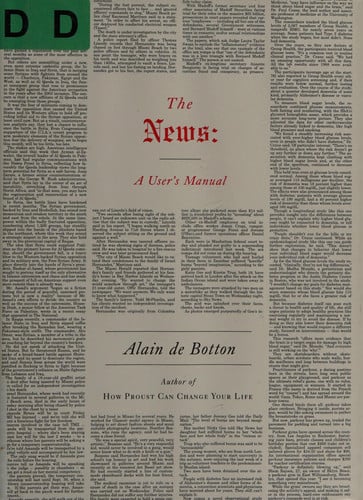
The News A User's Manual

Alain De Botton
From the author of The Architecture of Happiness , a thought-provoking look at the position that news has achieved in our lives. The news is everywhere. We can't stop constantly checking it on our computer screens, but what is this doing to our minds? We are never really taught how to make sense of the torrent of news we face every day, writes Alain de Botton, but this has a huge impact on our sense of what matters and of how we should lead our lives. In his dazzling new book, de Botton takes twenty-five archetypal news stories--including an airplane crash, a murder, a celebrity interview and a political scandal--and submits them to unusually intense analysis with a view to helping us navigate our news-soaked age. He raises such questions as: Why are disaster stories often so uplifting? What makes the love lives of celebrities so interesting? Why do we enjoy watching politicians being brought down? Why are upheavals in far-off lands often so boring? In The News: A User's Manual , de Botton has written the ultimate guide for our frenzied era, certain to bring calm, understanding and a measure of sanity to our daily (perhaps even hourly) interactions with the news machine.
McClelland & Stewart 2014-12-02 272 pages

Trump First How the President and His Associates Turned Their Backs on Me and My Family

Aaron G. Parnas
For almost three years, Aaron Parnas was in the middle of the most polarizing presidency in recent memory. Through his experiences, Aaron saw a different side of President Donald Trump and his administration--one scarier than the average person could imagine. Trump First tells a story of a young conservative, who often felt trapped in an orbit he believed was dangerous to America. In this memoir, Aaron discusses a number of meetings that he witnessed and took part in while simultaneously attending law school in the nation's capital.Witnessing these meetings confirmed Aaron's biggest fear. The President was using backchannel communications with various world leaders, including those in Ukraine and Venezuela, to push a Trump First foreign policy agenda instead of the America First agenda he ran on. This, as Aaron writes, created two State Departments--one that promoted official American policy, and a second, promoting the President's shadow foreign policy agenda.This memoir also takes on a more personal challenge, escaping the President's orbit following the arrest of Aaron's father, Lev Parnas. Trump First describes, in great detail, the excruciating days following his father's arrest, which included an almost 48-hour stint with the President's personal attorney, Rudy Giuliani. Aaron proceeds to tell the public a never before heard story about the months after the arrest while his father worked to get the truth out.
Independently Published 2020-10-29 163 pages

The POLITICS OF BAD FAITH The Radical Assault on America's Future

David Horowitz
In this intellectual companion piece to his acclaimed autobiography, Radical Son, David Horowitz argues that, even in this supposedly post-ideological, post-Cold War era, the historic themes of that conflict still drive our politics and animate our cultural debates. With keen political insight and a masterly grasp of history, he examines how the political Left, including those who describe themselves as liberals, has refused to learn from the past -- particularly from the checkered records of progressive movements for social justice. This important work is a cohesive and searing document for all who refuse to bury their heads in the sand while American institutions and beliefs are corrupted by the politics of bad faith masquerading under the guise of social justice.
Simon and Schuster 2000-03-03 224 pages

Dangerous Offenders The Elusive Target of Justice

Hauser Professor of Nonprofit Organizations Mark H Moore,Mark H. Moore,Susan R. Estrich,Robert Kingsley Professor of Law and Political Science Susan R Estrich,Daniel McGillis,William Spelman
Americans rank crime among the most urgent of social concerns. Overflowing prisons and public outcry have led many to propose that the criminal justice system could control crime more effectively by focusing on dangerous offenders. Recent social studies have suggested that serious criminality is highly concentrated and that high-rate offenders can be distinguished from others on the basis of prior criminal conduct, drug abuse, and employment record. Such studies urge judges to shift from rehabilitative sentencing to selective incapacitation, with longer prison sentences for convicted criminals who are deemed unusually dangerous. In response to these recommendations, some prosecutors' offices have established career criminal units designed to assure that repeat offenders will be prosecuted to the full measure of the law. Some police departments are experimenting with "perpetrator-oriented patrols" targeted on suspected high-rate offenders. The authors of this major book in criminal jurisprudence describe and analyze the intellectual and social challenge posed to public officials by this new thrust in criminal justice policy. They develop a framework for evaluating policies that focus on dangerous offenders. They first examine the general issues that arise as society considers the benefits and risks of concentrating on a particular category of criminals. They then outline how that approach might work at each stage of the criminal justice system--sentencing, pretrial detention, prosecution, and investigation. This cogently argued book provides much needed guidance on the crucial questions of whether sharpened attention to dangerous offenders is just, whether such a policy can be effective in managing the problem of crime, which applications seem particularly valuable, what the long-term risks to social institutions are, and what uncertainties must be monitored and resolved as the policy evolves.
Harvard University Press 2013-10 258 pages