2328 results for "Jewish History"

A.M. Klein, the father of Canadian Jewish literature: essays in the poetics of humanistic passion

Brenner, Rachel Feldhay
Analyzes the works of Canadian Jewish poet A.M. Klein (1909-1972) written in the late 1920s-early 1950s, reading them as a combative poetic response to history. Klein's early poetry in "Hath Not a Jew, " composed against the background of the rise of antisemitism in Europe and in Montreal, his hometown, reveals his deep identification with Jewish tradition and his disillusionment with the humanist inability to confront Nazism. Deeply affected by news of the Holocaust, he wrote his mock epic "The Hitleriad" in 1942, in which he presented Hitler's ugliness, mediocrity, and meanness of spirit. This seems an attempt to demystify Hitler, paralleled perhaps by Arendt's concept of the banality of evil. "The Rocking Chair, " a collection of poems, and the novel "The Second Scroll" represent Klein's attempt to come to terms with the post-Holocaust world. Ch. 4 (pp. 61-80), "The Hitleriad: Against the Silence of the Apocalypse, " appeared in "Studies in American Jewish Literature" 9 (1990).
E. Mellen Press 1990 144 pages

Hasidism and politics: the kingdom of Poland, 1815--1864

Wodziński, Marcin
Analysing the political relations between the Kingdom of Poland and the hasidic movement, this book examines plans formulated by the government and by groups close to government circles regarding hasidim, and describes how a hasidic body politic developed in response. Marcin Wodzinski demonstrates that the rise of hasidism was an important factor in shaping the Jewish policy of both central and provincial authorities and shows how the creation of socio-political conditions that were advantageous to the hasidic movement accelerated its growth. While concentrating on the dynamic that developed in the Kingdom of Poland, the discussion is informed by a consideration of the relationship between the state and the hasidic movement from its inception in the Polish - Lithuanian Commonwealth. The novelty of this study lies in the fact that, whereas most analyses of political culture concentrate on states and societies with well-established electoral systems of representation, Wodzinski focuses on the under-researched area of political relations between a non-democratic state and a low-status community lacking authorized representation. Applying concepts more often associated with cultural history, his analysis draws a distinction between the terms of reference of high-level political debate and the actual implementation of policy middle- and low-level officials. Similarly, in analysing hasidic responses he differentiates between high-level hasidic representations in the state and the grassroots politics of the community. This combination enables a broad contextualization of the whole subject, integrating the social and cultural history of Polish Jewry with that of Polish society in general.
The Littman Library of Jewish Civilization 2013 329 pages

The gate of heaven: the story of Congregation Shaar Hashomayim of Montreal, 1846-1996

Shuchat, Wilfred.
Rabbi Shuchat tells of the emergence of Shaar Hashomayim as a congregation separate from the Spanish and Portuguese fold, the generation-long tension between the two congregations, and the rebellion that produced the Temple Emanuel. He describes the role of the Canadian government in the ups and downs of Jewish immigration and details the effects of world-wide anti-Semitism on the local community, as well as the struggle for Jewish educational rights that ultimately produced a real public school system in the province of Quebec. The student protest that almost paralysed the Passover festival and the day school crisis that almost split the congregation are recounted in detail, and the Pavilion of Judaism at Expo '67 is described. Weaving together individual stories and the history of the Shaar, Rabbi Shuchat demonstrates how the turbulence of the nineteenth century produced a twentieth-century Shaar and Montreal Jewish community that are second to none in tolerance and creativity.
McGill-Queen's University Press 2000-09-15 480 pages

Reflections of a Wondering Jew

Morris Cohen
Much as he considered himself a philosopher, Morris Raphael Cohen was also immersed in the machinery of social life. From his first years of "engagement" as a volunteer teacher in Thomas Davidson's school for working-class people, to his last as professor of philosophy at New York's City College and at the University of Chicago, he constantly sought to understand the underlying assumptions of human behavior. The studies Cohen gathered together for Reflections of a Wondering Jew are an indication of representative achievements of his life. He was deeply involved in the experience of the American Jewish community, and much of his work here consists of an inquiry into and analysis of specifically Jewish affairs. Some of his most valuable contributions to American thought and maturity are those that were never included in standard philosophical efforts. His work and scholarship provide foundations for the field of human problems and the history of ideas. These lectures illuminated the way forward in so many of our crisis years. There is a certain tragedy to the fact that for many decades Morris Raphael Cohen had hoped to organize and put into systematic form his literary reflections on Jewish problems and American liberalism. Towards the end of his life, he faced the realization that many of his intended writings would never reach fruition. Though this volume may not be quite what Cohen intended, it is a product of a mature giant in American intellectual history.
[distributor] Taylor & Francis, c/o Bookpoint 2017-09-20 186 pages

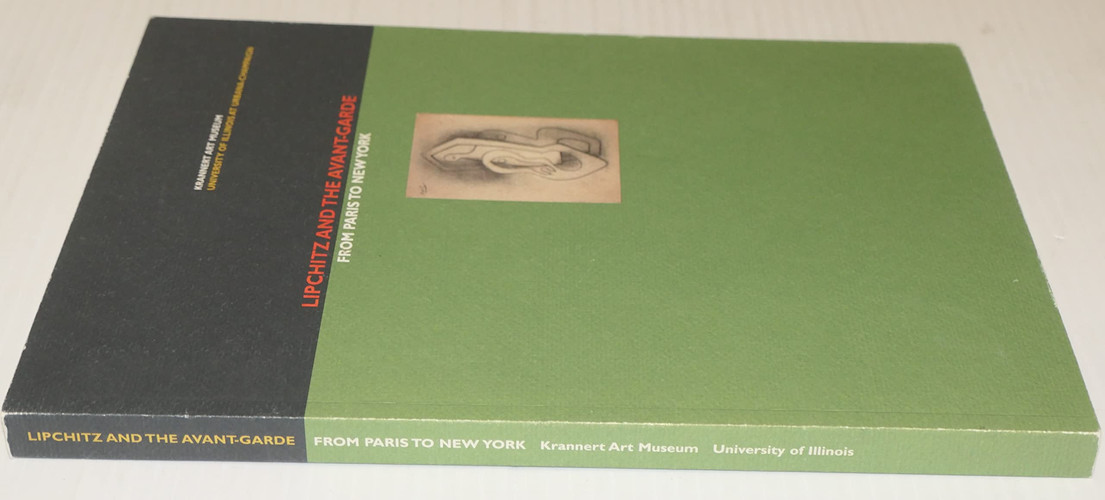
Lipchitz and the avant-garde: from Paris to New York

Lipchitz, Jacques
Utilizing works from museums across North America, Lipchitz and the Avant-Garde traces the path of the pioneering sculptor Jacques Lipchitz from his birthplace in Lithuania to his early work in Paris before World War I, where he was associated with the Parisian avant-garde and applied cubist principles to three-dimensional artwork. By breaking the volume and using different planes, Lipchitz created works that were a new force in the history of sculpture. His innovation of the transparents style in sculpture during the late 1920s was groundbreaking and was copied by many, including Picasso. At the outbreak of World War II the Jewish artist fled to New York, where he worked on increasingly monumental sculptures until his death in 1973. This substantive catalog contains new essays by internationally renowned scholars and translated articles by contemporaries Ramón Gómez de la Serna and Joaquin Torres-García that have not appeared in English before.
Krannert Art Museum and Kinkead Pavilion, University of Illinois at Urbana-Champaign 2001 152 pages

The Gnostic imagination: Gnosticism, Mandaeism, and Merkabah mysticism

Deutsch, Nathaniel
The Gnostic Imagination is the first comprehensive study of the relationship between Gnosticism and Merkabah mysticism. It includes an exhaustive analysis of Gershom Scholem's views on the subject, an analytical survey of other secondary literature, and a focused examination of primary sources. The work explores a wide range of topics including myth, exegesis, ascent traditions, and cosmology. Although the main focus is on western Gnostic traditions and Merkabah mysticism, the book also includes relevant material from Mandaeism and from later stages of Jewish mysticism such as German Pietism and Kabbalah. Not only is this volume the first to survey and evaluate the history of scholarship on this complex subject, but it also creates new pathways for future studies by illuminating the crucial methodological and topical issues in the field.
E.J. Brill 1995 163 pages

Woman in art: Helen Rosenau's 'little book' of 1944

Pollock, Griselda
"Griselda Pollock reintroduces an important feminist forerunner in this new, full-colour setting of Helen Rosenau's 1944 book Woman in Art. Helen Rosenau (1900-1984) was part of the influential migration of European Jewish intellectuals who fled to Britain and the United States during the 1930s, bringing with them exciting innovations in art history's methods. Only Rosenau, however, centred gender in her analysis. The result--her book Woman in Art: From Type to Personality--is a feminist art-historical project, as relevant today as when it was first published in 1944, in which Rosenau drew on contemporary discussions of gender in anthropology, philosophy, sociology, law, theology, history, and literature. In this new volume, ahead of the eightieth anniversary of its original publication, Rosenau's erudite and accessible text is prefaced with a personal memoir by Adrian Rifkin, who was once her student, new research into the refugee experience by Rachel Dickson, and a portrait of Rosenau as feminist intellectual by Griselda Pollock. In conversation with this new setting of the original text, richly illustrated with colour images, Pollock offers eye-opening new readings of key aspects of Rosenau's methods, concepts, arguments, and interpretations of famous artworks, establishing the place of Rosenau's "little book of 1944" in the historiographies of both feminist thought and cutting-edge art history across two centuries."-- Source other than Library of Congress.
Paul Mellon Centre for Studies in British Art 2023 388 pages

Peace flower: a nuclear space adventure

Aharoni, Ada
Review In this adventure story for the entire family anything does! It is a story of childhood innocence and world peace. -- Ladybug PressThis book is an innovative Masterpiece for young and old. -- New WavesThis is a still more revolutionary contribution to children's literature than Harry Popper... -- Mariv Product Description Peace Flower is a story which can be read from the age of ten to a hundred and ten. It is an imaginative tale of fantastic adventures in space, to find the Peace Flower in the Future and bring it back to earth as it does not exist in our present. Lee and Ronni two brave children face the terrible nuclear giant Nuki, who tries to stop them from bringing peace on earth, and they triumph. The book has been adopted by many schools and colleges to teach peace education. It is available in English, in Hebrew, and in Arabic. It is also available on tape, from Ladybug Press, Ca. About the Author Ada Aharoni is an Israeli poet, writer, and lecturer. She writes in English and Hebrew and has published twenty two books to date that have been translated into several languages. She believes that culture and literature can help in healing the urgent ailments of our global village, such as war and conflict, and the themes of peace and conflict resolution are major ones throughout her works. She studied at London University, where she earned an M. Phil. Degree on Henry Fielding, and at the Hebrew University in Jerusalem, where she was awarded a Ph.D. on: Saul Bellow, the Nobel Prize laureate. Her first novel, The Second Exodus, was published in 1983, and To Alexandria, Jerusalem and Freedom appeared in 1985. Her historical novel From The Nile to The Jordan, was published in 1994; and in 1996 she published The Peace Flower, a fantasy for young and old, which has been compared to St. Exupery's Little Prince. She is likewise one of the editors of the book: Saul Bellow: A Mosaic, that covers the First International Saul Bellow Conference, which she initiated and chaired at Haifa University. Among her published books are eight collections of poems in Hebrew, English, French and Arabic, and two books of translations of Israeli poetry, including Shin Shalom's New Poems. She is the Editor of the Anthology: A Song to Life and to World Peace, as well as of Waves of Peace (1997), dedicated to the memory of Yitzhak Rabin. She is the founder and editor of the Literary Magazine Galim: Waves (1987-1997), and the electronic journals internet Horizon: Pave Peace, and Poetry Israel: Lirit, featuring Israeli poets in English translation. Her latest published book is: You and I Can Change the World (Jan. 2000). Among her many prizes and awards are: The British Council Award, the Keren Amos President Award, the Haifa and Bremen Prize, The World Academy of Arts and Culture Award, the Korean Gold Crown of World Poets Award, the Shin Shalom Prize, the Yunus Emre Award, the Rachel Prize, and she was chosen as one the Hundred Global Heroines in Rochester, N.Y, in 1998. She was also awarded the Honorary Award of HSJE: The World Historical Society of the Jews from Egypt, for her "devoted and unmatched efforts to promote the history of the Jews from Egypt, through her visionary literature and poetry proclaiming peace in the world." She is President of the XIII World Congress of Poets (Haifa, Israel, 1992), and the founder and President of IFLAC: the International Forum for the Culture and Literature of Peace, and convener of PTLC the "Pave Peace Through Literature and Culture" commission of IPRA: the International Peace Research Association. She is also the founder and General Director of "The Bridge: Jewish and Arab Women for Peace in the Middle East." Ada Aharoni has taught literature and sociology at the University of Haifa, and sociology and Conflict Resolution, in the general studies department of the Technion in Haifa. She has been a guest lecturer and visiting professor at several American and European universities,
A. Aharoni 1996 119 pages

Testimony from the literary memoirs of Semyon Izrailevich Lipkin (1911-2003): translated by Yvonne Green

Green, Yvonne
The Jewish, Odesa-born poet, Semyon Izrailevich Lipkin (1911-2003), was a central figure in modern Russian literature, although until recently, he was best known in the West for his role in preserving the manuscript of Vasily Grossman's Life and Fate from the KGB. As a Soviet journalist in WW2, he witnessed and wrote about the horrors of Stalingrad, which led the Nobel Laureate Josef Brodsky to refer to him as 'Russia's war poet'. Later, during the years of Stalin's deportation of ethnic groups, Lipkin translated and preserved the language and writings of Tajiks, Uzbeks, and Tatars and, in doing so, became a living repository of their culture for which he risked censure and arrest from the Soviet authorities. In this memoir, Lipkin's humanity, civic courage, and friendship with many important Russian writers - Anna Akhmatova, Marina Tsvetaeva, Andrei Platonov, and of course, Grossman himself - shine through the reports of terror and oppression that characterized this most turbulent period of Russian history.
Hendon Press 2023-02-28 222 pages

Pledges of Jewish allegiance: conversion, law, and policymaking in nineteenth- and twentieth-century Orthodox responsa

Ellenson, David Harry,Gordis, Daniel
Since the late 1700s, when the Jewish community ceased to be a semiautonomous political unit in Western Europe and the United States and individual Jews became integrated-culturally, socially, and politically-into broader society, questions surrounding Jewish status and identity have occupied a prominent and contentious place in Jewish legal discourse. This book examines a wide array of legal opinions written by nineteenth- and twentieth-century orthodox rabbis in Europe, the United States, and Israel. It argues that these rabbis' divergent positions-based on the same legal precedents-demonstr.
Stanford University Press 2012-01-18 206 pages

The Zohar In Moslem & Christian Spain

Ariel Bension
'The Zohar' was compiled and composed in Spain in the thirteenth century, and exerted a powerful influence on Jewish life in medieval ghettoes. In this book, first published in 1932, Dr Bension was the first scholar to deal with the influence on Jewish mysticism of certain characteristics which underlie so much of the literature produced in Spain both by Christians and Muslims.
Hermon Press 1974-01-01 256 pages

Entrepreneurial vocations: learning from the callings of Augustine, Moses, mothers, Antigone, Oedipus, and Prospero

Krieger, Martin H.
Originally Published by Scholars Press Now Available from Duke University Press In this interdisciplinary work, Martin H. Krieger examines the entrepeneur in terms of modes and ideal figures drawn from religion and classical studies. In so doing, he provides a means or vocabulary with which entrepreneurs can articulate their experience of risk, commitment, and judgment. In addition, by establishing a comparison between the entrepreneur and the figures he utilizes from religious and classical literature, Krieger generates surprising new ways to look at the careers of such traditional figures as St. Augustine, Moses, Oedipus, Antigone, and the characters of Shakespeare's The Tempest. Both an exercise in the humanities and in the pragmatic world of business, Krieger's work offers an intriguing methodology for how humanistic learning can be applied to the real world concerns of the entrepreneur. A teaching and self-study guide to Entrepreneurial Vocation is included as an appendix for those wishing to adopt the text as a classroom resource.
Scholars Press 1996 210 pages

Writing with Scripture: the authority and uses of the Hebrew Bible in the Torah of formative Judaism

Neusner, Jacob
Analyzes how, in the formation of Judaism, the written Torah, also called the Hebrew Bible and Old Testament, relate to and served the dual Torah, which consisted of both oral and written elements. Argues against holding up the written texts alone as "proofs," and that the written and oral forms comprised a single, seamless whole. Annotation copyright Book News, Inc. Portland, Or.
Scholars Press 1993-01-01 188 pages

Jewish Biblical Commentators

William Rosenau
This work has been selected by scholars as being culturally important, and is part of the knowledge base of civilization as we know it. This work is in the "public domain in the United States of America, and possibly other nations. Within the United States, you may freely copy and distribute this work, as no entity (individual or corporate) has a copyright on the body of the work. Scholars believe, and we concur, that this work is important enough to be preserved, reproduced, and made generally available to the public. We appreciate your support of the preservation process, and thank you for being an important part of keeping this knowledge alive and relevant.
Creative Media Partners, LLC 2022-10-27 154 pages

The Jewish Law of Marriage and Divorce

M. Mielziner
This work has been selected by scholars as being culturally important, and is part of the knowledge base of civilization as we know it. This work was reproduced from the original artifact, and remains as true to the original work as possible. Therefore, you will see the original copyright references, library stamps (as most of these works have been housed in our most important libraries around the world), and other notations in the work. This work is in the public domain in the United States of America, and possibly other nations. Within the United States, you may freely copy and distribute this work, as no entity (individual or corporate) has a copyright on the body of the work. As a reproduction of a historical artifact, this work may contain missing or blurred pages, poor pictures, errant marks, etc. Scholars believe, and we concur, that this work is important enough to be preserved, reproduced, and made generally available to the public. We appreciate your support of the preservation process, and thank you for being an important part of keeping this knowledge alive and relevant.
Creative Media Partners, LLC 2019-03-08 150 pages

A History of the Jews in Babylonia, Part V Later Sasanian Times

Jacob Neusner
Jacob Neusner is Research Professor of Religion and Theology at Bard College and Senior Fellow of the Institute of Advanced Theology at Bard. He has published more than 900 books and unnumbered articles, both scholarly and academic and popular and journalistic, and is the most published humanities scholar in the world. He has been awarded nine honorary degrees, including seven US and European honorary doctorates. He received his AB from Harvard College in 1953, his PhD from Columbia University and Union Theological Seminary in 1961, and rabbinical ordination and the degree of Master of Hebrew Letters from the Jewish Theological Seminary of America in 1960. Neusner is editor of the 'Encyclopedia of Judaism' (Brill, 1999. I-III) and its Supplements; Chair of the Editorial Board of 'The Review of Rabbinic Judaism, ' and Editor in Chief of 'The Brill Reference Library of Judaism', both published by E. J. Brill, Leiden, The Netherlands. He is editor of 'Studies in Judaism', University Press of America. Neusner resides with his wife in Rhinebeck, New York. They have a daughter, three sons and three daughters-in-law, six granddaughters and two grandsons.
Wipf and Stock Publishers 2008-12-11 490 pages