58,196 results in 0.07 seconds

Ambassador Morgenthau's Story A Personal Account of the Armenian Genocide

Henry Morgenthau
The evocative, first-hand accounts of American ambassador Henry Morgenthau regarding the Armenian genocide are one of the most thorough, authoritative sources on the atrocities. This book contains the full accounts of Henry Morgenthau throughout his posting in Constantinople, Turkey. At the time the Ottoman Empire was on the brink of collapse; amid the chaos and upheaval began the Armenian genocide, a ruthless campaign of targeted killing which occurred over eight years, from 1915 to 1923. In his role as ambassador, Henry Morgenthau would receive regular, commonly excruciating reports of mass murders and forced deportations; revulsed, he moved to prevent further such atrocities taking place. Despite the efforts of Henry Morgenthau to convince his superiors in Washington to intervene on humanitarian grounds, his pleas fell on deaf ears. The masses of evidence he personally reviewed and verified are related in this book, as are many of the high-level meetings Morgenthau personally held with Ottoman leaders in an attempt to stem the holocaust of the Armenian people. Stonewalled, dismissed and waved away at every turn, the frustrations Morgenthau felt at the futility are amply expressed in this emotional and sometimes harrowing chronicle. The many obstructions he encountered with the Ottoman leadership led Morgenthau to resign his post in 1916. He spent the final three decades of his life tirelessly campaigning on behalf of the oppressed and victimized Ottoman peoples. As well as publishing this book plus hundreds of newspaper and magazine articles, Henry Morgenthau Sr. raised enormous sums for the displaced Armenians reeling from the horrific genocide. Recognized and lauded for his humanitarian work, he would represent the United States at the Second Geneva Conference in 1932.
Createspace Independent Publishing Platform 2017-04-11 204 pages

Roomanitarian

Rollins, Henry
In Roomanitarian, popular author, actor, musician, and spoken-word artist Henry Rollins returns to the combative prose that has won him critical acclaim and a legion of devoted fans. The book is divided into three parts: The first section, "Walking the Chasm,” written in the form of a poem, epitomizes Rollins’s beautifully stark, hard-hitting style. The second part, "Ended," is a series of short prose pieces reminiscent of Solipsist. Finally, the biting humor and social commentary Rollins is renowned for is on full display in "To Ann Hitler with Love," a series of mock love letters to a fictional woman who bears a striking resemblance to conservative pundit Ann Coulter.
2.13.61 Publications 2005-10-27 174 pages

The Faltering economy: the problem of accumulation under monopoly capitalism

Kalecki, Michał,Szlajfer, Henryk
The essays in this volume, by veteran economists as well as younger scholars, are part of a radical attempt to grapple with the problems of advanced capitalist development without discarding the real theoretical breakthroughs made by Keynes. The contributors argue that Keynes was correct in pointing to the economic contradictions stemming from unemployment, income inequality, and speculative finance, but failed to consider the class composition of social output, the macroeconomic effects of the modern firm, and the atrophy of investment under conditions of capitalist maturity. They thus seek to uncover the sources of stagnation under monopoly capitalism by building on the work of three of the great economists of modern times: Marx, Keynes, and Kalecki.
Monthly Review Press 1984 357 pages

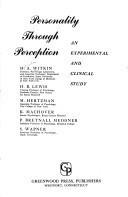
Personality through perception: an experimental and clinical study

Witkin, Herman A.
This volume is essentially the report of an elaborate ten-year study carried out by a team of experienced psychologists, under a variety of conditions The authors studied the relationship between perception and personality in widely differing young normal adults, a hospitalized phychiatric group, and children of different ages included. The authors discuss results for each of the tests used, the special scoring procedures devised for each, and the significance of this and similar studies for personality theory, for perceptual theory, and for research design in general. Implications for a possible rapprochement between clinically and experimentally oriented psychologists are also pointed out.
Greenwood Press 1972 571 pages

Satan's Diary

Leonid Andreyev,Herman Bernstein
Delve into the dark heart of morality with Leonid Andreyev's chilling exploration of good and evil, "Satan's Diary." This rediscovered work of religious and horror fiction presents a unique perspective on the eternal struggle, inviting readers to confront uncomfortable truths about human nature and the seductive power of darkness. Andreyev's masterful storytelling creates an unsettling atmosphere as he explores profound questions about temptation, sin, and redemption. A cornerstone of literary horror, "Satan's Diary" remains a compelling and thought-provoking read, offering a timeless glimpse into the complexities of faith and the enduring presence of the diabolical. This meticulously prepared print edition makes this classic of religious fiction available for all who seek a journey into the shadows. This work has been selected by scholars as being culturally important, and is part of the knowledge base of civilization as we know it. This work is in the public domain in the United States of America, and possibly other nations. Within the United States, you may freely copy and distribute this work, as no entity (individual or corporate) has a copyright on the body of the work. Scholars believe, and we concur, that this work is important enough to be preserved, reproduced, and made generally available to the public. We appreciate your support of the preservation process, and thank you for being an important part of keeping this knowledge alive and relevant.
Creative Media Partners, LLC 2025-03-28 124 pages

The last days of the Jerusalem of Lithuania: chronicles from the Vilna Ghetto and the Camps, 1939-1944

Kruk, Herman
An English version of the extant parts of Kruk's papers, including his diary and his chronicles of the Vilna ghetto (written in fictionalized form). The diary covers the periods from September 1939 to summer 1940 (Kruk's escape from Warsaw to Vilna), 23 June 1941 to 14 July 1943 (his experience in the ghetto of Vilna), and July-September 1944 (his incarceration in the labor camps of Klooga and Lagedi in Estonia). Concerning the Vilna ghetto, Kruk describes Nazi anti-Jewish measures, daily life in the ghetto, and resistance attempts. Dwells on the activities of the Judenrat, cultural life in the ghetto (where Kruk was a librarian), and the fate of the YIVO collections during the Nazi occupation. Mentions events in nearby Jewish towns (e.g. Lida, Oshmyany, Baranovichi). Kruk was killed in Lagedi; his papers were found after the liberation.
Yale University Press 2002-01-01 732 pages

Psychopaths: an introduction

Prins, Herschel
An expert introduction based on huge experience. Suitable for professionals, academics and general readers. With Questions, Suggestions for Further Reading and a Glossary of key terms. What is a psychopath? How can we tell? Are psychopaths always a risk to the public? How safe are we from criminal psychopaths? This basic guide looks at the history and development of psychopathy. It gives practical illustrations and explains key provisions for dealing with criminal psychopaths (with examples). It also examines possible causes, the difficulties involved in the assessment of risk, and the tools used to determine whether or not someone has a psychopathic personality. Psychopathy may exist in the boardroom or in sport just as it does in our prisons - sometimes driven or successful people can exhibit similar traits without undue adverse comment. But when concentrated in an individual with violent tendencies things become problematic and the chances are that they will not be deterred by or respond to everyday approaches to crime and punishment. Psychopaths may be cold, calculating, manipulative and lack empathy for victims or others. They may be charming, intelligent and walk the streets unnoticed. This book looks at how we seek to identify those who are dangerous or predatory and the arrangements to contain them in prisons and secure hospitals in the name of public safety (often for long periods of time). 'They are Manfred-like characters, existing in their own time and space': Dr Emmanuel Miller, in conversation with the author. 'I think we have to be willing to go into the darkness': Leading psychiatrist, Sarah Trevelyan. Reviews 'Reflects immense scholarship based on multidisciplinary perspectives, innate decency and an ability to convey complex behaviours in a readable style': John Harding CBE. 'A much needed text from one of the doyens in this field': Professor David Wilson. Professor Herschel Prins is highly respected in crime and mental health circles, having started out as a probation officer, worked for the Home Office, taught in universities and served on the Parole Board, Mental Health Review Tribunal, Mental Health Act Commission and as chair of various inquiries concerning psychopaths.
Waterside Press 2013 172 pages

How I became Hettie Jones

Jones, Hettie
Greenwich Village in the 1950s was a haven to which young poets, painters, and jazz musicians flocked. Among them was Hettie Cohen, who'd been born into a middle-class Jewish family in Queens and who'd chosen to cross racial barriers to marry the controversial black poet LeRoi Jones. Theirs was a bohemian life in the awakening East Village of underground publishing and jazz lofts, through which drifted such icons of the generation as Allen Ginsberg, Thelonious Monk, Jack Kerouac, Frank O'Hara, Billie Holiday, James Baldwin, and Franz Kline.
Grove Press 1997 239 pages