464 results for "American History"

Philosophy in an age of science: physics, mathematics, and skepticism

Putnam, Hilary
Hilary Putnam's unceasing self-criticism has led to the frequent changes of mind he is famous for, but his thinking is also marked by considerable continuity. A simultaneous interest in science and ethics - unusual in the current climate of contention - has long characterized his thought. In "Philosophy in an Age of Science", Putnam collects his papers for publication - his first volume in almost two decades. Mario De Caro and David Macarthur's introduction identifies central themes to help the reader negotiate between Putnam past and Putnam present: his critique of logical positivism; his enduring aspiration to be realist about rational normativity; his anti-essentialism about a range of central philosophical notions; his reconciliation of the scientific worldview and the humanistic tradition; and his movement from reductive scientific naturalism to liberal naturalism. Putnam returns here to some of his first enthusiasms in philosophy, such as logic, mathematics, and quantum mechanics. The reader is given a glimpse, too, of ideas currently in development on the subject of perception. Putnam's work, contributing to a broad range of philosophical inquiry, has been said to represent a "history of recent philosophy in outline."
Harvard University Press 2012-04-17 659 pages

The Progressive Presidents Roosevelt, Wilson, Roosevelt, Johnson

John Morton Blum
Advocates of a strong versus a weak presidency have struggled throughout American history, but never so fiercely as in the twentieth century, which saw the rise of progressivism. This is the story of four progressive presidents, from the first Roosevelt, who himself brought plenty of backbone to the office, to Woodrow Wilson , who articulated the theory of a progressive presidency, to FDR, who brought it unique power, and, finally, to Lyndon Johnson, who provided perhaps its last great surge in our century. In a time of progressive malaise, it is important to know the history, to see the benefits as well as the liabilities, in the progressive presidential tradition. That is the aim and achievement of this book.
W.W. Norton 1982 221 pages

We the people. Volume 3. The Civil Rights revolution

Ackerman, Bruce A.
The Civil Rights Revolution carries Bruce Ackerman’s sweeping reinterpretation of constitutional history into the era beginning with Brown v. Board of Education . From Rosa Parks’s courageous defiance, to Martin Luther King’s resounding cadences in “I Have a Dream,” to Lyndon Johnson’s leadership of Congress, to the Supreme Court’s decisions redefining the meaning of equality, the movement to end racial discrimination decisively changed our understanding of the Constitution. “The Civil Rights Act turns 50 this year, and a wave of fine books accompanies the semicentennial. Ackerman’s is the most ambitious; it is the third volume in an ongoing series on American constitutional history called We the People . A professor of law and political science at Yale, Ackerman likens the act to a constitutional amendment in its significance to the country’s legal development.” —Michael O’Donnell, The Atlantic “Ackerman weaves political theory with historical detail, explaining how the civil rights movement evolved from revolution to mass movement and then to statutory law...This fascinating book takes a new look at a much-covered topic.” —Becky Kennedy, Library Journal
The Belknap Press of Harvard University Press 2018-07-09 432 pages

Genesis: Truman, American Jews, and the origins of the Arab/Israeli conflict

Judis, John B.
"A probing look at one of the most incendiary subjects of our time--the relationship between the United States and Israel. There has been more than half a century of raging conflict between Jews and Arabs--a violent, costly struggle that has had catastrophic repercussions in a critical region of the world. In Genesis, John B. Judis argues that, while Israelis and Palestinians must shoulder much of the blame, the United States has been the principal power outside the region since the end of World War II and as such must account for its repeated failed efforts to resolve this enduring strife. The fatal flaw in American policy, Judis shows, can be traced back to the Truman years. What happened between 1945 and 1949 sealed the fate of the Middle East for the remainder of the century. As a result, understanding that period holds the key to explaining almost everything that follows--right down to George W. Bush's unsuccessful and ill-conceived effort to win peace through holding elections among the Palestinians, and Barack Obama's failed attempt to bring both parties to the negotiating table. A provocative narrative history animated by a strong analytical and moral perspective, and peopled by colorful and outsized personalities, Genesis offers a fresh look at these critical postwar years, arguing that if we can understand how this stalemate originated, we will be better positioned to help end it"--
Farrar, Straus and Giroux 2014 432 pages

Zulu woman: the life story of Christina Sibiya

Reyher, Rebecca Hourwich
In 1934, American writer Rebecca Hourwich Reyher recorded the remarkable life story of Christina Sibiya, the first of sixty-five wives of the uncrowned king of the Zulus. What Reyher faithfully recorded — and then crafted into a moving narrative — is the riveting story of a South African woman who entered life among the Zulu royal family and then, after enduring psychic and physical abuse, found the courage to leave. In 1915, fifteen-year-old Christina Sibiya leaves teaching at a mission school to become the first wife of Solomon ka Dinuzulu. While at the royal household, Sibiya successfully adjusts to the expectations of her new position: finding her place among the other wives, and negotiating Zulu and Christian tradition. The royal headquarters, however, becomes increasingly plagued by diviseness, dissolution, and ill health. After a series of hardships, climaxing in a beating by Solomon, Sibiya, at the age of twenty-eight, escapes to Durban. Although pursued by Solomon's representative, Sibiya successfully resists Solomon's authority by testifying first in a European magistrate's court and then at the royal headquarters that her marriage was invalid. First published in 1948, Zulu Woman is placed in new context by an introduction and afterword which consider the book's relationship to other African literature and oral history, attend to questions of power and authorship, and draw upon newly available archival materials.
Feminist Press at the City University of New York 1999 228 pages

Conversations with Gordon Lish

Lish, Gordon
"Known as "Captain Fiction," Gordon Lish (b. 1934) is among the most influential, and controversial, figures in modern American letters. As an editor at Esquire (1969-1977), Alfred A. Knopf (1977-1995) and The Quarterly (1987-1995), and as a teacher both in and outside the university system, he has worked closely with many of the most pioneering writers of recent times, including Raymond Carver, Don DeLillo, Barry Hannah, Amy Hempel, Sam Lipsyte, and Ben Marcus. A prolific author of stories and novels, Lish has also won a cult following for his own fiction, earning comparisons with Gertrude Stein and Samuel Beckett. Conversations with Gordon Lish collects all of Lish's major interviews, covering the entire span of his extraordinary career. Ranging from 1965 to 2015, these interviews document his pivotal role in the period's defining developments: the impact of the Californian counterculture, the rise and decline of so-called literary "minimalism," dramatic transformations in book and magazine publishing, and the ongoing growth of creative writing instruction. Over time, Lish--a self-described "dynamic conversationalist"--forges an evolving conversation not only with his interviewers, but with the central trends of twentieth-century literary history. This book will be essential reading not only for students and fans of contemporary fiction, but for writers too: included are several interviews in which Lish discusses his secretive private writing classes. Indeed, these pieces themselves amount to a masterclass in Lishian literary language--each is a work of art in its own right." -- provided by publisher.
University Press of Mississippi 2018 174 pages

Jews, Germans, and Allies: close encounters in occupied Germany

Grossmann, Atina
In the immediate aftermath of World War II, more than a quarter million Jewish survivors of the Holocaust lived among their defeated persecutors in the chaotic society of Allied-occupied Germany. Jews, Germans, and Allies draws upon the wealth of diary and memoir literature by the people who lived through postwar reconstruction to trace the conflicting ways Jews and Germans defined their own victimization and survival, comprehended the trauma of war and genocide, and struggled to rebuild their lives. In gripping and unforgettable detail, Atina Grossmann describes Berlin in the days following Germany's surrender--the mass rape of German women by the Red Army, the liberated slave laborers and homecoming soldiers, returning political exiles, Jews emerging from hiding, and ethnic German refugees fleeing the East. She chronicles the hunger, disease, and homelessness, the fraternization with Allied occupiers, and the complexities of navigating a world where the commonplace mingled with the horrific. Grossmann untangles the stories of Jewish survivors inside and outside the displaced-persons camps of the American zone as they built families and reconstructed identities while awaiting emigration to Palestine or the United States. She examines how Germans and Jews interacted and competed for Allied favor, benefits, and victim status, and how they sought to restore normality--in work, in their relationships, and in their everyday encounters. Jews, Germans, and Allies shows how Jews were integral participants in postwar Germany and bridges the divide that still exists today between German history and Jewish studies.
Princeton University Press 2007-09-24 393 pages

The sculpture of Louise Nevelson: constructing a legend

Nevelson, Louise
A comprehensive look at Louise Nevelson's career as a pioneering sculptor Louise Nevelson (1900-1988) was a towering figure in postwar American art, exerting great influence with her monumental installations, innovative sculptures made of found objects, and celebrated public artworks. The Sculpture of Louise Nevelson focuses on all phases of the artist's remarkable ascent to the top of the art world, from her groundbreaking works of the 1940s to complex pieces completed in the late 1980s. The most extensive study of Nevelson to be published in over 20 years, this beautifully illustrated book also demonstrates how Nevelson's flamboyant style and carefully cultivated persona enhanced her reputation as an artist of the first rank. Essays by distinguished scholars examine a wide variety of important issues and themes throughout Nevelson's career, including the role of monochromatic color in her painted wooden sculpture; the art-historical context of her work; her acclaimed large-scale commissioned artworks, which established her as a central figure in the public art revival of the late 1960s; and her "self-fashioning" as a celebrated artist, particularly her origins as a Ukrainian-born Jewish immigrant to the United States. An illustrated chronology and exhibition history accompany the text. Published in conjunction with the first major exhibition of Nevelson's work in America since 1980, this book provides essential information on and insights into the study of a revolutionary 20th-century artist. Published in association with The Jewish Museum Exhibition Schedule: The Jewish Museum, New York (May 5 - September 16, 2007) de Young, Fine Arts Museums of San Francisco (October 27, 2007 - January 13, 2008)
Jewish Museum 2007 238 pages

And nothing but the truth

Sekulow, Jay
In the 1960s a shadow of religious persecution fell across America. Public schools became as hostile to religion as their counterparts in Communist countries. Christians were stunned and dismayed. And this persecution increased for decades after that -- and continues even today. The government threatens intervention if workers display Bibles on their desks or mention their faith to coworkers. Local zoning committees deny churches protection against zoning laws that allow bars in their vicinity. Local governments ban films by Christians like James Dobson in public facilities. In And Nothing But the Truth you will learn how you can be a part of the new revolution of religious freedom sweeping our country. And you will discover what you can do to reclaim your community and your own rights.
T. Nelson Publishers 1996 276 pages

The Koch Papers My Fight Against Anti-Semitism

Edward I. Koch,Ed Koch,Rafael Medoff
For more than three decades, Ed Koch has been one of America's most interesting and outspoken political figures. In this provocative new book, Koch with Rafael Medoff guides readers through the major battles in his life-long fight against anti-Semitism. Interviews, speeches, new essays, never-before published personal correspondence, and more highlight his leadership--on campuses, in the media, on the streets of New York City, and in the halls of power in Washington, DC. The book also features personal letters from Henry Louis Gates, former President George Bush, and other prominent figures. Koch will reveal startling information for the first time here, and his writings are controversial, piercing, teasing, and questioning. This book will ignite discussion for years to come
Macmillan 2009-03-17 256 pages

Territory of lies: the exclusive story of Jonathan Jay Pollard, the American who spied on his country for Israel and how he was betrayed

Blitzer, Wolf
From Library Journal A penetrating expose of the case of Pollard, an American Jew who worked for U.S. Naval Intelligence and spied for Israel. Blitzer, the Washington correspondent for The Jerusalem Post , interviewed Pollard (now in federal prison) and also made use of many contacts in the Israeli government. The tale Blitzer tells is of a bright but unstable man, a dedicated Zionist but questionably loyal American, who offered his services to the Israelis, who in turn mounted a poorly organized intelligence operation in the United States. Blitzer raises many issues about the case that will be debated for years--the harsh sentence given to both Pollard and his wife, the question of dual loyalties, and the possibility of a third party involvement. A thoroughly provocative tale that needed to be told and was done so with a great deal of passion. - Sanford R. Silverburg, Catawba Coll. , Salisbury, N.C . Copyright 1989 Reed Business Information, Inc.
Harper & Row 1989 336 pages

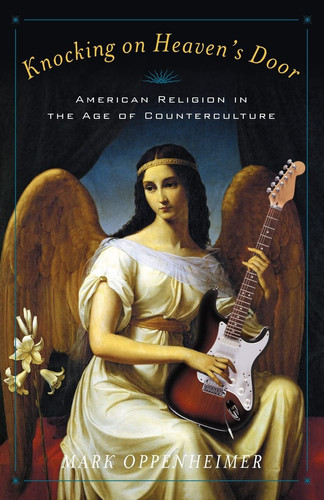
Knocking on Heaven's Door American Religion in the Age of Counterculture

Mark Oppenheimer
A witty and provocative reappraisal of the impact of the cultural upheavals of the sixties on American religious life What happened to American religion during the cultural revolution of the 1960s and early 1970s? The era has long been associated with the ascendancy of Eastern religions and fringe cults. But in this provocative book, Mark Oppenheimer demonstrates that contrary to conventional wisdom, most Americans did not turn on, tune in, and drop out of mainstream religious groups during the Age of Aquarius. Instead, many Americans brought the counterculture with them to their churches and temples, changing the face of American religion. Introducing us to America's first gay ministers and first female priests, to hippie Jews and folk-singing Catholics, Oppenheimer demonstrates that this was an era of extraordinary religious vitality. Drawing on a rich range of archival material as well as interviews with many of the protagonists, Knocking on Heaven's Door offersa wry and iconoclastic reappraisal of the ways in which the upheavals of the sixties changed America's relationship with God.
Yale University Press 2003 284 pages

A new republic: a history of the United States in the twentieth century

Lukacs, John
An eminent historian offers his views on American democracy In A New Republic, one of America's most respected historians offers a major statement on the nature of our political system and a critical look at the underpinnings of our society. American democracy, says John Lukacs, has been transformed from an exercise in individual freedom and opportunity to a bureaucratic system created by and for the dominance of special groups. His book, first published in 1984 as Outgrowing Democracy, is now reissued with a new introduction, in which Lukacs explains his methodology, and a new final chapter, which sums up Lukacs's thoughts on American democracy today. Reviews of the earlier edition "A rich, subtle, and often ingenious argument . . . an eloquent, provocative, but disturbing book."--Edwin M. Yoder, Jr., Washington Post Book World "Mr. Lukacs is an original and subtle historian, and [this book] is an engaging intellectual surprise party. . . . I was continuously enchanted by the play of his ideas--by the sharpness of his distinctions and the acuteness of his descriptions."--Naomi Bliven, New Yorker "It has been a long time since Americans were offered such a provocative interpretation of their historical predicament. . . . We would be foolish not to examine it closely."--Laurence Tool, Society
Yale University Press 2004-01-01 457 pages

Hail Babylon! NPR's Road Scholar Goes in Search of the American City

Andrei Codrescu
Andrei Codrescu takes us cross-country through the withered, yet alluring American urban landscape, visiting New York, Baltimore, New Orleans, Little Rock, San Antonio, Albuquerque, Las Vegas, and Portland, Oregon. He discovers that cities are at the very center of the forces determining our future, in this major work by one of America's most gifted social critics.
Macmillan 1999-06-19 272 pages

The best minds of my generation: a literary history of the Beats

Ginsberg, Allen
"In the summer of 1977, Allen Ginsberg decided it was time to teach a course on the literary history of the Beat Generation. This was twenty years after the publication of his landmark poem "Howl," and Jack Kerouac's seminal book On the Road. Through the creation of this course, which he ended up teaching five times, first at the Naropa Institute and later at Brooklyn College, Ginsberg saw an opportunity to make a record of the history of Beat Literature. Compiled and edited by renowned Beat scholar Bill Morgan, and with an introduction by Anne Waldman, The Best Minds of My Generation presents the lectures in edited form, complete with notes, and paints a portrait of the Beats as Ginsberg knew them: friends, confidantes, literary mentors, and fellow revolutionaries. Ginsberg was seminal to the creation of a public perception of Beat writers and knew all of the major figures personally, making him uniquely qualified to be the historian of the movement. In The Best Minds of My Generation, Ginsberg shares anecdotes of meeting Kerouac, Burroughs, and other writers for the first time, explains his own poetics, elucidates the importance of music to Beat writing, discusses visual influences and the cut-up method, and paints a portrait of a group who were leading a literary revolution. For academics and Beat neophytes alike, The Best Minds of My Generation is a personal and yet critical look at one of the most important literary movements of the twentieth century"--
Grove Press 2017 460 pages

Paul Rand

Heller, Steven
Paul Rand (1914-1996) was a pioneering figure in American graphic design whose career spanned almost seven decades. Always enquiring and investigating, he explored the formal vocabulary of European avant-garde art movements and synthesised them to produce a distinctive graphic language. Rand was a major force in editorial design, advertising and corporate identity. He was art director at "Esquire" and "Apparel Arts" magazines, and he designed the ground-breaking covers for the cultural journal "Direction". He worked at the Weintraub Advertising Agency from 1941-1954 and, in 1955, established his own design studio, acting as consultant to companies such as IBM, Westinghouse and UPS. His logos for these companies are world-renowned design classics. This book comprises a definitive collection of Rand's works, through an exploration of his advertising, publishing and corporate identity work. Steven Heller's text, with a foreword by designer Armin Hofmann, introduction by advertising guru George Lois, and a concluding essay by designer and writer Jessica Helfand, offer an insight into Paul Rand's work.
Phaidon 1999 255 pages

All those mornings . . . at the Post The 20th Century in Sports from Famed Washington Post Columnist Shirley Povich

Shirley Povich
Shirley Povich was the Dean of American sportswriters. As a columnist for The Washington Post for more than seventyfive years, he was an eyewitness to the most thrilling moments in American sports, including: the legendary 1927 Dempsy-Tunney "long count"; the celebrated 1938 race between Seabiscuit and War Admiral; the 1946 signing of Jackie Robinson by the Brooklyn Dodgers; Don Larsen's perfect game in the 1956 World Series; the Ali-Frazier fight of 1971; and the murder of eleven Israeli athletes at the 1972 Munich Olympics. But Povich's columns were about more than sports; they reflected the dramatic changes in American society over the course of the 20th Century. Driven by a strong sense of social justice, Povich called for the integration of major league baseball in 1939, and twenty years later he was still at it, attacking Washington Redskins owner George Preston Marshall for having an all-white team. For the 100th anniversary of his birth, Povich's children— David, Maury, and Lynn — and his colleague at the Post, former sports editor George Solomon, have pulled together this panoramic collection of Povich's most beloved columns. The result is a front-row seat to the most awe-inspiring sports moments of our American Century.
PublicAffairs 2006-05-02 432 pages

All those mornings-- at the Post: the twentieth century in sports from famed Washington post columnist Shirley Povich

Povich, Shirley
Shirley Povich was the Dean of American sportswriters. As a columnist for The Washington Post for more than seventyfive years, he was an eyewitness to the most thrilling moments in American sports, including: the legendary 1927 Dempsy-Tunney "long count"; the celebrated 1938 race between Seabiscuit and War Admiral; the 1946 signing of Jackie Robinson by the Brooklyn Dodgers; Don Larsen's perfect game in the 1956 World Series; the Ali-Frazier fight of 1971; and the murder of eleven Israeli athletes at the 1972 Munich Olympics. But Povich's columns were about more than sports; they reflected the dramatic changes in American society over the course of the 20th Century. Driven by a strong sense of social justice, Povich called for the integration of major league baseball in 1939, and twenty years later he was still at it, attacking Washington Redskins owner George Preston Marshall for having an all-white team. For the 100th anniversary of his birth, Povich's children— David, Maury, and Lynn — and his colleague at the Post, former sports editor George Solomon, have pulled together this panoramic collection of Povich's most beloved columns. The result is a front-row seat to the most awe-inspiring sports moments of our American Century.
Public Affairs 2005-04-05 404 pages