351 results for "Internet"

Ruling the waves: cycles of discovery, chaos, and wealth from the compass to the internet

Spar, Debora L.
Beginning with the development of the compass, Ruling the Waves examines a series of technological revolutions that promised, in their time, to transform the world's politics and business. With Debora Spar's gifted storytelling, each chapter reads like an adventure tale as she recounts the histories of the printing press and maps; of the telegraph, radio, and satellite television; of software, encryption, and the advent of digital music. At each of these junctures Spar suggests that invention led to both a wave of commerce and of chaos. Entrepreneurs such as Samuel Morse and Rupert Murdoch carved new markets from the emerging technology and proclaimed that the old rules no longer applied. And for a while, they were right. But eventually--and inevitably--even cowboys need rules: rules of property, rules of coordination, rules of competition. The erstwhile pioneers thus turn to government, lobbying for order and setting the stage for the next wave of discovery. A fascinating history of business, Ruling the Waves is also an original, thought-provoking analysis of the parallels between past innovations and inventions and our own tumultuous times.
Harcourt 2001 403 pages

Too big to know: rethinking knowledge now that the facts aren't the facts, experts are everywhere, and the smartest person in the room is the room

Weinberger, David
We used to know how to know. We got our answers from books or experts. We'd nail down the facts and move on. But in the Internet age, knowledge has moved onto networks. There's more knowledge than ever, of course, but it's different. Topics have no boundaries, and nobody agrees on anything. Yet this is the greatest time in history to be a knowledge seeker, if you know how. In Too Big to Know, Internet philosopher David Weinberger shows how business, science, education, and the government are learning to use networked knowledge to understand more than ever and to make smarter decisions than they could when they had to rely on mere books and experts. This groundbreaking book shakes the foundations of our concept of knowledge -- from the role of facts to the value of books and the authority of experts -- providing a compelling vision of the future of knowledge in a connected world. - Publisher.
Basic Books 2011 231 pages

Information wars: how we lost the global battle against disinformation & what we can do about it

Stengel, Richard
"In February of 2013, Richard Stengel, the former editor-in-chief of Time, joined the Obama administration as Under Secretary of State for Public Diplomacy and Public Affairs. Within days, two shocking events made world-wide headlines: ISIS executed American journalist James Foley on a graphic video seen by tens of millions, and Vladimir Putin's "little green men"-Russian special forces-invaded Crimea, amid a blizzard of Russian denials and false flags. What these events had in common besides their violent law-lessness is that they were the opening salvos in a new era of global information war, where countries and non-state actors use social media and disinformation to create their own narratives and undermine anyone who opposes them. Stengel was thrust onto the front lines of this battle as he was tasked with responding to the relentless weaponizing of information and grievance by ISIS, Russia, China, and others. He saw the scale of what he was up against and found himself hopelessly outgunned. Then, in 2016, the wars Stengel was fighting abroad came home during the presidential election, as "fake news" became a rallying cry and the Russians used the techniques they learned in Ukraine to influence the election here. Rarely has an accomplished journalist been not only a close observer but also a principal participant in the debates and decisions of American foreign policy. Stengel takes you behind the scenes in the ritualized world of diplomacy, from the daily 8:30 morning huddle with a restless John Kerry to a midnight sit-down in Saudi Arabia with the prince of darkness Mohammed bin Salman. The result is a rich account of a losing battle against trolls and bots-who are every bit as insidious as their names imply."--
Atlantic Monthly Press 2019-10 357 pages

Numerical Linear Algebra, Digital Signal Processing and Parallel Algorithms

Gene H. Golub,Paul Van Dooren
Numerical linear algebra, digital signal processing, and parallel algorithms are three disciplines with a great deal of activity in the last few years. The interaction between them has been growing to a level that merits an Advanced Study Institute dedicated to the three areas together. This volume gives an account of the main results in this interdisciplinary field. The following topics emerged as major themes of the - Singular value and eigenvalue decompositions, including applications, - Toeplitz matrices, including special algorithms and architectures, - Recursive least squares in linear algebra, digital signal processing and control, - Updating and downdating techniques in linear algebra and signal processing, - Stability and sensitivity analysis of special recursive least squares problems, - Special architectures for linear algebra and signal processing. This book contains tutorials on these topics given by leading scientists in each of the three areas. A consider- able number of new research results are presented in contributed papers. The tutorials and papers will be of value to anyone interested in the three disciplines.
Springer 2011-12-21 752 pages

The art of screen time: how your family can balance digital media and real life

Kamenetz, Anya
"Today's babies often make their debut on social media with the very first sonogram. They begin interacting with screens at around four months old. But is this good news or bad news? A wonderful opportunity to connect around the world? Or the first step in creating a generation of addled screen zombies? Many have been quick to declare this the dawn of a neurological and emotional crisis, but solid science on the subject is surprisingly hard to come by. In The Art of Screen Time, Anya Kamenetz--an expert on education and technology, as well as a mother of two young children--takes a refreshingly practical look at the subject. Surveying hundreds of fellow parents on their practices and ideas, and cutting through a thicket of inconclusive studies and overblown claims, she hones a simple message, a riff on Michael Pollan's well-known "food rules": Enjoy Screens. Not too much. Mostly with others. This brief but powerful dictum forms the backbone of a philosophy that will help parents moderate technology in their children's lives, curb their own anxiety, and create room for a happy, healthy family life with and without screens."--Amazon.com.
PublicAffairs 2018-01-30 266 pages

Letters from Prison

Rosa Luxemburg
Books are still among the most important cultural achievements of humanity. Their invention was as important as the Internet: for the first time, a mass transfer of information became possible. Education, science, research, but also entertainment was based on a new revolutionary basis. Books are changing society until today. The technical possibilities of mass printing led to a radical increase in titles in the 18th and 19th centuries. Nevertheless, the conditions were still very different than today: Who wrote a book at that time, often wrote a life's work. This is reflected in the high quality of old books. Unfortunately, books age. Paper is not made for eternity. Therefore, we have made it our mission to preserve the book of knowledge of humanity and to make old books available in high quality at low prices
Bod Third Party Titles 2019-05-24 86 pages

Humanity on a Tightrope Thoughts on Empathy, Family, and Big Changes for a Viable Future

Paul R. Ehrlich,Robert E. Ornstein
When we think of family, we most often think of our sisters and brothers, our cousins and grandparents, rather than our world family or even our community connections. We still identify with our differences more than our similarities, unless it's convenient to do otherwise. Here, two seasoned authors tackle the question of family and what it means to us now and how it might change to help us address the problems that affect us all. Using specific examples throughout the work, they present a unique approach to what it means to belong to one human family. Beginning with a consideration of how the family unit has begun to be defined by allegiances, by common ties and empathy, the authors then discuss the evolution of the family unit and how the "us" vs. "them" mentality gave way to a way of life that separated peoples rather than brought them together. They consider family values, how they arose, developed, were perverted or perfected to suit the family unit's needs, and the confusion that followed. Humanity on a Tightrope focuses on what families and family values are, and how they often create an "us versus them" mentality that is at the root of many of today's most crucial problems from terrorism, racism, and war to the failure of humanity to come to grips with potentially lethal global environmental problems. The book underlines a basic element for solving the human predicament - quickly spreading the domain of empathy. It takes a close look at how we can do that, building on the findings of both social and natural science and using tools ranging from brain imaging to the internet. It explains how civilization is unlikely to persist unless many more people learn to put themselves in the shoes of others to keep society balancing on the tightrope to sustainability - a tightrope suspended over the collapse of civilization.
Bloomsbury Academic 2012-03-16 210 pages

Don't Burn Anyone at the Stake Today

Alderman, Naomi
What’s the most useful thing you could know about your own life? In this era-defining book, developed from her groundbreaking Radio 4 essay series, Naomi Alderman turns her boundless curiosity and incisive thinking to a question that affects us all: how do we understand, and navigate, the epoch we’re living through? She calls this epoch the Information Crisis. The internet has flooded us with more knowledge, opinions, ideas, opportunities, as well as verbal attacks and misinformation, than ever before. It lets us learn more quickly and also spread falsehood more quickly, it brings us together and also divides us in new ways, it is now the lens through which we perceive and understand the world. There is no going back. But we have been here before. In fact, this is humanity’s third information crisis. The first, the invention of writing 5,000 years ago, and the second, the invention of the printing press 600 years ago, drastically reshaped our perceptions, interactions and mental landscapes in ways that feel acutely familiar. Overwhelmed by information, people become afraid and angry, unsettled and distressed, as well as more knowledgeable, educated and curious. By looking at those previous information crises, both the turmoil and the advances, Alderman asks what we can learn from the past to better understand our present, and prepare for our future. Drawing on the work of philosophers and historians, Don’t Burn Anyone at the Stake Today explores how new technology opens up new ways of being and helps us chart a way forward (once again), through the turbulent seas of information overload.[Bokinfo]
Penguin 2026-05-07 224 pages

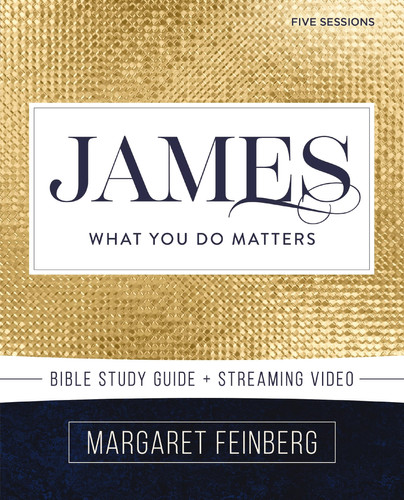
James Bible Study Guide Plus Streaming Video What You Do Matters

Margaret Feinberg
Uncover the deep riches of one of the Bible's greatest calls to godly living. "If there's one book that has taught me that what I do matters, it's the book of James." Beloved author and speaker Margaret Feinberg has been teaching the Bible for over 25 years. In her newest Bible study (video streaming included), she leads you through this treasure trove of wisdom and timely teaching. Join Margaret in a joy-filled, fresh study of the book of the Bible that sounds more like Jesus than any other letter in the New Testament. You'll discover the genuine markers of true faith, develop new practices of spiritual maturity, and discover how much the Father of heavenly lights treasures you. This study guide has everything you need for a full Bible study experience, including: The study guide itself--with discussion and reflection questions, video notes, and a leader's guide. An individual access code to stream all six video sessions online (DVD also available separately). Scripture memory cards and coloring pages. Sessions and Video Run Times: How You Respond to Hardship Matters (21:00) Your Response to God's Word Matters (19:00) How You See Others Matters (24:30) What You Say Matters (23:00) How You Live Matters (18:00) Watch on any device! Streaming video access code included. Access code subject to expiration after 12/31/2028. Code may be redeemed only by the recipient of this package. Code may not be transferred or sold separately from this package. Internet connection required. Void where prohibited, taxed, or restricted by law. Additional offer details inside.
HarperChristian Resources 2023-12-19 160 pages

Teach anyone to read: the no-nonsense guide

Pope, Lillie
Illiteracy is expanding worldwide, despite sophisticated teaching methods, heightened awareness of the importance of literacy, and the spread of computers and Internet usage. The population of nonreaders includes adults who cannot decipher instructions, rent agreements, contracts, the warnings on medications, or even the simple books their children bring home from school. Proper instruction can not only help children still in school, but it can also help the school dropouts and adults who need and want help in breaking the barriers to literacy. The methods described in Teach Anyone to Read: the No-Nonsense Guide have been used successfully for more than five decades by thousands of instructors, working with many thousands of students. The instructors have included both experienced and novice teachers and other school personnel, persons in the helping professions, and dedicated volunteers.
EJK Press 2008 273 pages

Info-aesthetics

Manovich, Lev
This book is available as open access through the Bloomsbury Open Access programme and is available on www.bloomsburycollections.com. Does new media represent a 'new avant-garde' of information? How can an information society be represented iconically if the activities that define it are all so dynamic? What are the cultural consequences of extending the internet into the physical world? In proposing software as modernity's new societal force, this book seeks to reclassify software as today's revitalized combustion engine, underpinning the logic of contemporary culture. Manovich investigates the ways in which the shift from an industrial to information society has resulted in new aesthetic sensibilities and representations. He describes software as the internal combustion engine of the information society, arguing that it is in software that the new cultural logic manifests itself most clearly. This is a cutting-edge and systematic examination of contemporary culture by the creator of the field of software studies.
Bloomsbury Academic 2010 288 pages

Bodies of work: essays

Acker, Kathy
With enervating experimentation but touching directness, postmodern novelist Acker (Portrait of an Eve, 1992; My Mother: Demonology, 1993; etc.) explores art, politics, and being in her first essay collection. Subjects are various, ranging from William Burroughs to Goya to San Francisco; many of the pieces have been published previously (prefaces to books, articles in Marxism Today, the Critical Quarterly, etc.). Despite the variety of subjects and sources, the collection is neatly structured: Essays are grouped agreeably by subject-'On Art and Artists,' 'The City,' 'Bodies of Work.' Though Acker says she aims to 'destroy' the essay form, she does more of what the form openly invites--to tinker and confess. For example, she interweaves stories into a piece on artist Nayland Blake and applies Wittgenstein's 'language games' to bodybuilding: 'In a gym, verbal language or language whose purpose is meaning occurs, if at all, only at the edge of becoming lost.' But she also reveals her current weightlifting goals and describes a childhood desire to be a pirate. Not surprisingly, her most accessible works are those written for a wide audience, particularly an illuminating essay for the Village Voice on film director Peter Greenaway and a moving piece for the MMLA on copyright in the age of the Internet. In all, these essays are serious and reflective of a discontented mind bent on deconstruction. Some may find dreary her tale of patriarchy, dualism, and linearity of time; her elliptical tales and stark sentences may lack immediate clarity. For sure, her essays aren't casually authoritative like Updike's or reassuringly religious like Dillard's. Read Acker when you're patient and don't want to be comforted--or even satisfied. An unthreatening introduction to a vexing writer.-Kirkus
Serpent's Tail 1997 175 pages

The Jewish Defense Organization's A History of Islamist Terrorism in America

Jewish Organization
Secret history of Islamist terrorism in America from Sirhan Sirhan to Major Hasan and how the JDO fights it. The JDO was founded in March 1982 in reaction to the demise of the Jewish Defense League (JDL). The JDO was never and never will be a Kahanist organization; instead it is based on principles first set forth by the Honorable Zev Jabotinsky, the founder of Revisionist Zionism. Jabotinsky, poet, statesman and militarist told Jewish audiences prior to the Holocaust to leave Europe. In 2010 JDO was able to get a meeting of the American Renaissance Party that was to be held at the Skyline Motel in Washington, D.C. cancelled despite the insistence of its manager that it take place. In February 2011 JDO quashed another meeting of this racist group with the help of the NAACP and City Council members Patrick Cannon and Councilman Warren Turner. These men had enough self-respect to stop these KKK jackasses from spewing their racial-hatred in Charlotte, North Carolina. Look what happened in Greensboro, North Carolina in 1979 when the Klan mowed down a "Death to the Klan" march staged by Communists. Declassified FBI documents revealed that JDO Chairman Mordechai Levy warned the FBI that the Klan was planning a violent attack but his intelligence was ignored due to his status as a Jewish militant. Just the opposite should have been true. In March 2011 the JDO was able to convince the landlord of the the Nazi-Holocaust revisionist scumy group The Institute of Historical Review not to renew their lease. In May 2011 the JDO held a demonstration in front of Nazi Headquarters on the Upper East Side of Manhattan. These are our latest actions - we've been staging these events and others for years and years. It is from this militant / activist point of view that the JDO research team studied the history of Islamist terrorism on American soil within certain parameters of interest. Rather than using a shotgun approach we zeroed in on terrorist plots in which bombs were actually constructed or shots were fired and excluded numerous conspiracies that the FBI nipped in the bud. Our researchers obtained the documents from every terrorism court case in the United States, conducted interviews, scoured the Internet in all languages, studied declassified government documents, filed FOIA requests then put the puzzle pieces together. We even collected the trash in front of the Permanent Observer Mission of Palestine to the United Nations at 115 East 65th Street in Manhattan and discovered cable traffic that indicated the PLO was using Syrian diplomatic pouches to smuggle bomb parts to various locations throughout the world. JDO turned these cables over to Israeli intelligence who cautioned JDO not to reveal its methodology as it was going to be applied to other hostile diplomatic installations. JDO waited for a year before revealing its discovery on local television. Shortly thereafter a car with two Arabic looking men parked outside JDO headquarters at 6 Bleecker Street in Manhattan. A JDO member displayed his semi-auto Uzi and invited the thugs upstairs. It was just another day in the 1980's at JDO Headquarters.
Jewish Defense Organization Press 2011 465 pages

The economic history of the Jewish people

Attali, Jacques
The story many have told can lead one to believe in the existence of a united Jewish people: rich, powerful, placed under centralized command and responsible for establishing a worldwide power strategy through money. Such a belief would merge with the fantasies that have spread across every century from Trajan to Constantine, from Matthew to Luther, from Marlow to Voltaire, from the Protocol of the Elders of Zion to Mein Kampf, to all that which is propagated today via the anonymity of the Internet. This is the story ripe to be challenged and retold. Herein lies the history of the relationship between the Jewish people, money and the world at large. The author is well aware of the subversive nature of this subject. It is a topic that has unleashed so many controversies and brought about so many massacres as to have become a veritable taboo, a topic that must not be evoked under any circumstance for fear of provoking some age-old catastrophe. Today, no one dares write on this topic, as if centuries of study have served no purpose other than to fuel book burning. It remains nevertheless in the best interest of modern mankind to understand how those who discovered monotheism also founded the ethics of capitalism, how some became its primary brokers and leading bankers, while others its most unrelenting enemy. In this book the author tackles the facts and the lies of the history of the relationship between the Jewish people, money and the world at large. "It seems essential that our world, and Jewish people themselves, face a part of their history that they may not care for but of which they have every reason to be proud." REVIEWS "The Economic History of the Jewish People by Jacques Attali is set to be as controversial as it is well documented and thoroughly researched by one of the foremost financial authorities of Europe, the Head of the Commission to Promote Economic Growth in France. Attali has written numerous books and knows this subject thoroughly. He has tackled it from the standpoint of history, myth, and dirty stories, proving some and dispelling others with facts. He has traced the economic experiences, leadership, and fall of the Jewish people from 2,000 years BC until present upheavals of economy worldwide. The book is fascinating for anyone interested in history, finance, or the Jewish people. It is an eye-opener in some instances and shows the influence, admitted or behind-the-scenes, which the Jewish people have had on the entire history of our world through the ages and how they have been rewarded or persecuted along the way for their use of any kind of tender (legal or illegal) around the world for 4,000 years. Really interesting and so very well written." Bonnie Neely, Amazon Top 1000 Reviewer, 2010/05/24
Eska Pub 2010 572 pages

Madison's metronome: the Constitution, majority rule, and the tempo of American politics

Weiner, Greg
In the wake of national crises and sharp shifts in the electorate, new members of Congress march off to Washington full of intense idealism and the desire for instant change—but often lacking in any sense of proportion or patience. This drive for instant political gratification concerned one of the key Founders, James Madison, who accepted the inevitability of majority rule but worried that an inflamed majority might not rule reasonably. Greg Weiner challenges longstanding suppositions that Madison harbored misgivings about majority rule, arguing instead that he viewed constitutional institutions as delaying mechanisms to postpone decisions until after public passions had cooled and reason took hold. In effect, Madison believed that one of the Constitution's primary functions is to act as a metronome, regulating the tempo of American politics. Weiner calls this implicit doctrine "temporal republicanism" to emphasize both its compatibility with and its contrast to other interpretations of the Founders' thought. Like civic republicanism, the "temporal" variety embodies a set of values—public-spiritedness, respect for the rights of others-broader than the technical device of majority rule. Exploring this fundamental idea of time-seasoned majority rule across the entire range of Madison's long career, Weiner shows that it did not substantially change over the course of his life. He presents Madison's understanding of internal constitutional checks and his famous "extended republic" argument as different and complementary mechanisms for improving majority rule by slowing it down, not blocking it. And he reveals that the changes we see in Madison's views of majority rule arise largely from his evolving beliefs about who, exactly, was behaving impulsively—whether abusive majorities in the 1780s, the Adams regime in the 1790s, the nullifiers in the 1820s. Yet there is no evidence that Madison's underlying beliefs about either majority rule or the distorting and transient nature of passions ever swayed. If patience was a fact of life in Madison's day—a time when communication and travel were slow—it surely is much harder to cultivate in the age of the Internet, 24-hour news, and politics based on instant gratification. While many of today's politicians seem to wed supreme impatience with an avowed devotion to original constitutional principles, Madison's Metronome suggests that one of our nation's great luminaries would likely view that marriage with caution.
University Press of Kansas 2012 194 pages

Novel gazing: queer readings in fiction

Eve Kosofsky Sedgwick
Novel Gazing is the first collection of queer criticism on the history of the novel. The contributors to this volume navigate new territory in literary theory with essays that implicitly challenge the "hermeneutic of suspicion" widespread in current critical theory. In a stunning introductory essay, Eve Kosofsky Sedgwick delineates the possibilities for a criticism that would be "reparative" rather than cynical or paranoid. The startlingly imaginative essays in the volume explore new critical practices that can weave the pleasures and disorientations of reading into the fabric of queer analyses. Through discussions of a diverse array of British, French, and American novels—including major canonical novels, best-sellers, children’s fiction, and science fiction—these essays explore queer worlds of taste, texture, joy, and ennui, focusing on such subjects as flogging, wizardry, exorcism, dance, Zionist desire, and Internet sexuality. Interpreting the works of authors as diverse as Benjamin Constant, Toni Morrison, T. H. White, and William Gibson, along with canonical queer modernists such as James, Proust, Woolf, and Cather, contributors reveal the wealth of ways in which selves and communities succeed in extracting sustenance from the objects of a culture whose avowed desire has often been not to sustain them. The dramatic reframing that these essays perform will make the significance of Novel Gazing extend beyond the scope of queer studies to literary criticism in general. Contributors . Stephen Barber, Renu Bora, Anne Chandler, James Creech, Tyler Curtain, Jonathan Goldberg, Joseph Litvak, Michael Lucey, Jeff Nunokawa, Cindy Patton, Jacob Press, Robert F. Reid-Pharr, Eve Kosofsky Sedgwick, Melissa Solomon, Kathryn Bond Stockton, John Vincent, Maurice Wallace, Barry Weller
Duke University Press 1997-12-15 518 pages

Life in Code A Personal History of Technology

Ellen Ullman
The never-more-necessary return of one of our most vital and eloquent voices on technology and culture, the author of the seminal Close to the Machine The last twenty years have brought us the rise of the internet, the development of artificial intelligence, the ubiquity of once unimaginably powerful computers, and the thorough transformation of our economy and society. Through it all, Ellen Ullman lived and worked inside that rising culture of technology, and in Life in Code she tells the continuing story of the changes it wrought with a unique, expert perspective. When Ellen Ullman moved to San Francisco in the early 1970s and went on to become a computer programmer, she was joining a small, idealistic, and almost exclusively male cadre that aspired to genuinely change the world. In 1997 Ullman wrote Close to the Machine, the now classic and still definitive account of life as a coder at the birth of what would be a sweeping technological, cultural, and financial revolution. Twenty years later, the story Ullman recounts is neither one of unbridled triumph nor a nostalgic denial of progress. It is necessarily the story of digital technology’s loss of innocence as it entered the cultural mainstream, and it is a personal reckoning with all that has changed, and so much that hasn’t. Life in Code is an essential text toward our understanding of the last twenty years—and the next twenty.
Picador 2018-08-07 320 pages

The end of the homosexual?

Altman, Dennis
In The End of the Homosexual? part memoir/part politicss; Dennis Altman connects what has happened within the changing queer world over the past forty years to larger social, political and cultural trends. This is a case study of both local and global change, yet one told from personal experience. Written engagingly, this timely new book explores the idea that major changes in the understanding of sexual and gender diversity reflect larger social and cultural shifts. For example, the internet has changed patterns of sexual behaviour as widely as did the contraceptive pill forty years ago. In both cases the changes were neither foreseen nor intended, and in both cases the impact of new technologies partly depended on political and ideological controls. Homosexuality has become a faultline for debates about western influence, and human rights. In this riveting and personally revealing work, Altman reflects on decades of cultural and political change and considers the future of sexuality: is this the end of the homosexual that gay liberationists predicted forty years ago?
University of Queensland Press 2013 246 pages

Choose your own disaster: A. a memoir, B. a personality quiz, C. a mostly true and completely honest look at one young woman's attempt to find herself, D. all of the above

Schwartz, Dana
A hilarious, quirky, and unflinchingly honest memoir about one young woman's terrible and life-changing decisions while hoping (and sometimes failing) to find herself, in the style of Never Have I Ever and Adulting. Join Dana Schwartz on a journey revisiting all of the terrible decisions she made in her early twenties through the internet's favorite method of self-knowledge: the quiz. Part-memoir, part-VERY long personality test, CHOOSE YOUR OWN DISASTER is a manifesto about the millennial experience and modern feminism and how the easy advice of "you can be anything you want!" is actually pretty fucking difficult when there are so many possible versions of yourself it seems like you could be. Dana has no idea who she is, but at least she knows she's a Carrie, a Ravenclaw, a Raphael, a Belle, a former emo kid, a Twitter addict, and a millennial just trying her best.--Amazon.com.
Grand Central Publishing 2018-06-19 260 pages

The language revolution

Crystal, David
We are living through the consequences of a linguistic revolution. Dramatic linguistic change has left us at the beginning of a new era in the evolution of human language, with repercussions for many individual languages. In this book, David Crystal, one of the world's authorities on language, brings together for the first time the three major trends which he argues have fundamentally altered the world's linguistic ecology: first, the emergence of English as the world's first truly global language; second, the crisis facing huge numbers of languages which are currently endangered or dying; and, third, the radical effect on language of the arrival of Internet technology. Examining the interrelationships between these topics, Crystal encounters a vision of a linguistic future which is radically different from what has existed in the past, and which will make us revise many cherished concepts relating to the way we think about and work with languages. Everyone is affected by this linguistic revolution. The Language Revolution will be essential reading for anyone interested in language and communication in the twenty-first century.
Polity Press 2004-03-12 142 pages