368 results for "Jewish History"

1929: mapping the Jewish world

Hasia R. Diner,Gennady Estraikh
Winner of the 2013 National Jewish Book Award, Anthologies and Collections The year 1929 represents a major turning point in interwar Jewish society, proving to be a year when Jews, regardless of where they lived, saw themselves affected by developments that took place around the world, as the crises endured by other Jews became part of the transnational Jewish consciousness. In the United States, the stock market crash brought lasting economic, social, and ideological changes to the Jewish community and limited its ability to support humanitarian and nationalist projects in other countries. In Palestine, the anti-Jewish riots in Hebron and other towns underscored the vulnerability of the Zionist enterprise and ignited heated discussions among various Jewish political groups about the wisdom of establishing a Jewish state on its historical site. At the same time, in the Soviet Union, the consolidation of power in the hands of Stalin created a much more dogmatic climate in the international Communist movement, including its Jewish branches. Featuring a sparkling array of scholars of Jewish history, 1929 surveys the Jewish world in one year offering clear examples of the transnational connections which linked Jews to each other—from politics, diplomacy, and philanthropy to literature, culture, and the fate of Yiddish—regardless of where they lived. Taken together, the essays in 1929 argue that, whether American, Soviet, German, Polish, or Palestinian, Jews throughout the world lived in a global context.
New York University Press 2013-08-12 244 pages

The pinch: a history : a novel

Stern, Steve
Now in paperback and "brimming with wondrous surprises . . . There's magic in The Pinch " ( The Boston Globe ) Steve Stern's prodigious imagination finds a wondrous home in the Pinch, a once-thriving Jewish community in Memphis. The Pinch revolves around a single enchanted day containing years, during which the antics of a group of Jewish mystics threaten to ravage the life of general store proprietor Pinchas Pin with miracles, and his nephew Muni's ardor for an alluring tightrope walker collides with his passion for chronicling the wonders of North Main Street. Their stories, gleaned by a hapless bookseller from a fabulist history book, transform the fate of the neighborhood. Now in paperback, The Pinch is a sparkling reminder that Steve Stern is one of our most talented and inimitable storytellers. "[A] big, rangy, saturated, antic new novel, a Pynchonian tragicomedy . . . Stern, an ebullient maestro of words and mayhem, wonder and conscience, orchestrates a cacophonous, whirling, gritty, tender, time-warping saga that encompasses a cavalcade of horror, stubborn love, cosmic slapstick, burlesque humor, and a scattering of miracles." -- Booklist (starred review) "Weird and wonderful . . . [ The Pinch is] a backdrop to Stern's poignant and antic drama, a playground on which his exuberant, larger-than-life characters can run wild . . . The Pinch is composed of . . . perfectly calibrated moments, all of which pulse with a dynamic inventiveness." -- Star Tribune (Minneapolis)
Graywolf Press 2016-09-20 349 pages

Nine American Jewish thinkers

Konvitz, Milton R.
The nine American Jews of whom Milton Konvitz writes are philosophers, jurists, or rabbis, widely known and readily accepted as American Jewish thinkers. Their work reflects all essential Jewish values. Each person in his own way has dedicated his work to the betterment of life and the advancement of human ideals. In this sense, their Jewishness is not defined by religion alone. Americanism permeated all they thought and all they did. Konvitz argues that in the complex modern world, secularists often serve God more handsomely than do members of synagogues or churches. For example, when the Supreme Court in 1954 (with Felix Frankfurter playing a key role behind the scenes) agreed to outlaw segregation of the races in public schools, was the Court's action secular or religious? When Congress passed the statute known as the Americans with Disabilities Act, requiring equal treatment of handicapped persons, was the action secular or religious? Is a minimum wage act secular or religious? Is Medicaid a secular or a religious act? Konvitz believes the distinction is not useful, or even possible. The book is divided into three parts, reflecting Konvitz's range of intellectual interests. The nine essays offer concise intellectual biographies of three American Jewish philosophers, three Supreme Court Justices, and three rabbis. The philosophers-Horace M. Kallen, Morris Raphael Cohen, and Sidney Hook-are world-renowned. The jurists-Louis D. Brandeis, Benjamin N. Cardozo, and Felix Frankfurter-hold prominent places in American legal history. And the three rabbis-Leo Jung, Robert Gordis, and Jacob Agus-are known wherever Jewish thought is studied. By treating with equal seriousness the lives and writings of both religious and secularist thinkers, the author intentionally minimizes the conventional antagonism and frequent conflict between religion and secularism. An unusual feature of the book is the fact that the author was a close friend of six of the persons whose lives and work are examined, allowing him a perceptive insight into their character and thought. Although the book is about serious subjects, its graceful style makes the contents easily accessible to lay persons as well as scholars and students of Judaica.
Transaction Publishers 2000 173 pages

In search of Jewish community: Jewish identities in Germany and Austria, 1918-1933

Michael Brenner,Derek J. Penslar
The history of Jews in interwar Germany and Austria is often viewed either as the culmination of tremendous success in the economic and cultural realms and of individual assimilation and acculturation, or as the beginning of the road that led to Auschwitz. By contrast, this volume demonstrates a reemerging sense of community within the German-speaking Jewish population of these two countries in the two decades after World War I. The fresh research presented here shows that although Jews may have experiences a deepening sence of impending crisis and economic decline, a renewal of Jewish communal life was taking place, as new groupings sprang up, including organizations for youth, for rural Jews, and for political groups such as Zionists and Bundists. Several chapters consider the impact of economis and political crises on German Jewish family life. Together, these engrossing essays form a complex mosaic of German Jewry on the eve of its demise.
Indiana University press 1998 251 pages

Rechnitz: and, The merchant's contracts

Jelinek, Elfriede
For much of her career, Elfriede Jelinek has been maligned in the press for both her unrelenting critique of Austrian complicity in the Holocaust and her provocative deconstructions of pornography. Despite this, her central role in shaping contemporary literature was finally recognized in 2004 with the award of the Nobel Prize in Literature. The committee acknowledged Jelinek's groundbreaking work that offers a "musical flow of voices and counter-voices in novels and plays that with extraordinary linguistic zeal reveal the absurdity of society's clichés and their subjugating power." Although she is an internationally recognized playwright, Jelinek's work is difficult to find in English, which makes this new volume, which includes Rechnitz: The Exterminating Angel and The Merchant's Contracts , all the more valuable. In Rechnitz , a chorus of messengers reports on the circumstances of the massacre of 180 Jews, an actual historical event that took place near the Austrian/Hungarian border town of Rechnitz. More than a docu-drama, this work explores the very transmission of historic memory and has been called Jelinek's best performance text to date. In The Merchant's Contracts , Jelinek brings us a comedy of economics, where the babble and media spin of spectators leave small investors alienated and bearing the brunt of the economic crisis. In the age of the global economy, Jelinek turns the story of a merchant of Vienna into a universal comedy of errors, making this her most accessible work. Along with an extensive introduction by the translator that both contextualizes and analyzes the two brilliant texts, a DVD of performances of both plays accompanies this volume. Available for the first time in English, this is a collection that testifies to the power and universality of Jelinek's work.
Seagull Books 2015 326 pages

New Babylonians: a history of Jews in modern Iraq

Bashkin, Orit
The Jews of post-World War I Iraq saw themselves as patriots of the new state, and the Jewish intelligentsia shared ideas of Arab nationalism. Several factors made the Arab elites regard the Jews as a problematic minority and put their Iraqi identities into question: the growing popularity of Zionism, Arab nationalism, and communism, which began to spread among both Muslim and Jewish youth. In the late 1930s the anti-colonial (i.e. anti-British) struggle, growing conflation of Judaism with Zionism, and Nazi propaganda led to a rise in anti-Jewish sentiments. These erupted in the "Farhud", a series of anti-Jewish riots in Baghdad in June 1941, during which ca. 180 Jews were killed. The Baghdad riots were followed by anti-Jewish excesses in Diwaniyya, Basra, Hila, and elsewhere. The authorities suppressed the riots, and a large number of pogromists were killed. Against the background of the Jewish-Arab conflict in Palestine in 1946-51, Iraqi Muslims increasingly identified the Jews with Zionism. The situation for the Jews became unbearable because of their social ostracism and outright discrimination, restrictions, and growing antisemitism. When a new government introduced a denationalization law for the Jews who wished to emigrate; the anti-Jewish atmosphere in the country, repressions, and the hysteria of fear for their future caused a great majority of the Jews to leave.
Stanford University Press 2012 310 pages

Love and war in the Jewish quarter

Levy Mossanen, Dora
"A breathtaking journey across Iran where war and superstition, jealousy and betrayal, and passion and loyalty rage behind the impenetrable walls of mansions and the crumbling houses of the Jewish Quarter. Against the tumultuous background of World War II, Dr. Yaran will find himself caught in the thrall of the anti-Semitic Governor General, the most powerful man in the country. Dr. Yaran falls in love with the Governor General's defiant wife, Velvet, upending not only the life of the doctor's beloved daughter, but the entire community. In his quest to save everything and everyone he loves, Dr. Yaran will navigate the intersections of magic, science, lust, and treachery. His sole ally is the Governor General's servant, an exotic eunuch, who will do anything to aid his mistress in her dangerous quest to attain forbidden love." --
Post Hill Press Book 2022-11-08 272 pages

The road to September 1939: Polish Jews, Zionists, and the Yishuv on the eve of World War II

Reinharz, Jehuda,Shaviṭ, Yaʿaḳov
In European and Holocaust historiography, it is generally believed that neither the Zionist movement nor the Yishuv were mindful of the plight of European Jews in the face of the Nazi threat during the 1930s. Drawing on a wide variety of memoirs, letters, and institutional reports by people from all walks of life, this volume sheds new light on a troubled period in Jewish history. Jehuda Reinharz and Yaacov Shavit trace Jewish responses to developments in Eastern and Central Europe, as well as reactions to British policy on the question of a Jewish homeland, to show that Zionists in the Yishuv worked tirelessly on the international stage on behalf of their coreligionists in Europe. Nevertheless, their efforts were all too often shattered by the realities of their powerlessness and lack of resources. Piercing to the heart of conversations about how or whether to save Jews in an increasingly hostile Europe, this volume provides a nuanced assessment of what could and could not be achieved in the years just prior to World War II and Holocaust.
Brandeis University Press 2020-03 432 pages

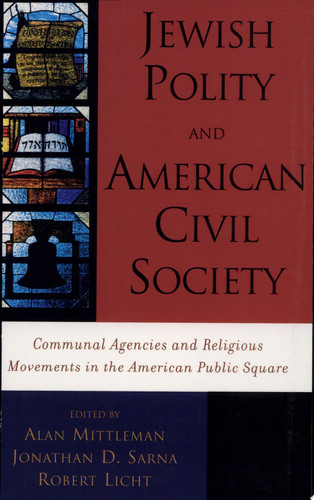
Jewish polity and American civil society: communal agencies and religious movements in the American public sphere

Alan Mittleman,Robert Licht,Jonathan D. Sarna
Jewish Polity and American Civil Society is a study of the civic and political engagements of American Jews as mediated by their communal and denominational institutions. The book explores how the various branches of the organized Jewish community seek to influence public affairs. Over the course of the last century, Jewish agencies and religious movements have tried to shape public debate and public policy on such issues as civil rights, church-state relations, and American foreign policy. The book sets the history of Jewish engagement in these areas into historical context; analyzes the motives, strategies, and tactics of various Jewish groups, and evaluates their successes and failures. The book also explores the underlying idea-the public philosophy-that informs American Jews' understanding of civic and political engagement.
Rowman & Littlefield 2002-07-23 420 pages

The dispersion of Egyptian Jewry: culture, politics, and the formation of a modern diaspora

Beinin, Joel
Egypt's indigenous Jewish population comprised Arabic-speaking Rabbanite and Karaite Jews, some of whom had been in the country since the early Islamic era. Jews expelled from Spain in 1492 took refuge in Egypt, and their numbers were augmented in the mid-nineteenth century by Sephardic immigrants. Originally welcomed elsewhere in the Ottoman Empire, these Spanish Jews came to Egypt seeking economic opportunity in the era of Suez Canal construction and the cotton boom. The late nineteenth century brought Ashkenazi Jews fleeing persecution in Eastern Europe. The different groups formed a heterogeneous community of cosmopolitan hybrids, which was both an element of strength and a factor in its eventual demise. The Dispersion of Egyptian Jewry examines the history of the Egyptian Jewish community after 1948, focusing on three major areas: the life of the majority of the community, which remained in Egypt from the1948 Arab-Israeli War until the aftermath of the 1956 Suez/Sinai War; the dispersion and reestablishment of Egyptian Jewish communities in the United states, France, and Israel; and contested memories of Jewish life in Egypt since President Anwar al-Sadat's visit to Jerusalem in 1977. Beinin argues that the experiences of Egyptian Jews cannot be adequately accounted for by either Egyptian nationalist or Zionist narratives. Fusing history, ethnography, literary analysis, and autobiography, Joel Beinin conducts an interdisciplinary investigation into identity, dispersion, and the retrieval of identity that is relevant for anyone interested in Egypt, the Jewish diaspora, or the formation of cultures and identities.
American University in Cairo Press 2005 329 pages

German, Jew, Muslim, gay: the life and times of Hugo Marcus

Baer, Marc David
"German, Jew, Muslim, Gay offers an astonishing perspective on the history of modern Germany through the vantage point of a man with multiple identities who devoted his life to religious utopias, fought for homosexual rights, wrote gay fiction, converted from Judaism to Islam (one of the few of any faith to do so), and considered himself part of a spiritual elite that held the key to Germany's salvation. Born in Posen in 1880, the son of a Jewish industrialist, Hugo Marcus converted to Islam and chose the name Hamid; he became the most important convert in Germany while retaining his membership in the Jewish community. He was renamed Israel by the Nazis and sent to the Sachsenhausen concentration camp in 1938, where he was in the unique position of Muslim witness to the Holocaust. The imam of his mosque gained his release and he escaped to Switzerland, where he wrote gay fiction under the pen name Hans Alienus. He died in Basel in 1966. The book challenges deeply ingrained perceptions of Muslim-Jewish relations during World War II and illuminates their interconnected histories in modern Europe. It also tells the unknown story of Marcus' orientalized Islam that, in echoing Goethe's, revitalized an essential strand of Germany's spiritual heritage"--
Columbia University Press 2020 300 pages

Between the lines: readings on Israel, the Palestinians, and the U.S. "war on terror"

Honig-Parnass, Tikva
This compilation of essays, edited by a Palestinian writer and an Israeli journalist, constitutes a challenge to critically rethink the Israeli-Palestinian conflict. Between the Lines presents a groundbreaking study that brings together insights from across the lines of conflict to put the latest chapter of Israeli apartheid and Palestinian resistance into context. Contributors include: Marwan Bargouti, Dr. Azmi Bishara, Dr. Sami Shalom Chetrit, Dr. Saleh Abdel Jawwad, Husam Khader, Eileen Kuttab, Dr. Yitzhak Laor, Dr. Adi Ophir, Dr. Ilan Pappe, Linda Tabar, Graham Usher and Dr. Jamal Zahalqa. "The destruction of a nation is not an everyday event in history. It is being carried out before our eyes, systematically and consciously, with cruelty and self-righteousness, and with the backing of the global superpower. These acute and informed essays develop a perspective on the background and unfolding of these events that is remote from anything likely to be heard in the West. They merit close attention and thoughtful consideration." --Noam Chomsky "This collection provides a lucid and critical analysis of the Israeli and American policies in the Middle East. The disastrous repercussions of this unholy alliance are presented in this collection through incisive and timely contributions. In the best tradition of [the journal] Between the Lines, readers will be rewarded by this collection that unmasks and exposes what the mainstream media refuses to report or admit." --Ilan Pappe, Israeli historian and author of A History of Modern Palestine Toufic Haddad is a Palestinian American activist who was formerly co-editor with Tikva Honig-Parnass of the Jerusalem-based magazine Between the Lines. Tikva Honig-Parnass is a Jewish Israeli active in radical anti-occupation movements.
Haymarket Books 2007 405 pages

The desert remembers my name: on family and writing

Alcalá, Kathleen
My parents always told me I was Mexican. I was Mexican because they were Mexican. This was sometimes modified to ÒMexican American,Ó since I was born in California, and thus automatically a U.S. citizen. But, my parents said, this, too, was once part of Mexico. My father would say this with a sweeping gesture, taking in the smog, the beautiful mountains, the cars and houses and fast-food franchises. When he made that gesture, all was cleared away in my mindÕs eye to leave the hazy impression of a better place. We were here when the white people came, the Spaniards, then the Americans. And we will be here when they go away, he would say, and it will be part of Mexico again. Thus begins a lyrical and entirely absorbing collection of personal essays by esteemed Chicana writer and gifted storyteller Kathleen Alcal‡. Loosely linked by an exploration of the many meanings of Òfamily,Ó these essays move in a broad arc from the stories and experiences of those close to her to those whom she wonders about, like Andrea Yates, a mother who drowned her children. In the process of digging and sifting, she is frequently surprised by what she unearths. Her family, she discovers, were Jewish refugees from the Spanish Inquisition who took on the trappings of Catholicism in order to survive. Although the essays are in many ways personal, they are also universal. When she examines her family history, she is encouraging us to inspect our own families, too. When she investigates a family secret, she is supporting our own search for meaning. And when she writes that being separated from our indigenous culture is Òa form of illiteracy,Ó we know exactly what she means. After reading these essays, we find that we have discovered not only why Kathleen Alcal‡ is a writer but also why we appreciate her so much. She helps us to find ourselves.
University of Arizona Press 2007 204 pages

What you did not tell: a Russian past and the journey home

Mazower, Mark
SHORLISTED FOR THE ORWELL PRIZE 2018 NEW STATESMAN AND EVENING STANDARD BOOKS OF THE YEAR 2017 'Brilliant ... a staggering story' Robert Fox, Evening Standard, Books of the Year 'Fascinating, vast and rich ... a dramatic family memoir' Guardian Uncovering his family's remarkable and moving stories, Mark Mazower recounts the sacrifices and silences that marked a generation and their descendants. It was a family that fate drove into the siege of Stalingrad, the Vilna ghetto, occupied Paris, and even into the ranks of the Wehrmacht . His British father was the lucky one, the son of Russian Jewish emigrants who settled in London after escaping the civil war and revolution. Max, the grandfather, had started out as a socialist and manned the barricades against tsarist troops, but never spoke of it. His wife, Frouma, came from a family ravaged by the Great Terror yet somehow making their way in Soviet society. In the centenary of the Russian Revolution, What You Did Not Tell recounts a brand of socialism erased from memory - humanistic, impassioned, and broad-ranging in its sympathies. But it also explores the unexpected happiness that may await history's losers, the power of friendship, and the love of place that allowed Max and Frouma's son to call England home.
Penguin Books 2018-07-05 400 pages

Prologue to annihilation: ordinary American and British Jews challenge the Third Reich

Norwood, Stephen H.
"American and British appeasement of Nazism during the early years of the Third Reich went far beyond territorial concessions. In Prologue to Annihilation: Ordinary American and British Jews Challenge the Third Reich, Stephen H. Norwood examines the numerous of ways that the two nations' official position of tacit acceptance of Jewish persecution enabled the policies that ultimately led to the Final Solution and how Nazi annihilationist intentions were clearly discernible even during the earliest years of Hitler's rule. Further, Norwood looks at the nature and impact of American and British Jewish resistance to Nazi persecution and the efforts of Jews at the grassroots level to press Jewish organizations to respond more forcefully to the Nazi menace. He examines the worldwide protest and boycott movements against Germany and German goods as well as mass demonstrations by working-class and lower-middle-class Jews in many American and British cities. Prologue to Annihilation details how the events of 1930-1936 tested American and British societies' willingness to accept Nazism and its anti-Jewish philosophy and illuminates the divisions that existed even within the Jewish community about how best to challenge Nazi antisemitic policies and atrocities"--
Indiana University Press 2021 347 pages

The Auschwitz Reports and the Holocaust in Hungary

Randolph L. Braham,William J. Vanden Huevel,William Jacobus Vanden Heuvel
Foreword / William J. vanden Heuvel, Robin Vrba. - Introduction / Randolph L. Braham, William J. vanden Heuvel. - Hungary and the Jewish question / Istvań Deák. - Hungary : the controversial chapter of the Holocaust / Randolph L. Braham. - America and the Holocaust in Hungary / Richard Breitman. - The Auschwitz Reports : who got them and when? / Zoltán Tibori Szabó. - When the veil was rent in Twain : Auschwitz, the Auschwitz Protocols, and the Shoah testimony of Rudolf Vrba / Robert Jan Van Pelt. - Rudolph Vrba and the Auschwitz Reports : conflicting historical interpretations / Ruth Linn. - The Kasztner affair : a reappraisal / Eli Reichenthal. - Confronting the Holocaust : an eyewitness account / George Klein. - Hungarian Holocaust : after 50 years / Donald Blinken.
Social Science Monographs 2011 291 pages