518 results for "Literature"

Time, history, and literature: selected essays of Erich Auerbach

Auerbach, Erich
Erich Auerbach (1892-1957), best known for his classic literary study Mimesis, is celebrated today as a founder of comparative literature, a forerunner of secular criticism, and a prophet of global literary studies. This book presents a selection of Auerbach's essays, many of which are little known outside the German-speaking world
Princeton University Press 2014 284 pages

In translation: translators on their work and what it means

Esther Allen,Susan Bernofsky
A collection of perspectives on translation, this anthology features essays by some of the world's most skillful writers and translators, including Haruki Murakami, Alice Kaplan, Peter Cole, Eliot Weinberger, Forrest Gander, Clare Cavanagh, David Bellos, and Jose Manuel Prieto. Discussing the process and possibilities of their art, they cast translation as a fine balance between scholarly and creative expression. The volume provides guidance on technique and style, while affirming for all readers the cultural, political, and aesthetic relevance of translation. These essays focus on a diverse group of languages, including Japanese, Turkish, Arabic, and Hindi, as well as frequently encountered European languages, such as French, Spanish, Italian, German, Polish, and Russian. Contributors speak on craft, aesthetic choices, theoretical approaches, and the politics of global cultural exchange, touching on the concerns and challenges that currently affect translators working in an era of globalization. Responding to the growing popularity of translation programs, literature in translation, and the increasing need to cultivate versatile practitioners, this anthology serves as a definitive resource for those seeking a modern understanding of the craft.
Columbia University Press 2013-06-04 264 pages

George Steiner at the New Yorker

Steiner, George
An education in a portmanteau: George Steiner at The New Yorker collects his best work from his more than 150 pieces for the magazine. Between 1967 and 1997, George Steiner wrote more than 130 pieces on a great range of topics for The New Yorker, making new books, difficult ideas, and unfamiliar subjects seem compelling not only to intellectuals but to “the common reader.” He possesses a famously dazzling mind: paganism, the Dutch Renaissance, children’s games, war-time Britain, Hitler’s bunker, and chivalry attract his interest as much as Levi-Strauss, Cellini, Bernhard, Chardin, Mandelstam, Kafka, Cardinal Newman, Verdi, Gogol, Borges, Brecht, Wittgenstein, Chomsky, and art historian/spy Anthony Blunt. Steiner makes an ideal guide from the Risorgimento in Italy to the literature of the Gulag, from the history of chess to the enduring importance of George Orwell. Again and again everything Steiner looks at in his New Yorker essays is made to bristle with some genuine prospect of turning out to be freshly thrilling or surprising.
A new directions book 2009-01-30 344 pages

Life sentences: literary essays

Epstein, Joseph
In Joseph Epstein's fourth collection of literary essays, he considers the lives and works of 19 writers of note, appreciating many of them, roughing up some others, and overall weighing them in the very finely calibrated balance of his well-stocked mind. "The modern essay has regained a good deal of its literary status in our time, much to the credit of Joseph Epstein"., --"Chicago Tribune".
W.W. Norton & Co 1997 347 pages

In praise of antiheroes: figures and themes in modern European literature, 1830-1980

Brombert, Victor
In an age of upheaval and challenged faith, traditional heroes are hard to come by, and harder still to love, with their bloodstained hands and backs unbowed by the consequences of their actions. Through penetrating readings of key works of modern European literature, Victor Brombert shows how a new kind of hero—the antihero—has arisen to replace the toppled heroic model. Though they fail, by design, to live up to conventional expectations of mythic heroes, antiheroes are not necessarily "failures." They display different kinds of courage more in tune with our time and our needs: deficiency translated into strength, failure experienced as honesty, dignity achieved through humiliation. Brombert explores these paradoxes in the works of Büchner, Gogol, Dostoevsky, Flaubert, Svevo, Hašek, Frisch, Camus, and Levi. Coming from diverse cultural and linguistic traditions, these writers all use the figure of the antihero to question handed-down assumptions, to reexamine moral categories, and to raise issues of survival and renewal embodying the spirit of an uneasy age.
University of Chicago Press 1999-04-15 168 pages

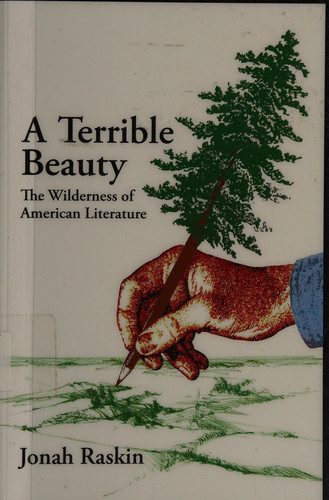
A terrible beauty: the wilderness of American literature

Raskin, Jonah
ABOUT THE BOOK Shortly before he published Walden; or Life in the Woods, Henry David Thoreau called ¿The library a wilderness of books.¿ He also noted that while Americans were ¿clearing the forest in our westward progress, we are accumulating a forest of books in our rear, as wild and unexplored as any of nature¿s primitive wildernesses.¿ In "A Terrible Beauty: the Wilderness of American Literature," Jonah Raskin takes a long close look at the forest of books that poets, novelists and essayists mapped and explored before and after Thoreau. The first work of cultural criticism to look back at writing in the United States from the perspective of the contemporary environmental crisis, Raskin offers insights for students, teachers and lovers of literature as well as for backpackers and hikers who have trekked across untrammeled forests, deserts and mountains. ABOUT THE AUTHOR Jonah Raskin, Phd, has taught American literature at Sonoma State University, the State University of New York at Stony Brook and as a Fulbright professor at the University of Antwerp and the University of Ghent in Belgium. The author of fifteen books, he earned his B.A. at Columbia College in New York, his M.A. at Columbia University and his Ph.D. at the University of Manchester, Manchester, England. He lives in northern California and has written for The San Francisco Chronicle, The L.A. Times, The Nation, The Redwood Coast Review and Catamaran.
Regent Press 2014 366 pages

From Mesopotamia to modernity: ten introductions to Jewish history and literature

Burton Visotzky,David Fishman
From Mesopotamia to Modernity is a one volume introduction to both Jewish history and literature from its earliest times up to the present. Leading experts in each field of Jewish history and literature contribute original and comprehensive essays introducing their subjects. Beginning readers will learn the rudiments for further study, and scholars will be refreshed by the balanced, yet challenging treatments found here.These introductory essays cover most major aspects of Jewish studies from the Bible and its time up to modern Judaism. The work is designed to serve undergraduate and graduate courses in Judaism as well as Church and Synagogue adult study courses. Ideal for reading groups, this work will lead readers to further study of the varied subjects considered. Each essay covers the basic field, be it in a given era of Jewish history or in a defined area of Jewish literature. Suggestions for further reading will assist the reader in moving beyond this volume to explore a given area in further detail. The introductions range from encyclopedic detail through elegiac essay and enthusiastic appreciation of the field considered. The authors hold positions in major academic institutions throughout the United States and Israel.
Westview Press 1999-07-29 274 pages

Facing Black and Jew: literature as public space in twentieth-century America

Newton, Adam Zachary
A reading of African American and Jewish American writers from Henry Roth and Ralph Ellison to Philip Roth and David Bradley. Reading the work of such writers alongside and through one another, Newton's book offers an original way of juxtaposing two major traditions in modern American literature, and rethinking the sometimes vexed relationship between two constituencies ordinarily confined to sociopolitical or media commentary alone. Newton combines Emmanuel Levinas's ethical philosophy and Walter Benjamin's theory of allegory in shaping an innovative kind of ethical-political criticism. Through artful, dialogical readings of Saul Bellow and Chester Himes, David Mamet and Anna Deavere Smith, and others, Newton seeks to represent American Blacks and Jews outside the distorting mirror of 'Black-Jewish Relations', and restrictive literary histories alike. A final chapter addresses the Black/Jewish dimension of the O. J. Simpson trial.
Cambridge University Press 1999-07-15 218 pages

Literature and the image of man

Lowenthal, Leo
This volume's predominant theme is bourgeois mentality and its historical development. The works of Lope de Vega, Calder�n, Cervantes, and Shakespeare, among others, are analyzed within the historical framework of the decline of feudalism and the rise of the absolute regimes. Those of Moli�re and Goethe are set against the background of an evolving and consolidating bourgeois society in Western Europe.
Transaction Publishers 2016 344 pages

Redrawing the boundaries: the transformation of English and American literary studies

Greenblatt, Stephen J.,Gunn, Giles
In this collection of essays, twenty-four leading scholars examine the major developments that have expanded the horizons of English and American literary studies during recent decades.Redrawing the Boundaries reviews the significant scholarship for major historical periods and surveys new directions in literary criticism and in composition studies. Each essay is accompanied by an annotated list of suggestions for further reading; the book concludes with an extensive list of works cited and a name index.For scholars, teachers, and students of literature, this remarkable work provides an essential overview of traditions and innovations that make up English and American literary studies today. -- Amazon.com.
Modern Language Association of America 1992 595 pages

Thousands of Broadways: dreams and nightmares of the American small town

Pinsky, Robert
Broadway, the main street that runs through Robert Pinsky’s home town of Long Branch, New Jersey, was once like thousands of other main streets in small towns across the country. But for Pinsky, one of America’s most admired poets and its former Poet Laureate, this Broadway is the point of departure for a lively journey through the small towns of the American imagination. Thousands of Broadways explores the dreams and nightmares of such small towns—their welcoming yet suffocating, warm yet prejudicial character during their heyday, from the early nineteenth century through World War II. The citizens of quintessential small towns know one another extensively and even intimately, but fail to recognize the geniuses and criminal minds in their midst. Bringing the works of such figures as Mark Twain, William Faulkner, Alfred Hitchcock, Thornton Wilder, Willa Cather, and Preston Sturges to bear on this paradox, as well as reflections on his own time growing up in a small town, Pinsky explores how such imperfect knowledge shields communities from the anonymity and alienation of modern life. Along the way, he also considers how small towns can be small minded—in some cases viciously judgmental and oppressively provincial. Ultimately, Pinsky examines the uneasy regard that creative talents like him often have toward the small towns that either nurtured or thwarted their artistic impulses. Of living in a small town, Sherwood Anderson once wrote that "the sensation is one never to be forgotten. On all sides are ghosts, not of the dead, but of living people." Passionate, lyrical, and intensely moving, Thousands of Broadways is a rich exploration of this crucial theme in American literature by one of its most distinguished figures.
University of Chicago Press 2009-05-15 98 pages

The affirming flame: a poetics of meaning

Friedman, Maurice S.
In a dialogue with modern literature, discusses the search for meaning through meeting with the particular. Ch. 10 (pp. 157-185), "The Shoah - Our Ultimate Confrontation, " analyzes works by Andre Schwarz-Bart, Primo Levi, Nelly Sachs, and Paul Celan on the Holocaust, which are "paradigmatic of the absurdity of our time." Schwarz-Bart's novel "The Last of the Just" portrays its protagonist as a "suffering servant" (Isaiah) who suffers voluntarily (including death in a gas chamber) for God, all Jews, and all humanity, during a period of the "eclipse of God." Levi found meaning after the Holocaust via his writing; in "Survival in Auschwitz" he wrote of an Italian civilian, Lorenzo, who represented humanity in a camp environment where there was mainly hunger, cold, and death. Sachs' poetry fused the horror of Holocaust death with a strange transcendence. Celan was torn between affirmation and negation, and "forever in exile"; in his poetry, God was both absurd and divine.
Prometheus Books 1999-03-01 252 pages

Barry Hannah

Charney, Mark J.
Born in Clinton, Mississippi, Barry Hannah has been a major force in southern literature since the 1970 publication of his first novel, Geronimo Rex, which won the Bellman Foundation Award in fiction. It was followed by his first collection of stories, Airships (1978), winner of the prestigious Arnold Gringrich Short Fiction Award, and the acclaimed novel Ray (1980). The honesty of Hannah's vision and his varied narrative voices have won him comparison to Walker Percy, William Faulkner, Eudora Welty, and Flannery O'Connor. One of the South's most original writers, Hannah explores the human psyche; he may write primarily about his experiences in the South, but his experiments with prose are not restricted to region. In this first full-length critical study of Hannah's works--six novels and two volumes of short stories--Mark Jay Charney deftly explores Hannah's connections with southern writers like Faulkner and Welty by examining both his progression as a fiction writer and his experiments with language, voice, and form. Expertly combining biographical information with critical analysis, Charney correlates Hannah's literary themes and techniques with the influences shaping his life. The book is organized chronologically to illustrate Hannah's growing preoccupation with unconventional narrative form and to delineate the thematic shift from violence and isolation to peaceful alternatives and community acceptance. This book is a most welcome introduction to the works of a writer who promises to remain one of South's most startling and iconoclastic voices.
Twayne Publishers 1992 115 pages