671 results for "Memoir"

This is not my memoir

Gregory, André,London, Todd
The autobiography-of-sorts of André Gregory, an iconic figure in American theater and the star of My Dinner with André This Is Not My Memoir tells the life story of André Gregory, iconic theater director, writer, and actor. For the first time, André shares memories from a life lived for art, including stories from the making of My Dinner with André . Taking on the dizzying, wondrous nature of a fever dream, This Is Not My Memoir includes fantastic and fantastical stories that take the reader from wartime Paris to golden-age Hollywood, from avant-garde theaters to monasteries in India. Along the way we meet Jerzy Grotowski, Helene Weigel, Gregory Peck, Gurumayi Chidvilasananda, Wallace Shawn, and many other larger-than-life personalities. This Is Not My Memoir is a collaboration between André and Todd London, who together create a portrait of an artist confronting his later years. Here, too, are the reflections of a man who only recently learned how to love. What does it mean to create art in a world that often places little value on the process of creating it? And what does it mean to confront the process of aging when your greatest work of art may well be your own life?
Picador USA 2021-11-16 240 pages

Blood, sweat, and my rock 'n' roll years: is Steve Katz a rock star?

Katz, Steve
On paper Steve Katz's career rivals anyone's except the 1960s' and '70's biggest stars: the Monterey Pop Festival with the legendary Blues Project, Woodstock with Blood, Sweat & Tears, and even producing rock's most celebrated speed addict, Lou Reed. There were world tours, and his résumé screams "Hall of Fame" -- it won't be long before BS&T are on that ballot. He has three Grammies (ten nominations), three Downbeat Reader's Poll Awards, three gold records, one platinum record, and one quadruple platinum platter (the second Blood, Sweat & Tears album), not to mention three gold singles with BS&T. All together, he's sold close to 29 million records. He had affairs with famous female folk singers, made love to Jim Morrison's girlfriend Pam when Jim was drunk and abusive, partied with Elizabeth Taylor and Groucho Marx, dined with Rudolf Nureyev, conversed with Martin Luther King, Jr. and Tennessee Williams, hung out with Andy Warhol, jammed with everyone from Mose Allison to Jimi Hendrix, and was told to get a haircut by both Mickey Spillane and Danny Thomas. But his memoir is more Portnoy's Complaint than the lurid party-with-your-pants-down memoir that has become the norm for rock 'n' roll books. It's an honest and personal account of a life at the edge of the spotlight--a privileged vantage point that earned him a bit more objectivity and earnest outrage than a lot of his colleagues, who were too far into the scene to lay any honest witness to it. Set during the Greenwich Village folk/rock scene, the Sixties' most celebrated venues and concerts, and behind closed doors on international tours and grueling studio sessions, this is the unlikely story of a rock star as nerd, nerd as rock star, a nice Jewish boy who got to sit at the cool kid's table and score the hot chicks.
Lyons Press 2015 244 pages

Turning right at Hollywood and Vine: the perils of coming out conservative in Tinseltown

Simon, Roger L.
An Academy Award-nominated screenwriter and a mystery novelist, Roger L. Simon is the only American writer to pull off the amazing trick of being profiled positively in both Mother Jones and National Review in one lifetime. The stunning story of his political odyssey is told in this memoir, where Simon recounts his migration from financier of the Black Panther Breakfast Program to pioneer blogosphere mogul beloved by the right as a 9/11 Democrat. But Simon is beholden to neither right nor left in this tale of Hollywood chic run amuck, as he talks out of school about his adventures with, among many others, Richard Pryor, Warren Beatty, Timothy Leary, Richard Dreyfuss, Woody Allen, and Julian Semyonov, the Soviet Union's version of Robert Ludlum and also a KGB colonel who tempted Simon to join the KGB himself. Among the topics covered along the way: Is there a new blacklist in Hollywood, this one targeting conservatives? Simon's red-carpet tours of the People's Republic of China, Cuba, and the Soviet Union with Hollywood screenwriters and famous mystery novelists. Why Al Gore's documentary on global warming didn't deserve the Oscar on artistic grounds alone; and why the Academy's voting system is so corrupt. And, as they say, there is much, much more besides.
Encounter Books 2010 209 pages

Artists' SoHo: 49 episodes of intimate history

Kostelanetz, Richard
How a little-known industrial neighborhood in New York unintentionally became a nexus of creative activity for a brief burst of time. During the 1960s and 1970s in New York City, young artists exploited an industrial wasteland to create spacious studios where they lived and worked, redefining the Manhattan area just south of Houston Street. Its use fueled not by city planning schemes but by word-of-mouth recommendations, the area soon grew to become a world-class center for artistic creation indeed, the largest urban artists' colony ever in America--let alone the world. Richard Kostelanetz's Artists' SoHo not only examines why the artists came and how they accomplished what they did but also delves into the lives and works of some of the most creative personalities who lived there during that period, including Nam June Paik, Robert Wilson, Meredith Monk, Richard Foreman, Hannah Wilke, George Macuinas, and Alan Suicide. Gallerists followed the artists in fashioning themselves, their homes, their buildings, and even their streets into transiently prominent exhibition and performance spaces. SoHo pioneer Richard Kostelanetz's extensively researched intimate history is framed within a personal memoir that unearths myriad perspectives: social and cultural history, the changing rules for residency and ownership, the ethos of the community, the physical layouts of the lofts, the types of art produced, venues that opened and closed, the daily rhythm, and the gradual invasion of "new people." Artists' SoHo also explores how and why this fertile bohemia couldn't last forever. As wealthier people paid higher prices, galleries left, younger artists settled elsewhere, and the neighborhood became a "SoHo Mall" of trendy stores and restaurants. Compelling and often humorous, Artists' SoHo provides an analysis of a remarkable neighborhood that transformed the art and culture of New York City over the past five decades.
Empire State Editions, an imprint of Fordham University Press 2015 272 pages

Adventures of a bystander

Drucker, Peter F.
"It is [a] belief in diversity and pluralism and the uniqueness of each person that underlies all my writings . . . " -from the Preface. Regarded as the most influential and widely read thinker on modern organizations and their management, Peter Drucker has also established himself as an unorthodox and independent analyst of politics, the economy, and society. A man of impressive scope and expertise, he has paved significant inroads in a number of key areas, sharing his knowledge and keen insight on everything from the plight of the employee and the effects of technology to the vicissitudes of the markets and the future of the new world order. Adventures of a Bystander is Drucker's rich collection of autobiographical stories and vignettes, in which this legendary figure paints a portrait of his remarkable life, and of the larger historical realities of his time. In a style that is both unique and engaging, Drucker conveys his life story -from his early teen years in Vienna through the interwar years in Europe, the New Deal era, World War II, and the postwar period in America-through intimate profiles of a host of fascinating people he's known through the years. Their personal histories are, as Drucker tells us, the beads for which his own life serves as the string. A colorful group, these diverse, often unpredictable, always multidimensional individuals were chosen "because each of them, in his or her own highly personal way, reflects and refracts the thirty crucial years from the end of World War I to the first post-World War II decade-the thirty years that largely formed the world in which we now live." An amazing pageant of characters, both famous and otherwise, springs from these pages, illuminating and defining one of the most tumultuous periods in world history. Along with bankers and courtesans, artists, aristocrats, prophets, and empire-builders, we meet members of Drucker's own family and close circle of friends, among them such prominent figures as Sigmund Freud, Henry Luce, Alfred Sloan, John Lewis, and Buckminster Fuller. Playing to perfection their roles as those who "reflect and refract" the customs, beliefs, and attitudes of the times, these singular personalities lend Adventures of a Bystander a striking "you-are-there" feel. A brief encounter with Freud becomes the catalyst for an absorbing, multidimensional description of the economics, politics, and social psychology of pre-World War II Europe. Drucker introduces us to Fritz Kraemer, a brilliant, monocle-wearing eccentric who became an influential mentor to the young Henry Kissinger. His personal memoir of Henry Luce documents the development of modern journalism, while in "The Indian Summer of Innocence," he rescues and preserves the very heart of the American experience during the last New Deal years before World War II. Shedding light on a turbulent and important era, Adventures of a Bystander also reflects Peter Drucker himself as a man of imaginative sympathy and enormous interest in people, ideas, and history. These enthralling stories complement and complete the groundbreaking analytical writing for which he is so revered. Luminous autobiographical stories by one of the greatest thinkers of our time "The cast of characters among whom Drucker moves is superbly rich, and the informed glimpse he provides of a vanished social and political universe is an education in itself. Adventures of a Bystander is better than a novel, more lively than an essay, and as thoughtful as both at their best." -The Harvard Business Review. "Adventures of a Bystander is a virtuoso performance in which Drucker displays a dazzling diversity of personal interests and knowledge, an awesome power of recall, and a crisp, highly readable writing style." -BusinessWeek. "Adventures of a Bystander appears in a stroke to have restored the art of the memoir and of the essay. It will doubtless be a while before its like comes round again." -The Washington Post.
Wiley 1997 344 pages

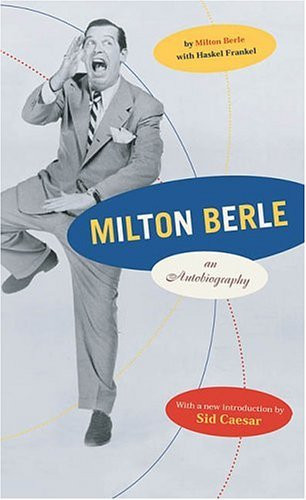
Milton Berle: an autobiography

Berle, Milton
(Applause Books). When Milton Berle died in the Spring of 2002, THE NEW YORK TIMES declared that the legendary comic "may have had a more profound influence on our way of life than some presidents or Nobel Prize winners." This landmark memoir, as startling today as it was when it was first published, reveals the life and times of the man known affectionately to millions as Uncle Miltie. Told with unflinching candor, here is one of the most fabled and influential show business careers of all time: from performing as a child in Vaudeville and making silent movies with Charlie Chaplin and Mary Pickford, to nightclub performances for Al Capone, working on radio during World War II, performing in Broadway musicals, and, finally, superstardom on television. Perhaps even more fascinating is Berle's scandal-ridden private life: his star-crossed love affair with a 1930's movie queen and the child they had out of wedlock, his numerous affairs with women ranging from evangelist Aimee Semple McPherson to Marilyn Monroe, and his stormy relationship with beautiful showgirl Joyce Mathews, whom Berle married twice. It is Berle's unsparing account of his life and his determination to show the world his real face that led Frank Sinatra, at the time, to call this "the gutsiest book I've read in years." Told with equal amounts of comedy and pathos, and featuring colorful appearancesby all the major stars of his day, MILTON BERLE is simply one of the best show business memoirs ever written.
Applause Theatre & Cinema Books 2002-09-01 337 pages

The monkey and the dragon: a true story about friendship, music, politics and life on the edge

Jaivin, Linda
Memoir, biography and travel book, The Monkey and the Dragon is a story about the personal and political tumult of a changing China. Linda Jaivin traces this transformation through the life of Hou Dejian: Taiwan pop star, defector to communist China, hunger-striker at Tiananmen Square, political activist, celebrity fengshui master and friend.
Text Pub 2001 438 pages

Let's face it: 90 years of living, loving, and learning

Douglas, Kirk
He has been one of the brightest stars in Hollywood, a hard-charging actor whose intensity on the screen has been mirrored in his personal life. As Kirk Douglas has grown older - he turned ninety in December 2006 - he has become less impetuous and more reflective. In this poignant and inspiring new memoir, Douglas contemplates what life is all about, weighing current events from his present frame of mind while summoning the passions of his younger days. Kirk Douglas is a born storyteller, and throughout Let's Face It he tells wonderful tales and shares favorite jokes and hard-won insights. In the book, he explores the mixed blessings of growing older and looks back at his childhood, his young adulthood, and his storied, glamorous, and colorful life and career in Hollywood. He tells delightful stories of the making of such films as Spartacus, Lust for Life, Champion, The Bad and the Beautiful, and many others. He includes anecdotes about his friends Frank Sinatra, Burt Lancaster, Lauren Bacall, Ronald Reagan, Ava Gardner, Henry Kissinger, Fred Astaire, Yul Brynner, John Wayne, and Johnny Cash. He reveals the secrets that have kept him and his wife, Anne, happily married for more than five decades, and talks fondly and movingly of times spent with his sons, Michael, Peter, Eric, and Joel, and his grandchildren. Douglas's life has been filled with pain as well as joy. In Let's Face It , he writes frankly for the first time about the tragic death of his son Eric from a drug overdose at age forty-five. Douglas tells what it was like to recover from several near-death episodes, including a helicopter crash, a stroke, and a cardiac event. He writes of his sadness that many of his closest friends are no longer with us; the book includes many moving stories such as one about a regular poker game at Frank Sinatra's house at which he and Anne have been fixtures along with Gregory Peck, Jack Lemmon, and their wives. Though many of the players are gone, the game continues to this day. In Let's Face It , Douglas reflects on how his Jewish faith has become more and more important to him over the years. He offers strong opinions on everything from anti-Semitism to corporate greed, from racism to Hurricane Katrina, and from the war in Iraq to the situation in Israel. He writes about the importance in his life of the need to improve education for all children and about how we need to care more about the world and less about ourselves. A must-read for every fan, this engrossing memoir provides an indelible self-portrait of a great star - while sharing the wit and wisdom Kirk Douglas has accumulated over a lifetime.
John Wiley & Sons 2007 238 pages

Oppenheimer: portrait of an enigma

Bernstein, Jeremy
A Revealing Profile of the Father of the Atomic Bomb Highly praised by New York Review of Books, The Spectator, Los Angeles Times, Booklist, & More J. Robert Oppenheimer was a puzzle to everyone. The nuclear physicist most responsible for the creation of the atomic bomb, he was a genius both scientifically and otherwise. His standards were impossibly high. He read widely in many languages, wrote poetry, and did superb science. Yet in Jeremy Bernstein's intensely interesting biographical memoir, Oppenheimer emerges as a man unsure of his identity and captive to an element of self-destructiveness in his makeup. Oppenheimer is the long-awaited book that many people feel Mr. Bernstein was almost born to write. As a former colleague of Oppenheimer's, he has composed a book that is both personal and historical, bringing the reader close to the life and workings of an extraordinary and controversial man. Oppenheimer once told the author that during the now-famous hearing in which he lost his security clearance—one of the most spectacular attacks of the McCarthy era—he felt it was happening to someone else. His lawyer at the hearing, after being with Oppenheimer day in and day out for several months, said he did not know him in any real sense at all. Yet everyone in the scientific community and in government agreed that without Oppenheimer's totally remarkable leadership at Los Alamos, the atomic bomb would not have happened, and the Second World War would have ended very differently. Filled with revealing insights and details that set the historical record straight, Oppenheimer is that rare quantity: a vastly entertaining study of one of the most important and enigmatic scientists of the atomic age. Illustrated with black-and-white photographs.
Ivan R. Dee 2004-03-01 223 pages

Crusaders in the courts: how a dedicated band of lawyers fought for the civil rights revolution

Greenberg, Jack
This book is both a powerful personal memoir and the definitive history of an organization that helped change American society. Jack Greenberg was a key figure at the NAACP Legal Defense and Educational Fund (LDF) for some thirty-five years. Most of the cases we associate from that period--school integration, equal employment, fair housing, voter registration--were LDF cases, either argued by Greenberg himself or litigated under his direction. Greenberg represented Martin Luther King, Jr., in Birmingham and won for him the right to march from Selma to Montgomery. Under Greenberg's leadership, the LDF forced the University of Mississippi to admit James Meredith and integrated the University of Alabama when George Wallace stood in the schoolhouse door. Greenberg won the cases in which the Supreme Court repudiated the "all deliberate speed" doctrine, which had made school desegregation intolerably slow. Through the 1970s and 1980s, LDF tackled most of the important cases that enforced the new civil rights legislation of the 1960s involving public accommodations, employment, education, and health care, and started the campaigns for prisoners' rights and against capital punishment. More than a history of the litigation that made the LDF so important, the book offers unique insights into its strategies, courtroom techniques, values, and personal relationships. Filled with stories only Greenberg could tell of his experiences with Thurgood Marshall, Martin Luther King, Jr., Marian Wright Edelman, Lani Guinier, Roy Wilkins, Vernon Jordan, Charlayne Hunter-Gault, Lyndon Johnson, and scores of others, Crusaders in the Courts is an epic saga of a critical period in American history as well as the poignant personal story of the evolution of a white Jewish lawyer into a major civil rights advocate.
BasicBooks 1994 634 pages

The sanest guy in the room: a life in lyrics

Black, Don
THE SUNDAY TIMES BESTSELLER '. . . a compelling memoir. Breezy and unpretentious, The Sanest Guy in the Room is a delightful collection of memories, insider information and after-dinner anecdotes' The Times 'Brilliant stories and wonderful behind-the-scenes glimpses of a life and career in show-business . . . It's bloody brilliant . . . Read it!' Michael Ball Don Black is the songwriter's songwriter, a composer's dream collaborator, and the man behind some of the twentieth century's greatest musical numbers. Black made his first foray into the glittering world of showbiz as a stand-up, before realising his error and focusing on his lifelong passion instead - music. Shirley Bassey, Michael Jackson, Quincy Jones, Henry Mancini and Barbra Streisand are just some of the artists Black has worked with over the years - not to mention his frequent collaborator, West End legend Andrew Lloyd Webber - in what can only be described as a remarkable musical career. Yet, never one to court fame, Black has always remained what Mark Steyn coined as 'the sanest guy in the room'. Interwoven with the stories behind songs such as 'Diamonds are Forever' and 'Born Free' are vignettes of Black's life with his beloved wife Shirley, who died in March 2018, after almost sixty years of marriage. Black writes movingly about how the enormity of his grief changed his life, and how the dark days are slowly turning into dark moments. The Sanest Guy in the Room is a rich and delightful paean to a life lived through song. It reveals the essence of Black's craft, looks at those who have inspired him and allows us to understand what made those icons tick. It is also a poignant tribute to Shirley, his biggest inspiration. Told with wit, warmth and great humour, this is Don Black's astonishing musical journey and an insight into a life behind the lyrics.
Constable 2021-06-03 320 pages

Love and struggle: my life in SDS, the Weather Underground, and beyond

Gilbert, David
"Written from the maximum-security prison where he has lived for almost 30 years, this enlightening memoir chronicles the militant career of David Gilbert, a radical activist whose incarceration is due to his involvement in the 1981 Brinks robbery, an attempted expropriation that resulted in four deaths. From his entry into the world of political activism as the founder of Students for a Democratic Society at Columbia University to his departure from public life in order to help build the clandestine resistance to war and racism known as the Weathermen, Gilbert relates all of the victories he has achieved and obstacles he has encountered during his struggle to build a new world. In telling the intensely personal story he is stripped of all illusions and assesses his journey from liberal to radical to revolutionary with rare humor and frankness"--Amazon.com, viewed March 2, 2012.
PM Press 2012 336 pages

Getting to the heart of the matter: my 36 years in the Senate

Levin, Carl
"Representing Michigan for thirty-six years in the U.S. Senate, Carl Levin, the longest-serving senator in Michigan history, was known for his dogged pursuit of the truth, his commitment to holding government accountable, and his basic decency. Getting to the Heart of the Matter: My 36 Years in the Senate is his story - from his early days in Detroit as the son of a respected lawyer to the capstone of his career as chair of both the Senate Armed Services Committee and the Senate Permanent Subcommittee on Investigations. Levin's career placed him at the center of some of our nation's most critical points in modern times: from the aftermath of the 1967 Detroit riots, to the Clinton impeachment, through 9/11 and the wars in Iraq and Afghanistan, and the 2008 financial crisis. He met with numerous world leaders, including Egypt's Anwar Sadat and China's Jiang Zemin. Getting to the Heart of the Matter recounts Levin's experiences, thoughts, and actions during these historic moments. Consisting of seventeen chapters, the book takes the reader through Levin's early life in Detroit of the 1940s, 50s, and 60s where he met his wife, started a family, practiced law and served as the first General Counsel for the newly created Michigan Civil Rights Commission and the chief appellate defender for Detroit's Legal Aid Office. Elected to the Detroit City Council in 1969, where Levin served for eight years including four as Council president, the book describes how his fight against the Department of Housing and Urban Development's devastating housing practices in the neighborhoods of Detroit led him to run for the U.S. Senate with a pledge to make government work more effectively. Winning election six times, Levin had an illustrious career in the Senate where he challenged leaders in government and the private sector for the greater good of the nation. Levin describes how, as a Democrat, throughout his time in the Senate, he worked with Republican senators who often held different policy positions in order to find common ground to achieve national goals, and how he and his Senate staff searched for creative solutions to trade issues, support for the auto industry and manufacturing sector, U.S. military action in Iraq and Afghanistan, and efforts to protect the Great Lakes and the environment, among many other issues. Levin's hope in writing this memoir is that by sharing his deeply held beliefs about the responsibility of elected officials, the book will serve as a resource for people beginning a career in, or contemplating running for, public office. Readers with an interest in politics, history, facts, and perseverance will find kinship in this book" -- provided by the publisher
Wayne State University Press 2021 338 pages

Copland. Since 1943

Copland, Aaron
Hailed as important, entertaining, and revealing, Copland: Since 1943 is composer Aaron Copland's irresistible account of the latter half of his career--a career that brought us such pioneering works as Appalachian Spring and Lincoln Portrait, the movie scores for Of Mice and Men and Our Town, and numerous other orchestral and chamber works. It tells the story of how a self-described "brash young man from Brooklyn" went on to become one of the founding fathers of "serious" American music. Featuring cameos by luminaries such as Leonard Bernstein, Martha Graham, Agnes de Mille, Benny Goodman, and other peers of Aaron Copland during this explosively creative period, Copland: Since 1943 is an invaluable memoir that charts the crescendo of one of the most accomplished careers in the modern canon.
St. Martin's Press 1989 463 pages