1011 results for "Science"

The Female Thing Dirt, envy, sex, vulnerability

Laura Kipnis
From the author of the acclaimed Against Love comes a pointed, audacious, and witty examination of the state of the female psyche in the post-post-feminist world of the twenty-first century. Women remain caught between feminism and femininity, between self-affirmation and an endless quest for self-improvement, between playing an injured party and claiming independence. Rather than blaming the usual suspects—men, the media—Kipnis takes a hard look at culprits closer to home, namely women themselves. Kipnis serves up the gory details of the mutual displeasure between men and women in painfully hilarious detail. Is anatomy destiny after all? An ambitious and original reassessment of feminism and women’s ambivalence about it, The Female Thing breathes provocative new life into that age-old question.
Knopf Doubleday Publishing Group 2007-10-09 192 pages

How to Become a Scandal Adventures in Bad Behavior

Laura Kipnis
A New York Times Book Review Editors' Choice We all relish a good scandal. Why do people feel compelled to act out their tangled psychodramas on the national stage, and why do we so enjoy watching them? The motifs are classic—revenge, betrayal, ambition, madness—though the pitfalls are ones we all negotiate daily. After all, every one of us is a potential scandal in the making: failed self-knowledge and colossal self-deception—the necessary ingredients—are our collective plight. How to Become a Scandal is "an extremely smart, funny, acid, and beautifully written meditation on a scary truth that we all try desperately to ignore" (David Shields, author of Reality Hunger: A Manifesto ).
Picador 2011-08-30 224 pages

Rectify The Power of Restorative Justice After Wrongful Conviction

Lara Bazelon
A powerful argument for adopting a model of restorative justice as part of the Innocence Movement—so exonerees, crime victims, and their communities can come together to heal In Rectify , a former Innocence Project director and journalist Lara Bazelon puts a face to the growing number of men and women exonerated from crimes that kept them behind bars for years—sometimes decades—and that devastate not only the exonerees but also their families, the crime victims who mistakenly identified them as perpetrators, the jurors who convicted them, and the prosecutors who realized too late that they helped convict an innocent person. Bazelon focuses on Thomas Haynesworth, a teenager arrested for multiple rapes in Virginia, and Janet Burke, a rape victim who mistakenly IDed him. It took over two decades before he was exonerated. Conventional wisdom points to an exoneration as a happy ending to tragic tales of injustice, such as Haynesworth’s. However, even when the physical shackles are left behind, invisible ones can be profoundly more difficult to unlock. In the midst of Bazelon’s frustration over the blatant limitations of courts and advocates, her hope is renewed by the fledgling but growing movement to apply the centuries-old practice of restorative justice to wrongful conviction cases. Using the stories of Thomas Haynesworth, Janet Burke, and other crime victims and exonerees, she demonstrates how the transformative experience of connecting isolated individuals around mutual trauma and a shared purpose of repairing harm unite unlikely allies. Movingly written and vigorously researched, Rectify takes to task the far-reaching failures of our criminal justice system and offers a window into a future where the power it yields can be used in pursuit of healing and unity rather than punishment and blame.
Beacon Press 2019-09-10 248 pages

Hello, Cruel World 101+ Alternatives to Suicide for Teens, Freaks, and Other Outlaws

Kate Bornstein
This 20th anniversary edition of transsexual trailblazer Kate Bornstein’s unconventional guide to staying alive for teens, freaks and gender outlaws features 20 NEW Alternatives, a new foreword by the author, and a new afterword by Paul Preciado. "A don't-hurt guide for anyone who's been tempted to give in to despair."— Time Out New York "You'll want to keep extra copies of this one on the shelf to give away to friends in need." — Bitch magazine Now updated and with new material Hello, Cruel World features a catalog of 121 alternatives to suicide that range from the playful (moisturize!), to the irreverent (shatter some family values), to the controversial, fun, challenging and easy. Encouraging readers to unleash their hearts' harmless desires, the book has only one directive: "Don't be mean." It is this guiding principle that brings the reader on a self-validating journey and toward a resounding decision to embrace life. Using graphics and checklists, and with great humor and gutsiness, Kate Bornstein dares readers to re-envision the gender system as we know it. She offers stories and insights that are tenderly intimate and unapologetically edgy. Hello, Cruel World also includes: an Introduction by Sara Quin of Tegan and Sara The Hello Cruel Scale of Feelings an Index of Alternatives with safety and effectiveness scales Suicide rates among LGBTQ+ teens are much higher than for their cis peers; with love and humor and confession and insight, Bornstein hopes to keep every freak out there alive. She is a radical role model, an affectionate best friend, and a guiding mentor all in one. This one-of-a-kind guide to staying alive is a much-needed, sometimes unorthodox approach to life for those who want to stay on the edge, and alive. Finalist, LGBT Nonfiction Lambda Literary Award, 2009 Honor Book, Stonewall Children’s and Young Adult Literature Award, 2009
Seven Stories Press 2025-04-29 288 pages

Christmas A Biography

Judith Flanders
A critically acclaimed New York Times bestselling author explores the Christmas holiday, from the original festival through present day traditions. Christmas has always been a magical time. Or has it? Thirty years after the first recorded Christmas, one archbishop was already complaining that his flock was spending the day, not in worship, but in dancing and feasting to excess. By 1616, the playwright Ben Jonson was nostalgically remembering the Christmases of the old days, certain that they had been better then. Other elements of Christmas are much newer--who would have thought gift-wrap was a novelty of the twentieth century? That the first holiday parade was neither at Macy’s, nor even in the USA? Some things, however, never change. The first known gag holiday gift book, The Boghouse Miscellany , was advertised in the 1760s "for gay Gallants, and good companions", while in 1805, the leaders of the Lewis and Clark expedition exchanged--what else?--presents of underwear and socks. Christmas is all things to all people: a religious festival, a family celebration, a period of eating and drinking. In Christmas , bestselling author and acclaimed social historian Judith Flanders casts a sharp eye on its myths, legends and history, deftly moving from the origins of the holiday in the Roman empire, through the first appearance of Christmas trees in Central Europe, to what might be the origins of Santa Claus--in Switzerland--to draw a picture of the season as it has never been seen before.
St. Martin's Publishing Group 2019-10-22 256 pages

Jean-Paul Sartre and the Jewish Question Anti-Antisemitism & the Politics of the French Intellectual

Jonathan Judaken
Jean-Paul Sartre and the Jewish Question examines the image of "the Jew" in Sartre's work to rethink not only his oeuvre but also the role of the intellectual in France and the politics and ethics of existentialism. It explores more broadly how French identity is defined through the abstraction and allegorization of "the Jew" and examines the role anti-antisemitic intellectuals play in this process. Jonathan Judaken reconsiders the origins of the intellectual in France in the context of the Dreyfus affair and Sartre's interventions in the parallel Franco-French conflicts in the 1930s and during the Vichy regime. He considers what it was possible to say on behalf of Jews and Judaism during the German occupation, Sartre's contribution after the war to the Vichy syndrome, his positions on the Arab-Israeli conflict, and the ways Sartre's reflections on the Jewish Question served as a template for his shift toward Marxism, his resistance to colonialism, and for the defining of debates about Jews and Judaism in postwar France by both Jewish and non-Jewish intellectuals. Judaken analyzes the texts that Sartre devoted to these issues and argues that "the Jew" constituted a foil Sartre consistently referenced in reflecting on politics in general and on the role of the intellectual in particular.
University of Nebraska Press 2009-04-17 408 pages

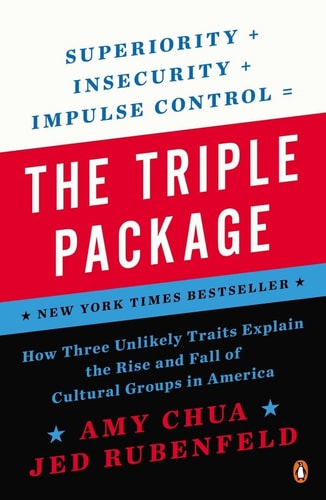
The Triple Package How Three Unlikely Traits Explain the Rise and Fall of Cultural Groups in America

Amy Chua,Jed Rubenfeld
"That certain groups do much better in America than others — as measured by income, occupational status, test scores, and so on — is difficult to talk about. In large part this is because the topic feels racially charged. The irony is that the facts actually debunk racial stereotypes. There are black and Hispanic subgroups in the United States far outperforming many white and Asian subgroups. Moreover, there’s a demonstrable arc to group success — in immigrant groups, it typically dissipates by the third generation — puncturing the notion of innate group differences and undermining the whole concept of 'model minorities.'" Mormons have recently risen to astonishing business success. Cubans in Miami climbed from poverty to prosperity in a generation. Nigerians earn doctorates at stunningly high rates. Indian and Chinese Americans have much higher incomes than other Americans; Jews may have the highest of all. Why do some groups rise? Drawing on groundbreaking original research and startling statistics, The Triple Package uncovers the secret to their success. A superiority complex, insecurity, impulse control—these are the elements of the Triple Package, the rare and potent cultural constellation that drives disproportionate group success. The Triple Package is open to anyone. America itself was once a Triple Package culture. It’s been losing that edge for a long time now. Even as headlines proclaim the death of upward mobility in America, the truth is that the old-fashioned American Dream is very much alive—but some groups have a cultural edge, which enables them to take advantage of opportunity far more than others. • Americans are taught that everyone is equal, that no group is superior to another. But remarkably, all of America’s most successful groups believe (even if they don’t say so aloud) that they’re exceptional, chosen, superior in some way. • Americans are taught that self-esteem—feeling good about yourself—is the key to a successful life. But in all of America’s most successful groups, people tend to feel insecure, inadequate, that they have to prove themselves. • America today spreads a message of immediate gratification, living for the moment. But all of America’s most successful groups cultivate heightened discipline and impulse control. But the Triple Package has a dark underside too. Each of its elements carries distinctive pathologies; when taken to an extreme, they can have truly toxic effects. Should people strive for the Triple Package? Should America? Ultimately, the authors conclude that the Triple Package is a ladder that should be climbed and then kicked away, drawing on its power but breaking free from its constraints. Provocative and profound, The Triple Package will transform the way we think about success and achievement.
Penguin 2015-01-27 352 pages

No Excuses Nine Ways Women Can Change How We Think About Power

Gloria Feldt
An invaluable guidebook, which contends that the most vexing problems facing women today isn't that doors of opportunity aren't open but that not enough women are walking through them Feminist icon Gloria Feldt pulls no punches in this new book, which argues that the most confounding problem facing women today isn't that doors of opportunity aren't open, but that not enough women are walking through them. From the boardroom to the bedroom, public office to personal relationships, she asserts that nobody is keeping women from parity-except themselves. Feldt puts women's power into an historical context, showing the ways in which women have made huge leaps forward in the past, only to pull back right when they were at the threshold. Feldt argues that there's no excuse-whether it's the way women are socialized, or pressure to conform, or work/life balance issues-for women today not to own their power. Women are still facing unequal pay, being passed over for promotions, entering public office at a much lesser rate than men, and oftentimes still struggling with traditional power dynamics in their interpersonal relationships. Feldt's solution to all these places where women face inequality is the same: we need to shift the way we think to achieve true parity with our male counterparts. No Excuses is divided into nine chapters that organized around how women can change the way they think, and therefore the way they act. These include: Know Your History and You Can Create the Future of Your Choice; Define the Terms-First; Embrace Controversy; Employ Every Medium; and other helpful ideas for using the tools and resources women already have to create the changes they want to see. No Excuses is a timely and invaluable book to help women equalize gender power in politics, work, and love.
Basic Books 2012-02-28 384 pages

Mathematics and Plausible Reasoning

George Polya
This two volume classic comprises two titles: "Patterns of Plausible Inference" and "Induction and Analogy in Mathematics". This is a guide to the practical art of plausible reasoning, particularly in mathematics, but also in every field of human activity. Using mathematics as the example par excellence, Polya shows how even the most rigorous deductive discipline is heavily dependent on techniques of guessing, inductive reasoning, and reasoning by analogy. In solving a problem, the answer must be guessed at before a proof can be given, and guesses are usually made from a knowledge of facts, experience, and hunches. The truly creative mathematician must be a good guesser first and a good prover afterward; many important theorems have been guessed but no proved until much later. In the same way, solutions to problems can be guessed, and a god guesser is much more likely to find a correct solution. This work might have been called "How to Become a Good Guesser."-From the Dust Jacket.
Lushena Books 2023-02-22 296 pages

The American Way of War Guided Missiles, Misguided Men, and a Republic in Peril

Eugene Jarecki
In the sobering aftermath of America's invasion of Iraq, Eugene Jarecki, the creator of the award-winning documentary Why We Fight , launches a penetrating and revelatory inquiry into how forces within the American political, economic, and military systems have come to undermine the carefully crafted structure of our republic -- upsetting its balance of powers, vastly strengthening the hand of the president in taking the nation to war, and imperiling the workings of American democracy. This is a story not of simple corruption but of the unexpected origins of a more subtle and, in many ways, more worrisome disfiguring of our political system and society. While in no way absolving George W. Bush and his inner circle of their accountability for misguiding the country into a disastrous war -- in fact, Jarecki sheds new light on the deepest underpinnings of how and why they did so -- he reveals that the forty-third president's predisposition toward war and Congress's acquiescence to his wishes must be understood as part of a longer story. This corrupting of our system was predicted by some of America's leading military and political minds. In his now legendary 1961 farewell address, President Dwight D. Eisenhower warned of "the disastrous rise of misplaced power" that could result from the increasing influence of what he called the "military industrial complex." Nearly two centuries earlier, another general turned president, George Washington, had warned that "overgrown military establishments" were antithetical to republican liberties. Today, with an exploding defense budget, millions of Americans employed in the defense sector, and more than eight hundred U.S. military bases in 130 countries, the worst fears of Washington and Eisenhower have come to pass. Surveying a scorched landscape of America's military adventures and misadventures, Jarecki's groundbreaking account includes interviews with a who's who of leading figures in the Bush administration, Congress, the military, academia, and the defense industry, including Republican presidential nominee John McCain, Colin Powell's former chief of staff Colonel Lawrence Wilkerson, and longtime Pentagon reformer Franklin "Chuck" Spinney. Their insights expose the deepest roots of American war making, revealing how the "Arsenal of Democracy" that crucially secured American victory in WWII also unleashed the tangled web of corruption America now faces. From the republic's earliest episodes of war to the use of the atom bomb against Japan to the passage of the 1947 National Security Act to the Cold War's creation of an elaborate system of military-industrial-congressional collusion, American democracy has drifted perilously from the intent of its founders. As Jarecki powerfully argues, only concerted action by the American people can, and must, compel the nation back on course. The American Way of War is a deeply thoughtprovoking study of how America reached a historic crossroads and of how recent excesses of militarism and executive power may provide an opening for the redirection of national priorities.
Free Press 2010-01-12 336 pages

Revolutionaries

Eric J. Hobsbawm
"One of the few genuinely great historians of our century" (The New Republic), Eric Hobsbawm has produced a canon of landmark books -- including The Age of Capital, The Age of Revolution, Bandits, and The Age of Extremes -- that has both set the standard for radical scholarship and influenced historical thinking across the political spectrum. Back in print after thirty years, Revolutionaries is vintage Hobsbawm, written amid one of the century's most intense periods of political and social upheaval. Few observers have been as astute at probing, criticizing, and clarifying radical movements, whether in Beijing or Berkeley. Ranging from historical investigations into communism to contemporary appraisals of revolutionary movements and meditations on Marxism, Hobsbawm's commentaries are essential guides to the ideas and people that changed the face of the twentieth century.
New American Library 1975 278 pages

Toward a General Theory of Action

Talcott Parsons,Edward Shils
This work has been selected by scholars as being culturally important and is part of the knowledge base of civilization as we know it. This work is in the public domain in the United States of America, and possibly other nations. Within the United States, you may freely copy and distribute this work, as no entity (individual or corporate) has a copyright on the body of the work. Scholars believe, and we concur, that this work is important enough to be preserved, reproduced, and made generally available to the public. To ensure a quality reading experience, this work has been proofread and republished using a format that seamlessly blends the original graphical elements with text in an easy-to-read typeface. We appreciate your support of the preservation process, and thank you for being an important part of keeping this knowledge alive and relevant.
Creative Media Partners, LLC 2018-10-15 520 pages

Think a Second Time

Dennis Prager
What are the two great lies of the 20th century? Is there a solution to evil? What matters more, blood or love? Can a good man go to a striptease show? Do you think you have the answers? ...Think a second time. Dennis Prager, theologian and philosopher turned talk-show host, is one of the most brilliant and compelling voices in America today. His extraordinarily popular radio show with the signature sign-off, "Think a second time," coupled with his own biweekly newsletter, has firmly established him as a fixture in intellectual communities nationwide. In Think a Second Time , Prager blends a rigorous and scholarly education with utterly original thinking on current events. From the dangers of idealism to the roots of extremism to his thoughts on God and an afterlife, Prager offers challenging answers to up-to-the-minute questions: Should a single woman have a child? Why don't good homes always produce good children? Is America really racist? Why does the Holocaust not negate the existence of God? Now, with an entirely new section on the precedent-setting "Baby Richard" custody case and an exploration of the issue of blood versus love, Prager continues to demonstrate his ability to draw clear moral lines in the sands of our very troubled times.
HarperCollins 1996-08-30 352 pages

The New Book of Lists The Original Compendium of Curious Information

David Wallechinsky,Amy Wallace
The original, benchmark compendium of facts weirder than fiction, intriguing information, and must-talk-about trivia that has sold over eight million copies worldwide and spawned many imitators. For nearly three decades David Wallechinsky and Amy Wallace have been researching curious facts and unusual statistics and the incredible stories behind them. Now the most entertaining and informative of these have been brought together in a long-awaited, thoroughly up-to-date, and Americanized new edition, including brand-new lists and list makers. Contributors include: Oliver Stone; Jane Fonda; Sean Connery; Robert Duvall; Pedro Almodovar; Stephen King; John Waters; Wynton Marsalis; Quincy Jones; Arnold Palmer; Kareem Abdul-Jabbar; Isaac Stern; Ian Rankin; Alan Dershowitz; Margaret Atwood; Dave Eggers; Brian Eno; and Elmore Leonard.
Canongate 2005 600 pages

America-Lite How Imperial Academia Dismantled Our Culture (and Ushered In the Obamacrats)

David Gelernter
America-Lite (where we all live) is just like America, only turned into an amusement park or a video game or a supersized Pinkberry, where the past and future are blank and there is only a big NOW. How did we come to expect no virtue and so much cynicism from our culture, our leaders—and each other? In this refreshingly judgmental book, David Gelernter connects the historical dots to reveal a stealth revolution carried out by post-religious globalist intellectuals who, by and large, “can’t run their own universities or scholarly fields, but are very sure they can run you.” These imperial academics have deployed their students into the top echelon of professions once monopolized by staid and steady WASPs. In this simple way, they have installed themselves as the new designated drivers of American culture. Imperial academics live in a world of theory; they preach disdain for mere facts and for old-fashioned fact-based judgments like true or false. Schoolchildren are routinely taught theories about history instead of actual history—they learn, for example, that all nations are equally nice except for America, which is nearly always nasty. With academic experts to do our thinking for us, we’ve politely shut up and let second-raters take the wheel. In fact, we have handed the keys to the star pupil and teacher’s pet of the post-religious globalist intellectuals, whose election to the presidency of the United States constituted the ultimate global group hug. How do we finally face the truth and get back into the driver’s seat? America-Lite ends with a one-point plan.
Encounter Books 2013-10-14 200 pages

The African Americans A Celebration of Achievement

Charles M. Collins,David Cohen
A colorful, instructive, and empowering celebration of African American achievers, past and present, this striking volume is enriched by historical discussion, archival photos, and the finest contemporary reportage, and is deserving of a vital place in the home library of every American family. 270 photos, 240 in color.
Penguin Group (USA) Incorporated 1995-09-01 240 pages

Content

Cory Doctorow
Readers will discover how America chose Happy Meal toys over copyright, why Facebook is taking a faceplant, how the Internet is basically just a giant Xerox machine, why Wikipedia is a poor cousin of The Hitchhikers Guide to the Galaxy, and how to enjoy free e-books. Notice: This Book is published by Historical Books Limited (www.publicdomain.org.uk) as a Public Domain Book, if you have any inquiries, requests or need any help you can just send an email to [email protected] This book is found as a public domain and free book based on various online catalogs, if you think there are any problems regard copyright issues please contact us immediately via [email protected]
CreateSpace Independent Publishing Platform 2016-04-18 180 pages

Dirt Road Revival How to Rebuild Rural Politics and Why Our Future Depends On It

Chloe Maxmin,Canyon Woodward
The Democratic Party left rural America behind. This urgent rallying cry shows how Democrats can win back and empower overlooked communities that have been pushing politics to the right—and why long-term progressive political power depends on it. Through 2 successful elections in rural red districts that few thought could be won by a Democrat, twentysomethings Maine state senator Chloe Maxmin (D-District 13) and campaign manager Canyon Woodward saw how the Democratic Party has focused for too long on the interests of elite leaders and big donors, forcing the party to abandon the concerns of rural America—jeopardizing climate justice, racial equity, economic justice, and more. Dirt Road Revival looks at how we got here and lays out a road map for progressive campaigns in rural America to build an inclusive, robust, grassroots politics that fights for equity and justice across our country. First, Maxmin and Woodward detail how rural America has been left behind. They explore rural healthcare, economic struggle, brain drain, aging communities, whiteness and racism, education access, broadband, Big Agriculture, and more. Drawing on their own experiences, they paint a picture of rural America today and pinpoint the strategic failures of Democrats that have caused the party to lose its rural foothold. Next, they tell the story of their successful campaigns in the most rural county in the most rural state in the nation. In 2018, Maxmin became the only Democrat to ever win Maine House District 88 and then unseated the highest-ranking Republican in Maine —the Senate Minority Leader—in 2020, making her the youngest woman senator in Maine’s history. Finally, Maxmin and Woodward distill their experiences into concrete lessons that can be applied to rural districts across the country to build power from the state and local levels on up. They lay out a new long-term vision for Democrats to rebuild trust and win campaigns in rural America by translating progressive values to a rural context, moving beyond the failed strategies of establishment consultants and utilizing grassroots-movement organizing strategies to effectively engage moderate rural voters.
Beacon Press 2023-05-23 200 pages

Freedom's Detective The Secret Service, the Ku Klux Klan and the Man Who Masterminded America's First War on Terror

Charles Lane
Chronicles the story of the Reconstruction-era Secret Service and its battle against the KKK's effort to suppress the emancipated African-American vote, sharing particular insights into the career of controversial Secret Service chief, Hiram C. Whitley. In the years following the Civil War, a new battle began. Newly freed African American men had gained their voting rights and would soon have a chance to transform Southern politics. Former Confederates and other white supremacists mobilized to stop them. Thus, the KKK was born. After the first political assassination carried out by the Klan, Washington power brokers looked for help in breaking the growing movement. They found it in Hiram C. Whitley. He became head of the Secret Service, which had previously focused on catching counterfeiters and was at the time the government's only intelligence organization. Whitley and his agents led the covert war against the nascent KKK and were the first to use undercover work in mass crime--what we now call terrorism--investigations. Like many spymasters before and since, Whitley also had a dark side. His penchant for skulduggery and dirty tricks ultimately led to his involvement in a conspiracy that would bring an end to his career and transform the Secret Service. Populated by intriguing historical characters--from President Grant to brave Southerners, both black and white, who stood up to the Klan--and told in a brisk narrative style, Freedom's Detective reveals the story of this complex hero and his central role in a long-lost chapter of American history.
Hanover Square Press 2021-03-02 352 pages