58,196 results in 0.08 seconds

A cross and a star: memoirs of a Jewish girl in Chile

Agosín, Marjorie
In this classic memoir that explores the Nazi presence in the south of Chile after the war, Marjorie Agosín writes in the voice of her mother, Frida, who grew up as the daughter of European Jewish immigrants in Chile in the World War II era. Woven into the narrative are the stories of Frida's father, who had to leave Vienna in 1920 because he fell in love with a Christian cabaret dancer; of her paternal grandmother, who arrived in Chile later with a number tattooed on her arm; and of her great-grandmother from Odessa, who loved the Spanish language so much that she repeated its harmonious sounds even in her sleep. Agosín's A Cross and a Star is a moving testament to endurance and to the power of memory and words. This edition includes a collection of important new photographs, a new afterword by the author, and a foreword by Ruth Behar.
University of New Mexico Press 2022-10 129 pages

Philosophers Speak for Themselves From Descartes to Locke

Thomas Vernor Smith,Marjorie Grene
Modern thought and modes of living have been immeasurably influenced by the philosophers of the Enlightenment—men such as Descartes, Hobbes, Spinoza, Newton, Leibniz, and Locke. Gathered together in this book and preceded by valuable biographical sketches are selections from the basic and most significant writings of each of these men.
University of Chicago Press 1956-08-15 488 pages

Going postal: school shootings, workplace massacres and the untold history of failed rebellions

Ames, Mark
American workers and children are rebelling violently all around us. Going Postal explores the rage-murder phenomenon that has both plagued and baffled America for the last three decades, offering provocative answers to the oft-asked question, "Why?" By juxtaposing the historical place of rage in America with the social climate that has existed since the 1980s—when Reaganomics began to widen the gap between executive and average-worker earnings—Ames crafts a convincing argument that these schoolyard and office massacres can be seen as modern-day slave rebellions. He explores numerous fascinating and unexpected cases in detail, showing that as with slave rebellions, these massacres are doomed, gory, sometimes even inadvertently comic, and grossly misunderstood. Taking up where Bowling for Columbine left off, this book seeks to set these murders in their proper context, thereby revealing their true meaning. Ames updates this edition with an eye toward recent events, including several new essays taking on the violent episodes at Northern Illinois and Virginia Tech universities, as well as workplace outrages like that in Alabama in March 2009. With the economy slumping and shooting rampages seemingly on the rise, Ames’s wide-scoped explanations have never been more prudent.
Soft Skull 2010 304 pages

Greenhouse solutions with sustainable energy

Diesendorf, Mark
Global warming is the hottest political issue of the day, and it is likely to become even more pressing over the coming years. It is arguably the most dangerous environmental problem and the most difficult political issue to be faced by the world in the 21st century. This important and proactive new book by Mark Diesendorf critically assesses the various technologies that have been put forward as solutions and constructs feasible scenarios for their effective implementation. based on energy efficiency, renewable energy and natural gas are commercially available today, and that their implementation could halve Australia's greenhouse gas emissions within just a few decades. To implement these technologies, new policies must be developed and implemented by all three levels of government.
University of New South Wales Press 2007 413 pages

Thabo Mbeki: the dream deferred

Gevisser, Mark
"Hailed in the Times Literary Supplement as 'probably the finest piece of non-fiction to come out of South Africa since the end of apartheid', The Dream Deferred is back in print and updated with a brilliant new epilogue. The prosperous Mbeki clan lost everything to apartheid. Yet the family saw its favourite son, Thabo, rise to become president of South Africa in 1999. A decade later, Mbeki was ousted by his own party and his legacy is bitterly contested – particularly over his handling of the AIDS epidemic and the crisis in Zimbabwe. Through the story of the Mbeki family, award-wining journalist Mark Gevisser tells the gripping tale of the last tumultuous century of South Africa life, following the family's path to make sense of the liberation struggle and the future that South Africa has inherited. At the centre of the story is Mbeki, a visionary yet tragic figure who led South Africa to freedom but was not able to overcome the difficulties of his own dislocated life. It is 15 years since Mbeki was unceremoniously dumped by the ANC, giving rise to the wasted years under Jacob Zuma. With the benefit of hindsight, and as Mbeki reaches the age of 80, Gevisser examines the legacy of the man who succeeded Mandela. '...essential reading for anyone intrigued by South Africa's complex philosopher-king.' -- The Economist.
Jonathan Ball Publishers 2022 418 pages

Abstraction and the Holocaust

Godfrey, Mark
Since the 1950s American artists have used abstraction to deliberately attempt to confront the memory of the Holocaust or accepted commissions for memorial works. Examines individual paintings, an architectural project, a video installation, a site-specific sculpture, and commissioned works by Richard Serra, Joel Shapiro, Sol LeWitt, and Ellsworth Kelley (all 1993) in the US Holocaust Memorial Museum. Concludes that abstract art works can represent the Holocaust in complex ways.
Yale University Press 2007-01-01 294 pages

Mathematics and logic

Kac, Mark
A description of the historical development of mathematics with a brief survey of high points and trenchant influences, originally published in 1986 by Praeger. A remarkable bargain. Fascinating study considers the origins and nature of mathematics, its development and role in the history of scientific thinking, impact of high-speed computers, 20th-century changes in the foundations of mathematics and mathematical logic, mathematization of science and technology, much more. Compelling reading for mathematicians, physicists, students₇anyone interested in the evolution of mathematical thought. 34 illustrations. 1968 edition.
Dover 1992 170 pages

The Big Oyster History on the Half Shell

Mark Kurlansky
“Part treatise, part miscellany, unfailingly entertaining.” –The New York Times “A small pearl of a book . . . a great tale of the growth of a modern city as seen through the rise and fall of the lowly oyster.” –Rocky Mountain News Award-winning author Mark Kurlansky tells the remarkable story of New York by following the trajectory of one of its most fascinating inhabitants–the oyster. For centuries New York was famous for this particular shellfish, which until the early 1900s played such a dominant a role in the city’s life that the abundant bivalves were Gotham’s most celebrated export, a staple food for all classes, and a natural filtration system for the city’s congested waterways. Filled with cultural, historical, and culinary insight–along with historic recipes, maps, drawings, and photos–this dynamic narrative sweeps readers from the seventeenth-century founding of New York to the death of its oyster beds and the rise of America’s environmentalist movement, from the oyster cellars of the rough-and-tumble Five Points slums to Manhattan’s Gilded Age dining chambers. With The Big Oyster , Mark Kurlansky serves up history at its most engrossing, entertaining, and delicious. “Suffused with [Kurlansky’s] pleasure in exploring the city across ground that hasn’t already been covered with other writers’ footprints.” – Los Angeles Times Book Review “Fascinating stuff . . . [Kurlansky] has a keen eye for odd facts and natural detail.” – The Wall Street Journal “Kurlansky packs his breezy book with terrific anecdotes.” – Entertainment Weekly “Magnificent . . . a towering accomplishment.” – Associated Press
Random House Publishing Group 2007-01-09 336 pages

The Unreasonable Virtue of Fly Fishing

Mark Kurlansky
National Outdoor Book Award Winner for Outdoor Literature From the award-winning, bestselling author of Cod- the irresistible story of the science, history, art, and culture of the least efficient way to catch a fish. Fly fishing, historian Mark Kurlansky has found, is a battle of wits, fly fisher vs. fish-and the fly fisher does not always (or often) win. The targets-salmon, trout, and char; and for some, bass, tarpon, tuna, bonefish, and even marlin-are highly intelligent, athletic animals. The allure, Kurlansky learns, is that fly fishing makes catching a fish as difficult as possible. The flies can be beautiful and intricate, some made with over two dozen pieces of feather and fur; the cast is a matter of grace and rhythm, with different casts and rods yielding varying results. Kurlansky is known for his deep dives into specific subjects, from cod to oysters to salt. But he spent his boyhood days on the shore of a shallow pond. Here, where tiny fish weaved under a rocky waterfall, he first tied string to a branch, dangled a worm into the water, and unleashed his passion for fishing. Since then, his love of the sport has led him around the world's countries, coasts, and rivers-from the wilds of Alaska to Basque country, from Ireland and Norway to Russia and Japan. And, in true Kurlansky fashion, he absorbed every fact, detail, and anecdote along the way. The Unreasonable Virtue of Fly Fishing marries Kurlansky's signature wide-ranging reach with a subject that has captivated him for a lifetime-combining history, craft, and personal memoir to show readers, devotees of the sport or not, the necessity of experiencing nature's balm first-hand.
Bloomsbury USA 2022-04-26 304 pages

Why do men have nipples? hundreds of questions you'd only ask a doctor after your third martini

Leyner, Mark
Is There a Doctor in the House? Say you’re at a party. You’ve had a martini or three, and you mingle through the crowd, wondering how long you need to stay before going out for pizza. Suddenly you’re introduced to someone new, Dr. Nice Tomeetya. You forget the pizza. Now is the perfect time to bring up all those strange questions you’d like to ask during an office visit with your own doctor but haven’t had the guts (or more likely the time) to do so. You’re filled with liquid courage . . . now is your chance! If you’ve ever wanted to ask a doctor . . . •How do people in wheelchairs have sex? •Why do I get a killer headache when I suck down my milkshake too fast? •Can I lose my contact lens inside my head forever? •Why does asparagus make my pee smell? •Why do old people grow hair on their ears? •Is the old adage “beer before liquor, never sicker, liquor before beer . . .” really true? . . . then Why Do Men Have Nipples? is the book for you. Compiled by Billy Goldberg, an emergency medicine physician, and Mark Leyner, bestselling author and well-known satirist, Why Do Men Have Nipples? offers real factual and really funny answers to some of the big questions about the oddities of our bodies.
Three Rivers Press 2005-07-26 217 pages

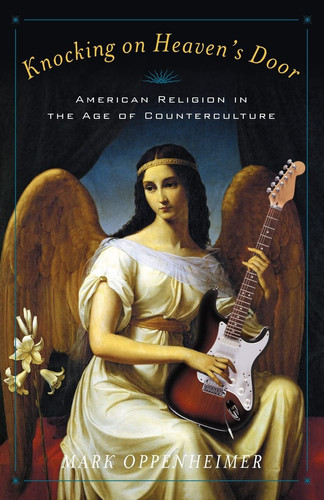
Knocking on Heaven's Door American Religion in the Age of Counterculture

Mark Oppenheimer
A witty and provocative reappraisal of the impact of the cultural upheavals of the sixties on American religious life What happened to American religion during the cultural revolution of the 1960s and early 1970s? The era has long been associated with the ascendancy of Eastern religions and fringe cults. But in this provocative book, Mark Oppenheimer demonstrates that contrary to conventional wisdom, most Americans did not turn on, tune in, and drop out of mainstream religious groups during the Age of Aquarius. Instead, many Americans brought the counterculture with them to their churches and temples, changing the face of American religion. Introducing us to America's first gay ministers and first female priests, to hippie Jews and folk-singing Catholics, Oppenheimer demonstrates that this was an era of extraordinary religious vitality. Drawing on a rich range of archival material as well as interviews with many of the protagonists, Knocking on Heaven's Door offersa wry and iconoclastic reappraisal of the ways in which the upheavals of the sixties changed America's relationship with God.
Yale University Press 2003 284 pages

Underground My Life with SDS and the Weathermen

Mark Rudd
In 1968, Mark Rudd led the legendary occupation of five buildings at Columbia University, a dramatic act of protest against the university's support for the Vietnam War and its institutional racism. The charismatic chairman of the Columbia chapter of Students for a Democratic Society—the largest radical student organization in the United States—Rudd went on to become a national symbol of student revolt, and co-founded the Weathermen faction of SDS, which helped organize the notorious Days of Rage in Chicago in 1969. But Mark Rudd wanted revolution, seeking to end war, racism, and injustice by any means necessary—even violence. By the end of 1970, he was one of the FBI's Most Wanted—and after a string of nonlethal bombings, he went into hiding for more than seven years before turning himself in to great media fanfare. In this gripping narrative, Rudd speaks out about this tumultuous period, the role he played in its crucial events, and its aftermath.
HarperCollins 2010-03-23 352 pages