58,196 results in 0.11 seconds

A very bad wizard: morality behind the curtain

Sommers, Tamler
In the first edition of A Very Bad Wizard: Morality behind the Curtain - Nine conversations, philosopher Tamler Sommers talked with an interdisciplary group of the world's leading researchers -- from the fields of social psychology, moral philosophy, cognitive science, and primatology - all working on the same issue: the origins and workings of morality. Together, these nine interviews pulled back some of the curtain, not only on our moral lives but - through Sommers' probing, entertaining, and well informed questions - on the way morality traditionally has been studied. This Second Edition increases the subject matter, adding eight additional interviews and offering features that will make A Very Bad Wizard more useful in undergraduate classrooms. These features include structuring all chapters around sections and themes familiar in a course in ethics or moral psychology; providing follow-up podcasts for some of the interviews, which will delve into certain issues from the conversations in a more informal manner; including an expanded and annotated reading list with relevant primary sources at the end of each interview; presenting instructor and student resources online in a companion website. (www.routledge.com/cw/sommers) The resulting new publication promises to synthesize and make accessible the latest interdisciplinary research to offer a brand new way to teach philosophical ethics and moral psychology. -- from back cover
Routledge 2016 322 pages

The House in Smyrna

Tatiana Salem Levy
An unforgettable story from one of Brazil's most accomplished and original new voices, this is a profoundly moving portrait of a young woman finding her way back into life. From one of Granta 's Best Young Brazilian Novelists comes a startling and powerful story about returning to one's origins in order to move forward. In Rio de Janeiro, a woman suffering from a mysterious illness, which is eroding her body and mind, decides to accept a challenge from her grandfather: to take the key to the house where he grew up--in the Turkish city of Smyrna--and open the door. As she embarks on this pilgrimage, she begins to write of her progress. The writing soon becomes an exploration of her family's legacy of displacement in Europe, told in several narrative strands. Sifting through family stories--her grandfather's migration from Turkey to Brazil, her parents' exile in Portugal under the Brazilian military dictatorship, her mother's death, and her own love affair with a violent man--she traces her family's history in a journey to make sense of the past and to understand her place in it. With an epic sweep of time and place--traversing Brazil, Turkey, and Portugal--this is a profoundly moving portrait of a young woman finding her way back into life. Spare, heartfelt, and evocative, The House in Smyrna is an unforgettable story from one of the most accomplished and original new voices in Brazil.
Scribe Publications Pty Limited 2018-08-07 160 pages

Break through: from the death of environmentalism to the politics of possibility

Nordhaus, Ted.
Current tactics can't solve today's complex global crises. The "bad boys of environmentalism" call for a bold and empowering new vision Environmental insiders Michael Shellenberger and Ted Nordhaus triggered a firestorm of controversy with their self-published essay "The Death of Environmentalism," which argued that environmentalism cannot deal with global warming and should die so that a new politics can be born. Global warming is far more complex than past pollution problems, and American values have changed dramatically since the movement's greatest victories in the 1960s, but environmentalists keep fighting the same old battles. Seeing a connection between the failures of environmentalism and the failures of the entire left-leaning political agenda, the authors point the way toward an aspirational politics that will resonate with modern American values and be capable of tackling our most pressing challenges. In this eagerly awaited follow-up to the original essay, the authors give us an expansive and eloquent manifesto for political change. What Americans really want, and what could serve as the basis for a new politics, is a vision capable of inspiring us to greatness. Making the case for abandoning old categories (nature/market, left/right), the authors articulate a pragmatism fit for our times that has already found champions in such prominent figures as Hillary Clinton and Barack Obama. This book will hit the same nerve as What's the Matter with Kansas and Don't Think of an Elephant . But its analysis will reshape American politics for decades to come.
Houghton Mifflin 2007-10-04 344 pages

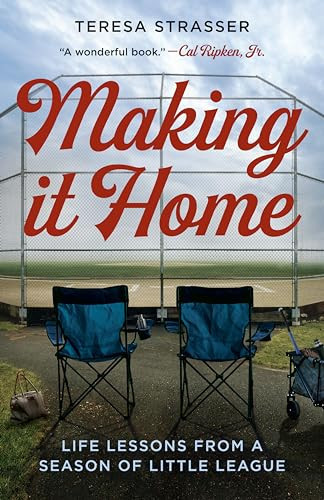
Making it home: life lessons from a season of little league

Strasser, Teresa
"An achingly heartfelt and surprisingly funny memoir about family, grief, and moving forward by an award-winning writer and TV personality. When her brother died from cancer, and then her mother just four months later, Teresa Strasser was left to mourn with her father, a cantankerous retired mechanic. As her son embarked on his first season pitching in Little League, Teresa and her dad formed a grief group of two in beach chairs lined up behind the first base line. There were no therapeutically trained facilitators and no rules other than those dictated by the Little League of America, and the human heart. For Teresa and her father, the stages of grief-with apologies to Dr. Kübler-Ross-were the draft, the regular season, and the playoffs. One season of baseball becomes the framework for a memoir about family, loss, and the fundamentals of baseball and life. Making It Home is a wise, witty, and bracingly honest journey through grief, self-doubt, and anxiety armed with humor and ultimately optimism. After all, baseball offers the chance to start over, every at-bat, every inning, every spring"--
Berkley 2023-06-06 338 pages

The Interior Castle or the Mansions of St. Teresa of Avila: New Study Guide Edition

Avila, St. Teresa of
The most readable and accurate version of The Interior Castle available! The classic book on prayer, plus discussion questions for group & school study "While I was beseeching Our Lord today...I began to think of the soul as if it were a castle made of a single diamond or of very clear crystal, in which there are many rooms, just as in Heaven there are many mansions." This was St. Teresa’s sweeping spiritual insight. Journey with one of the most remarkable figures in history as she explores the mystical mansions of the human soul ... of your soul. This is a journey unlike any other. Do you want to learn how to pray? The Interior Castle presents a breath-taking journey of the entire spiritual life from imprisonment by mortal sin to the Mystical Marriage of the soul with Christ. St. Teresa speaks to both the beginner and the advanced and the saints. She gives practical advice regarding the early struggles and the temptations to turn back. She describes each of the seven mansions in turn and urges us forward. Progress toward God through prayer is worth vastly more than all the treasures of this earth. A masterpiece of spiritual literature, this sixteenth-century work was inspired by the mystical vision of St. Teresa of Avila, one of the most gifted and beloved religious figures in history, who experienced spiritual espousal to God. In The Interior Castle, her most important and widely read book, St. Teresa describes how the soul enters the castle through prayer and meditation and experiences humility, detachment, suffering, and, ultimately, self-knowledge, as it advances from room to room. As the soul progresses toward the castle’s center, it comes closer to achieving ineffable peace and divine communion with God.
Holy Water Books 2024 287 pages

The Way of Perfection and Conceptions of Divine Love

Teresa of Avila
The Way of Perfection (Spanish: Camino de Perfecci�n) is a method for making progress in the contemplative life written by St. Teresa of �vila for the members of the reformed monastery of the Order she had founded.Teresa called this a "living book" and in it set out to teach her nuns how to progress through prayer and Christian meditation. The first 18 of the 42 chapters discuss the rationale of being a Carmelite, the rest deal with purpose and approaches to spiritual life.Conceptions of Divine Love was written in 1577. St. Teresa wrote this with the idea of explaining certain words found in the Book of Canticles. When her confessor read the title of her work, he ordered her to immediately burn it, which, of course, she did. But one of her nuns had copied the first seven chapters, which was then published in 1612. Here, Father John Dalton has translated only four of those chapters in 1852.
CreateSpace Independent Publishing Platform 2014-03-23 300 pages

The sixth extinction: journey among the lost and left behind

Glavin, Terry
The Sixth Extinction is a haunting account of the age in which we live. Ecologists are calling it the Sixth Great Extinction, and the world isn't losing just its ecological legacy; also vanishing is a vast human legacy of languages and our ways of living, seeing, and knowing. Terry Glavin confirms that we are in the midst of a nearly unprecedented, catastrophic vanishing of animals, plants, and human cultures. He argues that the language of environmentalism is inadequate in describing the unraveling of the vast system in which all these extinctions are actually related. And he writes that we're no longer gaining knowledge with every generation. We're losing it. In the face of what he describes as a dark and gathering sameness upon the Earth, Glavin embarks on a global journey to meet the very things we're losing (a distinct species every ten minutes, a unique vegetable variety every six hours, an entire language every two weeks) and on the way encounters some of the world's wonderful, rare things: a human-sized salmon in Russia; a mysterious Sino-Tibetan song-language; a Malayan tiger, the last of its kind; and a strange tomato that tastes just like black cherry ice cream. And he finds hope in the most unlikely places---a macaw roost in Costa Rica; a small village in Ireland; a relic community of Norse whalers in the North Atlantic; the vault beneath the Royal Botanical Garden at Kew; and the throne room of the Angh of Longwa in the eastern Himalayas. A fresh narrative take on the usual doom and gloom environmentalism, The Sixth Extinction draws upon zoology, biology, ecology, anthropology, and mythology to share the joys hidden within the long human struggle to conserve the world's living things. Here, we find hope in what's left: the absolute and stunning beauty in the Earth's last cultures and creatures.
Thomas Dunne Books/St. Martin's Press 2007-04-03 318 pages

Translation and survival: the Greek Bible and the Jewish Diaspora

Rajak, Tessa
The translation of the Hebrew Bible into Greek was the first major translation in Western culture. Its significance was far-reaching but largely forgotten. Without a Greek Bible, European history would have been entirely different - no Western Jewish diaspora and no Christianity. Translation and Survival is a radical new study of the ancient creators and receivers of the translations and of their impact. The Greek Bible sustained Jews who spoke Greek and made the survivalof the first Jewish diaspora possible: indeed, the translators invented the term 'diaspora'. The translations were a tool fo
Oxford University Press 2011-07-21 380 pages

Translation and survival: the Greek Bible of the ancient Jewish Diaspora

Rajak, Tessa
The translation of the Hebrew Bible into Greek was the first major translation in Western culture. Its significance was far-reaching but largely forgotten. Without a Greek Bible, European history would have been entirely different - no Western Jewish diaspora and no Christianity. Translation and Survival is a radical new study of the ancient creators and receivers of the translations and of their impact. The Greek Bible sustained Jews who spoke Greek and made the survival of the first Jewish diaspora possible: indeed, the translators invented the term 'diaspora'. The translations were a tool for the preservation of group identity and for the expression of resistance. They devised a new kind of language: many of the words they coined are still with us. The Greek Bible translations ended up as the Christian Septuagint, taken over along with the entire heritage of Hellenistic Judaism when the Church parted from the Synagogue. Here, a brilliant creation is restored to its first owners, and to its historical context among Jews, Greeks and Christians.
Oxford University Press 2009-04-09 380 pages

Crowns in Conflict

Theo Aronson
The years immediately before the First World War saw the last great flowering of European monarchy. Although sovereigns no longer ruled by divine right, their prestige and positions remained almost intact. The glittering centerpieces of national life, those crowned and anointed monarchs were still widely regarded as mystical, unassailable, divinely guided. And, with the majority of them being so closely related, they constituted a royal clan, an international freemasonry through which it was assumed the peace of Europe was being maintained. World War I shattered all this. King took up arms against king; cousin was pitted against cousin. Twelve leading monarchs, ranging from the vainglorious Kaiser Wilhelm II to such lesser-known figures as the brigandly Nicholas of Montenegro, the 'outre' Foxy Ferdinand of Bulgaria and the tragic Emperor Karl of Austria-Hungary, were involved in the conflict. For, in the end, that celebrated kinship of the family of kings proved irrelevant. Against the upheavals of these years, monarchs were revealed as both powerless and impotent. Here, Theo Aronson has assembled the entire cast of embattled monarchs. His is the story of eight momentous years viewed, as it were, from the monarchical standpoint; an account of the passing, not only of their particular world, but of the entire monarchic and dynastic order of the Continent. It describes the brilliant sunset and the dramatic break-up of the Europe of the Kings.
Salem House Publishers 1986-02

Heart of a Queen: Queen Victoria's Romantic Attachments

Aronson, Theo
'My nature', wrote Queen Victoria, 'is too passionate, my emotions too fervent, and I am a person who has to cling to someone in order to find peace and comfort.' To Queen Victoria, the love, attention and protection of a man was all but indispensable. During her long life, there were six men with whom her emotions were romantically involved: her first prime minister, the urbane Lord Melbourne; her husband, the idealistic Prince Albert; her fellow sovereign, the fascinating Napoleon III; her ghillie, the rough-hewn John Brown; another prime minister, the silver-tongued Disraeli; and her Indian servant, the exotic Munshi. The main appeal to Queen Victoria of these six apparently disparate characters was that they were men of distinctive personality: there was something exceptional about each of them. And they all treated her as a woman first, a queen second. By focusing on the Queen's romantic associations and making full use of recently revealed material, Theo Aronson has painted a fresh, intriguing and startlingly different portrait of Queen Victoria. With his talent for narrative and characterization, he has produced one of the most incisive and readable of his many royal biographies. Praise for Heart of a Queen: ’Theo Aronson always writes very thoughtfully and thoroughly. This book gave great insight into the relationships Queen Victoria had with the men in her life’ - Amazon review ‘Interesting angle on Queen Victoria who it seems could be amused! An intriguing read … Makes the Queen seem far less remote than some other portrayals’ - Amazon review Theo Aronson (1929–2003) was a South African-born writer who specialised in biographies of royal and other dynastic or celebrated figures. His warm and relaxed manner made him popular with the subjects of his works and their connections, many of whom granted him personal interviews, while C. P. Snow described his work as ‘bright with intelligence and human wisdom’.
Independently published 2023-03-30 302 pages

The Royal Family at War (Theo Aronson Royal History)

Aronson, Theo
'This war', wrote Winston Churchill to King George VI at the height of the Second World War, 'has brought throne and people closer together than was ever before recorded.' Here is a full and fascinating account of that coming together. It is a study of the contribution made not only by George VI and his redoubtable Queen, but also by the entire royal family during those turbulent years, and of how that contribution strengthened and popularized the monarchy. This is a family saga; an account of the lives, as much private as public, of all the diverse members of what George VI called 'The Firm'. Together with the tireless efforts of the King and Queen, it deals with such aspects as the Duke of Windsor's flirtation with fascism, the mysterious death of the Duke of Kent, the activities of the Athlones in Canada and the Gloucesters in Australia, and the imprisonment of the Princess Royal's eldest son, Viscount Lascelles. Occasionally tragic, often amusing, always interesting, The Royal Family at War is a richly detailed panorama of the monarchy in one of its finest hours. Theo Aronson is the author of over twenty works of royal historical biography including Grandmama of Europe, The King in Love, Napoleon and Josephine and a biography of Princess Margaret. In the course of researching and writing these books he has interviewed major and minor members of Britain’s royal family and members of the royal households, as well as various officials, servants, friends and others whose lives are in some way connected with the monarchy.
Independently published 2021-03-18 240 pages

The Golden Bees: The story of the Bonapartes

Aronson, Theo
Napoleon III, being accused on one occasion of having nothing of the Great Napoleon about him, replied with as much exasperation as wit, that he did, on the contrary, have his relations. This book is a domestic chronicle of the incredible Bonaparte family, a greedy, amorous, quarrelsome and hot-blooded Corsican clan who provided nineteenth-century Europe — and America — not only with two French emperors but also with a dazzling assortment of pretenders and parvenus, statesmen and eccentrics, great ladies and adventurers. Plumped onto the thrones of Europe by the career of Napoleon I, who probably took better care of his family than any other conqueror in history, the Bonapartes survived the wreck of the two empires they ruled, buzzing around the honeypots of the continent with all the persistence of the imperial bees of Napoleon's crest. This is a personal history, not a political one. It is the family, with its eccentricities, vulgarities and fascinations manifesting themselves in generation after generation, which holds the centre of the stage. The great political, economic and military events of the time are heard dimly as 'noises off'. Napoleon I himself appears as a son, brother, husband, father and above all as the founder of a dynasty, rather than as a great public figure. Theo Aronson paints this family portrait with a wealth of detail based on many years of research with historical documents and original records, letters, memoirs and family diaries. Praise for The Golden Bees: ‘A very considerable feat… a long, comfortable, easy-going sort of narrative full of tit-bits of information, stuffed with anecdotes’ - Observer ‘This is a hugely entertaining book. Neither biography nor history; but a mixture of both.… All lovers of royal gossip, of sprightly anecdotes and of the scandal and personal drama of history should delight in it’ - New York Times Theo Aronson is the author of over twenty works of royal historical biography, published in eleven languages. Among the widely read are Grandmama of Europe, The King in Love, Napoleon and Josephine and a biography of Princess Margaret. In the course of researching and writing these books he has interviewed major and minor members of Britain’s royal family and members of the royal households, as well as various officials, servants, friends and others whose lives are in some way connected with the monarchy.
Independently published 2021-05-28 494 pages

The Royal Family at War

Theo Aronson
'This war', wrote Winston Churchill to King George VI at the height of the Second World War, 'has brought throne and people closer together than was ever before recorded.' Here is a full and fascinating account of that coming together. It is a study of the contribution made, not only by George VI and his redoubtable Queen, but also by the entire royal family during those turbulent years. And of how that contribution strengthened and popularized the monarchy. This is a family saga; an account of the lives, as much private as public, of all the diverse members of what George VI called 'The Firm'. Together with the tireless efforts of the King and Queen, it deals with such aspects as the Duke of Windsor's flirtation with Fascism, the ground-clearing obsessions of Queen Mary, the mysterious death of the Duke of Kent, the activities of the Athlones in Canada and the Gloucesters in Australia, and the imprisonment of the Princess Royal's eldest son, Viscount Lascelles. Occasionally tragic, often amusing, always interesting, it is a richly detailed panorama of the monarchy in one of its finest hours. Theo Aronson has been granted an unprecedented series of audiences with the Queen Mother, Princess Margaret, Princess Alice. Duchess of Gloucester, and the late Princess Alice, Countess of Athlone, as well as interviews with many other members of the royal family and of the royal households. He has been permitted the use of previously unpublished letters, diaries and papers. The result is a colourful study by an author who has been consistently praised for his insight, scholarship and, above all, readability.
Thistle Publishing 2014-12-04 366 pages