58,196 results in 0.07 seconds

Sequential Analysis

Wald, Abraham
The inventor of a statistical inference system book describes his system and its applications. Discusses the general theory of the sequential probability ratio test, with comparisons to traditional statistical inference systems; applications that illustrate the general theory and of theoretical interest specific to these applications; possible approaches to the problem of sequential multi-valued decisions and estimation.
Wiley 1947 212 pages

Aby Warburg Bilderatlas Mnemosyne - the Original

Warburg, Aby,Heil, Axel,Scherer, Bernd M.,Sherman, Bill,Wedepohl, Claudia
From 1925 until his death in 1929 the Hamburg-based art and cultural scholar Aby Warburg worked on his Mnemosyne Atlas, a volume of plates that has, in the meanwhile, taken on mythical status in the study of modern art and visual studies. With this project, Warburg created a visual reference system that was far ahead of its time. In cooperation with the Warburg Institute, Roberto Ohrt and Axel Heil have now undertaken the task of finding all of the individual pictures from the atlas and displaying these reproductions of artworks from the Middle East, European antiquity, and the Renaissance in the same way that Warburg himself showed them, on panels hung with black fabric. This folio volume and the exhibition in Haus der Kulturen der Welt, Berlin succeed in restoring Warburg's vanished legacy something that researchers have long considered impossible. -- ABY WARBURG (1866-1929), scion of a Hamburg banking family, completed his doctorate in 1892 on the Italian Renaissance painter Sandro Botticelli. As a result, he comprehensively studied the interplay of myths, images and rites from different cultural contexts. This lead him to his main subject matter: the afterlife of antiquity in the Renaissance. With his attempt to break down the rigid boundaries of art history, Warburg is regarded as one of the fathers of modern pictorial science
Hatje Cantz 2020 183 pages

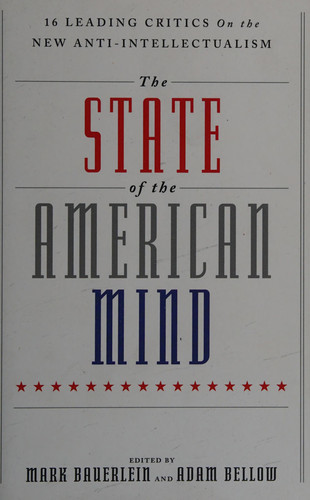
The state of the American mind: 16 leading critics on the new anti-intellectualism

Mark Bauerlein,Adam Bellow
In 1987, Allan Bloom’s The Closing of the American Mind was published; a wildly popular book that drew attention to the shift in American culture away from the tenants that made America—and Americans—unique. Bloom focused on a breakdown in the American curriculum, but many sensed that the issue affected more than education. The very essence of what it meant to be an American was disappearing. That was over twenty years ago. Since then, the United States has experienced unprecedented wealth, more youth enrolling in higher education than ever before, and technology advancements far beyond what many in the 1980s dreamed possible. And yet, the state of the American mind seems to have deteriorated further. Benjamin Franklin’s “self-made man” has become a man dependent on the state. Independence has turned into self-absorption. Liberty has been curtailed in the defense of multiculturalism. In order to fully grasp the underpinnings of this shift away from the self-reliant, well-informed American, editors Mark Bauerlein and Adam Bellow have brought together a group of cultural and educational experts to discuss the root causes of the decline of the American mind. The writers of these fifteen original essays include E. D. Hirsch, Nicholas Eberstadt, and Dennis Prager, as well as Daniel Dreisbach, Gerald Graff, Richard Arum, Robert Whitaker, David T. Z. Mindich, Maggie Jackson, Jean Twenge, Jonathan Kay, Ilya Somin, Steve Wasserman, Greg Lukianoff, and R. R. Reno. Their essays are compiled into three main categories: States of Mind: Indicators of Intellectual and Cognitive Decline These essays broach specific mental deficiencies among the population, including lagging cultural IQ, low Biblical literacy, poor writing skills, and over-medication. Personal and Cognitive Habits/Interests These essays turn to specific mental behaviors and interests, including avoidance of the news, short attention spans, narcissism, and conspiracy obsessions. National Consequences These essays examine broader trends affecting populations and institutions, including rates of entitlement claims, voting habits, and a low-performing higher education system. The State of the American Mind is both an assessment of our current state as well as a warning, foretelling what we may yet become. For anyone interested in the intellectual fate of America, The State of the American Mind offers an accessible and critical look at life in America and how our collective mind is faring.
Templeton Press 2015-06-16 260 pages

Ellington Boulevard

Adam Langer
Clarinetist Ike Morphy, his dog Herbie Mann, and a pair of pigeons who roost on his air conditioner are about to be evicted from their apartment on West 106th Street, also known as Duke Ellington Boulevard. Ike has never had a lease, just a handshake agreement with the recently deceased landlord; and now that landlord’s son stands to make a killing on apartment 2B. Centering on the fate of one apartment before, during, and after the height of New York’s real estate boom, Ellington Boulevard ’s characters include the Tenant and His Dog; the Landlord, a recovered alcoholic and womanizer who has newly found Judaism and a wife half his age; the Broker, an out-of-work actor whose new profession finally allows him to afford theater tickets he has no time to use; the Broker’s New Boyfriend, a second-rate actor who composes a musical about the sale of 2B ( “Is there no one I can lien on if this boom goes bust?” ). There’s also the Buyer, a trusting young editor at a dying cultural magazine, who falls in love with the Tenant; the Buyer’s Husband, a disaffected graduate student taken to writing bawdy faux-academic papers; and the Buyer’s Husband’s Girlfriend, a children’s book writer with a tragic past. With the humor and poignancy that made Langer’s first novel, Crossing California, a favorite book of the year among critics across the country, Ellington Boulevard is an ode to New York. It’s the story of why people come to a city they can’t afford, take jobs they despise, sacrifice love, find love, and eventually become the people they never thought they’d be—for better and for worse.
Random House Publishing Group 2009-05-26 336 pages

Telltale hearts: the origins and impact of the Vietnam antiwar movement

Garfinkle, Adam M.
More than two decades after the end of the Vietnam war, America's wounds have yet to heal. Still there is one conviction that most hawks and doves, then and now, share: that for better or worse, the Vietnam antiwar movement played an important role in turning American opinion against the war, limiting and ultimately ending US military activity in Southeast Asia. In reality however, this article of faith is quite wrong, as Telltale Hearts convincingly demonstrates. The antiwar movement, even at its radical height, was of marginal value and at times actually proved counterproductive to stopping or limiting the war. The movement unwittingly helped prolong the carnage, and more people on both sides were killed as a result.
Macmillan 1997 370 pages

Darwin's worms

Phillips, Adam
Adam Phillips has been called "the psychotherapist of the floating world" and "the closest thing we have to a philosopher of happiness." His style is epigrammatic; his intelligence, electric. His new book, Darwin's Worms, uses the biographical details of Darwin's and Freud's lives to examine endings-suffering, mortality, extinction, and death. Both Freud and Darwin were interested in how destruction conserves life. They took their inspiration from fossils or from half-remembered dreams. Each told a story that has altered our perception of our lives. For Darwin, Phillips explains, "the story to tell was how species can drift towards extinction; for Freud, the story was how the individual tended to, and tended towards his own death." In each case, it is a death story that uniquely illuminates the life story.
Basic Books 2000 148 pages

Tin House: Tenth Anniversary Issue

Charles Baxter,Aimee Bender
Who says summer reading means a lurid potboiler or sleazy celeb tell-all? Not "Tin House." Renowned for its beautiful design as well as its compelling content, the award-winning "Tin House" is a multisensory delight, as popular with critics as it is with readers. Each issue features the best writers of the day alongside a new generation of talent who are poised to become the most important voices of the future. Its summer issue offers an eclectic collection of short stories, profiles, author interviews, poetry, and essays, as well as unique departments such as Lost and Found, reviews of overlooked or underrated books, and Blithe Spirits and "Readable Feast, which present tales and recipes for drinks and food in a literary way. Breezy, sunny, funny, and always thought-provoking, "Tin House Summer Reading 2009" is beach reading for the smart set."
National Geographic Books 2009-08-25 224 pages

I, Goldstein: my screwed life

Goldstein, Al
The key distinction between Al Goldstein and Hugh Hefner is that the last thing on earth Al would be caught doing is taking himself seriously. Otherwise, given the amount of trouble Al has seen, his autobiography reads more like a tragedy than the absurd, uproarious comedy it is. Like a fat tiger with nine lives, Al Goldstein constantly collides with his own mortality, yet has survived for 69 years, so far. Recently, after finally succeeding in cannibalizing his entire fortune, Goldstein toughed his way through a full year homeless on the streets of New York — merely his latest accomplishment. Al's list of priors involve two dozen arrests, four ex-wives, Mafia hit contracts, thousands of death threats, innumerable medical procedures, and constant legal attack throughout his 34 years publishing Screw. Al's blood enemies include politicians, D.A.'s, CEO's and religious officials. When Goldstein was acquitted on pornography charges in Wichita, Kansas, in 1978, he flew the entire jury to New York to celebrate at Plato's Retreat, and took them all out to dinner on the anniversary of his acquittal. This landmark victory thereafter insured the right of Americans to view buck-ass naked sex with or without redeeming social value.
Thunder's Mouth Press 2006 271 pages

The Wisdom of Love

Alain Finkielkraut
The Wisdom of Love examines the seemingly contradictory claims of universalism and partisanship for the ethnic or racial Other. In discussions of topics ranging from the work of the Jewish philosopher Emmanuel Lävinas to the Dreyfus Affair of the 1890s to the contending positions of Right and Left in the recent culture wars in Europe and the Americas, Finkielkraut cautions against both an unreflective universalism and an equally inflexible advocacy of the Other. He argues instead that genuine respect for the Other is inseparable from calls for universal justice and equality. Rather than being opposites, otherness and universalism are, for Finkielkraut, inextricably bound to one another.
U of Nebraska Press 2001-03-01 153 pages