541 results for "Business History"

Financial innovations and market volatility

Miller, Merton H.
In this book, Nobel Laureate Merton Miller presents a sustained attack on the popular view that modern financial innovations have created excessive market volatility to the detriment of individual savers and business investors, and that regulation is essential in such forms as higher margin requirements, taxes on trading, and perhaps even closing down the future market.
Blackwell 1991-01 288 pages

Divine art, infernal machine: the reception of printing in the West from first impressions to the sense of an ending

Eisenstein, Elizabeth L.
"There is a longstanding confusion of Johann Fust, Gutenberg's one-time business partner, with the notorious Doctor Faustus. The association is not surprising to Elizabeth L. Eisenstein, for from its very early days the printing press was viewed by some as black magic. For the most part, however, it was welcomed as a "divine art" by Western churchmen and statesmen. Sixteenth-century Lutherans hailed it for emancipating Germans from papal rule, and seventeenth-century English radicals viewed it as a weapon against bishops and kings. An early colonial governor of Virginia thanked God for the absence of printing in his colony. A century later, revolutionaries on both sides of the Atlantic paid tribute to Gutenberg for setting in motion an irreversible movement that undermined the rule of priests and kings. Yet scholars continued to praise printing as a peaceful art. They celebrate the advancement of learning while expressing concern about information overload.
University of Pennsylvania Press 2011 368 pages

Divine art, infernal machine: the reception of printing in the West from first impressions to the sense of an ending

Eisenstein, Elizabeth L.
"There is a longstanding confusion of Johann Fust, Gutenberg's one-time business partner, with the notorious Doctor Faustus. The association is not surprising to Elizabeth L. Eisenstein, for from its very early days the printing press was viewed by some as black magic. For the most part, however, it was welcomed as a "divine art" by Western churchmen and statesmen. Sixteenth-century Lutherans hailed it for emancipating Germans from papal rule, and seventeenth-century English radicals viewed it as a weapon against bishops and kings. An early colonial governor of Virginia thanked God for the absence of printing in his colony. A century later, revolutionaries on both sides of the Atlantic paid tribute to Gutenberg for setting in motion an irreversible movement that undermined the rule of priests and kings. Yet scholars continued to praise printing as a peaceful art. They celebrate the advancement of learning while expressing concern about information overload.
University of Pennsylvania Press 2011-01-21 368 pages

The trials of Radclyffe Hall

Souhami, Diana
Radclyffe Hall was born in 1884 in Bournemouth in a house of horrors called 'Sunny Lawn'. It was an unhappy childhood, until her father's death when Radclyffe inherited £200,000. She was 18. She leased a London house, dressed in chappish clothes, called herself Peter then John & wrote her first collection of verse. She was a political reactionary, a reformed Catholic, obsessive about work, hunted with 3 packs, got her pipes from Dunhill's, wore brocade smoking jackets & had her hair cropped. She thought real women were born to be wives & disliked doing any business with them. Her 1st love was Mabel Batten, known as Ladye, who reputedly had an affair with Edward VII. Radclyffe Hall is now most famous for THE WELL OF LONELINESS, written in 1928. A novel about 'congenital inverts' - lesbian love - the book was suppressed both here & the US & caused Radclyffe to be put on trial under the Obscene Publications Act. Brilliantly written, this biography is a fresh and irreverent insight into the lives of one of the most alluring and eccentric women of this century.
Virago 1999 16 pages

Makin' toons: inside the most popular animated TV shows and movies

Neuwirth, Allan
From the first drawing board sketch to wriggling TV character, Makin’ Toons illustrates the thrills and challenges of making animated cartoon movies as told by the industry’s most successful creators. Cartoon lovers everywhere will be treated to 47 personal interviews with animation artists and industry leaders ranging from Shrek director Andrew Adamson to Rugrats producer Gabor Csupo. These and dozens of other fascinating firsthand accounts chronicle the behind-the-scene antics and commercial dynamics behind such blockbusters as The Simpsons, South Park, Beauty and the Beast, and Dragon Tales, to name just a few. Author Allan Neuwirth—an accomplished animation artist and writer himself—spices the book with insightful comments, hilarious anecdotes, and a true “toon artist’s” sense of humor. He also includes 75 never-before-published concept drawings, character designs, storyboards, and much more. Allworth Press, an imprint of Skyhorse Publishing, publishes a broad range of books on the visual and performing arts, with emphasis on the business of art. Our titles cover subjects such as graphic design, theater, branding, fine art, photography, interior design, writing, acting, film, how to start careers, business and legal forms, business practices, and more. While we don't aspire to publish a New York Times bestseller or a national bestseller, we are deeply committed to quality books that help creative professionals succeed and thrive. We often publish in areas overlooked by other publishers and welcome the author whose expertise can help our audience of readers.
Allworth Press 2003-04-01 272 pages

The telephone booth Indian

Liebling, A. J.
A classic work on Broadway sharpers, grifters, and con men by the late, great New Yorker journalist A. J. Liebling. Often referred to as “Liebling lowlife pieces,” the essays in The Telephone Booth Indian boisterously celebrate raffishness. A. J. Liebling appreciated a good scam and knew how to cultivate the scammers. Telephone Booth Indians (entrepreneurs so impecunious that they conduct business from telephone booths in the lobbies of New York City office buildings) and a host of other petty nomads of Broadway—with names like Marty the Clutch and Count de Pennies—are the protagonists in this incomparable Liebling work. In The Telephone Booth Indian , Liebling proves just why he was the go-to man on New York lowlife and con culture; this is the master at the top of his form, uncovering scam after scam and writing about them with the wit and charisma that established him as one of the greatest journalists of his generation and one of New York’s finest cultural chroniclers.
Broadway Books 2004-07-13 241 pages

The Dream Team The Rise and Fall of DreamWorks: Lessons from the New Hollywood

Daniel M. Kimmel
On October 12, 1994, Steven Spielberg, Jeffrey Katzenberg, and David Geffen-three of Hollywood's biggest players-announced they would form a new studio to produce feature films, television series, and pop music recordings. It didn't have a name, though Katzenberg's reference to his partners as the "Dream Team" eventually led to the company being dubbed DreamWorks. What the three men were attempting hadn't been done in more than sixty years: create a movie studio that could compete with the already existing major players. In The Dream Team , Daniel Kimmel tells the behind-the-scenes story of DreamWorks' rise-and the end of the dream eleven years later, when most of the company was sold off or shut down. Its plan for 1,087 acres of studio facilities that would include residences and retail operations came to naught. Its animation division was split off and went public. Its principals had already begun to go their own ways. Mr. Kimmel explores DreamWorks' successes: best-picture Oscars for American Beauty and Gladiator ; a near miss (but box office success) for Saving Private Ryan ; a smash animated hit Shrek winning the first Oscar ever for best animated feature and pointing the industry toward computer animation. But he also investigates why an enterprise with such promise failed to reach the heights. Was it the company's diffuse management style, or had the industry changed and consolidated so greatly that it was now impossible for new players to break into the ranks? Mr. Kimmel offers intriguing answers, showing how, more often than not, the guys tilting at windmills usually end up on the ground.
Bloomsbury Academic 2007-09-19 256 pages

Explaining long-term trends in health and longevity

Fogel, Robert William
"Explaining Long-Term Trends in Health and Longevity is a collection of essays by Nobel laureate Robert W. Fogel on the theory and measurement of ageing and health-related variables. Dr Fogel analyzes historic data on height, health, nutrition and life expectation to provide a clearer understanding of the past, illustrate the costs and benefits of using such measures and note the difficulties of drawing conclusions from data intended for different purposes. Dr Fogel explains how the basic findings of the anthropomorphic approach to historical analysis have helped reinterpret the nature of economic growth. Rising life expectancies and lower disease rates in countries experiencing economic growth highlight the importance of improving nutrition and agricultural productivity"--
Cambridge University Press 2012 174 pages

Man, Economy, and State, Scholar's Edition

Murray N. Rothbard
Rothbards great treatise and its complementary text are now combined into a single 4.5"x7" pocket edition. The full 1,500 page treatise in an easy to read and super convenient package. It might not seem possible but it is done and it works. It makes a great companion volume to Misess Human Action in pocket size, as well as the Bastiat Collection in pocket size. Murray N. Rothbards great treatise provides a sweeping presentation of Austrian economic theory, a reconstruction of many aspects of that theory, a rigorous criticism of alternative schools, and an inspiring look at a science of liberty that concerns nearly everything and should concern everyone. This edition takes this book out of the category of underground classic and raises it up to its proper status as one of the great economic treatises of all time, a book that is essential for anyone seeking a robust economic education. The captivating new introduction by Professor Joseph Salerno that frames up the Rothbardian contribution in a completely new way, and reassesses the place of this book in the history of economic thought. In Salernos view, Rothbard was not attempting to write a distinctively "Austrian" book but rather a comprehensive treatise on economics that eschewed the Keynesian and positivist corruptions. This is what accounts for its extraordinarily logical structure and depth. That it would later be called Austrian is only due to the long-lasting nature of the corruptions of economics that Rothbard tried to correct. Students have used this book for decades as the intellectual foil for what they have been required to learning from conventional economics classes. In many ways, it has built the Austrian school in the generation that followed Mises. It was Rothbard who polished the Austrian contribution to theory and wove it together with a full-scale philosophy of political ethics that inspired the generation of the Austrian revival, and continues to fuel its growth and development today. From Rothbard, we learn that economics is the science that deals with the rise and fall of civilization, the advancement and retrenchment of human development, the feeding and healing of the multitudes, and the question of whether human affairs are dominated by cooperation or violence. Economics in Rothbards wonderful book emerges as the beautiful logic of that underlies human action in a world of scarcity, the lens on how exchange makes it possible for people to cooperate toward their mutual betterment. We see how money facilitates this, and allows for calculation over time that permits capital to expand and investment to take place. We see how entrepreneurship, based on real judgments and risk taking, is the driving force of the market. Whats striking is how this remarkable book has lived in the shadows for so long. It began as a guide to Human Action, and it swelled into a treatise in its own right. Rothbard worked many years on the book, even as he was completing his PhD at Columbia University. He realized better than anyone else that Misess economic theories were so important that they needed restatement and interpretation. But he also knew that Misesian theory needed elaboration, expansion, and application in a variety of areas. The result was much more: a rigorous but accessible defense of the whole theory of the market economy, from its very foundations. But the publisher decided to cut the last part of the book, a part that appeared years later as Power and Market. This is the section that applies the theory presented in the first 1,000 pages to matters of government intervention. Issue by issue, the book refutes the case for taxation, the welfare state, regulation, economic planning, and all forms of socialism, large and small. It remains an incredibly fruitful assembly of vigorous argumentation and evidence. A major advantage of Man, Economy, and State, in addition to its systematic presentation, is that it is written in the clearest English you will find anywhere in the economics literature. The jargon is kept to a minimum. The prose is crystalline and vigorous. The examples are compelling. No one has explained the formation of prices, the damage of inflation, the process of production, the workings of interest rates, and a hundred of topics, with such energy and clarity. Over years, students have told us that this book is what made it possible for them to get through graduate school. Why? Because Rothbard takes on the mainstream in its own terms and provides a radical, logical, comprehensive answer. If you have read the book, you know the feeling that comes with reaching the last page: one walks away with the sense that one now fully understands economic theory and all its ramifications. It is a shame that the authentic edition of the classic that Rothbard wrote fully 40 years ago is only now coming into print. And yet the good news is that, at last, this remarkable work in the history of ideas, the book that makes such a technically competent, systematic, and sweeping case for the economics of liberty, is at last available. REVIEWS As the result of many years of sagacious and discerning meditation, [Rothbard] joins the ranks of the eminent economists by publishing a voluminous work, a systematic treatise on economics.... An epochal contribution to the general science of human action, praxeology, and its practically most important and up-to-now best elaborated part, economics. Henceforth all essential studies in in these branches of knowledge will have to take full account of the theories and criticisms expounded by Dr. Rothbard. Ludwig von Mises It is in fact the most important general treatise on economic principles since Ludwig von Misess Human Action in 1949. Henry Hazlitt Man, Economy, and State is Murray Rothbards main work in economic theory. It appeared in 1962, when Murray was only 36 years old. In it Murray develops the entire body of economic theory, in a step by step fashion, beginning with incontestable axioms and proceeding to the most intricate problems of business cycle theory and fundamental breakthroughs in monopoly theory. And along the way he presents a blistering refutation of all variants of mathematical economics. The book has in the meantime become a modern classic and ranks with Misess Human Action as one of the two towering achievements of the Austrian School of economics. In Power and Market, Murray analyzed the economic consequences of any conceivable form of government interference in markets. The Scholars Edition brings both books together to form a magnificent whole. Hans-Hermann Hoppe In 1972, this book was selling in hardback for $150 in current dollars. So the pocket edition, which includes Power and Market, a great index, plus improved layout, is about a fraction of the cost of the original, for a far better product.
Ludwig von Mises Institute 2009 1438 pages

Messages From My Father A Memoir

Calvin Trillin
Calvin Trillin, the celebrated New Yorker writer, offers a rich and engaging biography of his father, as well as a literate and entertaining fanfare for the common (and decent, and hard-working) man. Abe Trillin had the western Missouri accent of someone who had grown up in St. Joseph and the dreams of America of someone who had been born is Russia. In Kansas City, he was a grocer, at least until he swore off the grocery business. He was given to swearing off things—coffee, tobacco, alcohol, all neckties that were not yellow in color. Presumably he had also sworn off swearing, although he was a collector of curses, such as "May you have an injury that is not covered by workman's compensation." Although he had a strong vision of the sort of person he wanted his son to be, his explicit advice about how to behave didn't go beyond an almost lackadaisical "You might as well be a mensch." Somehow, though, Abe Trillin's messages got through clearly. The author's unerring sense of the American character is everywhere apparent in this quietly powerful memoir, Messages from My Father .
Macmillan 1997-06-12 128 pages

The Making of Global Capitalism The Political Economy of American Empire

Sam Gindin,Leo Panitch
The all-encompassing embrace of world capitalism at the beginning of the twenty-first century was generally attributed to the superiority of competitive markets. Globalization had appeared to be the natural outcome of this unstoppable process. But today, with global markets roiling and increasingly reliant on state intervention to stay afloat, it has become clear that markets and states aren’t straightforwardly opposing forces. In this groundbreaking work, Leo Panitch and Sam Gindin demonstrate the intimate relationship between modern capitalism and the American state, including its role as an “informal empire” promoting free trade and capital movements. Through a powerful historical survey, they show how the US has superintended the restructuring of other states in favor of competitive markets and coordinated the management of increasingly frequent financial crises. The Making of Global Capitalism , through its highly original analysis of the first great economic crisis of the twenty-first century, identifies the centrality of the social conflicts that occur within states rather than between them. These emerging fault lines hold out the possibility of new political movements transforming nation states and transcending global markets.
Verso Books 2025-08-05 480 pages

Missing man: the American spy who vanished in Iran

Meier, Barry
A real-life thriller about a CIA contractor who vanished in Iran and the international manhunt to find him In late 2013, Americans were shocked to learn that a former FBI agent turned private investigator who disappeared in Iran in 2007 was there on a mission for the CIA. The missing man, Robert Levinson, appeared in pictures dressed like a Guantánamo prisoner and pleaded in a video for help from the United States. Barry Meier, an award-winning investigative reporter for The New York Times , draws on years of interviews and never-before-disclosed CIA files to weave together a riveting narrative of the ex-agent’s journey to Iran and the hunt to rescue him. The result is an extraordinary tale about the shadowlands between crime, business, espionage, and the law, where secrets are currency and betrayal is commonplace. Its colorful cast includes CIA operatives, Russian oligarchs, arms dealers, White House officials, gangsters, private eyes, FBI agents, journalists, and a fugitive American terrorist and assassin. Missing Man is a fast-paced story that moves through exotic locales and is set against the backdrop of the twilight war between the United States and Iran, one in which hostages are used as political pawns. Filled with stunning revelations, it chronicles a family’s ongoing search for answers and one man’s desperate struggle to keep his hand in the game.
Farrar, Straus and Giroux 2018-02-20 279 pages

Capital and credit in British overseas trade: the view from the Chesapeake, 1700-1776

Price, Jacob M.
In a model study Jacob Price illuminates the dynamic growth of Britain’s foreign trade in the eighteenth century through an investigation of the investment patterns and credit institutions that financed that expansion. Concentrating on the trade between Britain and the Chesapeake tobacco colonies of Virginia and Maryland, for which a unique set of records exists, Price surveys the ways in which commerce developed and working capital was mobilized in Britain to support expanding overseas trade. Price develops the clearest picture ever of the financial environment within Britain as it affected Southern colonies in the preindustrial age. He does so by determining the kind of capital resources merchants in foreign trade actually commanded and measuring how much of their own wealth merchants brought to trade. In great and absorbing detail he discusses also the development of merchant-oriented banks in London and other ports, reinvestment of profits, long-term borrowing on bond, and the long-term credit provided to export merchants by wholesalers in textiles, ironmongery, and other industries. The relationship of debt to the coming of the American Revolution is also treated. Tobacco growers suffered more than others from a psychological unease caused by immense debt and were more revolutionary than farmers with less intensive capital needs and, hence, with lighter debt. This history will enlighten Anglo-American historians, economic historians, and historians of the American revolutionary era.
Harvard University Press 1980-12-02 233 pages

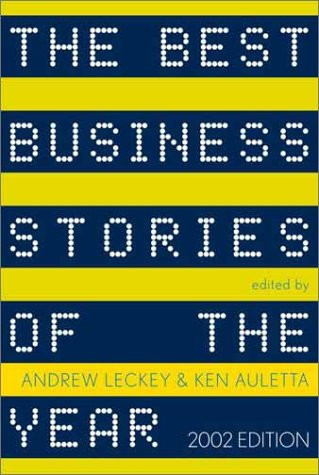
The Best Business Stories of the Year

Andrew Leckey,Ken Auletta
"[The editors] cast their net wide, picking up some excellent stories from nontraditional sources that even avid readers of the business press may have missed."-"USA Today," on the 2001 edition Series editor Andrew Leckey and guest editor Ken Auletta have scoured the print media, consulted with the editors of major business and general interest publications, and surveyed journalism school deans to find the best business stories from the last twelve months. Among those selected: Michael Lewis on teenage stock trader Jonathan Lebed, from "The New York Times Magazine"; James B. Stewart on the irrepressible Michael Milken, from "The New Yorker"; and many others from the pages of "The Wall Street Journal, Rolling Stone, Fortune, Rocky Mountain News, "and" Wired. " The second annual edition continues the excellence and comprehensive range of this fascinating anthology series.
Pantheon Books 2002 470 pages

Branson

Tom Bower
'Bower's book is a devastating indictment' Sunday Times 'Explosive ... Bower reveals a remarkable and sinister picture of the man who likes to appear as the ever-smiling hero' Daily Mail A sensational critical biography of the man and his business practices. No British tycoon is better known, few claim to be richer and none has masterminded a more recognisable brand than Richard Branson. What is behind the success of the buccaneering balloonist, the tabloids' favourite celebrity nude, the 'grinning jumper' and the scourge of corporate goliaths? Tom Bower has a uncovered a different tale to the one so eagerly promoted by Virgin's publicists. Here is the full story of Branson: his businesses, his friendships, his ambition, his law-breaking, his drug-taking, his bullying. Offering an intimate scrutiny of exactly how Richard Branson created and sold himself, this biography reveals Branson to be a single-minded profiteer who, while occasionally generous to others, has a fixed purpose to enhance his family's wealth in secret off-shore trust funds. Instead of a glittering saint, Branson emerges as a devious actor, proud of plucking for his own profit the good ideas of others.
Fourth Estate 2001 393 pages

Ruling the waves: cycles of discovery, chaos, and wealth from the compass to the internet

Spar, Debora L.
Beginning with the development of the compass, Ruling the Waves examines a series of technological revolutions that promised, in their time, to transform the world's politics and business. With Debora Spar's gifted storytelling, each chapter reads like an adventure tale as she recounts the histories of the printing press and maps; of the telegraph, radio, and satellite television; of software, encryption, and the advent of digital music. At each of these junctures Spar suggests that invention led to both a wave of commerce and of chaos. Entrepreneurs such as Samuel Morse and Rupert Murdoch carved new markets from the emerging technology and proclaimed that the old rules no longer applied. And for a while, they were right. But eventually--and inevitably--even cowboys need rules: rules of property, rules of coordination, rules of competition. The erstwhile pioneers thus turn to government, lobbying for order and setting the stage for the next wave of discovery. A fascinating history of business, Ruling the Waves is also an original, thought-provoking analysis of the parallels between past innovations and inventions and our own tumultuous times.
Harcourt 2001 403 pages

Capitalism for beginners

Lekachman, Robert
Perturbed by stagflation? In pain from recession? Sick with worry about whether the world economy can survive? You've gone to your corner economist and you couldn't understand the cure? Finally! An amusing, soundly researched, and highly accessible book that tells you everything you want to know about capitalism- the system its greatest theorists though could never survive.In this fair, concise, and good-humoured book, Robert Lekachman, Distinguished Professor of Economics at the City University of New York, assesses capitalism for what it's supposed to do deliver the goods. He starts by questioning the United States, where capitalism seems as natural as breathing and the free market is as much a byword as Mom's apple pie. But what are the realities? To understand them, he wittily documents capitalism's history from Adam Smith and Karl Marx to late last night; from mercantilism to monetarism, with explanations in between of investment and money, business cycles, the postwar boom, and the present recession.No sermons are preached. Readers must consider for themselves the dilemma that confronts us the future of capitalism and its effect on the world.
Writers and Readers 1981 174 pages

For Those I Loved

Martin Gray,Max Gallo
"Those who cannot remember the past are condemned to repeat it." --George Santayana We need only to look back to Rwanda, and now to Darfur, to see that once again we are living the worst of times. Who better to guide our understanding and give us hope than Martin Gray--a man who survived the worst of times, flourished, and still managed to find joy in living? Martin has come full circle since his boyhood world was turned upside down by the German invasion of Poland in 1939. Overnight, the teenage Martin and his family were immersed in the horrors of the Holocaust and held captive in the Warsaw Ghetto. It was a nightmare of brutality, starvation, and death. Martin became a clever smuggler to help his family survive--until the "butchers" of Treblinka took his mother and brothers. Against impossible odds, Martin survived and returned to fight in the Warsaw Ghetto Uprising. As the Nazis incinerated the ghetto, he escaped to fight with the partisans, and then the Red Army. After the war, Martin made his way to New York. The cunning and skills he developed during the war enabled him to learn the language and create a successful business. At 35, he retired to France with a fortune and a beautiful Dutch wife, starting a family and living in happiness and peace. But his world was shattered once again by a forest fire that engulfed his fleeing family. In a tragic repeat of history, Martin alone survived. Martin Gray's past could be our future if we don't heed his call to be the change. In this 35th anniversary expanded edition of For Those I Loved, a book beloved by millions of readers worldwide, Martin reminds us that the past is connected to the present. Only we can ensure that history is not repeated.
Book Club Associates 1974 319 pages

Five Men of Frankfort

M. E. Ravage
With Three New Appendices. Few Jewish names in the history of Europe have attracted more fame, more conspiracy theories, rumors, and mystery than the name Rothschild. This biography, written by a leading Jewish historian, pulls no punches in telling the true story of the banking dynasty, once known as the "financiers of nations." Cutting through all the myths and exaggeration which have surrounded the Rothschilds, Five Men of Frankfort reveals how the four Rothschild sons spread throughout Europe-to London, Paris, Vienna, and Naples, to set up a banking network which inaugurated the system of moving money internationally through simultaneous deposits and withdrawals. British indebtedness to the Rothschilds for their help in defeating Napoleon was then exploited by getting the British government to persuade the other nations of Europe-including the Austrian, Prussian, and Russian governments-to start using the Rothschilds as bankers and as the providers of their national loans and debt. Although this book ends its narrative at the beginning of the nineteenth century, this new edition has three new appendices which reveal the full extent of the Rothschild business empire to the present day. These appendices reveal in an astonishing amount of detail how this Jewish family from Frankfort ended up loaning money to governments on five continents, and their role in modern-day financial transactions across the world. This book strips away the myths which surround the Rothschilds, and provides a sober assessment of why this banking house has become the foremost subject of conspiracy theories around the globe.
Blurb, Incorporated 2019-03-31 346 pages