376 results for "Economic Development"

Historical legacies of communism in Russia and Eastern Europe

Mark R. Beissinger,Stephen Kotkin
"This book takes stock of arguments about the historical legacies of communism that have become common within the study of Russia and East Europe more than two decades after communism's demise and elaborates an empirical approach to the study of historical legacies revolving around relationships and mechanisms rather than correlation and outward similarities. Eleven essays by a distinguished group of scholars assess whether post-communist developments in specific areas continue to be shaped by the experience of communism or, alternatively, by fundamental divergences produced before or after communism. Chapters deal with the variable impact of the communist experience on post-communist societies in such areas as regime trajectories and democratic political values; patterns of regional and sectoral economic development; property ownership within the energy sector; the functioning of the executive branch of government, the police, and courts; the relationship of religion to the state; government language policies; and informal relationships and practices"--
Cambridge University Press 2014 247 pages

An Appeal To Reason : A Cool Look At Global Warming

Nigel Lawson
Global warming is an issue on which everyone - from layman to scientist, besides politicians, economists, policy makers and businessmen - has a stake, and an opinion that often borders on the extreme. In this persuasively argued work, Nigel Lawson calls for a fresh look at global warming, without in any way discounting the importance of the subject. Lawson carefully and succinctly examines all aspects of the debate: the science, the economics, the politics and the ethics. He concludes that conventional wisdom on global warming is suspect on a number o grounds; that global warming is not the devastating threat to the planet it is widely alleged to be; and that the remedy being proposed is, for very good reasons, not politically attainable; and even if it were, it would be worse than the warming it is supposed to avert. This hard-hitting response, argued with logic, common sense and wit, is particularly relevant to India, given that as a prime mover of the so-called 'Basic' countries (Brazil, South Africa, India and China) India is at the forefront of the environment debate, and that policies on emissions applicable to developed nations would have a direct impact on its rapid economic development - and livelihoods.
HarperCollins Publishers India 2010-12-28 192 pages

˜Theœ rise of modern Judaism: an intellectual history of German Jewry 1650-1942

Graupe, Heinz Mosche
This book illustrates the rise of modern Judaism through the social and intellectual history of the Jews in Germany. It covers three centuries, up until the violent suppression of the last spark of visible Jewish spiritual-intellectual life in Germany during the Second World War. As a background understanding of this intellectual development, the political, economic, and social events of this three-century-long development are repeatedly drawn upon. This book shows the significance of German Jewry in Jewish history.
Krieger 1978 329 pages

Federalists reconsidered

Ben-Atar, Doron
These essays demonstrate that American political culture was fashioned in a dialogue between Federalists and Jeffersonians. They portray an active Federalist coalition that offered a vibrant intellectual and political alternative throughout the era of the early republic. Cutting across boundaries of region, culture, race, gender, and class, Federalists struggled with the problems of nation building, national identity, and economic development.
University Press of Virginia 1998 310 pages

Manchurian railways and the opening of China: an international history

Bruce A. Elleman,Stephen Kotkin
The railways of Manchuria offer an intriguing vantage point for an international history of northeast Asia. Before the completion of the Trans-Siberian railway in 1916, the only rail route from the Imperial Russian capital of St. Petersburg to the Pacific port of Vladivostok transited Manchuria. A spur line from the Manchurian city of Harbin led south to ice-free Port Arthur. Control of these two rail lines gave Imperial Russia military, economic, and political advantages that excited rivalry on the part of Japan and unease on the part of weak and divided China. Meanwhile, the effort to defend and retain that strategic hold against rising Japanese power strained distant Moscow. Control of the Manchurian railways was contested in the Russo-Japanese War of 1904-5; Japan's 1931 invasion and establishment of the puppet state of Manchukuo; the second Sino-Japanese War and World War II in Asia; and, the Chinese civil war that culminated in the Communist victory over the Nationalists. Today, the railways are critical to plans for development of China's sparsely populated interior. This volume brings together an international group of scholars to explore this fascinating history.
M.E. Sharpe 2010 235 pages

So much to do: a full life of business, politics, and confronting fiscal crises

Ravitch, Richard
Every city and every state needs a Richard Ravitch. In sixty years on the job, whether working in business or government, he was the man willing to tackle some of the most complex challenges facing New York. Trained as a lawyer, he worked briefly for the House of Representatives, then began his career in his family's construction business. He built high-profile projects like the Whitney Museum and Citicorp Center but his primary energy was devoted to building over 40,000 units of affordable housing including the first racially integrated apartment complex in Washington, D.C. He dealt with architects, engineers, lawyers, bureaucrats, politicians, union leaders, construction workers, bankers, and tenants—virtually all of the people who make cities and states work. It was no surprise that those endeavors ultimately led to a life of public service. In 1975, Ravitch was asked by then New York Governor Hugh Carey to arrange a rescue of the New York State Urban Development Corporation, a public entity that had issued bonds to finance over 30,000 affordable housing units but was on the verge of bankruptcy. That same year, Ravitch was at Carey's side when New York City's biggest banks said they would no longer underwrite its debt and he became instrumental to averting the city's bankruptcy. Throughout his career, Ravitch divided his time between public service and private enterprise. He was chairman of the Metropolitan Transportation Authority from 1979 to 1983 and is generally credited with rebuilding the system. He turned around the Bowery Savings Bank, chaired a commission that rewrote the Charter of the City of New York, served on two Presidential Commissions, and became chief labor negotiator for Major League Baseball. Then, in 2008, after Governor Eliot Spitzer resigned in a prostitution scandal and New York State was in a post-financial-crisis meltdown, Spitzer's successor, David Paterson, appointed Ravitch Lieutenant Governor and asked him to make recommendations regarding the state's budgeting plan. What Ravitch found was the result of not just the economic downturn but years of fiscal denial. And the closer he looked, the clearer it became that the same thing was happening in most states. Budgetary pressures from Medicaid, pension promises to public employees, and deceptive budgeting and borrowing practices are crippling our states' ability to do what only they can do—invest in the physical and human infrastructure the country needs to thrive. Making this case is Ravitch's current public endeavor and it deserves immediate attention from both public officials and private citizens.
PublicAffairs 2014-04-29 254 pages

The rise of European liberalism

Laski, Harold J.
Beginning with the new worlds of the Renaissance and the Reformation, this book traces the growth of liberal doctrine through the advent of the French Revolution. It shows the relationship of liberalism to the emerging economic system of capitalism, and the impact of this relationship upon science, philosophy, and literature. Laski explains how the same causes which produced the socially active aspect of liberalism also inspired the growth of socialism. The contributions of men like Machiavelli, Locke, and Voltaire, the influence of the voyages of discovery, and the effect of the Puritan Rebellion are among the special topics discussed. The Rise of European Liberalism is a historical survey of the development of liberal thought, from its earliest whispers in early Protestantism to its significance in the "Red Decade" of the 1930s. Laski argues that liberalism as a philosophy came into existence with the rise of capitalism and thus functions primarily as an ideological defense of private property in a business civilization. Hence, liberalism's progressive side is doomed to defeat because, throughout its history, the bourgeois nature of the ideology has always prevailed. In the new introduction, John Stanley traces the history and influences of Laski's thought and provides a detailed analysis of Laski's work. The essay provides a coherent study in itself of why Laski is better remembered than widely read. The Rise of European Liberalism is a classic text that deserves rediscovery for historians, philosophers, sociologists, and political scientists of the present day.
Transaction Publishers 1997 287 pages

Social goals and social organization: essays in memory of Elisha Pazner

Leonid Hurwicz,David Schmeidler,Hugo Sonnenschein
Published as a tribute to the memory of Elisha Pazner, this book contains a collection of essays providing a comprehensive view of the design and evaluation of economic mechanisms, written and edited by the major contributors to the field. Amongst the topics included are bargaining theory and the economics of competitive bidding. The surveys are preceded by 'A Perspective', by Leo Hurwicz which contains a systematic account of the development of the literature on mechanism design, and this provides a context for both the surveys and the six published papers authored or co-authored by Elisha Pazner that complete the book and demonstrate Pazner's interest in and contribution to the study of economic mechanisms. Leonid Hurwitcz is the Nobel Prize Winner 2007 for The Sveriges Riksbank Prize in Economic Sciences in Memory of Alfred Nobel, along with colleagues Eric Maskin and Roger Myerson, for his work on the effectiveness of markets.
Cambridge University Press 2005-11-17 365 pages

The political economy of health care: a clinical perspective

Tudor Hart, Julian
This is a passionate analysis of the historical development, current state and potential future shape of the National Health Service by distinguished doctor and author, Julian Tudor Hart.Drawing on many years of clinical experience, Tudor Hart sets out to explore how the NHS might be reconstituted as a humane service for all (rather than a profitable one for the few) and a civilising influence on society as a whole.His starting point is an attack on the creeping commercialisation of the health service - the privatisation of a growing number of spheres and the application of market economics to procurement, delivery and management. Combining clinical, political and economic arguments, he then proposes his own economic analysis of the NHS, 'derived not from classical theory but from experience of the real health care economy'. The author's aim is to provide 'a big picture' for students, academics, health professionals and NHS users that will inspire them to challenge received wisdoms about how the NHS should develop in the 21st century.
The Policy Press 2006 320 pages

Historical Fiction and Other Reading References for Classes in Junior and Senior High Schools

Hannah Logasa
Text extracted from opening pages of book: HISTORICAL FICTION and other Reading References for Classes in JUNIOR AND SENIOR HIGH SCHOOLS Compiled by HANNAH _ LOGASA The University of Chicago Home-Study Department Author of The High School Library, The Study Hall FOURTH REVISED AND ENLARGED EDITION Philadelphia McKinley Publishing Co. 1949 SYMBOLS USED IN THIS WORK * Especially valuable x Junior high school level Copyright, 1949 McKinky Publishing Co. Made in the United States [ 2] TABLE OF CONTENTS'-PACE Symbols usecrm tms woric _ r v .. A . K, .... r: --. 2 Preface to the Fourth Revised and Enlarged Editioi.: .....: ..: .*.: .*..: ....: .. r.: .?... $ Introduction ., .*...... 5 ANNOTATED LIST OF HISTORICAL MATERIAL ANCIENT HISTORY I. Primitive life 13 II. Oriental life '. 17 III. Ancient Greece and her civilization 21 IV. Early Rome and the Roman Empire 25 MEDIEVAL AND MODERN EUROPE I. Traditional and legendary history: Empire of Charlemagne and the invasion of the Northmen, 600-1000 31 II. Medieval life institutions, 1000-1400 35 III. Renaissance and the Reformation to 1643 44 IV. Absolutism and the struggle for colonial and commercial supremacy, 1643-1786 56 V. French revolution and the Reign of Napoleon Bonaparte, 1789-1815 61 VI. Reaction, revolution and the nationalizing of the European states, 1815-1871 66 VII. Democracy, Liberalism, and the nineteenth-century expansion of Europe, 1871-1914 70 VIII. The World War, 1914-1918 73 IX. Post-War Europe, and Spheres of Influence, 1918-78 X. World War II and after 86 CANADA I. Discovery, exploration, colonization, 1000-1673 91 II. Anglo-French rivalry, 1673-1867 93 III. Confederation, and after, 1867-97 LATIN AMERICA I. Discovery, exploration and conquest, 1400-1808 102 II. Struggles for independence, 1808-1867 106 III. Experiments in democratic government, and development, looe-luv UNITED STATES HISTORY I. Discovery and exploration, 1400-1607 v .......... 116 II. Colonization and the struggle for supremacy in North America, 1607-1753 118 III. Revolution and the establishment of the American Nation, 1763-1789.... 127 IV. Nationalism and democracy, 1789-1829 135 V. Expansion, 1829-1861 } g VI. Conflict, 1861-1865 -* * J* i VII. Reconstruction and consolidation, 1865-1897 lol VIII National expansion and the new democracy, 1897-1914 loo IX. The World War, 1914-1918 #] X. The United States since the World War, 1918-1942 174 XL World War II and after 179 APPENDIX I. Islands of the Sea 183 II. Selected List of Source Books Ancient History; v { JJ Medieval and Modern European History --.. *&* United States History } Jg World War II and after * j Author and title index iyD [ 3] THE FOURTH REVISED AND ENLARGED EDITION The present revision consists of over 900 new titles. Three hundred of the older titles were omitted, not because they were no longer useful, but in order to make room for the newer material. A new section, Islands of the seas has been added to the Appendix. These small land areas have become of increasing importance because of their geographic location, political influence, and economic possibili ties. The larger islands, and continents that play a world role were not included in this section. Added also, were two sections of World War II, and after. These will be found in their chronological order. For different reasons compiling this work has presented problems. A few might be mentioned: ( a) The periodcovered by this revision coincided with the world conflict. Few books on various periods, and phases of history were published, e. g., Ancient history; World War I. This had its effect on the proportion of material in the list. ( b) The book output was marked by a change of format in many books. The binding, margins, paper, and print was not up to pre-war standards. This has a bearing on the life of the physical book, and its possible rebinding. ( c) The language in some of the books was frank, and in other cases crude. In each such case the book had to be judged
Literary Licensing, LLC 2012-04 282 pages

Brothers from afar: rabbinic approaches to apostasy and reversion in medieval Europe

Kanarfogel, Ephraim
"Revisionist approach to a status of apostates in medieval European rabbinic thought. View this in full screen In Brothers from Afar: Rabbinic Approaches to Apostasy and Reversion in Medieval Europe, Ephraim Kanarfogel challenges a long-held view that those who had apostatized and later returned to the Jewish community in northern medieval Europe were encouraged to resume their places without the need for special ceremony or act that verified their reversion. Kanarfogel's evidence suggests that from the late twelfth century onward, leading rabbinic authorities held that returning apostates had to undergo ritual immersion and other rites of contrition. He also argues that the shift in rabbinic positions during the twelfth and thirteenth centuries was fundamentally a response to changing Christian perceptions of Jews and was not simply an internal halakhic or rabbinic development. Brothers from Afar is divided into seven chapters. Kanarfogel begins the book with Rashi (1040-1105), the pre-eminent European rabbinic authority, who favored an approach which sought to smooth the return of penitent apostates. He then goes on to explain that although Jacob Katz, a leading Jewish social historian, maintains that this more lenient approach held sway in Ashkenazic society, a series of manuscript passages indicate that Rashi's view was challenged in several significant ways by northern French Tosafists in the mid-twelfth century. German Tosafists mandated immersion for a returning apostate as a means of atonement, akin to the procedure required of a new convert. In addition, several prominent tosafists sought to downgrade the status of apostates from Judaisim who did not return, in both marital and economic issues, well beyond the place assigned to them by Rashi and others who supported his approach. Although these mandates were formulated along textual and juridical lines, considerations of how to protect the Jewish communities from the inroads of increased anti-Judaism and the outright hatred expressed for the Jews as unrivaled enemies of Christianity, played a large role. Indeed, medieval Christian sources that describe how Jews dealt with those who relapsed from Christianity to Judaism are based not only on popular practices and culture but also reflect concepts and practices that had the approbation of the rabbinic elite in northern Europe. Brothers from Afar belongs in the library of every scholar of Jewish and medieval studies"--
Wayne State University Press 2021 240 pages

A Trumpet of Sedition Political Theory and the Rise of Capitalism, 1509-1688

Ellen Meiksins Wood,Neal Wood
The period from 1509 to 1688 was one of great social turbulence in Britain, and a key period in the history of political thought. This work covers the major themes of the time, including conceptions of the state and of natural rights, consent and property. It provides an examination of the main texts, situating them in their social and historical context. It looks at the role of the canonical thinkers - Thomas More, Hobbes, and Locke - and the participation of Sir Thomas Smith and radical thinkers such as the Levellers. These figures are viewed in the context both of their time, and of the wider social, economic and political arena. The authors set out to show how specific patterns of historical development relate to distinctive traditions in political thought.
Pluto Press 1997 150 pages

The former Soviet Union in transition

United States Congress Joint Economic Committee
A collection of papers assessing the economies of the newly independent states of the former Soviet Union, prepared by a large number of government and private experts at the request of the Joint Economic Committee, US Congress. The volume is divided into six sections: the transition to market economies; integration into the world economy; key sectoral developments (energy/agriculture/environment/science/ transportation); defense and conversion; human resources affecting the economy; and political- economic profiles. Each section is introduced with an overview essay. Paper edition (unseen), $35. Annotation copyright by Book News, Inc., Portland, OR
M.E. Sharpe 1993 1222 pages

Argentine democracy: the politics of institutional weakness

Steven Levitsky,Maria Victoria Murillo
During the 1990s Argentina was the only country in Latin America to combine radical economic reform and full democracy. In 2001, however, the country fell into a deep political and economic crisis and was widely seen as a basket case. This book explores both developments, examining the links between the (real and apparent) successes of the 1990s and the 2001 collapse. Specific topics include economic policymaking and reform, executive-legislative relations, the judiciary, federalism, political parties and the party system, and new patterns of social protest. Beyond its empirical analysis, the book contributes to several theoretical debates in comparative politics. Contemporary studies of political institutions focus almost exclusively on institutional design, neglecting issues of enforcement and stability. Yet a major problem in much of Latin America is that institutions of diverse types have often failed to take root. Besides examining the effects of institutional weakness, the book also uses the Argentine case to shed light on four other areas of current debate: tensions between radical economic reform and democracy; political parties and contemporary crises of representation; links between subnational and national politics; and the transformation of state-society relations in the post-corporatist era. Besides the editors, the contributors are Javier Auyero, Ernesto Calvo, Kent Eaton, Sebasti&án Etchemendy, Gretchen Helmke, Wonjae Hwang, Mark Jones, Enrique Peruzzotti, Pablo T. Spiller, Mariano Tommasi, and Juan Carlos Torre.
Pennsylvania State University Press 2005 325 pages

Jewish life after the USSR

Zvi Y. Gitelman,Musya Glants,Marshall I. Goldman
Since the late 1980s, one of the world's largest Jewish populations has faced a unique dilemma: at the very time it has gained unprecedented freedoms, Soviet and post-Soviet Jewry has encountered political uncertainty, economic instability, and resurgent antisemitism. A population teetering simultaneously on the edge of decline and revival, Jews in the former Soviet Union have had to decide whether to take advantage of the new opportunity to revive Jewish life and rebuild Jewish communities, live in the newly established states but disappear as Jews, or abandon their former homes and emigrate to Israel or elsewhere. Jewish Life after the USSR is the first book to study post-Soviet Jewry in depth. Its careful analyses of demographic, cultural, political, and ethnic processes affecting an important post-Soviet population also give insights into larger developments in the post-Soviet states. A fine-grained snapshot of one of the world's great Jewish centers, the volume is essential reading for those seeking to understand the past, present, and future of post-Soviet Jewry. Contributors: Robert J. Brym, Valery Chervyakov, Alanna Cooper, Theodore H. Friedgut, Zvi Gitelman, Musya Glants, Marshall I. Goldman, Martin Horwitz, Judith Deutsch Kornblatt, Mikhail Krutikov, Yohanan Petrovsky-Shtern, Yaacov Ro'i, Vladimir Shapiro, Sarai Brachman Shoup, and Mark Tolts.
Indiana University Press 2003 286 pages

Two Arabs, a Berber, and a Jew: entangled lives in Morocco

Rosen, Lawrence
In this work by seasoned scholar Lawrence Rosen, we follow the fascinating intellectual developments of four ordinary Moroccans over the span of 40 years. Walking and talking with Haj Hamed Britel, Yaghnik Driss, Hussein Qadir, and Shimon Benizri - in a country that, in a little over a century, has gone from an underdeveloped colonial outpost to a modern Arab country in the throes of economic growth and religious fervour - Rosen details a fascinating plurality of viewpoints on culture, history, and the ways both can be dramatically transformed. Through the intellectual lives of these four men, this book explores a number of interpretative and theoretical issues that have made Arab culture distinct, especially in relationship to the West: how nothing is ever hard and fast, how everything is relational and always a product of negotiation.
The University of Chicago Press 2015 363 pages

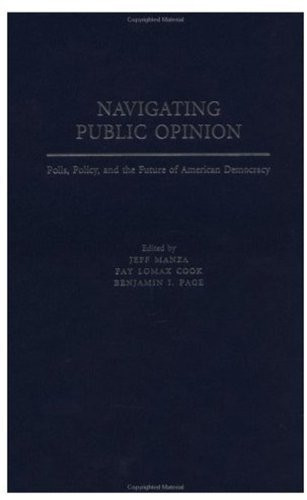
Navigating public opinion: polls, policy, and the future of American democracy

Professor of Sociology Jeff Manza,Jeff Manza,Fay Lomax Cook,Professor of Human Development and Social Policy in the School of Education and Social Policy Fay Lomax Cook,Benjamin I. Page,Gordon Scott Fulcher Professor of Decision Making in the Department of Political Science Benjamin I Page
Do politicians listen to the public? How often and when? Or are the views of the public manipulated or used strategically by political and economic elites? Navigating Public Opinion brings together leading scholars of American politics to assess and debate these questions. It describes how the relationship between opinion and policy has changed over time; how key political actors use public opinion to formulate domestic and foreign policy; and how new measurement techniques might improve our understanding of public opinion in contemporary polling and survey research. The distinguished contributors shed new light on several long-standing controversies over policy responsiveness to public opinion. Featuring a new analysis by Robert Erikson, Michael MacKuen, and James Stimson that builds from their pathbreaking work on how public mood moves policy in a macro-model of policymaking, the volume also includes several critiques of this model by Lawrence Jacobs and Robert Shapiro, another critique by G. William Domhoff, and a rejoinder by Erikson and his coauthors. Other highlights include discussions of how political elites, including state-level policymakers, presidents, and makers of foreign policy, use (or shape) public opinion; and analyses of new methods for measuring public opinion such as survey-based experiments, probabilistic polling methods, non-survey-based measures of public opinion, and the potential and limitations of Internet polls and surveys. Introductory and concluding essays provide useful background context and offer an authoritative summary of what is known about how public opinion influences public policy. A must-have for all students of American politics, public opinion, and polling, this state-of-the-art collection addresses issues that lie at the heart of democratic governance today.
Oxford University Press 2002 376 pages

The right to trade: rethinking the aid for trade agenda

Stiglitz, Joseph E.,Charlton, Andrew
Aid for trade is a fixture in the development landscape, accounting for approximately 25 per cent of total ODA, and is being positioned as a building block in the future development agenda beyond the 2015 expiry of the Millennium Development Goals. In The Right to Trade , Nobel Prize-winning economist Joseph E Stiglitz and Andrew Charlton argue that aid for trade has not delivered on its initial promise. To create a genuinely pro-development trade liberalisation agenda, the authors propose that a right to trade and a right to development be enshrined within the WTOs dispute settlement system; and that aid for trade funds be consolidated into a coherent and predictable framework, where dedicated funds are committed by rich countries to a Global Trade Facility and dispersed through a transparent and competitive process. Together these proposals would help ensure that international trade works for developing countries and will help preserve a development-friendly multilateral trading system.
Commonwealth Secretariat 2013 43 pages

Entrepreneurship in the global economy: engine for economic growth

Kressel, Henry
"Entrepreneurs have long been drivers of innovation in developed countries. They start companies and create new industries that keep economies strong and prosperous. Today, however, in developing nations such as China, state-controlled economies are building robust industries at stunning speed and siphoning off jobs from the West. How can entrepreneurs function in the face of this challenge? Can they continue to create economic value in a globalized business environment? This book addresses the crucial issue of state planning vs. free enterprise and examines specific problems surrounding entrepreneurship in the global economy through nine case histories of entrepreneurial companies. It also looks at how and why government gets involved in economic growth and how entrepreneurs contribute to economic value. Based on this analysis, the authors argue that companies can succeed, even in controlled economies, by understanding the customs and policies of countries where they do business"--
Cambridge University Press 2012-07-19 266 pages