833 results for "Environment"

That's what she said: what men and women need to know about working together

Lipman, Joanne
Women spend their working lives adapting to an environment set up for men, by men: from altering the way they speak to changing the clothes they wear to power posing. But still the gender gap persists. And once you see it - women being overlooked, interrupted, their ideas credited to men - it's impossible to ignore. But it needn't be this way. Diving deep into the wide range of government initiatives, corporate experiments and social science research Joanne Lipman offers fascinating new revelations about the way men and women work culled from the Enron scandal, from brain research, from transgender scientists and from Iceland's campaign to 'feminise' an entire nation. Packed with fascinating and entertaining examples - from the woman behind the success of Tupperware to how Google reinvented its hiring process - That's What She Said is a rallying cry to both men and women to finally take real steps towards closing the gender gap.
William Morrow, an imprint of HarperCollinsPublishers 2019-02-26 12 pages

Cannibals and kings: the origins of cultures

Harris, Marvin
Since time began, man has been threatened by growing populations and diminishing resources. In response, he has created idiosyncratic cultures whose forms and functions can - to the outsider - seem incomprehensible. In fascinating and at times bizarre detail a distinguished American anthropologist traces the evolution of cultures in terms not of traditionally accepted notions of the inexorable march of material progress but rather of man's supremely rational survival tactics and adaptability in a world which ever threatens him with extinction.
Fontana 1978 255 pages

Hella

Gerrold, David
"Hella is a planet where everything is oversized--especially the ambitions of the colonists. The trees are mile-high, the dinosaur herds are huge, and the weather is extreme--so extreme, the colonists have to migrate twice a year to escape the blistering heat of summer and the atmosphere-freezing cold of winter. Kyle is a neuro-atypical young man, emotionally challenged, but with an implant that gives him real-time access to the colony's computer network, making him a very misunderstood savant. When an overburdened starship arrives, he becomes the link between the established colonists and the refugees from a ravaged Earth. The Hella colony is barely self-sufficient. Can it stand the strain of a thousand new arrivals, bringing with them the same kinds of problems they thought they were fleeing? Despite the dangers to himself and his family, Kyle is in the middle of everything--in possession of the most dangerous secret of all. Will he be caught in a growing political conspiracy? Will his reawakened emotions overwhelm his rationality? Or will he be able to use his unique ability to prevent disaster?"--Provided by publisher.
Daw Books, Inc 2020 441 pages

The Republican Roosevelt

Blum, John Morton
This is a book about politics and politicians; about elections, lawmaking, governing, and how they work. It is also about power, its increasing concentration in American society, and its implications at home and abroad especially for those who exercise it. It is a book about the Republican Party during the period in which it developed the forces and frictions which still characterize it today. Finally, it is a book about a remarkably successful and vibrant man who contained within himself much of the best and the worst of his environment, who contributed generously to American life, who knew in his time disappointment, temptation, and pain, but also glory; a man remembered most by his intimates for the "fun of him." The author is in an enviable position to assess these matters. During five years as Associate Editor of The Letters of Theodore Roosevelt , he read and studied all TR's letters as well as all his published works, and delved deeply into the relevant literature of the period, including the vast material in the Congressional Record. From this rich store, John Morton Blum has drawn a new interpretation of Roosevelt the conservative, Roosevelt the professional Republican politician and Roosevelt the leader of men. He presents new material on Roosevelt's work as the manager of the Republican Party and as manager of Congress. He relates Roosevelt's roles in these situations to his conduct of foreign policy-a foreign policy so anticipatory of that of contemporary America-and to his Progressiveness-a doctrine of government with strong affinities to both the New Deal and the New Crusade.
Harvard University Press 1977 170 pages

You and me: the neuroscience of identity

Greenfield, Susan
"What is it that makes you distinct from me? Identity is a term much used but hard to define. For that very reason, it has long been a topic of fascination for philosophers but has been regarded with aversion by neuroscientists - until now. Susan Greenfield takes us on a journey in search of a biological interpretion of this most elusive of concepts, guiding us through the social and psychiatric perspectives and ultimately into the heart of the physical brain. As the brain adapts exquisitely to environment, do cultural challenges of the 21st century mean that we are facing unprecedented changes to identity itself?"--Back cover.
Notting Hill Editions 2011 145 pages

Biology under the influence: dialectical essays on ecology, agriculture, and health

Lewontin, Richard C.
How do we understand the world? While some look to the heavens for intelligent design, others argue that it is determined by information encoded in DNA. Science serves as an important activity for uncovering the processes and operations of nature, but it is also immersed in a social context where ideology influences the questions we ask and how we approach the material world. Biology Under the Influence: Dialectical Essays on the Coevolution of Nature and Society breaks from the confirms of determinism, offering a dialectical analysis for comprehending a dynamic social and natural world. In Biology Under the Influence , Richard Lewontin and Richard Levins provide a devastating critique of genetic determinism and reductionism within science while exploring a broad range of issues including the nature of science, biology, evolution, the environment, pubic health, and dialectics, They dismantle the ideology that attempts to naturalize social inequalities, unveil the alienation of science and nature, and illustrate how a dialectical position serves as a basis for grappling with historical developments and a world characterized by change. Biology Under the Influence brings together the illuminating essays of two prominent scientists who work to demystify and empower the public's understanding of science and nature.
Monthly Review Press 2007-11-01 400 pages

The state of the world atlas

Kidron, Michael
Distinctive yet accessible, these full-color maps and graphics afford readers a unique view of current international affairs by translating key political, economic, and social indicators into readily grasped visual form. "Unique and uniquely beautiful, " previous editions of this atlas have told us "more about the world today than a dozen statistical abstracts or scholarly tomes" (Los Angeles Times). In addition to the many topics covered in the previous edition -- population growth and migrations; pressures on the environment; military spending and the arms trade; racism and gender politics -- this new edition includes presentations on stock markets, state crimes, superpowerdom, ethnicity and multiculturalism, the Internet, digital media, and more. For a concise yet comprehensive survey of the world today, The State of the World Atlas is unmatched.
Simon & Schuster 1981-03-09 176 pages

The Way to Win: Taking the White House in 2008

Halperin, Mark,Harris, John F.
In The Way to Win, two of the country’s most accomplished political reporters explain what separates the victors from the victims in the unforgiving environment of modern presidential campaigns. Mark Halperin, political director of ABC News, and John F. Harris, the national politics editor of The Washington Post, tell the story of how two families–the Bushes and the Clintons–have held the White House for nearly a generation and examine Hillary Clinton’s prospects for extending this record in 2008. Based on years of research, including private campaign memos and White House communications, The Way to Win reveals the surprising details of how the Bushes and Clintons have closely studied each the other’s successes and failures and used these lessons to shape their own strategies for winning elections and wielding power. In the case of George W. Bush, the strategic genius is Karl C. Rove, arguably the most influential White House aide in history. For the first time, Halperin and Harris cut through the myths and controversies surrounding Rove to illuminate in brilliant, behind-the-scenes detail what he actually does–his Trade Secrets for winning elections. In the case of the Clintons, the chief strategist is Bill Clinton himself. Drawing on their fifteen years reporting on and interviewing him, Halperin and Harris deconstruct and decipher the Clinton style, identifying the methods that all candidates can use in their pursuit of the White House. The Way to Win takes a lively and irreverent approach, but Halperin and Harris also show the disturbing ways that American politics has become a Freak Show–their name for a political culture that provides incentives for candidates, activists, interest groups, and the news media to emphasize ideological extremism and personal attack. For the first time, Halperin and Harris describe how Freak Show campaigns orchestrated by the likes of Internet pioneer Matt Drudge forced Al Gore and John Kerry to lose control of their public images (with considerable help from the candidates’ own ineptitude) and lose the White House. On the brink of what will be one of the most intense, most exciting presidential elections in American history, The Way to Win is the book that armchair political junkies have been waiting for. Filled with peerless analysis and eye-opening revelations from the trenches, it is a must read for everyone who follows American politics. From the Hardcover edition.
Random House Inc 2008 480 pages

The lesson of this century: with two talks on freedom and the democratic state

Popper, Karl R.
Br> The Lesson of This Century : With Two Talks on Freedom and the Democratic State by Popper, Karl R.; Camiller, Patrick (Translator); Bosetti, Giancarlo (As told to) Terms of use In The Lesson of this CenturyPopper's purpose is to warn us against the increasing violence and egoism of our society. What solutions can we offer to the problems of the environment, demography and corruption? How can we prevent the violence our society engenders? How can we preserve our democratic system while at the same time paving the way for global peace? Popper believes that the philosopher has a duty to intervene in politics and he utters a clear call to all of us to recognise our responsibilities. He reminds us that it is our actions which will create the world of tomorrow. The interviews in this volume were originally given to the Italian journalist Giancarlo Bosetti. The volume also includes the transcript of an interview about the moral dangers of television not previously available in English. Descriptive content provided by Syndetics"! a Bowker service.
Routledge 1997 96 pages

Audacity How Barack Obama Defied His Critics and Created a Legacy That Will Prevail

Jonathan Chait
An unassailable case that, in the eyes of history, Barack Obama will be viewed as one of America’s best and most accomplished presidents. Over the course of eight years, Barack Obama has amassed an array of outstanding achievements. His administration saved the American economy from collapse, expanded health insurance to millions who previously could not afford it, negotiated an historic nuclear deal with Iran, helped craft a groundbreaking international climate accord, reined in Wall Street and crafted a new vision of racial progress. He has done all of this despite a left that frequently disdained him as a sellout, and a hysterical right that did everything possible to destroy his agenda even when they agreed with what he was doing. Now, as the page turns to our next Commander in Chief, Jonathan Chait, acclaimed as one of the most incisive and meticulous political commentators in America, digs deep into Obama’s record on major policy fronts—economics, the environment, domestic reform, health care, race, foreign policy, and civil rights—to demonstrate why history will judge our forty-fourth president as among the greatest in history. Audacity does not shy away from Obama’s failures, most notably in foreign policy. Yet Chait convincingly shows that President Obama has accomplished what candidate Obama said he would, despite overwhelming opposition—and that the hopes of those who voted for him have not been dashed despite the smokescreen of extremist propaganda and the limits of short-term perspective.
HarperCollins 2017-01-24 384 pages

Rebalancing society: radical renewal beyond left, right, and center

Mintzberg, Henry
Our world is out of balance, says Henry Mintzberg, and the consequences are proving fateful: the degradation of our environment, the demise of our democracies, and the denigration of ourselves, with greed having been raised to some sort of high calling. But we can set things right. Mintzberg argues that a healthy society is built on three balanced pillars: a public sector of respected governments, a private sector of responsible enterprises, and what he calls a plural sector of robust voluntary associations (nonprofits, NGOs, etc.). Communism collapsed because the public sector was overbearing - balance triumphed in 1989, not capitalism. But that misunderstanding has led to the private sector becoming overbearing in many countries, especially the United States, and this imbalance is wreaking havoc. Many governments are now so co-opted by their private sectors that they won't be able to lead the process of renewal. And corporate social responsibility, however laudable, cannot compensate for the corporate social irresponsibility we see all around us. So Mintzberg offers specific ideas for strengthening the plural sector, which has the inclination and the independence to lead radical renewal by challenging unacceptable practices and developing better ones. This means change must be led not by some "them" but by each of us and all of us - if we care about our planet and our progeny.
Berrett-Koehler Publishers, Inc 2015-01-05 151 pages

The Prokaryotes: Prokaryotic Communities and Ecophysiology

Edward F. DeLong,Stephen Lory,Erko Stackebrandt,Fabiano Thompson,Eugene Rosenberg
Product Description The Prokaryotes is a comprehensive, multi-authored, peer reviewed reference work on Bacteria and Achaea. This fourth edition of The Prokaryotes is organized to cover all taxonomic diversity, using the family level to delineate chapters. Different from other resources, this new Springer product includes not only taxonomy, but also prokaryotic biology and technology of taxa in a broad context. Technological aspects highlight the usefulness of prokaryotes in processes and products, including biocontrol agents and as genetics tools. The content of the expanded fourth edition is divided into two parts: Part 1 contains review chapters dealing with the most important general concepts in molecular, applied and general prokaryote biology; Part 2 describes the known properties of specific taxonomic groups. Two completely new sections have been added to Part 1: bacterial communities and human bacteriology. The bacterial communities section reflects the growing realization that studies on pure cultures of bacteria have led to an incomplete picture of the microbial world for two fundamental reasons: the vast majority of bacteria in soil, water and associated with biological tissues are currently not culturable, and that an understanding of microbial ecology requires knowledge on how different bacterial species interact with each other in their natural environment. The new section on human microbiology deals with bacteria associated with healthy humans and bacterial pathogenesis. Each of the major human diseases caused by bacteria is reviewed, from identifying the pathogens by classical clinical and non-culturing techniques to the biochemical mechanisms of the disease process. The 4th edition of The Prokaryotes is the most complete resource on the biology of prokaryotes. Review From the book reviews:“This book … edited and written by great scientists covers essential contributions on different types of prokaryotic communities as well as on the prokaryotic functions in different environments. … This volume, as well as the whole series, should be available in every large scientific library.” (Ioan I. Ardelean, Bulletin of Micro and Nanoelectrotechnologies, Vol. 5 (3-4), December, 2014) About the Author Eugene Rosenberg, Professor of Microbiology at Tel Aviv University, Israel Edward F. DeLong, Professor at Department of Civil and Environmental Engineering & Department of Biological Engineering, Massachusetts Institute of Technology, Cambridge, MA, USA Stephen Lory, Professor at Department of Microbiology and Molecular Genetics, Harvard Medical School, Boston, MA, USA Erko Stackebrandt, German Collection of Microorganisms and Cell Cultures GmbH, DSMZ, Braunschweig, Germany Fabiano Thompson, Professor at Center of Health Sciences, Federal University of Rio de Janeiro, Brazil
Springer 2013 548 pages

Scientific Conversations Interviews on Science from The New York Times

Claudia Dreifus
In these thirty-eight interviews, originally published in the weekly Science Times section of The New York Times , Claudia Dreifus brings all of her colorful personality to bear on her subjects, as well as an arsenal of philosophy, literature, and current events, and an unmistakable curiosity. As each conversation unfolds, we learn surprising and fascinating things about some of the most intriguing figures and issues in science today. Dreifus's outsider status in the world of science is perhaps one of her greatest interviewing strengths. A political journalist for much of her career, she stumbled into a position at the Science Times section. With little more scientific background than the average person, she scrambled to prepare for her meetings with some of the greatest minds in a broad range of disciplines-from astronomy to geology, from biology and medicine to computer science and mathematics. She soon found herself in a refreshingly candid environment, so unlike the one she had known on the political beat. It is from this perspective that she makes science tangible, accessible, and entertaining.
Henry Holt and Company 2002-11-01 272 pages

Punitive damages.\How juries decide

Cass R. Sunstein,Reid Hastie,John W. Payne,David A. Schkade,W. Kip Viscusi
Over the past two decades, the United States has seen a dramatic increase in the number and magnitude of punitive damages verdicts rendered by juries in civil trials. Probably the most extraordinary example is the July 2000 award of $144.8 billion in the Florida class action lawsuit brought against cigarette manufacturers. Or consider two recent verdicts against the auto manufacturer BMW in Alabama. In identical cases, argued in the same court before the same judge, one jury awarded $4 million in punitive damages, while the other awarded no punitive damages at all. In cases involving accidents, civil rights, and the environment, multimillion-dollar punitive awards have been a subject of intense controversy. But how do juries actually make decisions about punitive damages? To find out, the authors-experts in psychology, economics, and the law-present the results of controlled experiments with more than 600 mock juries involving the responses of more than 8,000 jury-eligible citizens. Although juries tended to agree in their moral judgments about the defendant's conduct, they rendered erratic and unpredictable dollar awards. The experiments also showed that instead of moderating juror verdicts, the process of jury deliberation produced a striking "severity shift" toward ever-higher awards. Jurors also tended to ignore instructions from the judges; were influenced by whatever amount the plaintiff happened to request; showed "hindsight bias," believing that what happened should have been foreseen; and penalized corporations that had based their decisions on careful cost-benefit analyses. While judges made many of the same errors, they performed better in some areas, suggesting that judges (or other specialists) may be better equipped than juries to decide punitive damages. Using a wealth of new experimental data, and offering a host of provocative findings, this book documents a wide range of systematic biases in jury behavior. It will be indispensable for anyone interested not only in punitive damages, but also jury behavior, psychology, and how people think about punishment.
University of Chicago Press 2003-09-15 285 pages

After the Rights Revolution: reconceiving the regulatory state

Sunstein, Cass R.
In the twentieth century, American society has experienced a "rights revolution": a commitment by the national government to promote a healthful environment, safe products, freedom from discrimination, and other rights unknown to the founding generation. This development has profoundly affected constitutional democracy by skewing the original understanding of checks and balances, federalism, and individual rights. Cass Sunstein tells us how it is possible to interpret and reform this regulatory state regime in a way that will enhance freedom and welfare while remaining faithful to constitutional commitments. Sunstein vigorously defends government regulation against Reaganite/Thatcherite attacks based on free-market economics and pre-New Deal principles of private right. Focusing on the important interests in clean air and water, a safe workplace, access to the air waves, and protection against discrimination, he shows that regulatory initiatives have proved far superior to an approach that relies solely on private enterprise. Sunstein grants that some regulatory regimes have failed and calls for reforms that would amount to an American perestroika: a restructuring that embraces the use of government to further democratic goals but that insists on the decentralization and productive potential of private markets. Sunstein also proposes a theory of interpretation that courts and administrative agencies could use to secure constitutional goals and to improve the operation of regulatory programs. From this theory he seeks to develop a set of principles that would synthesize the modern regulatory state with the basic premises of the American constitutional system. Teachers of law, policymakers and political scientists, economists and historians, and a general audience interested in rights, regulation, and government will find this book an essential addition to their libraries.
Harvard University Press 1990 284 pages

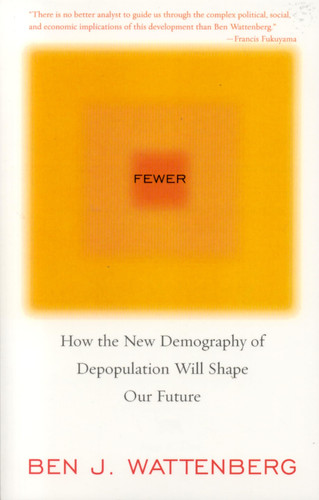
Fewer How the New Demography of Depopulation Will Shape Our Future

Ben J. Wattenberg
For at least 650 years, since the time of the Black Plague, the world's population has headed in only one direction: up. But within a few decades the number of people on earth will level off and then will likely decline over an extended period of time. In Fewer, the author explains how and why birthrates and fertility rates are now falling at an alarming rate in countries throughout the world--both modern and less developed. And he explores the major implications--for world politics, the environment, and the international economy--of this momentous shift. Illustrated with 23 clarifying charts.
Bloomsbury Academic 2004 241 pages