551 results for "History"

Life so far

Friedan, Betty
At last Betty Friedan herself speaks about her life and career. With the same unsparing frankness that made The Feminine Mystique one of the most influential books of our era, Friedan looks back and tells us what it took -- and what it cost -- to change the world. Betty Friedan's The Feminine Mystique, published in 1963, started the women's movement; it sold more than four million copies and was recently named one of the one hundred most important books of the century. In Life So Far, Friedan takes us on an intimate journey through her life -- a lonely childhood in Peoria, Illinois; salvation at Smith College; her days as a labor reporter for a union newspaper in New York (from which she was dismissed when she became pregnant); unfulfilling and painful years as a suburban housewife; finding great joy as a mother; and writing The Feminine Mystique, which grew out of a survey of her Smith classmates and started it all. Friedan chronicles the secret underground of women in Washington, D.C., who drafted her in the early 1960s to spearhead an "NAACP" for women, and recounts the courage of many, including some Catholic nuns who played a brave part in those early days of NOW, the National Organization for Women. Friedan's feminist thinking, a philosophy of evolution, is reflected throughout her book. She recognized early that the women's movement would falter if institutions did not change to reflect the new realities of women's lives, and she fought to keep the movement practical and free of extremism, including "man-hating." She describes candidly the movement's political infighting that brought her to the point of legal action and resulted in a long breach with fellow leaders Gloria Steinem and Bella Abzug. Friedan is frank about her twenty-two-year marriage to Carl Friedan, an advertising entrepreneur. She writes about the explosive cycle of drinking, arguing, and physical battering she endured and explores her prolonged inability to leave the marriage. (They are now friends and the grandparents of nine.) Friedan was not only pivotal in the founding of NOW, she was also the driving force behind the creation of the National Abortion and Reproductive Rights Action League (NARAL), the National Women's Political Caucus (NWPC), and the First Women's Bank and Trust Company. She made history by introducing the issue of sex discrimination as an argument against the ratification of a Supreme Court nominee. She convinced the Secretary General of the United Nations to declare 1975 the International Year of the Woman. In this volume, Friedan brings to extraordinary life her bold and contentious leadership in the movement. She lectures, writes, leads think tanks, and organizes women and men to work together in political, legal, and social battles on behalf of women's rights. It is exactly this breadth of vision that makes Friedan's memoir an important and compelling work.
Simon & Schuster 2000-05-10 399 pages

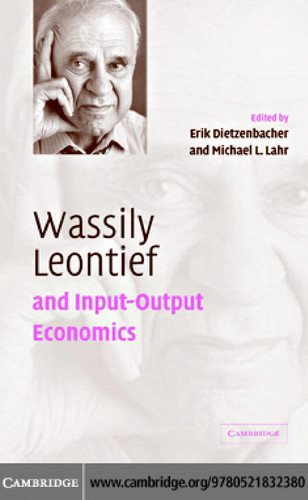
Wassily Leontief and input-output economics

Wassily Leontief,Erik Dietzenbacher,Michael L. Lahr
Wassily Leontief (1905–1999) was the founding father of input-output economics, for which he received the Nobel Prize in 1973. This book offers a collection of papers in memory of Leontief by his students and close colleagues. The first part, 'Reflections on Input-Output Economics', focuses upon Leontief as a person and scholar as well as his personal contributions to economics. It includes contributions by Nobel Laureate Paul A. Samuelson who shares his memories of a young Professor Leontief at Harvard and ends with the last joint interview with Wassily and his wife, to date previously unpublished. The second part, 'Perspectives of Input-Output Economics', includes theoretical and empirical research inspired by Leontief's work and offers a wide-ranging sample of the state of interindustry economics, a field Leontief founded. This is a strong collection likely to appeal to a wide range of professionals in universities, government, industry and international organizations.
Cambridge University Press 2004-03-25 396 pages

Generation exodus: the fate of young Jewish refugees from Nazi Germany

Laqueur, Walter
Relates the multiple ways adopted by young German Jews (born mainly between 1914-28) to escape from Nazi Germany. Their destinations included Palestine, Great Britain, the USA, South America, and China. Dwells on the routes of escape - sometimes dangerous, and on the organizational framework of the escape - sometimes part of a political underground. Some young persons managed to survive in Germany. Many Jews, both those who escaped and those who remained in Germany, joined the anti-Nazi struggle in multiple forms - from the underground in Berlin to joining up with the Red Army. Many countries of destination were reluctant to accept the refugees, in part due to antisemitism. Other possible frameworks (e.g. communists) were also not eager to help Jews. The majority of the émigrés did not return to Germany after the war.
Brandeis University Press, Published by University Press of New England 2001 345 pages

Speaking freely: my life in publishing and human rights

Bernstein, Robert L.,Merlino, Doug
What do Dr. Seuss, William Faulkner, Toni Morrison, Andrei Sakharov, and James Michener have in common? They were all published by Bob Bernstein during his twenty-five-year run as president of Random House, before he brought the dissidents Liu Binyan, Jacobo Timerman, Natan Sharansky, and Václav Havel to worldwide attention in his role as the father of modern human rights. Starting as an office boy at Simon & Schuster in 1946, Bernstein moved to Random House in 1956 and succeeded Bennett Cerf as president ten years later. The rest is publishing and human rights history. In a charming and self-effacing work, Bernstein reflects for the first time on his fairy tale publishing career, hobnobbing with Truman Capote and E.L. Doctorow; conspiring with Kay Thompson on the Eloise series; attending a rally for Random House author George McGovern with film star Claudette Colbert; and working with publishing luminaries including Dick Simon, Alfred Knopf, Robert Gottlieb, André Schiffrin, Peter Osnos, Susan Peterson, and Jason Epstein as Bernstein grew Random House from a $40 million to an $800 million-plus "money making juggernaut," as Thomas Maier called it in his biography of Random House owner Si Newhouse. In a book sure to be savored by anyone who has worked in the publishing industry, fought for human rights, or wondered how Theodor Geisel became Dr. Seuss, Speaking Freely beautifully captures a bygone era in the book industry and the first crucial years of a worldwide movement to protect free speech and challenge tyranny around the globe.
The New Press 2016 341 pages

A boy from Georgia: coming of age in the segregated South

Jordan, Hamilton
When Hamilton Jordan died of peritoneal mesothelioma in 2008, he left behind a mostly finished memoir, a book on which he had been working for the last decade. Jordan's daughter, Kathleen - with the help of her brothers and mother - took up the task of editing and completing the book. A Boy from Georgia - the result of this posthumous father-daughter collaboration - chronicles Hamilton Jordan's childhood in Albany, Georgia, charting his moral and intellectual development as he gradually discovers the complicated legacies of racism, religious intolerance, and southern politics, and affords his readers an intimate view of the state's wheelers and dealers. Jordan's middle-class childhood was bucolic in some ways and traumatizing in others. As Georgia politicians battled civil rights leaders, a young Hamilton straddled the uncomfortable line between the southern establishment to which he belonged and the movement in which he believed. Fortunate enough to grow up in a family that had considerable political clout within Georgia, Jordan went into politics to put his ideals to work. Eventually he became a key aide to Jimmy Carter and was the architect of Carter's stunning victory in the presidential campaign of 1976; Jordan later served as Carter's chief of staff. Clear eyed about the triumphs and tragedies of Jordan's beloved home state and region, A Boy from Georgia tells the childhood story of a remarkable life in a voice that is witty, vivid, and honest. -- from dust jacket.
University of Georgia Press 2015 228 pages

Visionary women

Nazarian, Angella M.
"Following the great success of Pioneers of the Possible, Angella Nazarian returns with an extraordinary sequel, Visionary Women. Featuring a foreword by Melanne Verveer, the director of the Georgetown Institute for Women, Peace and Security, this new title highlights twenty more innovative and forward-thinking women. From Malala Yousafzai as the youngest Nobel Prize laureate and Carmen Amaya beginning her remarkable dance career at age four to swimmer Diana Nyad breaking a world record at sixty-four and Doris Lessing still penning stories into her nineties, this inspiring volume will compel readers to reconnect with their own dreams and envision new goals to challenge themselves at any stage of life"--Publisher's description.
Assouline 2015 165 pages

Last days at hot slit: the radical feminism of Andrea Dworkin

Dworkin, Andrea
"Radical feminist author Andrea Dworkin was a caricature of the manhater in the popular imagination as well as a polarizing figure within the women's movement, infamous for her antipornography stance in the 1970s and 1980s. Now, more than a decade after her death, this timely collection of her writing showcases the prescience of her analyses: of the genocidal character of sexual violence; of the devastating nihilism of white male supremacy, and of the toll it takes--especially on those who resist. This rediscovery of Dworkin's work will serve as a flashpoint for crucial feminist conversations today. Why is the cost of speaking out against abuse and inequality still so high? Why is the problematic work of brilliant women forced into oblivion, when that of flawed great men is embraced? What can we learn from the bitter divisions and discarded ideas of previous generations?"--Page 4 of cover.
Semiotext(e) 2019-03-05 407 pages

Alejandro Tsakimp: a Shuar healer in the margins of history

Rubenstein, Steven
In the heavily forested foothills of the Andes Mountains in Ecuador, a Shuar healer named Alejandro Tsakimp leads many lives. He is a peasant who sells cattle and lumber, a member of the Shuar Federation, a son and a brother, a husband and a father, a student and a worker, and, finally, a troubled shaman. Being a healer has long been both a burden and a resource, for the power to cure is also the power to kill, and shamans like Tsakimp are frequently in danger from accusations of witchcraft. But the situation of the Shuar today is especially perilous, and Tsakimp must constantly negotiate relations of power not only with rival shamans and his patients, but with the better-educated and richer officials of the Shuar Federation and his own siblings as well. In his own words, Alejandro Tsakimp tells of his lives and relationships, the practice of shamanism, and the many challenges and triumphs he has encountered since childhood. He was born at the time when Shuar were first confronting the impact of Ecuadorian colonialism, which had triggered devastating intertribal conflict over the production and trade of shrunken heads and intratribal feuding fueled by accusations of witchcraft. Tsakimp was first exposed to healing practices when he was cured in the womb by a shaman. Later he actively pursued this knowledge in the hopes of curing his father, another shaman, who was ill from witchcraft. His father's death in 1990 created conflict among his heirs, who were the first generation of Shuar to inherit property. Tsakimp's family fiercely competed for the property and eventually accused one another of witchcraft and parricide. Anthropologist Steven Rubenstein, who began working with Tsakimp in 1989, has skillfully edited Tsakimp's stories and provides essential background information. Ruben-stein argues that although these stories reveal tensions between individual and collective autonomy on the colonial frontier, they also resist simplistic dichotomies such as state versus indigene and modern versus traditional. Alejandro Tsakimp provides a revealing look at the relationship between anthropologist and shaman and an insightful glimpse into the complicated lives of South American Indians today.
University of Nebraska Press 2002-01-01 322 pages

Abraham: the first historical biography

Rosenberg, David
The world's major religions-Judaism, Christianity, and Islam-find a common root in one man: Abraham. Yet Abraham looms so large in the realm of world religions that he has remained a ward of the Divine rather than a flesh-and-blood citizen of Humanity. In his monumental new book, David Rosenberg provides a long-overdue history of the patriarch; while revealing that the original story embedded in the Bible is actually our oldest historical biography. We also discover that the wandering ascetic of tradition cannot explain our deep-seated feelings for Abraham and his God. The road that Abraham traveled was marked by signs of civilization that we still recognize: libraries, museums, hotels, and houses of worship. He is a sophisticated, educated Sumerian; an artisan who became the first Jew. Moreover, through Rosenberg's audacious translation of the Abraham story from Genesis, we learn that many of the core tenets of the monotheistic tradition-the idea of God's covenant and the soul-are Sumerian in origin. Rosenberg first finds Abraham at his father's workshop in the cosmopolitan city of ancient Ur and follows his journey through what is today the Middle East. What kind of baggage-emotional, material, and spiritual-would Abraham have taken with him on his migration to a new land? Abraham does more than present a founding spiritual figure and his dynamic relationships with father, wife, and son. We witness this man as he transforms his heritage into an anxious embrace of religion with secular culture-the human condition in which we are still enfolded today.
Basic Books 2006-03-20 342 pages

Woody

Evanier, David
"In this first biography of Woody Allen in over a decade, David Evanier discusses key movies, plays and prose as well as Allen's personal life. Evanier tackles the themes that Allen has spent a lifetime sorting through in art: morality, sexuality, Judaism, the eternal struggle of head and heart. Woody will be the definitive word on a major American talent as he begins his ninth decade, and his sixth decade of making movies"--
St. Martin's Press 2015 384 pages

Maravich

Federman, Wayne
Gaining access to personal letters, albums and scrapbooks, plus spending hours with family members among some 300 interviews, has allowed the authors to craft the definitive biography of one of the most remarkable basketball stories in history. They reveal new facts and provide startling insight into Pistol Pete Maravich, who lived a life of triumph and tragedy before finding happiness in religion in the years before his death at age 40.
Sport Classic Books 2006 422 pages

Theo: the autobiography of Theodore Bikel

Bikel, Theodore
An award-winning actor on screen and stage ( The Defiant Ones , The African Queen , The Sound of Music , My Fair Lady , Fiddler on the Roof ), an activist for civil rights and progressive causes worldwide, and a singer whose voice has won him great applause, Theodore Bikel here tells his own compelling life story. Born in Austria, raised in Palestine, educated in England, and with a stellar career in the United States and around the world, Bikel offers a personal history parallel to momentous events of the twentieth century. In an eloquent, fiercely committed voice, he writes of the Third Reich, the birth of the State of Israel, the McCarthy witch hunts of the 1950s, and the tumultuous 1960s in America. In a new postscript to this paperback edition, he looks at recent events in the Middle East and takes both sides to task for their excesses.
University of Wisconsin Press 2002-09-05 452 pages

Karl Marx: philosophy and revolution

Avineri, Shlomo
"Karl Marx (1818-1883)--philosopher, historian, sociologist, economist, current affairs journalist, and editor--was one of the most influential and revolutionary thinkers of modern history, but he is rarely thought of as a Jewish thinker, and his Jewish background is either overlooked or misrepresented. Here, distinguished scholar Shlomo Avineri argues that Marx's Jewish origins did leave a significant impression on his work. Marx was born in Trier, then part of Prussia, and his family had enjoyed equal rights and emancipation under earlier French control of the area. But then its annexation to Prussia deprived the Jewish population of its equal rights. These developments led to the reluctant conversion of Marx's father, and similar tribulations radicalized many young intellectuals of that time who came from a Jewish background. Avineri puts Marx's Jewish background in its proper and balanced perspective, and traces Marx's intellectual development in light of the historical, intellectual, and political contexts in which he lived."--Publisher's description.
Yale University Press 2019-08-06 217 pages

Battling for peace: a memoir

Peres, Shimon
"One of the great statesmen of our century, Shimon Peres, winner of the 1994 Nobel Peace Prize, has shaped the history of Israel and the future of the Middle East. In the seventies, as Israel's minister of defense, he engineered the legendary Entebbe raid against PLO terrorists; in the eighties, as prime minister, he saved the Israeli economy from near collapse; and as foreign minister, Shimon Peres is now a key negotiator in the peace accords that he helped bring about. In Battling for Peace, he tells, for the first time, the story of his amazing career. As we follow Peres from his ancestral home in Poland to Israel, from the youth village of Ben-Shemen to Kibbutz Alumot, from youth movement leader to prime minister, we are introduced both to a man and to a nation. A thoughtful, disciplined, and immensely resourceful young man, Peres was singled out by Israel's great leader David Ben-Gurion, who appointed him, while still in his twenties, director general of the Ministry of Defense. From this point on, Peres's life was inseparable from his country's history. Peres writes of his bitter quarrels with Golda Meir and Yitzhak Rabin, and of his great admiration for Ben-Gurion, Moshe Dayan, and Francois Mitterrand. He discusses the origins of Israel's nuclear program, and tells how he led the way toward the Oslo agreement, describing his secret talks with King Hussein in London ten years ago, and revealing how a chance for peace was thwarted by self-serving politicians and timid American diplomacy"--OCLC
Random House 1995-05-10 350 pages