492 results for "Leadership"

Leaders in war: West Point remembers the 1991 Gulf War

Frederick W. Kagan,Christian Kubik
Leaders in War present unique first-person perspectives across the spectrum of American combat operations during the 1991 Persian Gulf War. From division commanders to platoon leaders, the authors deliver an insider's view of tough leadership challenges, tragic failures, and triumphant victories. Leaders in War captures the essence of the post-Cold War US Army: how an all-volunteer army, equipped with new weapons systems and adjusting to new battle doctrine, mounted one of history's most successful military campaigns. Described here are the details of the tremendous logistical challenges, innovations in intelligence, ground combat operations from platoon to division, and a wide range of combat support operations. Leaders in War focuses not just on the successes, but on the failures as well, in operations ranging from violent tank battles against the vaunted Iraqi Republican Guard to train-and-fill operations thousands of miles away. Leaders in War illustrates how US Army leaders adapted to the psychological strains of combat, the fog of war, unforeseeable challenges, and the fury of tank warfare during the Persian Gulf War.
Frank Cass 2005 200 pages

It's all about who you hire, how they lead-- and other essential advice from a self-made leader

Mandel, Morton L.
Describes how Mort Mandel built a $3 billion company from scratch, yet also managed to spend up to a third of his time in the social sector, building & supporting non-profit organisations. Provides inspiration & lessons on leadership skills such as building culture, customer relationships & execution that are necessary to achieve crossover success.
Jossey-Bass 2013 194 pages

The Violent Gang

Lewis Yablonsky
A newly revised and expanded edition of Dr. Lewis Yablonsky's classic study of violent urban gangs. Drawing on "live research" gathered while he was director of community crime-prevention program Yablonsky traces the "natural history" of two infamous New York City gangs. In their own words gang members tell why they murdered a fifteen-year-old polio victim and describe patterns of gang organization, leadership, alliances, warfare, and violence. Yablonsky also discusses programs for dealing with such groups and offers a new plan for gang control. In his introduction to his new edition, Dr. Yablonsky outlines significant parallels between the activities of teen-age gangs and the rebellious behavior of many of today's young people. There is also a new and vital chapter in the "patters of violence" that plague contemporary society. "... a model of powerful and incisive writing in the field of sociology.... An important and immensely useful work." - Los Angeles Times
Authors Choice Press 2009-06 348 pages

Leadership the hard way: why leadership can't be taught and how you can learn it anyway

Frohman, Dov,Howard, Robert
Leadership the Hard Way presents a method of living and working that can truly facilitate the learning of leadership. Their method shows how to go against the current, fight conventional wisdom, and embrace the unexpected. It is about trusting oneself and valuing intuition, principles, and imagination as much as hard skills and analysis. Frohman combines his counterintuitive ideas with experiences from his own background'from escaping the Nazis as a child to becoming a leading innovator in the semiconductor industry'to show how readers can build their own leadership abilities. A leader's values and personality, he ultimately reveals, are the only sure source of stability in a world of continuous change.
Jossey-Bass 2008 127 pages

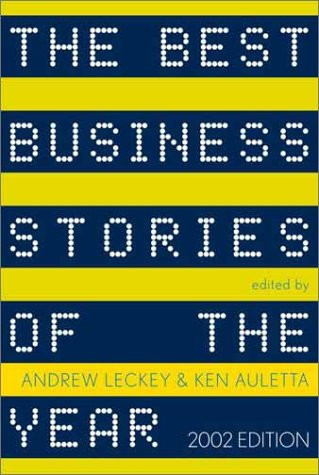
The Best Business Stories of the Year

Andrew Leckey,Ken Auletta
"[The editors] cast their net wide, picking up some excellent stories from nontraditional sources that even avid readers of the business press may have missed."-"USA Today," on the 2001 edition Series editor Andrew Leckey and guest editor Ken Auletta have scoured the print media, consulted with the editors of major business and general interest publications, and surveyed journalism school deans to find the best business stories from the last twelve months. Among those selected: Michael Lewis on teenage stock trader Jonathan Lebed, from "The New York Times Magazine"; James B. Stewart on the irrepressible Michael Milken, from "The New Yorker"; and many others from the pages of "The Wall Street Journal, Rolling Stone, Fortune, Rocky Mountain News, "and" Wired. " The second annual edition continues the excellence and comprehensive range of this fascinating anthology series.
Pantheon Books 2002 470 pages

Mr. & Mrs. Hollywood Edie and Lew Wasserman and Their Entertainment Empire

Kathleen Sharp
Ever wonder why so many B actors wind up as A-grade politicians? Or how the casting couch worked? Acclaimed author Kathleen Sharp traces the influence of show business through the lives of its first power couple. Edie and Lew Wasserman built the world's largest talent agency, MCA, created the multibillion-dollar Universal Studios, and helped shape Washington, DC. Starting from MCA's birth in gangland Chicago, Lew represented stars such as Jimmy Stewart and Marilyn Monroe; pioneered TV with Leave It to Beaver and Miami Vice ; spawned the blockbuster movie model with Psycho and Jaws ; and developed a mega-theme park. His savvy wife, Edie, was the daughter of a mob attorney, the queen of A-list parties, and Lew's secret agent who boosted their status. Yet, the couple was attacked by rivals, federal prosecutors, and their own protégés. Even so, over the course of seven decades they managed to vanquish their enemies and parlay their influence far beyond Sunset Strip into governors' mansions, Senate chambers, and the White House. At the end, Edie and Lew became diplomats, kingmakers, and philanthropists, who elevated the fortunes of middle-class workers and California itself. Based on some four hundred interviews, this book features Janet Leigh, Clark Gable, Grace Kelly, John Belushi, Jean Stein, and Steven Spielberg along with the Kennedys, the Johnsons, the Reagans, and the Clintons. It's a fascinating read about how two kids from Cleveland created the largest entertainment conglomerate in the world and wound up ruling twentieth-century America.
Blackstone Publishing 2017-12-05 538 pages

I've Got Your Back Coaching Top Performers from Center Court to the Corner Office

Brad Gilbert,James Kaplan
I've Got Your Back is filled with insider stories about the pressure- filled world of Grand Slam tennis. From the drama of the U.S. Open and Wimbledon to private moments on the practice court, Gilbert shares what really happens when an already great performer is determined to reach his absolute personal best.
Penguin Group (USA) Incorporated 2005-05 240 pages

World view: global strategies for the new economy

Garten,JeffreyE
How to Globalize to Survive in the New Economy At a time in which globalization impacts corporate strategy as never before, corporate leaders are challenged to consider all the implications of a new global economy. Characterized by a myriad of competing forces, this new global economy is highlighted by unprecedented advances in technology of all kinds. With such unrelenting change blurring the view, corporate leaders need the benefit of the best thinking in order to focus on the right global strategies. World View offers just such thinking, featuring examples of strategies and best practices used by successful companies worldwide in moving toward global markets. In his introduction to this collection of Harvard Business Review articles, editor Jeffrey Garten pinpoints five emerging themes: * Operating in a global market requires CEOs to rethink every aspect of their strategies. * The best strategies require that organizations gather massive amounts of information and process it effectively. * Companies that succeed on a global scale are constant innovators, learning and implementing simultaneously. * Great global companies create cultures conducive to extensive internal and external collaboration and networking. * Radical change brings unprecedented opportunity to capture markets and enhance shareholder value. Seeing globalization through the eyes of leading thinkers and executives who have mastered its challenges, World View presents forward-thinking insights for corporate leaders determined to succeed in the always-new and uncertain global economy. A Harvard Business Review Book.
Harvard Business School Press 2000-01-02 340 pages

Jefferson Davis's generals

G. S. Boritt
Confederate General P.G.T.Beauregard once wrote that ""no people ever warred for independence with more relative advantages than the Confederates."" If there was any doubt as to what Beauregard sought to imply, he later to chose to spell it out: the failure of the Confederacy lay with the Confederate president Jefferson Davis. In Jefferson Davis's Generals, a team of America's most distinguished Civil War historians present fascinating examinations of the men who led the South through the nation's bloodiest conflict, focusing in particular on Jefferson Davis's relationships with five key ge
Oxford University Press 2000 217 pages

When rabbis abuse: power, gender, and status in the dynamics of sexual abuse in Jewish culture

Sztokman, Elana Maryles
"The Jewish community has been rocked by shocking stories about rabbis and other community leaders sexually abusing their congregants, their students, or their coworkers. And the question on everyone's mind is: How is this happening? With a portrait of high profile figures, including their personality types and tactics, Dr. Sztokman's analysis is grounded in interviews with 84 abuse victims/survivors, Jewish communal professionals, and volunteers. The book documents how communal settings are ripe for abuse, how abusers coopt Jewish values as a grooming tactic, how high-profile abusers often receive high-profile support, and how the search for support and accountability often doubly victimizes the abused. Dr. Sztokman concludes with sweeping recommendations for social and cultural change, reminding us that we are not free to desist from action, especially not now." --
Lioness Books and Media 2022 421 pages

Doing capitalism in the innovation economy: reconfiguring the three-player game between markets, speculators and the state

Janeway, William H.
"Legendary economist Hyman Minsky identified author William H. Janeway as a 'theorist-practitioner' of financial economics; this book is an expression of that double life. Interweaving his unique professional perspective with political and financial history, Janeway narrates the dynamics of the innovation economy from the standpoint of a seasoned practitioner of venture capital, operating on the frontier where financial speculation intersects with novel technology. In this fully revised and updated edition, Janeway develops his theory that asset bubbles play a central role in financing technological innovation and that state investment in national goals enable the innovation process. Now, the Digital Revolution, sponsored by the state and funded by speculation, has matured to attack the authority, and even the legitimacy, of governments. The populist response in the West, especially in the United States, opens the door for China to seize leadership of the innovation economy from America"--
Cambridge University Press 2018 425 pages

Vicious circle: a novel of complicity

Littell, Robert
An Israeli government minister is assassinated in the home of his mistress, and in repsonse, Elihu, an ageing Mossad officer, leads his final raid, killing a Hamas leader in his bed. Out of this familiarly cyclical scenario emerges what is perhaps Robert Littell's most heartfelt and suspenseful novel. While the global community, united under the leadership of a visionary female US president, brokers a major compromise between Israel and the Palestinian authority, Isaac Apfulbaum, a well-known fundamentalist Rabbi, is taken hostage by Dr. al-Saath, a legendary Palestinian terrorist, who demands the release of several Palestinian prisoners. As Israel coaxes Elihu out of retirement to hunt down the terrorist who motivated his final mission, al-Saath and Apfulbaum fund themselves building an extraordinary relationship between hostage taker and hostage: parallels between these two battle-hardened partisans become the bonds that could lead to reconciliation. But with the Mossad strike team closing in, has the vicious circle already been closed?
Duckworth 2008-10-25 304 pages

The mystical origins of Hasidism

Elior, Rachel
The words ‘hasid’ and ‘hasidism’ have become so familiar to people interested in the Jewish world that little thought is given to understanding exactly what hasidism is or considering its spiritual and social consequences. What, for example, are the distinguishing features of hasidism? What innovations does it embody? How did its founders see it? Why did it arouse opposition? What is the essential nature of hasidic thought? What is its spiritual essence? What does its literature consist of? What typifies its leadership? What is the secret of its persistence through the centuries? How have scholars explained its origins? Is hasidism an expression of mystical ideas, or a response to changing social circumstances? What is its connection to kabbalah? To Shabateanism? To messianism? What is its relationship to the traditional structures of authority in the Jewish world? This book aims to answer all these questions in a lucid and accessible manner. Rachel Elior focuses on the fundamental positions and the factors of primary importance: the substantial issues that recur in the hasidic texts, including how hasidim have seen themselves over the centuries, how they have constructed a new spiritual and social ideal, and how that ideal has stood the test of reality. The goal is to present the main characteristics of the hasidic movement and to examine the social implications of its mystical ideas. The text is fully supported by references to the relevant hasidic sources and academic literature. The book concludes with a list of the hasidic texts on which the discussion is based and a comprehensive bibliography of scholarly works on kabbalah and hasidism.
Littman Library of Jewish Civilization 2006 258 pages

Civil War on Race Street The Civil Rights Movement in Cambridge, Maryland

Peter B. Levy
Civil War on Race Street, so named because Race Street was the road that divided blacks and whites in Cambridge, Maryland, is a detailed examination of one of the most vibrant locally based struggles for racial equality during the 1960s. Beginning with an overview of Cambridge, particularly its history of racial and class relations, Peter Levy traces the emergence of the modern civil rights movement in this city on Maryland's Eastern Shore. Catalyzed by the arrival of freedom in 1962, the movement in Cambridge expanded in 1963 and 1964 under the leadership of Gloria Richardson, one of the most prominent (and one of the few female) civil rights leaders in the nation. In the years after her departure from Cambridge, the movement went into decline until 1967, when it underwent a brief revival that culminated with a riot allegedly incited by black power spokesman H. Rap Brown. In the wake of the riot, blacks and whites in Cambridge sought to rebuild their city and return to a politics of moderation. However, Spiro Agnew, then governor of Maryland, used the riot to advance his political career and the fortunes of the New Right, thereby garnering the attention of the public (as well as Richard Nixon) and achieving the vice-presidency in 1968. At the same time, H. Rap Brown saw his influence and that of the civil rights movement decline.
University Press of Florida 2003-01-31 264 pages

Russian peasants and Soviet power: a study of collectivization

Lewin, Moshe
The collectivization of the peasants in the USSR constituted a social upheaval of a totally unprecedented nature. It was one of the most remarkable events of the present century and it has a history as long as that of Soviet power itself. The idea of a collectivized agriculture, much favoured by the leadership after the revolution, had been left in abeyance during the NEP period. Interest in the idea, and in the collective movement, revived at the time of the 'grain crisis' at the beginning of 1928. It was during this crisis that collectivization of the peasantry and the creation of a powerful kolkhoz and sovkhoz sector began to be taken seriously as a means of solving, at one and the same time, both the formidable problem of grain and the whole 'accursed problem' of relations between the Soviet authorities and the peasants.
Norton 1975 539 pages