560 results for "Physics"

Lectures on the infrared structure of gravity and gauge theory

Strominger, Andrew
A short, graduate-level synthesis of recent developments in theoretical physics, from a pioneer in the field Lectures on the Infrared Structure of Gravity and Gauge Theory presents an accessible, graduate-level synthesis of a frontier research area in theoretical physics. Based on a popular Harvard University course taught by the author, this book gives a concise introduction to recent discoveries concerning the structure of gravity and gauge theory at very long distances. These discoveries unite three disparate but well-developed subjects in physics. The first subject is the soft theorems, which were found by particle physicists in the 1950s to control the behavior of low-energy photons and are essential for all collider predictions. The second subject is asymptotic symmetries, found by general relativists in the 1960s to provide a surprising, infinite number of exact relations between distinct physical phenomena. The third subject is the memory effect, the measurement of which is sought in upcoming gravitational wave observations. An exploration of the physical and mathematical equivalence of these three subjects has provided a powerful new perspective on old results and led to a plethora of new results, involving symmetries of QED, gluon scattering amplitudes, flat-space holography in quantum gravity, black hole information, and beyond. Uniquely connective and cutting-edge, Lectures on the Infrared Structure of Gravity and Gauge Theory takes students and scholars to the forefront of new developments in the discipline. Materials are presented in a "lecture notes" style with problem sets included Concise and accessible pedagogical approach Topics include soft theorems, the memory effect, asymptotic symmetries with applications to QED, Yang-Mills theory, quantum gravity, and black holes
Princeton University Press 2018 184 pages

Quantum theory of optical coherence: selected papers and lectures

Glauber, Roy J.
A summary of the pioneering work of Glauber in the field of optical coherence phenomena and photon statistics, this book describes the fundamental ideas of modern quantum optics and photonics in a tutorial style. It is thus not only intended as a reference for researchers in the field, but also to give graduate students an insight into the basic theories of the field. Written by the Nobel Laureate himself, the concepts described in this book have formed the basis for three further Nobel Prizes in Physics within the last decade.
Wiley-VCH 2007-04-09 639 pages

Endless Universe (Abandoned): Rewriting Cosmic History

Steinhardt, Paul J. & Neil Turok
Two world-renowned scientists present an audacious new vision of the cosmos that “steals the thunder from the Big Bang theory.” — Wall Street JournalThe Big Bang theory—widely regarded as the leading explanation for the origin of the universe—posits that space and time sprang into being about 14 billion years ago in a hot, expanding fireball of nearly infinite density. Over the last three decades the theory has been repeatedly revised to address such issues as how galaxies and stars first formed and why the expansion of the universe is speeding up today. Furthermore, an explanation has yet to be found for what caused the Big Bang in the first place.In Endless Universe , Paul J. Steinhardt and Neil Turok, both distinguished theoretical physicists, present a bold new cosmology. Steinhardt and Turok “contend that what we think of as the moment of creation was simply part of an infinite cycle of titanic collisions between our universe and a parallel world” ( Discover ). They recount the remarkable developments in astronomy, particle physics, and superstring theory that form the basis for their groundbreaking “Cyclic Universe” theory. According to this theory, the Big Bang was not the beginning of time but the bridge to a past filled with endlessly repeating cycles of evolution, each accompanied by the creation of new matter and the formation of new galaxies, stars, and planets.Endless Universe provides answers to longstanding problems with the Big Bang model, while offering a provocative new view of both the past and the future of the cosmos. It is a “theory that could solve the cosmic mystery” ( USA Today ).
Doubleday 2006 224 pages

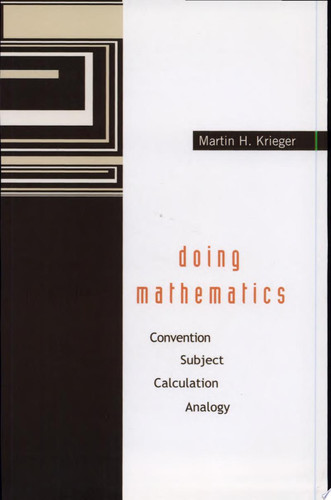
Doing mathematics: convention, subject, calculation, analogy

Krieger, Martin H.
This book discusses some ways of doing mathematical work and the subject matter that is being worked upon and created. It argues that the conventions we adopt, the subject areas we delimit, what we can prove and calculate about the physical world, and the analogies that work for mathematicians--all depend on mathematics, what will work out and what won't. And the mathematics, as it is done, is shaped and supported, or not, by convention, subject matter, calculation, and analogy. The causes studied include the central limit theorem of statistics, the sound of the shape of a drum, the connection between algebra and topology, the stability of matter, the Ising model, and the Langlands Program in number theory and representation theory. Contents: Convention: How Means and Variances are Entrenched as Statistics; Subject: The Fields of Topology; Appendix: The Two-Dimensional Ising Model of a Ferromagner; Calculation: Strategy, Structure, and Tactics in Applying Classical Analysis; Analogy; A Syzygy Between a research Program in Mathematics and a Research Program in Physics, Each of Which is Itself an Analogy; Mathematics in Concreto. Readership: Mathematicians, Physicists, philosophers and historians of science.
World Scientific 2003 454 pages

Principles of the theory of solids

Ziman, J. M.
Professor Ziman's classic textbook on the theory of solids was first pulished in 1964. This paperback edition is a reprint of the second edition, which was substantially revised and enlarged in 1972. The value and popularity of this textbook is well attested by reviewers' opinions and by the existence of several foreign language editions, including German, Italian, Spanish, Japanese, Polish and Russian. The book gives a clear exposition of the elements of the physics of perfect crystalline solids. In discussing the principles, the author aims to give students an appreciation of the conditions which are necessary for the appearance of the various phenomena. A self-contained mathematical account is given of the simplest model that will demonstrate each principle. A grounding in quantum mechanics and knowledge of elementary facts about solids is assumed. This is therefore a textbook for advanced undergraduates and is also appropriate for graduate courses.
Cambridge University Press 1972 435 pages

The spiritual universe: one physicist's vision of spirit, soul, matter, and self

Wolf, Fred Alan
Why do we believe in the soul? Does it actually exist? If so, what is it? Does it differ from the self? Is it part of the material world? Does it survive the body after death?In The Spiritual Universe, Fred Alan Wolf brings the most modern perspective of quantum physics to the most ancient questions of religion and philosophy. Taking the reader on a fascinating tour of both Western and Eastern tho[Bokinfo]
Moment Point Press 1999 325 pages

Quantum theory: concepts and methods

Peres, Asher
This book will be useful to anyone who wants to understand the use of quantum theory for the description of physical processes. It is a graduate level text, ideal for independent study, and includes numerous figures, exercises, bibliographical references, and even some computer programs. The first chapters introduce formal tools: the mathematics are precise, but not excessively abstract. The physical interpretation too is rigorous. It makes no use of the uncertainty principle of other ill-defined notions. The central part of the book is devoted to Bell's theorem and to the Kochen-Specker theorem. It is here that quantum phenomena depart most radically from classical physics. There has recently been considerable progress on these issues, and the latest developments have been included. The final chapters discuss further topics of current research: spacetime symmetries, quantum thermodynamics and information theory, semiclassical methods, irreversibility, quantum chaos, and especially the measuring process. In particular, it is shown how modern techniques allow the extraction of more information from a physical system than traditional measurement methods. For physicists, mathematicians and philosophers of science with an interest in the applications and foundations of quantum theory. The volume is suitable as a supplementary graduate textbook.
Kluwer Academic Publishers 1995-09-30 446 pages

It Ain't Necessarily So... Bro

Karl Kruszelnicki
In the next book in Dr Karl's mega-selling science series, Australia's favourite scientist answers more curly questions about life, the universe and everything; questions such as Are virgin births possible? (they are) Will a black hole suck you in? (it won't) Is the most radioactive device in our homes the microwave? (it's not, it's the smoke detector)No-one conveys the excitement and wonder of science quite like Dr Karl and this, his twenty-fifth book, takes us on another thoroughly entertaining exploration of the world around us. If you like your science fun and unpredictable, don't miss this new addition to the Dr Karl library.
HarperCollins 2006 227 pages

Dr Karl's Random Road Trip Through Science

Karl Kruszelnicki
In this, his 45th book, Dr Karl goes full kolour, with brilliant and funny illustrations to match his dress sense. So take a technikolour trip through science with the intrepid Dr Karl, Australia's favourite science guru. Q: HOW MANY DR KARL BOOKS ARE THERE IN THE UNIVERSE? A: MORE THAN A MILLION! Dr Karl is on a mission to track down Awe and Wonder in the Universe. Why do wombats poo cubes? What nearly destroyed humanity on Halloween 2015? How do you use an incinerating toilet? Find out why we've sent a spacecraft with Dr Karl's name on it to kiss the Sun, whether cannibalism is nutritious, and the answer to the Biggeset Question of All - why does spaghetti always break into three pieces? Plus a whole lot more. So strap in and get ready for a random ride through the Universe. Who knows where you'll end up!
ABC Books 2024-05 192 pages

Science and religion: are they compatible?

Paul Kurtz
In recent years a noticeable trend toward harmonizing the distinct worldviews of science and religion has become increasingly popular. Despite marked public interest, many leading scientists remain skeptical that there is much common ground between scientific knowledge and religious belief. Indeed, they are often antagonistic. Can an accommodation be reached after centuries of conflict?In this stimulating collection of articles on the subject, Paul Kurtz, with the assistance of Barry Karr and Ranjit Sandhu, have assembled the thoughts of scientists from various disciplines. Among the distinguished contributors are Sir Arthur C. Clarke (author of 2001: A Space Odyssey, and numerous other works of science fiction); Nobel Prize Laureate Steven Weinberg (professor of physics at the University of Texas at Austin); Neil deGrasse Tyson (Princeton University astrophysicist and director of the Hayden Planetarium); James Lovelock (creator of the Gaia hypothesis); Kendrick Frazier (editor of the Skeptical Inquirer); Steven Pinker (professor of psychology at MIT); Richard Dawkins (zoologist at Oxford University); Eugenie Scott (physical anthropologist and executive director of the National Center for Science Education); Owen Gingerich (professor of astronomy at Harvard University); Martin Gardner (prolific popular science writer); the late Richard Feynman (Nobel Prize-winning physicist) and Stephen Jay Gould (professor of geology at Harvard University); and many other eminent scientists and scholars.Among the topics discussed are the Big Bang and the origin of the universe, intelligent design and creationism versus evolution, the nature of the "soul," near-death experiences, communication with the dead, why people do or do not believe in God, and the relationship between religion and ethics.
Prometheus Books 2003-04 366 pages

Foundations of modern physics

Weinberg, Steven
"In addition to his ground-breaking research, Nobel Laureate Steven Weinberg is known for a series of highly praised texts on various aspects of physics, combining exceptional physical insight with a a gift for clear exposition. Describing the foundations of modern physics in their historical context and with some new derivations, Weinberg introduces topics ranging from early applications of atomic theory through thermodynamics, statistical mechanics, transport theory, special relativity, quantum mechanics, nuclear physics, and quantum field theory. This volume provides the basis for advanced undergraduate and graduate physics courses as well as being a handy introduction to aspects of modern physics for working scientists"--
Cambridge University Press 2021-04-22 310 pages

Physics: the first science

Lindenfeld, Peter
Today's physics textbooks have become encyclopedic, offering students dry discussions, rote formulas, and exercises with little relation to the real world. Physics: The First Science takes a different approach by offering uniquely accessible, student-friendly explanations, historical and philosophical perspectives and mathematics in easy-to-comprehend dialogue. It emphasizes the unity of physics and its place as the basis for all science. Examples and worked solutions are scattered throughout the narrative to help increase understanding. Students are tested and challenged at the end of each chapter with questions ranging from a guided-review designed to mirror the examples, to problems, reasoning skill building exercises that encourage students to analyze unfamiliar situations, and interactive simulations developed at the University of Colorado. With their experience instructing both students and teachers of physics for decades, Peter Lindenfeld and Suzanne White Brahmia have developed an algebra-based physics book with features to help readers see the physics in their lives. Students will welcome the engaging style, condensed format, and economical price.
Rutgers University Press 2011 366 pages

Soft Matter Physics: An Introduction

Kleman, Maurice,Laverntovich, Oleg D.
Introductions to solid state physics have, ever since the initial book by F. Seitz in 1940, concentrated on simple crystals, with few atoms per cell, bonded together by strong ionic, covalent, or metallic bonds. References to weaker bonds, such as van der Waals forces in rare gases, or to geometric or chemical disorder (e.g., alloys or glasses) have been limited. The physical understanding of this ?eld started well before Seitz’s book and led to a number of Nobel prizes after the last war. Applications cover classical metallurgy, el- tronics, geology and building materials, as well as electrical and ionic transport, chemical reactivity, ferroelectricity and magnetism. But in parallel with this general and well publicized trend, and sometimes earlier as far as physical concepts were concerned, an exploration and increasingly systematic study of softer matter has developed through the twentieth century. More often in the hands of physical chemists and crystallographers than those of pure physicists, the ?eld had for a long time a reputation of complexity. If progress in polymers was steady but slow, interest in liquid crystals had lain dormant for forty years, after a bright start lasting through 1925, to be revived in the late 1960s based on their possible use in imaging techniques. The optoelectronic properties of the ?eld in general are even more recent.
Springer 2013-04-25 672 pages

Heat and Thermodynamics

Mark W. Zemansky
This respected text deals with large-scale, easily known thermal phenomena and then proceeds to small-scale, less accessible phenomena. The wide range of mathematics used in Dittman and Zemansky's text simultaneously challenges students who have completed a course in impartial differential calculus without alienating those students who have only taken a calculus-based general physics course. Examples of calculations are presented shortly after important formulas are derived. Students see the solutions of problems related to the formulas. Actual thermodynamic experiments are explained in detail. The student sees the applicability of abstract thermodynamic concepts and formulas to real situations.
McGraw-Hill Education 1997 487 pages

Twenty Lectures on Thermodynamics

Buchdahl, H. A.
Twenty Lectures on Thermodynamics is a course of lectures, parts of which the author has given various times over the last few years. The book gives the readers a bird's eye view of phenomenological and statistical thermodynamics. The book covers many areas in thermodynamics such as states and transition; adiabatic isolation; irreversibility; the first, second, third and Zeroth laws of thermodynamics; entropy and entropy law; the idea of the application of thermodynamics; pseudo-states; the quantum-static al canonical and grand canonical ensembles; and semi-classical gaseous systems. The text is recommended for physics students who are in need of a basic yet effective knowledge in the foundations of thermodynamics, as the book explains its many concepts in such an elementary and pedagogic manner, giving the readers a greater understanding of the core of the subject.
Pergamon 2013-12-28 114 pages

Supersonic Flow and Shock Waves

Richard Courant,K.O. Friedrichs
The Springer edition of this book is an unchanged reprint of Courant and Friedrich's classical treatise which was first published in 1948. The basic research for it took place during World War II, but there are many aspects which still make the book interesting as a text and as a reference. It treats basic aspects of the dynamics of compressible fluids in mathematical form, and attempts to present a systematic theory of nonlinear wave propagation, particularly in relation to gas dynamics. Written in the form of an advanced textbook, it accounts for classical as well as some fairly recent developments. The authors intend their audience to be engineers, physicists and mathematicians alike.
Springer New York 2012-11-17 464 pages

Introduction to the Theory of Relativity

Peter Gabriel Bergmann
This work has been selected by scholars as being culturally important and is part of the knowledge base of civilization as we know it. This work is in the public domain in the United States of America, and possibly other nations. Within the United States, you may freely copy and distribute this work, as no entity (individual or corporate) has a copyright on the body of the work. Scholars believe, and we concur, that this work is important enough to be preserved, reproduced, and made generally available to the public. To ensure a quality reading experience, this work has been proofread and republished using a format that seamlessly blends the original graphical elements with text in an easy-to-read typeface. We appreciate your support of the preservation process, and thank you for being an important part of keeping this knowledge alive and relevant.
Creative Media Partners, LLC 2021-09-09 312 pages

Uncommon Sense

J. Robert Oppenheimer
J. Robert Oppenheimer, a leading physicist in the Manhattan Project, recognized that scientific inquiry and discovery could no longer be separated from their effect on political decision-making, social responsibility, and human endeavor in general. He openly addressed issues of common concern and as a scientist accepted the responsibility brought about by nuclear physics. This collection of essays and speeches, only a few of which have been previously published, presents an extraordinary thinker and scientist as well as a compassionate human being. No issue is too small or too large if it is in some way connected to the emergence of a weapon as terrible and powerful as the atom bomb. Oppenheimer discusses the shift in scientific awareness and its impact on education, the question of openness in a society forced to keep secrets, the conflict between individual concerns and public and political necessity, the future of science and its effects on future politics---in short, the common and uncommon sense we find in our modern day reality. Uncommon Sense presents a responsible scientist and a concerned man who foresaw the problems the discovery of fission would create. And we should no neglect to read between the lines: The peak of Oppenheimer’s career coincided with the McCarthy era, the repercussions of which strongly affected his personal and professional life. The themes of openness and freedom becomes, therefore, recurring concerns in this collection of essays and speeches.
Birkhäuser Boston 2012-03-08 196 pages