776 results for "Science"

Psychology and the Soul

Otto Rank
2011 Reprint of 1950 Translation by William Turner. Full facsimile of the original edition, not reproduced with Optical Recognition Software. Recommended, both as a fascinating and little-known document in the history of psychology and as a provocative reading of the history of psychology. (Religious Studies Review). Will interest many students of the history of psychoanalysis... Rank's conclusions contribute to present-day controversies about the status of psychoanalysis as a science. (Psychiatric Times ) The first complete English translation of a work that Rank published in 1930. It draws on anthropology, sociology, mythology, religion, philosophy, history, and literature to chart the development of the human psyche... The book's antimaterialistic passion makes it a compelling counterpoint to the stern biology of our own age, and the bounds it sets to what psychoanalysis can claim are justly drawn. (Wilson Quarterly ) Unquestionably Rank's most important work... This new translation is an effort to create a Rank for our millennium... [and it] reads elegantly and comfortably in English... The argument is complex and intricate, consisting of a long historical/ethnographic sweep that takes us from a 'primitive' state, via animism through the Christian or sexual era to the scientific era and modern development of psychology... Along the way we find traces of many of Rank's other brilliant psychological surveys -- the double, Don Juan, heroes' birth myths, the theme of incest -- woven into this massive canvas and viewed on the largest scale... Throughout this book, the grand tapestry is set with some remarkable gems of observation. (Naomi Segal Psychoanalysis and History ) This is the first complete translation of Otto Rank's fascinating text on the nature and history of the concept of the Soul and Will in the psychological history of humankind... a tour de force in vigour, scope and application to many contemporary issues such as sexual behaviors, the nature of dreaming, incest prohibitions and narcissism, to name but a few. (L.R. Edgar Journal of the Royal Anthropological Society ) In his last years, Otto Rank turned his lifetime of thought and learning toward two of the most difficult topics in human history: religion and the soul. The result was this now-classic work, available in this new, very accessible English translation. Unlike many other intellectuals of the twentieth century, Rank maintains a place for the soul rather than dismissing it as a fantasy. The soul and the beliefs about it, he argues, set forth the foundation for psychology, with its complex analyses of consciousness, self-consciousness, and personality. Rank's commentary is not limited to beliefs about individual souls but includes ideas about group souls, sometimes encompassing nations or generations. Rank suggests that it is in expression of group beliefs that the idea of the soul attains its greatest power. What is the soul? Otto Rank treats it as a universal and essential belief for individuals and their societies, constant in function but evolving in form through millennia. To borrow a post-Rankian metaphor, the soul was created in the big bang of irresistible psychological force colliding with immutable biological fact-our will to live forever against death. The collision creates a spark in our individual and social consciousness which through history has become both consolation and inspiration: the immortal soul. All ideologies reflect this phenomenon and modify its expression to suit the era. Otto Rank wrote before the atom bomb or television, both of which alter our perception of death without changing the fact. Rank's introduction of the soul as an essential part of contemporary psychology helps explain a number of perplexing, irrational phenomena in contemporary life.
Martino Fine Books 2011 206 pages

Spinoza, atheist

Nadler, Steven
"In 1656, a young Amsterdam merchant was excommunicated by his Portuguese-Jewish community in the harshest terms it had ever used. Baruch Spinoza was accused of unspecified "horrifying heresies," but the precise reasons for his expulsion remain a mystery. When he published his Theological-Political Treatise in 1670, which was condemned as "the most atheistic book ever written," he began to reveal to the world what his heresies may have been. Yet ever since the eighteenth century, most readers and scholars have assumed that Spinoza was a pantheist--even a "God-intoxicated man," as the poet Novalis put it. After all, how could a person whose books are suffused with talk of God be an atheist? In Spinoza, Atheist, Steven Nadler, one of the world's leading authorities on the philosopher, aims to settle the question and show that that's exactly what he was. Nadler makes a powerful case that there is no real divinity for Spinoza. God is Nature, and isn't an object of worshipful awe or religious reverence but can only be understood through philosophy and science. There is nothing supernatural--no mystery, ineffability, or sublimity. Spinoza does speak of "blessedness" and "salvation," but these, too, are to be understood in natural and rational terms, as the peace of mind and happiness that come from understanding ourselves and the world. Whether Spinoza believed in God is a fascinating and enduring controversy. Spinoza, Atheist promises to transform our understanding of his views and to make clear just how radical a thinker he was and remains."--
Princeton University Press 2026-04-07 244 pages

The dialectical biologist

Levins, Richard
Scientists act within a social context and from a philosophical perspective that is inherently political. Whether they realize it or not, scientists always choose sides. The Dialectical Biologist explores this political nature of scientific inquiry, advancing its argument within the framework of Marxist dialectic. These essays stress the concepts of continual change and codetermination between organism and environment, part and whole, structure and process, science and politics. Throughout, this book questions our accepted definitions and biases, showing the self-reflective nature of scientific activity within society.
Harvard University Press 1985 303 pages

Philosophy in turbulent times: Canguilhem, Sartre, Foucault, Althusser, Deleuze, Derrida

Roudinesco, Elisabeth
For Elisabeth Roudinesco, a historian of psychoanalysis and one of France's leading intellectuals, Canguilhem, Sartre, Foucault, Althusser, Deleuze, and Derrida represent a "great generation" of French philosophers who accomplished remarkable work and lived incredible lives. These troubled and innovative thinkers endured World War II and the cultural and political revolution of the 1960s, and their cultural horizon was dominated by Marxism and psychoanalysis, though they were by no means strict adherents to the doctrines of Marx and Freud. Roudinesco knew many of these intellectuals personally, and she weaves an account of their thought through lived experience and reminiscences. Canguilhem, for example, was a distinguished philosopher of science who had a great influence on Foucault's exploration of sanity and madness-themes Althusser lived in a notorious personal drama. And in dramatizing the life of Freud for the screen, Sartre fundamentally altered his own philosophical approach to psychoanalysis. Roudinesco launches a passionate defense of Canguilhem, Sartre, Foucault, Althusser, Deleuze, and Derrida against the "new philosophers" of the late 1970s and 1980s, who denounced the work-and sometimes the private lives-of this great generation. Roudinesco refutes attempts to tar them, as well as the Marxist and left-wing tradition in general, with the brush of Soviet-style communism. In Freudian theory and the philosophy of radical commitment, she sees a bulwark against the kind of manipulative, pill-prescribing, and normalizing psychology that aims to turn individuals into mindless consumers. Intense, clever, and persuasive, Philosophy in Turbulent Times captivates with the dynamism of French thought in the twentieth century.
Columbia University Press 2008 184 pages

Tradition

Shils, Edward
Tradition, by esteemed sociologist Edward Shils, was the first book to fully explore the history, significance, and future of tradition as a whole. Intent on questioning the meaning of the antitraditionalist impulse in today's society, Shils argues here that the tendency to distrust and rebel against tradition is at the heart of tradition itself; only through suspicion and defiance does tradition actually move forward. Revealing the importance of tradition to social and political institutions, technology, science, literature, religion, and scholarship, Tradition remains the definitive work on this vital element of our society.--provided by publisher
University of Chicago Press 1981 334 pages

How to Educate a Citizen The Power of Shared Knowledge to Unify a Nation

Jr. E. D. Hirsch
"Profound, vital and correct. Hirsch highlights the essence of our American being and the radical changes in education necessary to sustain that essence. Concerned citizens, teachers, and parents take note! We ignore this book at our peril."-- Joel Klein, former Chancellor of New York City Public Schools Now in paperback, the bestselling author of Cultural Literacy delivers a powerful manifesto on the failures of America's early education system and its impact on our current national malaise, advocating for a shared knowledge curriculum students everywhere can be taught--an educational foundation that can help improve and strengthen America's unity, identity, and democracy. In How to Educate a Citizen, E.D. Hirsch continues the conversation he began thirty years ago with his classic bestseller Cultural Literacy, urging America's public schools, particularly at the elementary level, to educate our children more effectively to help heal and preserve the nation. Since the 1960s, our schools have been relying on "child-centered learning." History, geography, science, civics, and other essential knowledge have been dumbed down by vacuous learning "techniques" and "values-based" curricula; indoctrinated by graduate schools of education, administrators and educators have believed they are teaching reading and critical thinking skills. Yet these cannot be taught in the absence of strong content, Hirsch argues. The consequence is a loss of shared knowledge that would enable us to work together, understand one another, and make coherent, informed decisions. A broken approach to school not only leaves our children under-prepared and erodes the American dream but also loosens the spiritual bonds and unity that hold the nation together. Drawing on early schoolmasters and educational reformers such as Noah Webster and Horace Mann, Hirsch charts the rise and fall of the American early education system and provides a blueprint for closing the national gap in knowledge, communications, and allegiance. Critical and compelling, How to Educate a Citizen galvanizes our schools to equip children with the power of shared knowledge.
HarperCollins Publishers 2021-09-07 224 pages

Religions, Values, and Peak-Experiences

Abraham H. Maslow
Proposing religious experience as a legitimate subject for scientific investigation, Maslow studies the human need for spiritual expression. About the Author Abraham H. Maslow taught at Brooklyn College and the Western Behavioral Sciences Institute, and was Chairman of the Department of Psychology at Brandeis University. From 1967 to 1968 he was Preseident of the American Psychological Association. Dr. Maslow was one of the foremost spokesmen of the humanistic, or "Third Force," psychologies, and author of many books and articles, including Toward a Psychology of Being, The Psychology of Science, and Religions, Values, and Peak-Experiences.
www.bnpublishing.com 2019-10-07 122 pages

Men And Politics

Fischer, Louis
This scarce antiquarian book is a facsimile reprint of the original. Due to its age, it may contain imperfections such as marks, notations, marginalia and flawed pages. Because we believe this work is culturally important, we have made it available as part of our commitment for protecting, preserving, and promoting the world's literature in affordable, high quality, modern editions that are true to the original work.
Kessinger Publishing, LLC 2010-09-10 682 pages

Utopia as method: the imaginary reconstruction of society

Levitas, Ruth
"In this major new work by one of the leading writers on Utopian Studies, Ruth Levitas argues that a prospective future of ecological and economic crises poses a challenge to the utopian imaginary, to conceive a better world and alternative future. Utopia as Method does not construe utopia as goal or blueprint, but as a holistic, reflexive method for developing what those possible futures might be. It begins by treating utopia as the quest for grace, through a hermeneutics that recovers the utopian meaning in our culture, explored through colour and music. Moving from the existential to the social, it draws on H.G. Wells's claim that the creation of utopias is the distinctive and proper method of sociology, and on the tentative reappearance of utopia in contemporary social theory. It proposes a constructive method, the Imaginary Reconstitution of Society. This fusion of explicitly normative social theory and analytic critique rehabilitates utopia as an integral part of sociology, and offers a means of collective engagement in shaping a better tomorrow."--Publisher's description.
Palgrave Macmillan 2013 268 pages

The craftsman

Sennett, Richard
Defining craftsmanship far more broadly than "skilled manual labor," Richard Sennett maintains that the computer programmer, the doctor, the artist, and even the parent and citizen engage in a craftsman's work. Craftsmanship names the basic human impulse to do a job well for its own sake, says the author, and good craftsmanship involves developing skills and focusing on the work rather than ourselves. In this thought-provoking book, one of our most distinguished public intellectuals explores the work of craftsmen past and present, identifies deep connections between material consciousness and ethical values, and challenges received ideas about what constitutes good work in today's world. The Craftsman engages the many dimensions of skill--from the technical demands to the obsessive energy required to do good work. Craftsmanship leads Sennett across time and space, from ancient Roman brickmakers to Renaissance goldsmiths to the printing presses of Enlightenment Paris and the factories of industrial London; in the modern world he explores what experiences of good work are shared by computer programmers, nurses and doctors, musicians, glassblowers, and cooks. Unique in the scope of his thinking, Sennett expands previous notions of crafts and craftsmen and apprises us of the surprising extent to which we can learn about ourselves through the labor of making physical things --
Yale University Press 2008 326 pages

For a New Liberty The Libertarian Manifesto

Murray N. Rothbard
In For a New Liberty: The Libertarian Manifesto, Rothbard proposes a once-and-for-all escape from the two major political parties, the ideologies they embrace, and their central plans for using state power against people. Libertarianism is Rothbard's radical alternative that says state power is unworkable and immoral and ought to be curbed and finally overthrown.To make his case, Rothbard deploys his entire system of thought: natural law, natural rights, Austrian economics, American history, the theory of the state, and more.It is relentless, scientific, analytical, and morally energetic — a book that makes an overwhelming case. Indeed, it gave an entire movement its intellectual consciousness and earned Rothbard the titles "Mr. Libertarian" and "The State's Greatest Living Enemy."Society without the nation-state? Rothbard shows that this is the way for peace, prosperity, security, and freedom for all. In the entire history of libertarian ideas, no book has more successfully combined ideological rigor, theoretical exposition, political rhetoric, historical illustration, and strategic acumen. Rothbard poured a lifetime of research and all his intellectual energy into this project and he succeeded in writing a classic.The book is the result of the only contract Rothbard ever received from a mainstream commercial publisher. He was asked to sum up the whole of the libertarian creed. Looking at the original manuscript, which was nearly complete after its first draft, it seems that it was a nearly effortless joy for him to write. It is seamless, unrelenting, and full of life.He cut no corners and pulled no punches. It appeared in 1973 and created a whole movement that set out to crush the political monopoly.In subject after subject, this book is informative, bracing, and challenging. It also features the characteristically clear writing style for which Rothbard is famous, which stemmed from his organized thinking and passionate drive to teach and change the world.The book begins with American history to show that the revolution of 1776 was the most libertarian of any in history. The pastors, pamphleteers, and statesmen who led it held that the state has no rights that the people themselves do not possess. They demanded full liberty, not some truncated version that existed in the old world. In this discussion, the reader comes to appreciate the founders of the United States of America as never before.Rothbard then sets out to rekindle that fire, first through a discussion of the philosophy and ethics of freedom. The central axiom: no man or group of men may aggress against the person and property of anyone else. He justifies the axiom on the basis of natural rights. It is an axiom that has few opponents, until Rothbard spells out its implications: taxation is theft, conscription is slavery, and war is mass murder, among many other points.Bracing indeed! But the state is the primary violator of this simple axiom. It presumes the right to rob and kill while purporting to protect us from robbing and killing. Thus follows a full theory of the state, how it gains and maintains controls over the population (but not through a "social contract"!), the various failed methods for keeping it in check (not even constitutions work!), its operations and tendencies to work its evil (it never has enough power), and how intellectuals become co-opted by the forces of state power.The book is still regarded as "dangerous" precisely because, once the exposure to Rothbardianism takes place, no other book on politics, economics, history, or sociology can be read the same way again.
Ludwig von Mises Institute 2020 420 pages

The Sword of Moses An Ancient Book of Magic

Gaster, M.
The Sword of Moses: An Ancient Book of Magic by M. Gaster is a comprehensive study of an ancient Jewish magical text known as the Sword of Moses. The book explores the origins, history, and contents of this fascinating text, which is believed to date back to the 6th or 7th century CE. The Sword of Moses contains a variety of magical spells and incantations, including those for healing, protection, and divination. The book also includes detailed analysis of the text's language, structure, and symbolism, as well as its relationship to other Jewish magical traditions. The author provides extensive historical and cultural context for the Sword of Moses, drawing on a wide range of sources from Jewish and non-Jewish traditions. The Sword of Moses: An Ancient Book of Magic is a must-read for anyone interested in the history of Jewish magic and mysticism.1896. From a unique manuscript. With introduction, translation, an index of mystical names, and a facsimile. A Gnostic text, originally in Hebrew, discusses the names of God, which are thought by Kabbalists to have magical powers. With a complete original version and a facsimile of the original papyrus.This scarce antiquarian book is a facsimile reprint of the old original and may contain some imperfections such as library marks and notations. Because we believe this work is culturally important, we have made it available as part of our commitment for protecting, preserving, and promoting the world's literature in affordable, high quality, modern editions, that are true to their original work.
Kessinger Publishing, LLC 2010-09-10 96 pages

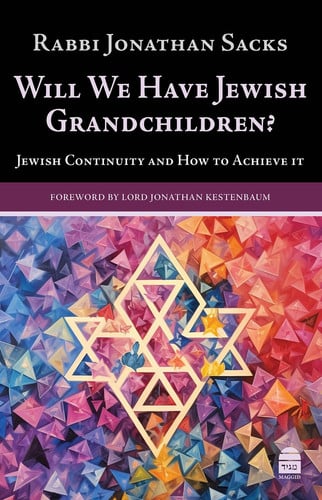
Will We Have Jewish Grandchildren?

Sacks, Jonathan
The Jewish people, having survived for thousands of years in the most adverse circumstances, including the Holocaust and horrific terrorist attacks, is today also threatened by intermarriage and assimilation. Jewish communities throughout the diaspora are experiencing demographic decline: Why has this happened, and can anything be done to reverse the trend? Times have changed and that, in consequence, communal priorities need to change also.In Will We Have Jewish Grandchildren?, Rabbi Sacks issues an inspiring summons to collective action to counteract the prevailing trend of assimilation and hand on the age-old faith and traditions to a new generation.
Maggid 2024-07-15 176 pages

Knowledge and practical interests

Stanley, Jason
"Jason Stanley presents a startling and provocative claim about knowledge: that whether or not someone knows a proposition at a given time is in part determined by his or her practical interests. Whether a true belief is knowledge is not merely a matter of supporting beliefs or reliability; in the case of knowledge, practical rationality and theoretical rationality are intertwined. Stanley defends this thesis against alternative accounts of the phenomena that motivate it, such as the claim that knowledge attributions are linguistically context-sensitive (contextualism about knowledge attributions), and the claim that the truth of a knowledge claim is somehow relative to the person making the claim (relativism about knowledge)."--BOOK JACKET.
Clarendon 2007-11-15 191 pages

A Little Book on Love

Jacob Needleman
A Los Angeles Times Healthy Bestseller and winner of the Body Mind Spirit magazine Award of Excellence. A LITTLE BOOK ON LOVE explores the great works of philosophy, myth, and sacred wisdom. Written by philosopher Jacob Needleman, it offers a bold new interpretation of why two people are brought together in the miracle called love. In A LITTLE BOOK ON LOVE, Needleman uses eclectic sources to explain the essence and nature of the miracle that is love. From the radiant poetry of the great Sufi mystic Rumi to the revelations of Saint Paul, Needleman guides readers on an enthralling journey of discovery. Resonating with hope and wisdom, A LITTLE BOOK ON LOVE demonstrates that true love can transcend both time and the mundane to become a precious resource for anyone who wants a relationship to last a lifetime--and beyond.
Dell Books (Paperbacks) 2003-10-01

Essays in Legal and Moral Philosophy

Kelsen, H.
In his choice of texts, the Editor has been faced with the difficult task of selecting, from among the author's more than 600 publications, those of the greatest philosophical interest. It is chiefly the topics of value-rela tivism and the logic of norms that have been kept in view. The selection has also been guided by the endeavour to reprint, so far as possible, texts which have not hitherto appeared in English. At times, however, this aim has had to be discarded, in order to include works of key im portance and also the latest expressions of Kelsen's view. In addition to the two topics already mentioned, the Editor has con sidered Kelsen's discussions of the causal principle to be so far worthy of philosophical attention, that some writings on causality and account ability have been included in this collection of philosophical studies. OTA WEINBERGER Hans Kelsen died on April 19th, 1973. Only his work now lives, for the inspiration of future generations of jurists and philosophers. Graz, 25th April, 1973 OT A WEINBERGER TRANSLATOR'S NOTE I am obliged to the Editor for his careful scrutiny of the translation, which has led to a number of corrections and improvements in the text.
Springer 2011-12-09 340 pages

The philosophical correspondence of David Armstrong and David Lewis

Armstrong, David M.,Lewis, David Kellogg
"This is the complete philosophical correspondence between two of the leading analytic philosophers of the late twentieth century, David Armstrong and David Lewis. Ranging from 1968 until Lewis' untimely death in 2001, this volume is an extraordinary philosophical repository of the highest order. It contains the backstory to some of the most important recent works of analytic metaphysics as well as documenting the formation of a deep philosophical friendship"--
Oxford University Press 2025-10-23 580 pages

The unnatural nature of science

Wolpert, L.
How is it that nobody--except maybe scientists--sees science for what it is? In this entertaining and provocative book, Lewis Wolpert draws on the entire history of science, from Thales of Miletus to Watson and Crick, from the study of eugenics to the discovery of the double helix. The result is a scientist's view of the culture of science, authoritative and informed and at the same time mercifully accessible to those who find cohabiting with this culture a puzzling experience. Science is arguably the defining feature of our age. For anyone who hopes to understand its nature, this lively and thoughtful book provides the perfect starting point.
Harvard University Press 1993 191 pages