1222 results for "World Literature"

The complete stories

Malamud, Bernard
New York Times Notable Book of the Year Publishers Weekly Best Book of 1997 With an Introduction by Robert Giroux, The Complete Stories of Bernard Malamud is "an essential American book," Richard Stern declared in the Chicago Tribune when the collection was published in hardcover. His praise was echoed by other reviewers and by readers, who embraced the book as they might a displaced person in one of Malamud's stories, now returned to us, complete and fulfilled and recognized at last. The volume gathers together fifty-five stories, from "Armistice" (1940) to "Alma Redeemed" (1984), and including the immortal stories from The Magic Barrel and the vivid depictions of the unforgettable Fidelman. It is a varied and generous collection of great examples of the modern short story, which Malamud perfected, and an ideal introduction to the work of this great American writer.
Farrar,Straus and Giroux 1998-10-12 634 pages

Erasmus of Rotterdam

Stefan Zweig
What an unforgettable drama! With swift, powerful strokes he brushes in the background of the age with its abounding vitality, its great discoveries, its exuberant art and literature, its pageant of battles like knightly jousts, and of kings' palaces and of swelling commerce, and the thirst for sensation and for learning and full-blooded life. Against this many-colored background Zweig has painted two magnificent heads, those of Erasmus and Luther, his titanic adversary..... A contribution to the literature of the world -- says the New York Herald Tribune.
Viking Press 1956 247 pages

Tevye the dairyman: and Motl the cantor's son

Sholem Aleichem
For the 150th anniversary of the birth of the "Jewish Mark Twain,"a new translation of his most famous works Tevye the Dairyman and Motl the Cantor's Son are the most celebrated characters in all of Jewish fiction. Tevye is the lovable, Bible-quoting father of seven daughters, a modern Job whose wisdom, humor, and resilience inspired the lead character in Fiddler on the Roof . And Motl is the spirited and mischievous nine-year-old boy who accompanies his family on a journey from their Russian shtetl to New York, and whose comical, poignant, and clear-eyed observations capture with remarkable insight the struggles and hopes and triumphs of Jewish immigrants to America at the turn of the twentieth century. For more than seventy years, Penguin has been the leading publisher of classic literature in the English-speaking world. With more than 1,700 titles, Penguin Classics represents a global bookshelf of the best works throughout history and across genres and disciplines. Readers trust the series to provide authoritative texts enhanced by introductions and notes by distinguished scholars and contemporary authors, as well as up-to-date translations by award-winning translators.
Penguin Group 2009-01-27 376 pages

Making stories: law, literature, life

Bruner, Jerome S.
Stories pervade our daily lives, from human interest news items, to a business strategy described to a colleague, to daydreams between chores. Stories are what we use to make sense of the world. But how does this work? In Making Stories , the eminent psychologist Jerome Bruner examines this pervasive human habit and suggests new and deeper ways to think about how we use stories to make sense of lives and the great moral and psychological problems that animate them. Looking at legal cases and autobiography as well as literature, Bruner warns us not to be seduced by overly tidy stories and shows how doubt and double meaning can lie beneath the most seemingly simple case.
Harvard University Press 2003 130 pages

Children's fantasy literature: an introduction

Levy, Michael,Mendlesohn, Farah
"Fantasy has been an important and much-loved part of children's literature for hundreds of years, yet relatively little has been written about it. Children's Fantasy Literature traces the development of the tradition of the children's fantastic - fictions specifically written for children and fictions appropriated by them; from the sixteenth to the twenty-first century, examining the work of Lewis Carroll, L. Frank Baum, C. S. Lewis, Roald Dahl, J. K. Rowling and others from across the English-speaking world. The volume considers changing views on both the nature of the child and on the appropriateness of fantasy for the child reader, the role of children's fantasy literature in helping to develop the imagination, and its complex interactions with issues of class, politics and gender. The text analyses hundreds of works of fiction, placing each in its appropriate context within the tradition of fantasy literature"--
Cambridge University Press 2016-04-21 274 pages

Touch magic: fantasy, faerie & folklore in the literature of childhood

Yolen, Jane
We must equip our children with story in order to keep them linked with the past and ready for the future. "Our children are growing up without their birthright: the myths, fairy tales, fantasies and folklore that are their proper legacy." The essays in Touch Magic, Jane Yolen's classic call-to-arms advocating the use of fantasy and folklore in children's literature, echo that statement. Yolen argues persuasively that fantasy, folklore, and the realm of story provide children with the necessary tools for facing the world, understanding its ways and capriciousness, indeed, becoming truly human. “I believe that culture begins in the cradle,” she writes. “To do without tales and stories and books is to lose humanity's past, is to have no star map for our future.” August House now offers a richly expanded version of this seminal volume. With six new essays that tender fresh perspectives on the morality of fairy tales, time travel, the definition of story, and, of course, why such themes are essential to the development of today's children, Touch Magic heralds a new millennium of fantasy, myth, and storytelling. “Story is our wall against the dark,” Yolen contends, and as adults, we must equip our children with story in order to keep them linked with the past and ready for the future. Touch magic, and pass it on.
August House 2000 128 pages

The foreign policy of Hitler's Germany: starting World War II, 1937-1939

Weinberg, Gerhard L.
These two volumes are designed to explain the origins of World Way II by focusing on the role of German foreign policy under Hitler. New light is shed on German rearmament, on the efforts of Britain and France to avert war, on the annexation of Austria, on the Munich Agreement, and on the final steps to war in 1939. Both specialists and general readers will find much of interest in these two volumes. The German foreign policy, as determined by Adolf Hitler, is analyzed on the basis of comprehensive research in German, British, and American archives. The published documents of France, Italy, Russia, and numerous other countries as well as the extensive literature on the subject and the papers of many participants have been researched to present what still remains the only comprehensive study in any language of the road to way in 1939. This edition adds a new preface relating these volumes to the evidence, the controversies, and the literature of the years since they were first written.
Humanities Press 1994 728 pages

Comedy in a Minor Key

Hans Keilson
A penetrating study of ordinary people resisting the Nazi occupation - and, true to its title, a dark comedy of wartime manners - Comedy in a Minor Key tells the story of Wim and Marie, a Dutch couple who first hide a Jew they know as Nico, then must dispose of his body when he dies of pneumonia. This novella, first published in 1947 and now translated into English for the first time, shows Hans Keilson at his best- deeply ironic, penetrating, sympathetic, and brilliantly modern, an heir to Joseph Roth and Franz Kafka. In 2008, when Keilson received Germany's prestigious Welt Literature Prize, the citation praised his work for exploring 'the destructive impulse at work in the twentieth century, down to its deepest psychological and spiritual ramifications.' Published to celebrate Keilson's hundredth birthday, Comedy in a Minor Key - and The Death of the Adversary , reissued in paperback - will introduce American readers to a forgotten classic author, a witness to World War II and a sophisticated storyteller whose books remain as fresh as when they first came to light.
Scribe Publications 2011 104 pages

The Foreign Policy of Hitler's Germany

Gerhard L. Weinberg
These two volumes are designed to explain the origins of World Way II by focusing on the role of German foreign policy under Hitler. New light is shed on German rearmament, on the efforts of Britain and France to avert war, on the annexation of Austria, on the Munich Agreement, and on the final steps to war in 1939. Both specialists and general readers will find much of interest in these two volumes. The German foreign policy, as determined by Adolf Hitler, is analyzed on the basis of comprehensive research in German, British, and American archives. The published documents of France, Italy, Russia, and numerous other countries as well as the extensive literature on the subject and the papers of many participants have been researched to present what still remains the only comprehensive study in any language of the road to way in 1939. This edition adds a new preface relating these volumes to the evidence, the controversies, and the literature of the years since they were first written.
Bloomsbury Academic 1994-01-01 746 pages

The invention of racism in classical antiquity

Isaac, Benjamin H.
There was racism in the ancient world, after all. This groundbreaking book refutes the common belief that the ancient Greeks and Romans harbored "ethnic and cultural," but not racial, prejudice. It does so by comprehensively tracing the intellectual origins of racism back to classical antiquity. Benjamin Isaac's systematic analysis of ancient social prejudices and stereotypes reveals that some of those represent prototypes of racism--or proto-racism--which in turn inspired the early modern authors who developed the more familiar racist ideas. He considers the literature from classical Greece to late antiquity in a quest for the various forms of the discriminatory stereotypes and social hatred that have played such an important role in recent history and continue to do so in modern society. Magisterial in scope and scholarship, and engagingly written, The Invention of Racism in Classical Antiquity further suggests that an understanding of ancient attitudes toward other peoples sheds light not only on Greco-Roman imperialism and the ideology of enslavement (and the concomitant integration or non-integration) of foreigners in those societies, but also on the disintegration of the Roman Empire and on more recent imperialism as well. The first part considers general themes in the history of discrimination; the second provides a detailed analysis of proto-racism and prejudices toward particular groups of foreigners in the Greco-Roman world. The last chapter concerns Jews in the ancient world, thus placing anti-Semitism in a broader context.
Princeton University Press 2006 563 pages

Higher Cortical Functions in Man

Alexander R. Luria
This full-length translation of Professor Luria's book introduces to the English speaking world a major document in neuropsychology, summarizing Professor Luria's earlier contributions to that area for nearly a third of a century. It is a monumental contribution. Nothing of this scope exists in the Western literature of this field, with the possible exception of Ajuriaguerra and Hecaen's book (in French) on the cerebral cortex. Professor Luria's book thus marks a further and decisive step toward the eventual coalescence of neurology and psychology, a goal to which only a few laboratories in the East and West have been devoted over the last decades. The book is unique in its organization. The first half deals with observations and interpretations concerning the major syndromes of man's left cerebral hemisphere: those grievous distortions of higher functions traditionally described as aphasia, agnosia, and apraxia. There is also a detailed and brilliant analysis of the syndrome of massive frontal-lobe involvement. The entire second half of the book is given over to a painstaking description of Professor Luria's tests, many of them introduced by himself, and set out in such detail that anyone could repeat them and thus verify Professor Luria's interpretations.
Springer 2012-02-16 662 pages

Loner

Wayne, Teddy
"For fans of Donna Tartt's The Secret History, a propulsive literary novel about sexual obsession in which a meek Harvard freshman becomes dangerously infatuated with a classmate. David Federman has never felt appreciated. One of the most painfully forgettable members of his New Jersey high school class--yet the only one accepted to Harvard--shy, witty David arrives in Cambridge fully expecting to embrace, and be welcomed by, a new tribe of like-minded peers. But at first, beyond the friendly advances of a plain-looking girl named Sara, his social status seems devastatingly unlikely to change. Then he meets Veronica Morgan Wells. Instantly infatuated, struck by both her beauty and her brains, David falls feverishly in love with the woman he sees as a charismatic goddess. Determined to stop at nothing to win her attention and a coveted invite into her glamorous Upper East Side world, David begins compromising his own moral standards, tossing everything aside for this one, great chance at happiness. But neither Veronica nor David, it turns out, are exactly as they seem... A darkly comic and riveting portrayal of psychosexual obsession from one of the most acclaimed writers of his generation, Loner also turns the traditional campus novel on its head as it explores contemporary gender politics and class--and discovers just what we're capable of when our greatest enemies turn out to be ourselves"--
Simon & Schuster 2016-09 203 pages

Fallout: spies, superbombs, and the ultimate Cold War showdown

Sheinkin, Steve
"As World War II comes to a close, the United States and the Soviet Union emerge as the two greatest world powers on extreme opposites of the political spectrum. After the United States showed its hand with the atomic bomb in Hiroshima, the Soviets refuse to be left behind. With communism sweeping the globe, the two nations begin a neck-and-neck competition to build even more destructive bombs and conquer the Space Race. In their battle for dominance, spy planes fly above, armed submarines swim deep below, and undercover agents meet in the dead of night. The Cold War game grows more precarious as weapons are pointed towards each other, with fingers literally on the trigger. The decades-long showdown culminates in the Cuban Missile Crisis, the world's close call with the third-and final-world war"--
Roaring Brook Press 2021-09-07 342 pages

The global war on Morris

Israel, Steve
A witty political satire ripped from the headlines and written by Congressman Steve Israel, who's met the characters, heard the conversations, and seen the plot twists firsthand. Meet Morris Feldstein, a pharmaceutical salesman living and working in western Long Island who loves the Mets, loves his wife Rona, and loves things just the way they are. He doesn't enjoy the news; he doesn't like to argue. Rona may want to change the world; Morris wants the world to leave him alone. Morris does not make waves. But one day Morris is seduced by a lonely, lovesick receptionist at one of the doctors' offices along his sales route, and in a moment of weakness charges a non-business expense to his company credit card. No big deal, you might think. Easy mistake. But the government's top-secret surveillance program, anchored by a giant, complex supercomputer known as NICK, thinks differently. Eventually NICK begins to thread together the largely disparate and tenuously connected strands of Morris's life.
Simon & Schuster 2015 289 pages

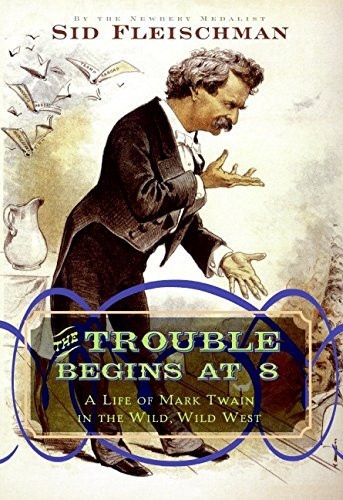
The trouble begins at 8: a life of Mark Twain in the wild, wild West

Fleischman, Sid
"Mark Twain was born fully grown, with a cheap cigar clamped between his teeth." So begins Sid Fleischman's ramble-scramble biography of the great American author and wit, who started life in a Missouri village as a barefoot boy named Samuel Clemens. Abandoning a career as a young steamboat pilot on the Mississippi River, Sam took a bumpy stagecoach to the Far West. In the gold and silver fields, he expected to get rich quick. Instead, he got poor fast, digging in the wrong places. His stint as a sagebrush newspaperman led to a duel with pistols. Had he not survived, the world would never have heard of Tom Sawyer or Huckleberry Finn—or red-headed Mark Twain. Samuel Clemens adopted his pen name in a hotel room in San Francisco and promptly made a jumping frog (and himself) famous. His celebrated novels followed at a leisurely pace; his quips at jet speed. "Don't let schooling interfere with your education," he wrote. Here, in high style, is the story of a wisecracking adventurer who came of age in the untamed West; an ink-stained rebel who surprised himself by becoming the most famous American of his time. Bountifully illustrated.
Greenwillow Books 2008 224 pages

Bawaajigan: stories of power

Nathan Niigan Noodin Adler,Christine Miskonoodinkwe Smith
"Dreams play a powerful role in Indigenous culture, serving as warning, insight, guidance, solace, or hope. Bawaajigan - an Anishinaabemowin word for dream or vision - is a collection of powerful literary short fiction by Indigenous writers from across Turtle Island. Stories about the connection between the spirit world and everyday life and the rest of the cosmos; urban-fantasy and high-fantasy worlds; alternative histories, and alternative realities; brushes with the supernatural, the prophetic, the hallucinatory, and the surreal. Among these themes we find stories ranging from the gritty, the gothic, the comedic, and the heart-wrenchingly tragic: a tale about the state of sleep-deprivation that conjures an uncertainty as to where dream ends and reality begins; the ominous tension of television static that conjures a certainty of something terrible about to happen; encounters with spirit guides, and spirit enemies; confrontations with ghosts haunting residential school hallways, and ghosts looking on from the afterlife; and with concepts based on Ouija boards, bead-dreamers, Haudenosaunee wizards, talking eagles, giant snakes, sacred white buffalo calves, spider's silk, a burnt and blood-stained diary, longings for what could-have-been, worm holes fallen through reality, poppy-induced deliriums, imaginary friends, and knowledge revealed. Unifying everything: these are stories about the strength and power of dreams."--
Exile Editions 2019 254 pages

I am Hermes!

Gerstein, Mordicai
At birth, Hermes, son of Zeus and the Nymph Maia, says his first word: "Gimme!" In this brilliant, hilarious graphic novel about the mischievous, fun-loving messenger of the gods, Caldecott Medal winner Mordicai Gerstein, transports classical mythology to the 21st century. "The world!" the newly born Hermes says. "It's even better than I expected! I love it! I want it all!" This book is filled with joy, exuberance, and humor. On his first day of life, Hermes manages to trick a turtle into surrendering its shell and a ram into surrendering its horns, thereby inventing the lyre, music, and song! He also manages to steal his brother Apollo's precious cows, but later redeems himself by outwitting the giant brothers Otus and Ephialtes, who have kidnapped Mars. These adventures and more, all derived from classical mythology, are told with great humor as well as a twenty-first century sensibility by the colossally talented Mordicai Gerstein. The art in this graphic novel is truly spectacular, with 250 illustrations, executed by a master artist and filled with unique humor. A Bank Street Best Book of the Year
Holiday House 2018 68 pages